


Search results
Search for "1,3-dipolar" in Full Text gives 202 result(s) in Beilstein Journal of Organic Chemistry. Showing first 200.
Multicomponent synthesis of spiropyrrolidine analogues derived from vinylindole/indazole by a 1,3-dipolar cycloaddition reaction
Beilstein J. Org. Chem. 2016, 12, 2893–2897, doi:10.3762/bjoc.12.288
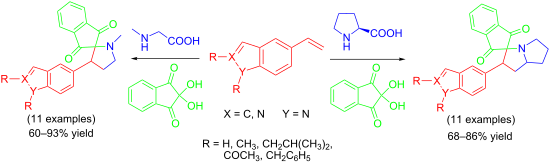
- -pot multicomponent synthesis. The method uses the 1,3-dipolar cycloaddition reaction between N-alkylvinylindole/indazole and azomethine ylides, prepared in situ from cyclic/acyclic amino acids. The 1,3-dipolar cycloaddition proceeds efficiently under thermal conditions to afford the regio- and
- of biological importance [1][2]. The regio- and stereoselective construction of spiro compounds by utilizing the 1,3-dipolar cycloaddition reaction of azomethine ylides has been reported [3][4][5][6]. However, unlike the previous reports, the present method is concise and facilitates the one-pot
- synthesis of multifunctionalized spiranes. The earlier works reveal the use of different reaction conditions to prepare functionalized spiroindane, spiropyrolidine, spiropyrrolizidine and spirooxindole derivatives. Among them, the 1,3-dipolar cycloaddition based route is preferred due to multiple advantages


Synthesis of spiro[isoindole-1,5’-isoxazolidin]-3(2H)-ones as potential inhibitors of the MDM2-p53 interaction
Beilstein J. Org. Chem. 2016, 12, 2793–2807, doi:10.3762/bjoc.12.278
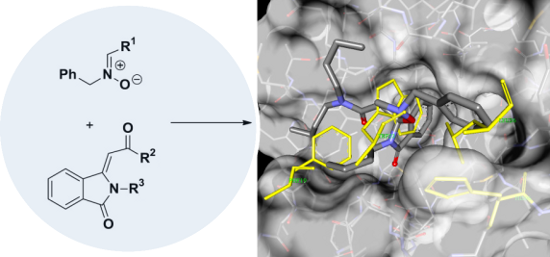
- Farmaco, Università di Catania, Viale A. Doria, 95100 Catania, Italy Dipartimento di Chimica, Università di Pavia, Via Taramelli 12, 27100 Pavia, Italy 10.3762/bjoc.12.278 Abstract A series of spiro[isoindole-1,5-isoxazolidin]-3(2H)-ones has been synthesized by 1,3-dipolar cycloaddition of N
- be linked to the inhibition of the protein–protein p53-MDM2 interaction. Docking measurements support the biological data. Keywords: antitumor agents; DFT studies; 1,3-dipolar cycloaddition; docking studies; spiro-compounds; Introduction The p53 tumor suppressor protein is a transcriptional factor
- construction of the spiro[isoxazolidin-isoindolinone] system. The synthetic scheme (Figure 2) exploits the strategy of the 1,3-dipolar cycloaddition of nitrones on the substrate isoindolin-3-methylene-1-one 2, obtained by a recent methodology of a PdI2 catalyzed aminocarbonylation-N-heterocyclization of 2


A versatile route to polythiophenes with functional pendant groups using alkyne chemistry
Beilstein J. Org. Chem. 2016, 12, 2682–2688, doi:10.3762/bjoc.12.265

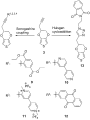
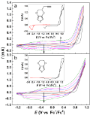
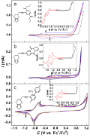
- Huisgen 1,3-dipolar cycloaddition between N-(2-azidoethyl)phthalimide and the alkyne terminal of pyEDOT under ultrasound conditions in 73% yield. Detailed synthetic routes are presented in Supporting Information File 1. Figure 1a shows the cyclic voltammograms (CVs) for electrochemical polymerization of


Development of a continuous process for α-thio-β-chloroacrylamide synthesis with enhanced control of a cascade transformation
Beilstein J. Org. Chem. 2016, 12, 2511–2522, doi:10.3762/bjoc.12.246
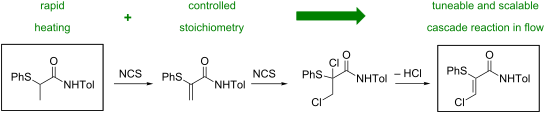
- ] and 1,3-dipolar cycloadditions [6][7][8][9], and oxidation of the sulfide group [10][11][12] are among a wide array of transformations which have been successfully applied to these compounds (Scheme 1). In order to fully exploit the synthetic potential of these β-chloroacrylamides, however, a means of




Sydnone C-4 heteroarylation with an indolizine ring via Chichibabin indolizine synthesis
Beilstein J. Org. Chem. 2016, 12, 2503–2510, doi:10.3762/bjoc.12.245

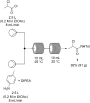
- other metals and represent a versatile tool for obtaining hybrid heterocycles with properties that are useful for the development of new advanced materials and for medicinal purposes [1][2][3][4]. Recently, we obtained, by 1,3-dipolar cycloaddition reactions of sydnone-ylides as bis(1,3-dipoles) with
- interesting chemical reactions of sydnones are their electrophilic substitution at C-4 and their participation in 1,3-dipolar cycloaddition reactions with olefinic and acetylenic dipolarophiles to form pyrazoles and functional transformation at C-4 [20][21][22][23][24][25][26]. Herein we present the synthesis
- of indolizines 4 (Figure 1) with the indolizine directly attached to C-4 of a sydnone ring by the indolizine Chichibabin approach. In addition, the new indolizine structures 5, connected through a keto group to a sydnone ring, were prepared by 1,3-dipolar cycloaddition reaction starting from the same


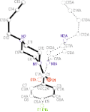
Synthesis, dynamic NMR characterization and XRD studies of novel N,N’-substituted piperazines for bioorthogonal labeling
Beilstein J. Org. Chem. 2016, 12, 2478–2489, doi:10.3762/bjoc.12.242
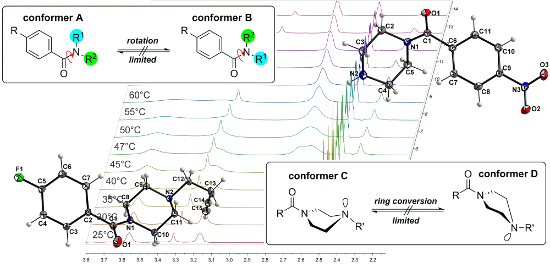
- to demonstrate the Cu-catalyzed azide–alkyne click reaction (Huisgen 1,3-dipolar cycloaddition) and the traceless Staudinger ligation, a proof of concept study was performed for the site-selective labeling of a pharmacologically active peptide and a small organic compound. These compounds provide the




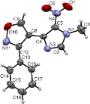
Combined experimental and theoretical studies of regio- and stereoselectivity in reactions of β-isoxazolyl- and β-imidazolyl enamines with nitrile oxides
Beilstein J. Org. Chem. 2016, 12, 2390–2401, doi:10.3762/bjoc.12.233

- 4i), respectively. The regio- and stereospecificity and the apparent reaction rate increase by the introduction of electron-withdrawing substituents into the benzonitrile oxide structure, allow to presume that the reaction of enamines with nitrile oxides can be described as 1,3-dipolar cycloadditions
- nitrile oxides as inverse electron-demand 1,3-dipolar cycloaddition. The found stereoselectivity of the cycloaddition is driven by the higher stability of the E-isomer of the starting enamine, whereas the regioselectivity is controlled by better orbital overlap in the transition state leading to the




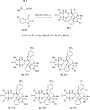
An effective one-pot access to polynuclear dispiroheterocyclic structures comprising pyrrolidinyloxindole and imidazothiazolotriazine moieties via a 1,3-dipolar cycloaddition strategy
Beilstein J. Org. Chem. 2016, 12, 2240–2249, doi:10.3762/bjoc.12.216

- -triazine moieties has been developed. The method relies on a 1,3-dipolar cycloaddition of azomethine ylides generated in situ from isatin derivatives and sarcosine to 6-benzylideneimidazo[4,5-e]thiazolo[3,2-b]-1,2,4-triazine-2,7-diones. Keywords: azomethine ylides; cycloaddition; diastereoselectivity
- constructing complex N-heterocyclic systems in a regio and stereocontrolled fashion is the 1,3-dipolar cycloaddition of azomethine ylides to electron-deficient alkenes as dipolarophiles [2][3][4][5][6][7][8]. The in situ preparation of azomethine ylides from different carbonyl and amino components makes the
- cycloaddition one of the most valuable means of combinatorial chemistry. Such multicomponent reactions are characterized by productivity, operational simplicity, and efficiency [9][10][11][12][13]. A highly interesting class of heterocycles which is accessible through 1,3-dipolar cycloaddition reactions are





Beta-hydroxyphosphonate ribonucleoside analogues derived from 4-substituted-1,2,3-triazoles as IMP/GMP mimics: synthesis and biological evaluation
Beilstein J. Org. Chem. 2016, 12, 1476–1486, doi:10.3762/bjoc.12.144
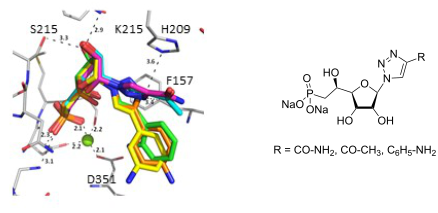
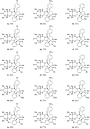
- synthesis of 1,2,3-triazolonucleotides (1a–o, Figure 1) was envisaged using the Huisgen 1,3-dipolar cycloaddition of the azido-sugar-phosphonate key-intermediate 2 (Scheme 1) and selected commercially available alkynes. Thus, (1-azido-2,5-di-O-acetyl-3-O-benzoyl-6-deoxy-6-diethylphosphono)-β-ribo-(5S


Synthesis of ferrocenyl-substituted 1,3-dithiolanes via [3 + 2]-cycloadditions of ferrocenyl hetaryl thioketones with thiocarbonyl S-methanides
Beilstein J. Org. Chem. 2016, 12, 1421–1427, doi:10.3762/bjoc.12.136

- [3 + 2]-cycloadditions. The high reactivity of ferrocenyl thioketones is demonstrated by the fact that no products of competitive reactions, such as dimerization of the intermediate 1,3-dipole or 1,3-dipolar electrocyclizations, were observed. Based on these observations one can expect that


Application of Cu(I)-catalyzed azide–alkyne cycloaddition for the design and synthesis of sequence specific probes targeting double-stranded DNA
Beilstein J. Org. Chem. 2016, 12, 1348–1360, doi:10.3762/bjoc.12.128
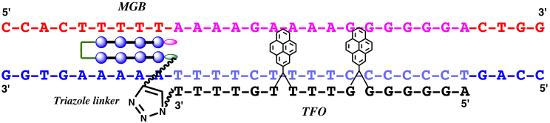
- experience, these reactions are not suitable for TINA-TFO derivatives due to excessive formation of side products. Copper(I)-catalyzed azide–alkyne cycloaddition (CuAAC) as a variation of the Huisgen 1,3-dipolar cycloaddition has become a widely used conjugation method in which the stereoselective formation


Synergistic chiral iminium and palladium catalysis: Highly regio- and enantioselective [3 + 2] annulation reaction of 2-vinylcyclopropanes with enals
Beilstein J. Org. Chem. 2016, 12, 1340–1347, doi:10.3762/bjoc.12.127
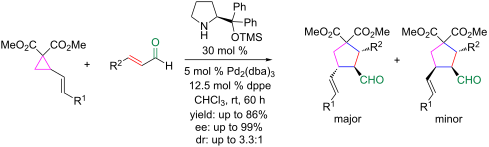
- ; Introduction The power of “donor–acceptor” (D–A) cyclopropanes as versatile 1,3-dipolar components is fuelled by its capacity of serving a complementary approach to a wide array of 5-membered ring structures, which are difficult or impossible to access by classic [3 + 2] cycloaddition reactions [1][2][3][4][5


Copper-catalyzed [3 + 2] cycloaddition of (phenylethynyl)di-p-tolylstibane with organic azides
Beilstein J. Org. Chem. 2016, 12, 1309–1313, doi:10.3762/bjoc.12.123

- : cycloaddition; copper catalyst; ethynylstibane; organic azide; 1,2,3-triazole; Introduction The 1,3-dipolar azide–alkyne cycloaddition (AAC) has been effective for the synthesis of a wide variety of 1,2,3-triazoles [1]. However, this reaction has some limitations such as the requirement of high temperature and


Multicomponent reactions: A simple and efficient route to heterocyclic phosphonates
Beilstein J. Org. Chem. 2016, 12, 1269–1301, doi:10.3762/bjoc.12.121
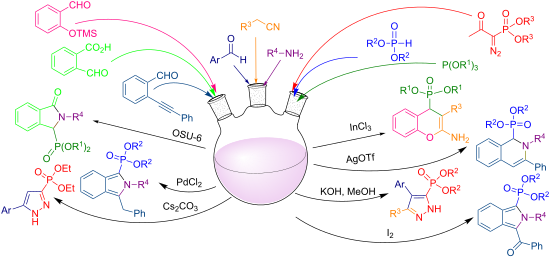
- process involves the 1,3-dipolar cycloaddition of alkynes 182 with in situ generated nitrone 185 to afford isoxazolines 186 which rapidly rearrange to aziridinylphosphonates 183. An efficient method for the synthesis of 1,2,3-triazoles is the copper(I)-catalyzed Husigen cycloaddition of azides with
- . 6 1,3-Dipolar cycloaddition-based multicomponent reactions 1,3-Dipolar cycloaddition-based multicomponent reactions usually involve the cycloaddition of in situ generated 1,3-dipoles and dipolarophiles to give five-membered heterocycles. In recent years, many heterocyclic phosphonates have been
- developed for the preparation of different 3-carbo-5-phosphonylpyrazoles 223 (Scheme 45) [83]. The corresponding phosphonylpyrazoles 223 were formed via a Claisen–Schmidt/1,3-dipolar cycloaddition/oxidation process under basic conditions in MeOH in 30–91% yields. The dual reactivity of diethyl (1-diazo-2


Diradical reaction mechanisms in [3 + 2]-cycloadditions of hetaryl thioketones with alkyl- or trimethylsilyl-substituted diazomethanes
Beilstein J. Org. Chem. 2016, 12, 716–724, doi:10.3762/bjoc.12.71

- important classes of organic reactions, and [3 + 2]- cycloadditions, also known as 1,3-dipolar cycloadditions or Huisgen reactions, offer a universal tool for the preparation of five-membered heterocycles with a variable number of heteroatoms in the ring [1][2]. In addition to their practical importance
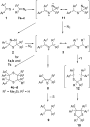
- . Only after warming up above −45/40 °C compounds 2 are expected to decompose yielding the reactive thiocarbonyl ylide 3. Under these conditions, the latter intermediates can undergo either 1,3-dipolar electrocyclization to give thiiranes 8 or dimerization leading to 1,4-dithianes 4 [20][26]. This


Enabling technologies and green processes in cyclodextrin chemistry
Beilstein J. Org. Chem. 2016, 12, 278–294, doi:10.3762/bjoc.12.30
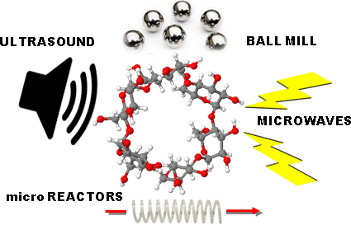
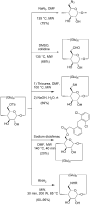
- drug delivery systems and toxic compounds scavengers, and have been obtained by grafting CDs into polymeric matrices. A multi-carrier for combined diagnostic and theranostic applications was obtained via the functionalization of carbon nanotubes with CD using a MW-assisted 1,3-dipolar cycloaddition. As



Spiro-fused carbohydrate oxazoline ligands: Synthesis and application as enantio-discrimination agents in asymmetric allylic alkylation
Beilstein J. Org. Chem. 2016, 12, 166–171, doi:10.3762/bjoc.12.18
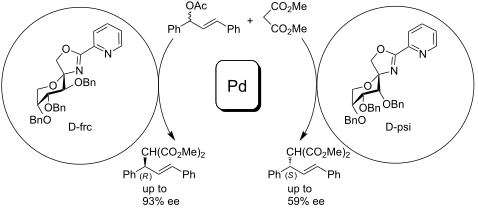
- stereo-differentiating potential of carbohydrate ligands in this type of reaction where their gluco-PHOX ligand, derived from glucosamine, resulted in a high enantiomeric excess of up to 98% [14]. Recently, Vidal et al. reported on a spiro-bis(isooxazoline) ligand A (Figure 1) [15] prepared via 1,3
- -dipolar cycloaddition of 2,6-pyridinedicarbonitrile N,N-dioxide to acetyl protected exo-glucal. The performance of ligand A in asymmetric catalysis was then tested in the palladium-catalyzed allylic addition of dimethyl malonate to 1,3-diphenylallyl acetate which, however, afforded the desired allylic




Easy access to heterobimetallic complexes for medical imaging applications via microwave-enhanced cycloaddition
Beilstein J. Org. Chem. 2015, 11, 2202–2208, doi:10.3762/bjoc.11.239

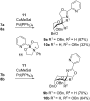
- -like macrocycle on the other side, have been easily linked by microwave azide–alkyne 1,3-dipolar cycloaddition. The preliminary relaxivity study of these heterobimetallic complexes was also investigated for potential MRI applications. Results and Discussion We first wish to report a “library” of azido


Preparation of a disulfide-linked precipitative soluble support for solution-phase synthesis of trimeric oligodeoxyribonucleotide 3´-(2-chlorophenylphosphate) building blocks
Beilstein J. Org. Chem. 2015, 11, 1553–1560, doi:10.3762/bjoc.11.171
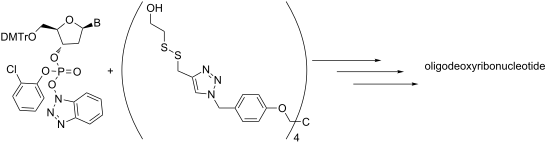
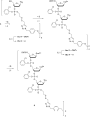
- -triazol-1-ylmethylphenyl}pentaerythritol support (3) is outlined in Scheme 1. Commercially available S-propargyl thioacetate was first conjugated to the tetrakis-O-[4-(azidomethylphenyl)pentaerythritol support (1) [7] by Cu(I) catalyzed 1,3-dipolar cycloaddition [24][25], yielding tetrakis-O-({4-[4




Synthesis and spectroscopic properties of β-triazoloporphyrin–xanthone dyads
Beilstein J. Org. Chem. 2015, 11, 1434–1440, doi:10.3762/bjoc.11.155
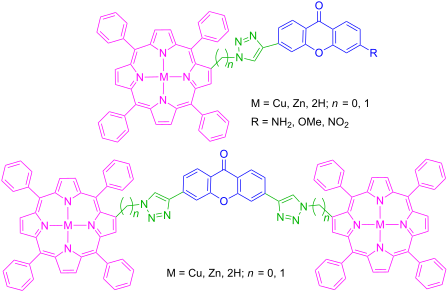
- )-catalyzed Huisgen 1,3-dipolar cycloaddition reaction of copper(II) 2-azido-5,10,15,20-tetraphenylporphyrin or zinc(II) 2-azidomethyl-5,10,15,20-tetraphenylporphyrin with various alkyne derivatives of xanthones in DMF containing CuSO4 and ascorbic acid at 80 °C. Furthermore, these metalloporphyrins underwent
- fluorescence spectra of these porphyrin–xanthone dyads. Keywords: 1,3-dipolar cycloaddition; fluorescence; synthesis; triazoloporphyrin-xanthone dyads; UV–vis spectroscopy; Introduction In the past few decades, porphyrin macrocycles have emerged as a unique class of heterocyclic compounds and as most
- porphyrins with diverse functionalities such as quinolone [19], ferrocene [20], carbohydrate [21] and fullerene [22] through a copper(I)-catalyzed Huisgen–Sharpless–Meldal 1,3-dipolar cycloaddition reaction [23][24]. Some of these triazolo-bridged porphyrin dyads have shown an efficient intramolecular energy


Selected synthetic strategies to cyclophanes
Beilstein J. Org. Chem. 2015, 11, 1274–1331, doi:10.3762/bjoc.11.142
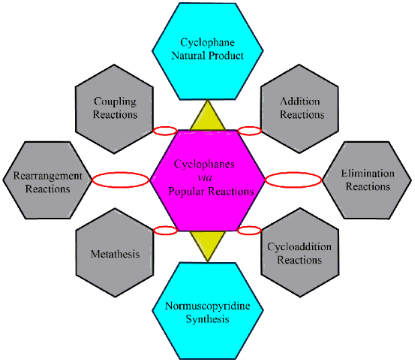
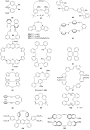
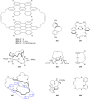
- (Scheme 51). [3 + 2] Cycloaddition (1,3-dipolar cycloaddition/click reaction): In 2010, Raghunathan and co-workers [185] have synthesized a C2-symmetric triazolophane by a copper(I)-catalyzed azide-alkyne cycloaddition, involving a click reaction. The dipropargyl fluorenyl derivative 299 was prepared from






Indolizines and pyrrolo[1,2-c]pyrimidines decorated with a pyrimidine and a pyridine unit respectively
Beilstein J. Org. Chem. 2015, 11, 1079–1088, doi:10.3762/bjoc.11.121
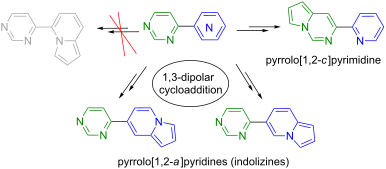
- Fundulea, Calarasi, Romania 10.3762/bjoc.11.121 Abstract The three possible structural isomers of 4-(pyridyl)pyrimidine were employed for the synthesis of new pyrrolo[1,2-c]pyrimidines and new indolizines, by 1,3-dipolar cycloaddition reaction of their corresponding N-ylides generated in situ from their
- pyrimidine. Herein, we report the efficient synthesis of small libraries of structurally diverse pyrrolo-fused heterocycles starting from the 4-pyridylpyrimidine isomers via 1,3-dipolar cycloaddition of corresponding N-ylides with several activated alkynes. The biologic and luminescent properties of newly
- ]pyrimidines or pyrimidinyl-substituted indolizines. The synthetic strategy was the 1,3-dipolar cycloaddition reaction of the corresponding N-ylides [21][22][23][24][25]. The structural variety of the compounds was determined by the series of dipolarophiles employed. The new final compounds were structurally


Multivalent polyglycerol supported imidazolidin-4-one organocatalysts for enantioselective Friedel–Crafts alkylations
Beilstein J. Org. Chem. 2015, 11, 730–738, doi:10.3762/bjoc.11.83
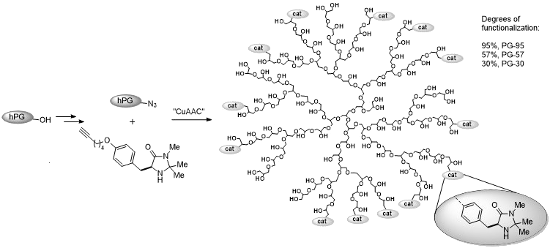
- support in asymmetric organocatalysis. The use of chiral imidazolidinones in organocatalysis has been extensively reported for a wide range of enantioselective reactions involving α,β-unsaturated aldehydes, such as the Diels–Alder reactions [50], 1,3-dipolar cycloadditions [51] and Friedel–Crafts


Novel stereocontrolled syntheses of tashiromine and epitashiromine
Beilstein J. Org. Chem. 2015, 11, 596–603, doi:10.3762/bjoc.11.66

- 1,3-dipolar cycloaddition and reduction [34] (Figure 3). (−)-Tashiromine has been accessed through the ring closure of difunctionalized acyclic chiral sulfonamide-based β-amino acids [35], the cyclization of pyrrole derivatives with a chiral side-chain [36], or the enantioselective arylation of


On the strong difference in reactivity of acyclic and cyclic diazodiketones with thioketones: experimental results and quantum-chemical interpretation
Beilstein J. Org. Chem. 2015, 11, 504–513, doi:10.3762/bjoc.11.57

- , Poland 10.3762/bjoc.11.57 Abstract The 1,3-dipolar cycloaddition of acyclic 2-diazo-1,3-dicarbonyl compounds (DDC) and thioketones preferably occurs with Z,E-conformers and leads to the formation of transient thiocarbonyl ylides in two stages. The thermodynamically favorable further transformation of C
- , carbocyclic diazodiketones are much less reactive under similar conditions due to the locked cyclic structure and are unfavorable for the 1,3-dipolar cycloaddition due to the Z,Z-conformation of the diazo molecule. This structure results in high, positive values of the Gibbs free energy change for the first
- stage of the cycloaddition process. Keywords: diazocarbonyl compounds; 1,3-dipolar cycloaddition; 1,3-oxathioles; thiiranes; thiocarbonyl ylides; thioketones; Introduction Dipolar cycloadditions of diazo compounds have been of great interest for a long time as they provide a means for the preparation





