


Search results
Search for "mannose" in Full Text gives 104 result(s) in Beilstein Journal of Organic Chemistry.
A bivalent glycopeptide to target two putative carbohydrate binding sites on FimH
Beilstein J. Org. Chem. 2010, 6, 801–809, doi:10.3762/bjoc.6.90
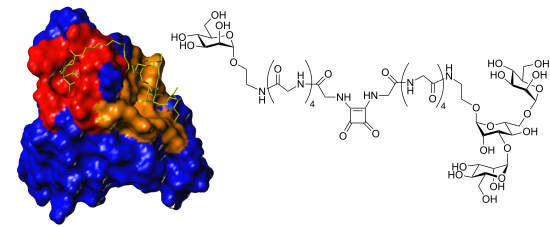
- Thisbe K. Lindhorst Kathrin Bruegge Andreas Fuchs Oliver Sperling Christiana Albertina University of Kiel, Otto Diels Institute of Organic Chemistry, Otto-Hahn-Platz 4, D-24098 Kiel, Germany, Fax: +49 431 8807410 10.3762/bjoc.6.90 Abstract FimH is a mannose-specific bacterial lectin found on type
- surface of many bacteria, comprising carbohydrate-binding sub-units [4][5][6]. The type 1 fimbriae, for example, which are widely spread among the Enterobacteriaceae are terminated with the mannose-specific protein FimH. FimH is structured in the form of two domains, a carbohydrate-specific adhesin domain
- -mannosyl moiety, for example, the terminal mannoside residues of high-mannose-type glycoproteins of the glycocalyx [12]. However, the precise nature of the ligand-receptor interactions is not fully understood. For example, when multivalent carbohydrate ligands were tested as ligands of FimH and type 1



New amphiphilic glycopolymers by click functionalization of random copolymers – application to the colloidal stabilisation of polymer nanoparticles and their interaction with concanavalin A lectin
Beilstein J. Org. Chem. 2010, 6, No. 58, doi:10.3762/bjoc.6.58
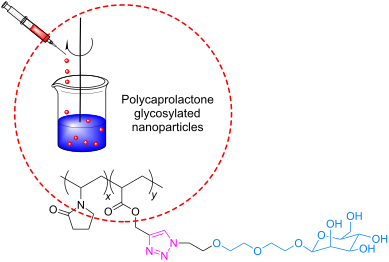
- et Supramoléculaires (ICBMS), Chimie Organique 2 – Glycochimie, UMR CNRS 5246, CPE-Lyon. 43, boulevard du 11 Novembre 1918, Villeurbanne, F-69622, France 10.3762/bjoc.6.58 Abstract Glycopolymers with mannose units were readily prepared by click chemistry of an azido mannopyranoside derivative and a
- Pluronic® F-68. The mannose moieties are accessible at the surface of nanoparticles and available for molecular recognition by concanavalin A lectin. Interaction of mannose units with the lectin were evaluated by measuring the changes in nanoparticles size by dynamic light scattering in dilute media
- [1] whilst mannose units can be used for nerve cells targeting [2]. Besides naturally occurring polysaccharides, macromolecular engineering allows quite interesting possibilities for modelling of synthetic glycopolymers [3]. The hydrophobic component can be introduced by any convenient polymer moiety


(Pseudo)amide-linked oligosaccharide mimetics: molecular recognition and supramolecular properties
Beilstein J. Org. Chem. 2010, 6, No. 20, doi:10.3762/bjoc.6.20
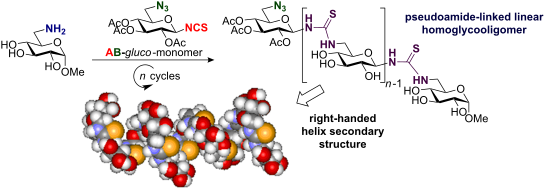
- units present, more so than is the case with other biomolecules such as polypeptides or oligonucleotides. This is determined by the stereochemical identity of the monosaccharide units present (e.g. glucose, galactose, mannose), their glycosidic linkage positions (e.g. 1→4, 1→6), the nature at anomeric
- -oligomers of mannose- and glucose-derived furanoid SAAs [58] in order to constrain their conformational degrees of freedom and to induce desirable structural elements essential for their biological activities, such as tubular structures for transporting ions or molecules across membranes. Detailed ROESY



Vinylogous Mukaiyama aldol reactions with 4-oxy-2-trimethylsilyloxypyrroles: relevance to castanospermine synthesis
Beilstein J. Org. Chem. 2007, 3, No. 38, doi:10.1186/1860-5397-3-38

- early castanospermine syntheses were carbohydrate-based, and used glucose or mannose as their starting materials. However, in more recent times there has been a trend towards using other building blocks from the chiral pool to introduce some of the chiral centres.[23][24] Of these approaches, a number


Other Beilstein-Institut Open Science Activities



