Search for "phenols" in Full Text gives 217 result(s) in Beilstein Journal of Organic Chemistry. Showing first 200.
Beilstein J. Org. Chem. 2018, 14, 1778–1805, doi:10.3762/bjoc.14.152
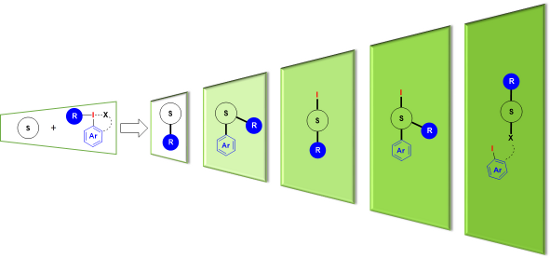
Graphical Abstract
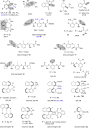
Figure 1: The structures of biologically active natural and synthetic products having spirocyclic moiety.
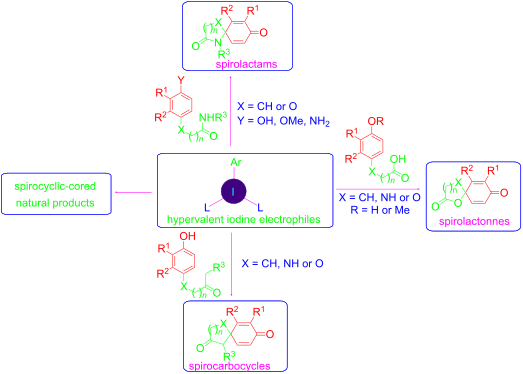
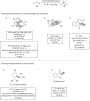
Scheme 1: Iodine(III)-mediated spirocyclization of substituted phenols 7 and 11 to 10 and 13, respectively.
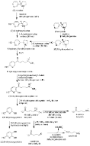
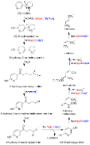
Scheme 2: PIDA-mediated spirolactonization of N-protected tyrosine 14 to spirolactone 16.
Figure 2: The structures of polymer-supported iodine(III) reagents 17a and 17b.
Scheme 3: Spirolactonization of substrates 14 to spirolactones 16 using polymer-supported reagents 17a and 17b...
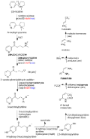
Scheme 4: PIDA-mediated spirolactonization of 1-(p-hydroxyaryl)cyclobutanols 18 to spirolactones 19.
Scheme 5: Iodine(III)-mediated spirocyclization of aryl alkynes 24 to spirolactones 26 by the reaction with b...
Scheme 6: Bridged iodine(III)-mediated spirocyclization of phenols 27 to spirodienones 29.
Scheme 7: Iodine(III)-mediated spirocyclization of arnottin I (30) to its spirocyclic analogue arnottin II (32...
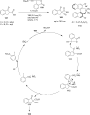
Scheme 8: Iodine(III)-catalyzed spirolactonization of p-substituted phenols 27 to spirolactones 29 using iodo...
Scheme 9: Iodine(III)-catalyzed oxylactonization of ketocarboxylic acid 34 to spirolactone 36 using iodobenze...
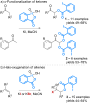
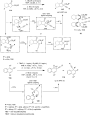
Scheme 10: Iodine(III)-mediated asymmetric oxidative spirocyclization of naphthyl acids 37 to naphthyl spirola...
Scheme 11: Oxidative cyclization of L-tyrosine 14 to spirocyclic lactone 16 using PIDA (15).
Scheme 12: Oxidative cyclization of oxazoline derivatives 41 to spirolactams 42 using PIDA (15).
Scheme 13: Oxidative cyclization of oxazoline 43 to spirolactam 44 using PIDA 15 as oxidant.
Scheme 14: PIFA-mediated spirocyclization of amides 46 to N-spirolactams 47 using PIFA (31) as an electrophile....
Scheme 15: Synthesis of spirolactam 49 from phenolic enamide 48 using PIDA (15).
Scheme 16: Iodine(III)-mediated spirocyclization of alkyl hydroxamates 50 to spirolactams 51 using stoichiomet...
Scheme 17: PIFA-mediated cyclization of substrate 52 to spirocyclic product 54.
Scheme 18: Synthesis of spiro β-lactams 56 by oxidative coupling reaction of p-substituted phenols 55 using PI...
Scheme 19: Iodine(III)-mediated spirocyclization of para-substituted amide 58 to spirolactam 59 by the reactio...
Scheme 20: Iodine(III)-mediated synthesis of spirolactams 61 from anilide derivatives 60.
Scheme 21: PIFA-mediated oxidative cyclization of anilide 60 to bis-spirobisoxindole 61.
Scheme 22: PIDA-mediated spirocyclization of phenylacetamides 65 to spirocyclic lactams 66.
Scheme 23: Oxidative dearomatization of arylamines 67 with PIFA (31) to give dieniminium salts 68.
Scheme 24: PIFA-mediated oxidative spirocarbocyclization of 4-methoxybenzamide 69 with diphenylacetylene (70) ...
Scheme 25: Synthesis of spiroxyindole 75 using I2O5/TBHP oxidative system.
Scheme 26: Iodine(III)-catalyzed spirolactonization of functionalized amides 76 to spirolactones 77 using iodo...
Scheme 27: Intramolecular cyclization of alkenes 78 to spirolactams 80 using Pd(II) 79 and PIDA (15) as the ox...
Scheme 28: Iodine(III)-catalyzed spiroaminocyclization of amides 76 to spirolactam 77 using bis(iodoarene) 81 ...
Scheme 29: Iodine(III)-catalyzed spirolactonization of N-phenyl benzamides 82 to spirolactams 83 using iodoben...
Scheme 30: Iodine(III)-mediated asymmetric oxidative spirocyclization of phenols 84 to spirolactams 86 using c...
Scheme 31: Iodine(III)-catalyzed asymmetric oxidative spirocyclization of N-aryl naphthamides 87 to spirocycli...
Scheme 32: Cyclization of p-substituted phenolic compound 89 to spirolactam 90 using PIDA (15) in TFE.
Scheme 33: Iodine(III)-mediated synthesis of spirocyclic compound 93 from substrates 92 using PIDA (15) as an ...
Scheme 34: Iodine(III)-mediated spirocyclization of p-substituted phenol 48 to spirocyclic compound 49 using P...
Scheme 35: Bridged iodine(III)-mediated spirocyclization of O-silylated phenolic compound 96 in the synthesis ...
Scheme 36: PIFA-mediated approach for the spirocyclization of ortho-substituted phenols 98 to aza-spirocarbocy...
Scheme 37: Oxidative cyclization of para-substituted phenols 102 to spirocarbocyclic compounds 104 using Koser...
Scheme 38: Iodine(III)-mediated spirocyclization of aryl alkynes 105 to spirocarbocyclic compound 106 by the r...
Scheme 39: Iodine(III)-mediated spirocarbocyclization of ortho-substituted phenols 107 to spirocarbocyclic com...
Scheme 40: PIFA-mediated oxidative cyclization of substrates 110 to spirocarbocyclic compounds 111.
Scheme 41: Iodine(III)-mediated cyclization of substrate 113 to spirocyclic compound 114.
Scheme 42: Iodine(III)-mediated spirocyclization of phenolic substrate 116 to the spirocarbocyclic natural pro...
Scheme 43: Iodine(III)-catalyzed spirocyclization of phenols 117 to spirocarbocyclic products 119 using iodoar...
Scheme 44: PIFA-mediated spirocyclization of 110 to spirocyclic compound 111 using PIFA (31) as electrophile.
Scheme 45: PIDA-mediated spirocyclization of phenolic sulfonamide 122 to spiroketones 123.
Scheme 46: Iodine(III)-mediated oxidative spirocyclization of 2-naphthol derivatives 124 to spiropyrrolidines ...
Scheme 47: PIDA-mediated oxidative spirocyclization of m-substituted phenols 126 to tricyclic spiroketals 127.
Figure 3: The structures of chiral organoiodine(III) catalysts 129a and 129b.
Scheme 48: Iodine(III)-catalyzed oxidative spirocyclization of substituted phenols 128 to spirocyclic ketals 1...
Scheme 49: Oxidative spirocyclization of para-substituted phenol 131 to spirodienone 133 using polymer support...
Scheme 50: Oxidative cyclization of bis-hydroxynaphthyl ether 135 to spiroketal 136 using PIDA (15) as an elec...
Scheme 51: Oxidative spirocyclization of phenolic compound 139 to spirodienone 140 using polymer-supported PID...
Scheme 52: PIFA-mediated oxidative cyclization of catechol derived substrate 142 to spirocyclic product 143.
Scheme 53: Oxidative spirocyclization of p-substituted phenolic substrate 145 to aculeatin A (146a) and aculea...
Scheme 54: Oxidative spirocyclization of p-substituted phenolic substrate 147 to aculeatin A (146a) and aculea...
Scheme 55: Oxidative spirocyclization of p-substituted phenolic substrate 148 to aculeatin D (149) using elect...
Scheme 56: Cyclization of phenolic substrate 131 to spirocyclic product 133 using polymer-supported PIFA 150.
Scheme 57: Iodine(III)-mediated oxidative intermolecular spirocyclization of 7-methoxy-α-naphthol (152) to spi...
Scheme 58: Oxidative cyclization of phenols 155 to spiro-ketals 156 using electrophilic species PIDA (15).
Scheme 59: Iodine(III)-catalyzed oxidative spirocyclization of ortho-substituted phenols 158 to spirocyclic ke...
Beilstein J. Org. Chem. 2018, 14, 1655–1659, doi:10.3762/bjoc.14.141
Graphical Abstract
Scheme 1: Synthesis of THP ether 3a.
Scheme 2: Synthesis of THP ethers 3b–l in the presence of NH4HSO4@SiO2. All reactions were run at rt, in the ...
Scheme 3: Deprotection of THP ether 3i.
Scheme 4: One-pot synthesis of 3-[4-(tetrahydro-2H-pyran-2-yl)oxymethylphenyl]-3-pentanol (4fa).
Scheme 5: One-pot synthesis of 4-(tetrahydro-2H-pyran-2-yloxymethyl)benzyl alcohol (4fb).
Beilstein J. Org. Chem. 2018, 14, 1619–1636, doi:10.3762/bjoc.14.138
Graphical Abstract
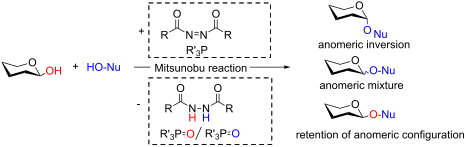
Scheme 1: Left: The Mitsunobu reaction is essentially a nucleophilic substitution of alcohols occurring with ...
Scheme 2: Mechanistic considerations on the Mitsunobu reaction with carbohydrate hemiacetals (depicted in sim...
Scheme 3: Anomeric esterification using the Mitsunobu procedure [29].
Scheme 4: Conversion of allyl glucuronate into various 1-O-esterified allyl glucuronates using anomeric Mitsu...
Scheme 5: Synthesis of anomeric glycosyl esters as substrates for Au-catalyzed glycosylation [40].
Scheme 6: Correlation between pKa value of the employed acids (or alcohol) and the favoured anomeric configur...
Scheme 7: Synthesis of the β-mannosyl phosphates for the synthesis of HBP 43 by anomeric phosphorylation acco...
Scheme 8: Synthesis of phenyl glycosides 44 and 45 from unprotected sugars [24].
Scheme 9: Synthesis of azobenzene mannosides 47 and 48 without protecting group chemistry [46].
Scheme 10: Synthesis of various aryl sialosides using Mitsunobu glycosylation [25].
Scheme 11: Mitsunobu synthesis of different jadomycins [54,55]. BOM: benzyloxymethyl.
Scheme 12: Stereoselectivity in the Mitsunobu synthesis of catechol glycosides in the gluco- and manno-series [56]....
Scheme 13: Formation of a 1,2-cis glycoside 80 assisted by steric hindrance of the β-face of the disaccharide ...
Scheme 14: Stereoselective β-D-mannoside synthesis [60].
Scheme 15: TIPS-assisted synthesis of 1,2-cis arabinofuranosides [63]. TIPS: triisopropylsilyl.
Scheme 16: The Mitsunobu reaction with glycals leads to interesting rearrangement products [69].
Scheme 17: Synthesis of disaccharides using mercury(II) bromide as co-activator in the Mitsunobu reaction [75].
Scheme 18: Synthesis of various fructofuranosides according to Mitsunobu and proposed neighbouring group parti...
Scheme 19: The Mitsunobu reaction allows stereoslective acetalization of dihydroartemisinin [77].
Scheme 20: Synthesis of alkyl thioglycosides by Mitsunobu reaction [81].
Scheme 21: Preparation of iminoglycosylphthalimide 115 from 114 [85].
Scheme 22: Mitsunobu reaction as a key step in the total synthesis of aurantoside G [87].
Scheme 23: Utilization of an N–H acid in the Mitsunobu reaction [88].
Scheme 24: Mitsunobu reaction with 1H-tetrazole [89].
Scheme 25: Formation of a rebeccamycin analogue using the Mitsunobu reaction [101].
Scheme 26: Synthesis of carbohydrates with an alkoxyamine bond [114].
Scheme 27: Synthesis of glycosyl fluorides and glycosyl azides according to Mitsunobu [118,119].
Scheme 28: Anomeric oxidation under Mitsunobu conditions [122].
Beilstein J. Org. Chem. 2018, 14, 1508–1528, doi:10.3762/bjoc.14.128
Graphical Abstract
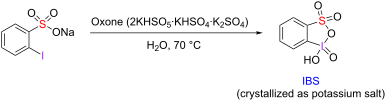
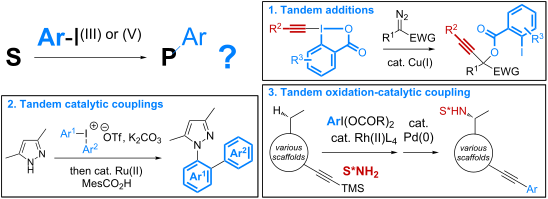
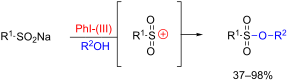
Scheme 1: Strategies to address the issue of sustainability with polyvalent organoiodine reagents.
Scheme 2: Functionalization of ketones and alkenes with IBX.
Scheme 3: Functionalization of pyrroles with DMP.
Scheme 4: Catalytic benzoyloxy-trifluoromethylation reported by Szabó.
Scheme 5: Catalytic benzoyloxy-trifluoromethylation reported by Mideoka.
Scheme 6: Catalytic 1,4-benzoyloxy-trifluoromethylation of dienes.
Scheme 7: Catalytic benzoyloxy-trifluoromethylation of allylamines.
Scheme 8: Catalytic benzoyloxy-trifluoromethylation of enynes.
Scheme 9: Catalytic benzoyloxy-trifluoromethylation of allenes.
Scheme 10: Alkynylation of N-(aryl)imines with EBX for the formation of furans.
Scheme 11: Catalytic benzoyloxy-alkynylation of diazo compounds.
Scheme 12: Catalytic asymmetric benzoyloxy-alkynylation of diazo compounds.
Scheme 13: Catalytic 1,2-benzoyloxy-azidation of alkenes.
Scheme 14: Catalytic 1,2-benzoyloxy-azidation of enamides.
Scheme 15: Catalytic 1,2-benzoyloxy-iodination of alkenes.
Scheme 16: Seminal study with cyclic diaryl-λ3-iodane.
Scheme 17: Synthesis of alkylidenefluorenes from cyclic diaryl-λ3-iodanes.
Scheme 18: Synthesis of alkyne-substituted alkylidenefluorenes.
Scheme 19: Synthesis of phenanthrenes from cyclic diaryl-λ3-iodanes.
Scheme 20: Synthesis of dibenzocarbazoles from cyclic diaryl-λ3-iodanes.
Scheme 21: Synthesis of triazolophenantridines from cyclic diaryl-λ3-iodanes.
Scheme 22: Synthesis of functionalized benzoxazoles from cyclic diaryl-λ3-iodanes.
Scheme 23: Sequential difunctionalization of cyclic diaryl-λ3-iodanes.
Scheme 24: Double Suzuki–Miyaura coupling reaction of cyclic diaryl-λ3-iodanes.
Scheme 25: Synthesis of a δ-carboline from cyclic diaryl-λ3-iodane.
Scheme 26: Synthesis of N-(aryl)carbazoles from cyclic diaryl-λ3-iodanes.
Scheme 27: Synthesis of carbazoles from cyclic diaryl-λ3-iodanes.
Scheme 28: Synthesis of carbazoles and acridines from cyclic diaryl-λ3-iodanes.
Scheme 29: Synthesis of dibenzothiophenes from cyclic diaryl-λ3-iodanes.
Scheme 30: Synthesis of various sulfur heterocycles from cyclic diaryl-λ3-iodanes.
Scheme 31: Synthesis of dibenzothioheterocycles from cyclic diaryl-λ3-iodanes.
Scheme 32: Synthesis of dibenzosulfides and dibenzoselenides from cyclic diaryl-λ3-iodanes.
Scheme 33: Synthesis of dibenzosulfones from cyclic diaryl-λ3-iodanes.
Scheme 34: Seminal study with linear diaryl-λ3-iodanes.
Scheme 35: N-Arylation of benzotriazole with symmetrical diaryl-λ3-iodanes.
Scheme 36: Tandem catalytic C–H/N–H arylation of indoles with diaryl-λ3-iodanes.
Scheme 37: Tandem N-arylation/C(sp2)–H arylation with diaryl-λ3-iodanes.
Scheme 38: Catalytic intermolecular diarylation of anilines with diaryl-λ3-iodanes.
Scheme 39: Catalytic synthesis of diarylsulfides with diaryl-λ3-iodanes.
Scheme 40: α-Arylation of enolates using [bis(trifluoroacetoxy)iodo]arenes.
Scheme 41: Mechanism of the α-arylation using [bis(trifluoroacetoxy)iodo]arene.
Scheme 42: Catalytic nitrene additions mediated by [bis(acyloxy)iodo]arenes.
Scheme 43: Tandem of C(sp3)–H amination/sila-Sonogashira–Hagihara coupling.
Scheme 44: Tandem reaction using a λ3-iodane as an oxidant, a substrate and a coupling partner.
Scheme 45: Synthesis of 1,2-diarylated acrylamidines with ArI(OAc)2.
Beilstein J. Org. Chem. 2018, 14, 1491–1497, doi:10.3762/bjoc.14.126
Graphical Abstract
Figure 1: Compounds containing a phenoxazine moiety.
Scheme 1: Reported syntheses of phenoxazine derivatives.
Scheme 2: Retrosynthesis of phenoxazine.
Scheme 3: Synthesis of iodonium salt 5a.
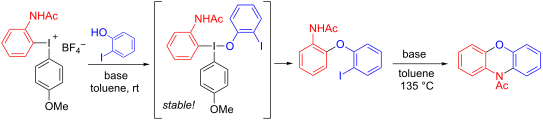
Scheme 4: Synthesis of iodonium salt 7.
Scheme 5: O-Arylation via route B.
Scheme 6: a) Cyclization of diaryl ether 3. b) Attempted one pot-synthesis of 2. aBased on recovered 3.
Scheme 7: Formal synthesis of phenoxazine (1). aBased on recovered 3.
Beilstein J. Org. Chem. 2018, 14, 1263–1280, doi:10.3762/bjoc.14.108
Graphical Abstract
Scheme 1: Overview of different types of iodane-based group-transfer reactions and their atom economy based o...
Scheme 2: (a) Structure of diaryliodonium salts 1. (b) Diarylation of a suitable substrate A with one equival...
Scheme 3: Synthesis of biphenyls 3 and 3’ with symmetrical diaryliodonium salts 1.
Scheme 4: Synthesis of diaryl thioethers 5.
Scheme 5: Synthesis of two distinct S-aryl dithiocarbamates 7 and 7’ from one equivalent of diaryliodonium sa...
Scheme 6: Synthesis of substituted isoindolin-1-ones 9 from 2-formylbenzonitrile 8 and the postulated reactio...
Scheme 7: Domino C-/N-arylation of indoles 10.
Scheme 8: Domino modification of N-heterocycles 12 via in situ-generated directing groups.
Scheme 9: Synthesis of triarylamines 17 through a double arylation of anilines.
Scheme 10: Selective conversion of novel aryl(imidazolyl)iodonium salts 1b to 1,5-disubstituted imidazoles 18.
Scheme 11: Selected examples for the application of cyclic diaryliodonium salts 19.
Scheme 12: Tandem oxidation–arylation sequence with (dicarboxyiodo)benzenes 20.
Scheme 13: Oxidative α-arylation via the transfer of an intact 2-iodoaryl group.
Scheme 14: Tandem ortho-iodination/O-arylation cascade with PIDA derivatives 20b.
Scheme 15: Synthesis of meta-N,N-diarylaminophenols 28 and the postulated mechanism.
Scheme 16: (Dicarboxyiodo)benzene-mediated metal-catalysed C–H amination and arylation.
Scheme 17: Postulated mechanism for the amination–arylation sequence.
Scheme 18: Auto-amination and cross-coupling of PIDA derivatives 20c.
Scheme 19: Tandem C(sp3)–H olefination/C(sp2)–H arylation.
Scheme 20: Atom efficient functionalisations with benziodoxolones 36.
Scheme 21: Atom-efficient synthesis of furans 39 from benziodoxolones 36a and their further derivatisations.
Scheme 22: Oxyalkynylation of diazo compounds 42.
Scheme 23: Enantioselective oxyalkynylation of diazo compounds 42’.
Scheme 24: Iron-catalysed oxyazidation of enamides 45.
Beilstein J. Org. Chem. 2018, 14, 1244–1262, doi:10.3762/bjoc.14.107
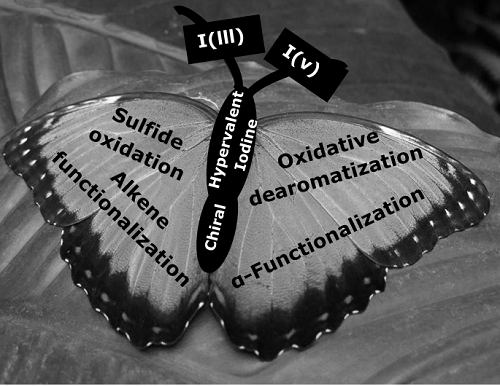
Graphical Abstract
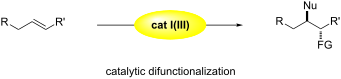
Scheme 1: An overview of different chiral iodine reagents or precursors thereof.
Scheme 2: Asymmetric oxidation of sulfides by chiral hypervalent iodine reagents.
Scheme 3: Oxidative dearomatization of naphthol derivatives by Kita et al.
Scheme 4: [4 + 2] Diels–Alder dimerization reported by Birman et al.
Scheme 5: m-CPBA guided catalytic oxidative naphthol dearomatization.
Scheme 6: Oxidative dearomatization of phenolic derivatives by Ishihara et al.
Scheme 7: Oxidative spirocyclization applying precatalyst 11 developed by Ciufolini et al.
Scheme 8: Asymmetric hydroxylative dearomatization.
Scheme 9: Enantioselective oxylactonization reported by Fujita et al.
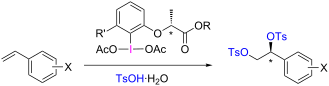
Scheme 10: Dioxytosylation of styrene (47) by Wirth et al.
Scheme 11: Oxyarylation and aminoarylation of alkenes.
Scheme 12: Asymmetric diamination of alkenes.
Scheme 13: Stereoselective oxyamination of alkenes reported by Wirth et al.
Scheme 14: Enantioselective and regioselective aminofluorination by Nevado et al.
Scheme 15: Fluorinated difunctionalization reported by Jacobsen et al.
Scheme 16: Aryl rearrangement reported by Wirth et al.
Scheme 17: α-Arylation of β-ketoesters.
Scheme 18: Asymmetric α-oxytosylation of carbonyls.
Scheme 19: Asymmetric α-oxygenation and α-amination of carbonyls reported by Wirth et al.
Scheme 20: Asymmetric α-functionalization of ketophenols using chiral quaternary ammonium (hypo)iodite salt re...
Scheme 21: Oxidative Intramolecular coupling by Gong et al.
Scheme 22: α-Sulfonyl and α-phosphoryl oxylation of ketones reported by Masson et al.
Scheme 23: α-Fluorination of β-keto esters.
Scheme 24: Alkynylation of β-ketoesters and amides catalyzed by phase-transfer catalyst.
Scheme 25: Alkynylation of β-ketoesters and dearomative alkynylation of phenols.
Beilstein J. Org. Chem. 2018, 14, 1203–1207, doi:10.3762/bjoc.14.101
Graphical Abstract
Scheme 1: Mechanistic hypothesis.
Scheme 2: Extension of the method.
Scheme 3: Carbon-based nucleophiles.
Scheme 4: THF ring opening.
Beilstein J. Org. Chem. 2018, 14, 930–954, doi:10.3762/bjoc.14.80
Graphical Abstract
Figure 1: Conventional chemotherapy versus targeted chemotherapy. Black color = Solid malignant tumor; red = ...
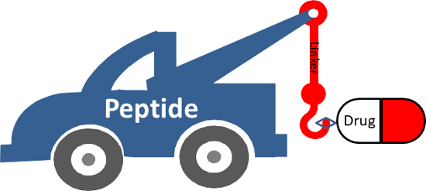
Figure 2: A. General structural architecture of the ideal navigated drug delivery system [31]. B. General structu...
Figure 3: Binding and penetration mechanism of iRGD. The iRGD peptide is accumulated on the surface of αv int...
Figure 4: Representative examples of anticancer drugs utilized for the construction of PDCs. The most usual c...
Figure 5: Illustration of the drug release mechanism from the self-immolative spacer PABC conjugated to a tum...
Figure 6: Structures of the PDCs named AN-152 and AN-207.
Figure 7: Structure of the PDC named AN-238.
Figure 8: Chemical structure and synthetic scheme for the PDC ANG1005. (A) ANG1005 is composed of three molec...
Figure 9: Structure of oxime linked Dau–GnRH-III conjugate with or without cathepsin B labile spacer and thei...
Figure 10: Synthesis of the most effective GnRH-III–Dau conjugate with two drug molecules [153].
Figure 11: Structures of the four different PDCs of D-Lys6-GnRH-I and gemcitabine (GSG, GSG2, 3G, 3G2) [19].
Figure 12: Structures of (A) native sunitinib; (B) SAN1 analog of sunitinib and (C) assembled PDC named SAN1GS...
Figure 13: Synthetic scheme for the formation of GSG and the unexpected side product [156].
Figure 14: Illustration of uncharted guanidinium peptide coupling reagent side reactions during PDCs synthesis ...
Figure 15: Putative mechanism for the formation of the uronium side product [156].
Beilstein J. Org. Chem. 2018, 14, 849–855, doi:10.3762/bjoc.14.70
Beilstein J. Org. Chem. 2018, 14, 659–663, doi:10.3762/bjoc.14.53
Graphical Abstract
Scheme 1: Enantioselective dioxytosylation of styrene as a seminal example.
Figure 1: Series of lactate-based hypervalent iodine reagents.
Scheme 2: Plausible pathways in dioxytosylation of styrenes.
Beilstein J. Org. Chem. 2018, 14, 560–575, doi:10.3762/bjoc.14.43
Graphical Abstract
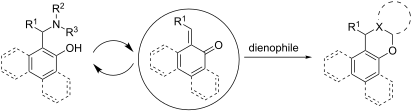
Scheme 1: Formation of amidoalkylnaphthols 4 via o-QM intermediate 3.
Scheme 2: Asymmetric syntheses of triarylmethanes starting from diarylmethylamines.
Scheme 3: Proposed mechanism for the formation of 2,2-dialkyl-3-dialkylamino-2,3-dihydro-1H-naphtho[2,1-b]pyr...
Scheme 4: Cycloadditions of isoflavonoid-derived o-QMs and various dienophiles.
Scheme 5: [4 + 2] Cycloaddition reactions between aminonaphthols and cyclic amines.
Scheme 6: Brønsted acid-catalysed reaction between aza-o-QMs and 2- or 3-substituted indoles.
Scheme 7: Formation of 3-(α,α-diarylmethyl)indoles 52 in different synthetic pathways.
Scheme 8: Alkylation of o-QMs with N-, O- or S-nucleophiles.
Scheme 9: Formation of DNA linkers and o-QM mediated polymers.
Beilstein J. Org. Chem. 2018, 14, 499–505, doi:10.3762/bjoc.14.35
Graphical Abstract
Scheme 1: Cross dehydrogenative coupling of N-arylglycine esters with C–H nucleophiles.
Scheme 2: Electrochemical CDC reaction of 2a and various N-arylglycine esters. Reaction conditions for the in...
Scheme 3: Scope of 2 using n-Bu4NI as mediator. Reaction conditions:1a (0.5 mmol), 2 (0.6 mmol), n-Bu4NI (30 ...
Scheme 4: Scaling up.
Scheme 5: Control experiments.
Scheme 6: A plausible mechanism for the electrocatalytic cross dehydrogenative coupling of N-arylglycine este...
Beilstein J. Org. Chem. 2018, 14, 345–353, doi:10.3762/bjoc.14.22
Graphical Abstract
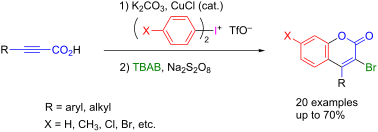
Scheme 1: One-pot preparation of 4-aryl-3-bromocoumarins 3 from 3-aryl-2-propynoic acids 1 with diphenyliodon...
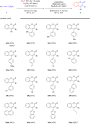
Scheme 2: One-pot preparation of 3-bromo-4-phenylcoumarins 3a from 3-phenyl-2-propynoic acid (1a) with daryli...
Scheme 3: Derivatization of 3-bromo-4-phenylcoumarin.
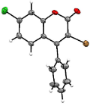
Figure 1: ORTEP of 3-bromo-7-chloro-4-phenylcoumarin (3Da).
Scheme 4: Possible reaction pathway.
Beilstein J. Org. Chem. 2018, 14, 203–242, doi:10.3762/bjoc.14.15
Graphical Abstract
Figure 1: Selected examples of drugs with fused pyrazole rings.
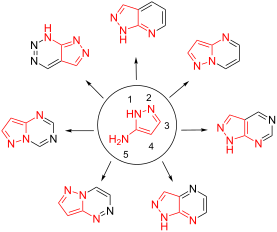
Figure 2: Typical structures of some fused pyrazoloazines from 5-aminopyrazoles.
Scheme 1: Regiospecific synthesis of 4 and 6-trifluoromethyl-1H-pyrazolo[3,4-b]pyridines.
Scheme 2: Synthesis of pyrazolo[3,4-b]pyridine-6-carboxylates.
Scheme 3: Synthesis of 1,4,6-triaryl-1H-pyrazolo[3,4-b]pyridines with ionic liquid .
Scheme 4: Synthesis of coumarin-based isomeric tetracyclic pyrazolo[3,4-b]pyridines.
Scheme 5: Synthesis of 6-substituted pyrazolo[3,4-b]pyridines under Heck conditions.
Scheme 6: Microwave-assisted palladium-catalyzed synthesis of pyrazolo[3,4-b]pyridines.
Scheme 7: Acid-catalyzed synthesis of pyrazolo[3,4-b]pyridines via enaminones.
Scheme 8: Synthesis of pyrazolo[3,4-b]pyridines via aza-Diels–Alder reaction.
Scheme 9: Synthesis of macrocyclane fused pyrazolo[3,4-b]pyridine derivatives.
Scheme 10: Three-component synthesis of 4,7-dihydro-1H-pyrazolo[3,4-b]pyridine derivatives.
Scheme 11: Ultrasonicated synthesis of spiro[indoline-3,4'-pyrazolo[3,4-b]pyridine]-2,6'(1'H)-diones.
Scheme 12: Synthesis of spiro[indoline-3,4'-pyrazolo[3,4-b]pyridine] derivatives under conventional heating co...
Scheme 13: Nanoparticle-catalyzed synthesis of pyrazolo[3,4-b]pyridine-spiroindolinones.
Scheme 14: Microwave-assisted multicomponent synthesis of spiropyrazolo[3,4-b]pyridines.
Scheme 15: Unexpected synthesis of naphthoic acid-substituted pyrazolo[3,4-b]pyridines.
Scheme 16: Multicomponent synthesis of variously substituted pyrazolo[3,4-b]pyridine derivatives.
Scheme 17: Three-component synthesis of 4,7-dihydropyrazolo[3,4-b]pyridines and pyrazolo[3,4-b]pyridines.
Scheme 18: Synthesis of pyrazolo[3,4-b]pyridine-5-spirocycloalkanediones.
Scheme 19: Ultrasound-mediated three-component synthesis of pyrazolo[3,4-b]pyridines.
Scheme 20: Multicomponent synthesis of 4-aryl-3-methyl-1-phenyl-4,6,8,9-tetrahydropyrazolo [3,4-b]thiopyrano[4...
Scheme 21: Synthesis of 2,3-dihydrochromeno[4,3-d]pyrazolo[3,4-b]pyridine-1,6-diones.
Scheme 22: FeCl3-catalyzed synthesis of o-hydroxyphenylpyrazolo[3,4-b]pyridine derivatives.
Scheme 23: Ionic liquid-mediated synthesis of pyrazolo[3,4-b]pyridines.
Scheme 24: Microwave-assisted synthesis of pyrazolo[3,4-b]pyridines.
Scheme 25: Multicomponent synthesis of pyrazolo[3,4-b]pyridine-5-carbonitriles.
Scheme 26: Unusual domino synthesis of 4,7-dihydropyrazolo[3,4-b]pyridine-5-nitriles.
Scheme 27: Synthesis of 4,5,6,7-tetrahydro-4H-pyrazolo[3,4-b]pyridines under conventional heating and ultrasou...
Scheme 28: L-Proline-catalyzed synthesis of of pyrazolo[3,4-b]pyridine.
Scheme 29: Microwave-assisted synthesis of 5-aminoarylpyrazolo[3,4-b]pyridines.
Scheme 30: Microwave-assisted multi-component synthesis of pyrazolo[3,4-e]indolizines.
Scheme 31: Synthesis of fluoropropynyl and fluoroalkyl substituted pyrazolo[1,5-a]pyrimidine.
Scheme 32: Acid-catalyzed synthesis of pyrazolo[1,5-a]pyrimidine derivatives.
Scheme 33: Chemoselective and regiospecific synthesis of 2-(3-methylpyrazol-1’-yl)-5-methylpyrazolo[1,5-a]pyri...
Scheme 34: Regioselective synthesis of 7-trifluoromethylpyrazolo[1,5-a]pyrimidines.
Scheme 35: Microwave-assisted synthesis of 7-trifluoromethylpyrazolo[1,5-a]pyrimidine carboxylates.
Scheme 36: Microwave and ultrasound-assisted synthesis of 7-trifluoromethylpyrazolo[1,5-a]pyrimidines.
Scheme 37: Base-catalyzed unprecedented synthesis of pyrazolo[1,5-a]pyrimidines via C–C bond cleavage.
Scheme 38: Synthesis of aminobenzothiazole/piperazine linked pyrazolo[1,5-a]pyrimidines.
Scheme 39: Synthesis of aminoalkylpyrazolo[1,5-a]pyrimidine-7-amines.
Scheme 40: Synthesis of pyrazolo[1,5-a]pyrimidines from condensation of 5-aminopyrazole 126 and ethyl acetoace...
Scheme 41: Synthesis of 7-aminopyrazolo[1,5-a]pyrimidines.
Scheme 42: Unexpected synthesis of 7-aminopyrazolo[1,5-a]pyrimidines under solvent free and solvent-mediated c...
Scheme 43: Synthesis of N-(4-aminophenyl)-7-aryloxypyrazolo[1,5-a]pyrimidin-5-amines.
Scheme 44: Base-catalyzed synthesis of 5,7-diarylpyrazolo[1,5-a]pyrimidines.
Scheme 45: Synthesis of 6,7-dihydropyrazolo[1,5-a]pyrimidines in PEG-400.
Scheme 46: Synthesis of 7-heteroarylpyrazolo[1,5-a]pyrimidine-3-carboxamides.
Scheme 47: Synthesis of 7-heteroarylpyrazolo[1,5-a]pyrimidine derivatives under conventional heating and micro...
Scheme 48: Synthesis of N-aroylpyrazolo[1,5-a]pyrimidine-5-amines.
Scheme 49: Regioselective synthesis of ethyl pyrazolo[1,5-a]pyrimidine-7-carboxylate.
Scheme 50: Sodium methoxide-catalyzed synthesis of 3-cyano-6,7-diarylpyrazolo[1,5-a]pyrimidines.
Scheme 51: Synthesis of various pyrazolo[3,4-d]pyrimidine derivatives.
Scheme 52: Synthesis of hydrazinopyrazolo[3,4-d]pyrimidine derivatives.
Scheme 53: Synthesis of N-arylidinepyrazolo[3,4-d]pyrimidin-5-amines.
Scheme 54: Synthesis of pyrazolo[3,4-d]pyrimidinyl-4-amines.
Scheme 55: Iodine-catalyzed synthesis of pyrazolo[3,4-d]pyrimidinones.
Scheme 56: Synthesis of ethyl 6-amino-2H-pyrazolo[3,4-d]pyrimidine-4-carboxylate.
Scheme 57: Synthesis of 4-substituted-(3,6-dihydropyran-4-yl)-1H-pyrazolo[3,4-d]pyrimidines.
Scheme 58: Synthesis of 1-(2,4-dichlorophenyl)pyrazolo[3,4-d]pyrimidin-4-yl carboxamides.
Scheme 59: Synthesis of 5-(1,3,4-thidiazol-2-yl)pyrazolo[3,4-d]pyrimidine.
Scheme 60: One pot POCl3-catalyzed synthesis of 1-arylpyrazolo[3,4-d]pyrimidin-4-ones.
Scheme 61: Synthesis of 4-amino-N1,C3-dialkylpyrazolo[3,4-d]pyrimidines under Suzuki conditions.
Scheme 62: Microwave-assisted synthesis of pyrazolo[3,4-b]pyrazines.
Scheme 63: Synthesis and derivatization of pyrazolo[3,4-b]pyrazine-5-carbonitriles.
Scheme 64: Synthesis of 2-thioxo-pyrazolo[1,5-a][1,3,5]triazin-4-ones.
Scheme 65: Synthesis of 2,3-dihydropyrazolo[1,5-a][1,3,5]triazin-4(1H)-one.
Scheme 66: Synthesis of pyrazolo[1,5-a][1,3,5]triazine-8-carboxylic acid ethyl ester.
Scheme 67: Microwave-assisted synthesis of 4,7-dihetarylpyrazolo[1,5-a][1,3,5]triazines.
Scheme 68: Alternative synthetic route to 4,7-diheteroarylpyrazolo[1,5-a][1,3,5]triazines.
Scheme 69: Synthesis of 4-aryl-2-ethylthio-7-methylpyrazolo[1,5-a][1,3,5]triazines.
Scheme 70: Microwave-assisted synthesis of 4-aminopyrazolo[1,5-a][1,3,5]triazine.
Scheme 71: Synthesis of pyrazolo[3,4-d][1,2,3]triazines from pyrazol-5-yl diazonium salts.
Scheme 72: Synthesis of 2,5-dihydropyrazolo[3,4-e][1,2,4]triazines.
Scheme 73: Synthesis of pyrazolo[5,1-c][1,2,4]triazines via diazopyrazolylenaminones.
Scheme 74: Synthesis of pyrazolo[5,1-c][1,2,4]triazines in presence of sodium acetate.
Scheme 75: Synthesis of various 7-diazopyrazolo[5,1-c][1,2,4]triazine derivatives.
Scheme 76: One pot synthesis of pyrazolo[5,1-c][1,2,4]triazines.
Scheme 77: Synthesis of 4-amino-3,7,8-trinitropyrazolo-[5,1-c][1,2,4]triazines.
Scheme 78: Synthesis of tricyclic pyrazolo[5,1-c][1,2,4]triazines by azocoupling reaction.
Beilstein J. Org. Chem. 2018, 14, 155–181, doi:10.3762/bjoc.14.11
Graphical Abstract
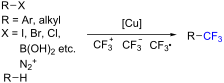
Figure 1: Selected examples of pharmaceutical and agrochemical compounds containing the trifluoromethyl group....
Scheme 1: Introduction of a diamine into copper-catalyzed trifluoromethylation of aryl iodides.
Scheme 2: Addition of a Lewis acid into copper-catalyzed trifluoromethylation of aryl iodides and the propose...
Scheme 3: Trifluoromethylation of heteroaromatic compounds using S-(trifluoromethyl)diphenylsulfonium salts a...
Scheme 4: The preparation of a new trifluoromethylation reagent and its application in trifluoromethylation o...
Scheme 5: Trifluoromethylation of aryl iodides using CF3CO2Na as a trifluoromethyl source.
Scheme 6: Trifluoromethylation of aryl iodides using MTFA as a trifluoromethyl source.
Scheme 7: Trifluoromethylation of aryl iodides using CF3CO2K as a trifluoromethyl source.
Scheme 8: Trifluoromethylation of aryl iodides and heteroaryl bromides using [Cu(phen)(O2CCF3)] as a trifluor...
Scheme 9: Trifluoromethylation of aryl iodides with DFPB and the proposed mechanism.
Scheme 10: Trifluoromethylation of aryl iodides using TCDA as a trifluoromethyl source. Reaction conditions: [...
Scheme 11: The mechanism of trifluoromethylation using Cu(II)(O2CCF2SO2F)2 as a trifluoromethyl source.
Scheme 12: Trifluoromethylation of benzyl bromide reported by Shibata’s group.
Scheme 13: Trifluoromethylation of allylic halides and propargylic halides reported by the group of Nishibayas...
Scheme 14: Trifluoromethylation of propargylic halides reported by the group of Nishibayashi.
Scheme 15: Trifluoromethylation of alkyl halides reported by Nishibayashi’s group.
Scheme 16: Trifluoromethylation of pinacol esters reported by the group of Gooßen.
Scheme 17: Trifluoromethylation of primary and secondary alkylboronic acids reported by the group of Fu.
Scheme 18: Trifluoromethylation of boronic acid derivatives reported by the group of Liu.
Scheme 19: Trifluoromethylation of organotrifluoroborates reported by the group of Huang.
Scheme 20: Trifluoromethylation of aryl- and vinylboronic acids reported by the group of Shibata.
Scheme 21: Trifluoromethylation of arylboronic acids via the merger of photoredox and Cu catalysis.
Scheme 22: Trifluoromethylation of arylboronic acids reported by Sanford’s group. Isolated yield. aYields dete...
Scheme 23: Trifluoromethylation of arylboronic acids and vinylboronic acids reported by the group of Beller. Y...
Scheme 24: Copper-mediated Sandmeyer type trifluoromethylation using Umemoto’s reagent as a trifluoromethylati...
Scheme 25: Copper-mediated Sandmeyer type trifluoromethylation using TMSCF3 as a trifluoromethylation reagent ...
Scheme 26: One-pot Sandmeyer trifluoromethylation reported by the group of Gooßen.
Scheme 27: Copper-catalyzed trifluoromethylation of arenediazonium salts in aqueous media.
Scheme 28: Copper-mediated Sandmeyer trifluoromethylation using Langlois’ reagent as a trifluoromethyl source ...
Scheme 29: Trifluoromethylation of terminal alkenes reported by the group of Liu.
Scheme 30: Trifluoromethylation of terminal alkenes reported by the group of Wang.
Scheme 31: Trifluoromethylation of tetrahydroisoquinoline derivatives reported by Li and the proposed mechanis...
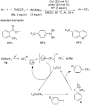
Scheme 32: Trifluoromethylation of phenol derivatives reported by the group of Hamashima.
Scheme 33: Trifluoromethylation of hydrazones reported by the group of Baudoin and the proposed mechanism.
Scheme 34: Trifluoromethylation of benzamides reported by the group of Tan.
Scheme 35: Trifluoromethylation of heteroarenes and electron-deficient arenes reported by the group of Qing an...
Scheme 36: Trifluoromethylation of N-aryl acrylamides using CF3SO2Na as a trifluoromethyl source.
Scheme 37: Trifluoromethylation of aryl(heteroaryl)enol acetates using CF3SO2Na as the source of CF3 and the p...
Scheme 38: Trifluoromethylation of imidazoheterocycles using CF3SO2Na as a trifluoromethyl source and the prop...
Scheme 39: Copper-mediated trifluoromethylation of terminal alkynes using TMSCF3 as a trifluoromethyl source a...
Scheme 40: Improved copper-mediated trifluoromethylation of terminal alkynes reported by the group of Qing.
Scheme 41: Copper-catalyzed trifluoromethylation of terminal alkynes reported by the group of Qing.
Scheme 42: Copper-catalyzed trifluoromethylation of terminal alkynes using Togni’s reagent and the proposed me...
Scheme 43: Copper-catalyzed trifluoromethylation of terminal alkynes using Umemoto’s reagent reported by the g...
Scheme 44: Copper-catalyzed trifluoromethylation of 3-arylprop-1-ynes reported by Xiao and Lin and the propose...
Beilstein J. Org. Chem. 2018, 14, 135–147, doi:10.3762/bjoc.14.9
Graphical Abstract
Scheme 1: A selection of widespread fungal volatiles.
Figure 1: Total ion chromatogram of a representative headspace extract from Daldinia clavata MUCL 47436. Peak...
Scheme 2: Identified volatiles from Daldinia clavata MUCL 47436.
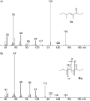
Figure 2: Mass spectra of volatiles from D. clavata that were identified by synthesis.
Scheme 3: Synthesis of manicone (10).
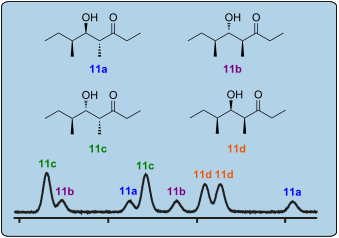
Scheme 4: Synthesis of a racemic mixture of all four diastereomers of 11.
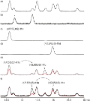
Figure 3: Gas chromatographic analysis of 11 on a homochiral stationary phase. a) Synthetic mixture of all ei...
Scheme 5: Enantioselective synthesis of (4R,5S,6S)-11c and (4S,5R,6S)-11d.
Scheme 6: Epimerisations of (4R,5S,6S)-11c and (4S,5R,6S)-11d under basic conditions.
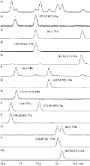
Figure 4: Gas chromatographic analysis of 11 on a homochiral stationary phase. a) Synthetic mixture of all ei...
Scheme 7: Proposed biosynthesis for (4R,5R,6S)-11a.
Figure 5: Mass spectra of a) 6-methyl-5,6-dihydro-2H-pyran-2-one (9), b) 6-propyl-5,6-dihydro-2H-pyran-2-one,...
Scheme 8: Synthesis of 6-methyl-5,6-dihydro-2H-pyran-2-one (9) and 6-nonyl-2H-pyran-2-one (17).
Beilstein J. Org. Chem. 2017, 13, 2800–2818, doi:10.3762/bjoc.13.273
Graphical Abstract
Scheme 1: Trifluoromethylation of silyl enol ethers.
Scheme 2: Continuous flow trifluoromethylation of ketones under photoredox catalysis.
Scheme 3: Trifluoromethylation of enol acetates.
Scheme 4: Photoredox-catalysed tandem trifluoromethylation/cyclisation of N-arylacrylamides: a route to trifl...
Scheme 5: Tandem trifluoromethylation/cyclisation of N-arylacrylamides using BiOBr nanosheets catalysis.
Scheme 6: Photoredox-catalysed trifluoromethylation/desulfonylation/cyclisation of N-tosyl acrylamides (bpy: ...
Scheme 7: Photoredox-catalysed trifluoromethylation/aryl migration/desulfonylation of N-aryl-N-tosylacrylamid...
Scheme 8: Proposed mechanism for the trifluoromethylation/aryl migration/desulfonylation (/cyclisation) of N-...
Scheme 9: Photoredox-catalysed trifluoromethylation/cyclisation of N-methacryloyl-N-methylbenzamide derivativ...
Scheme 10: Photoredox-catalysed trifluoromethylation/cyclisation of N-methylacryloyl-N-methylbenzamide derivat...
Scheme 11: Photoredox-catalysed trifluoromethylation/dearomatising spirocyclisation of a N-benzylacrylamide de...
Scheme 12: Photoredox-catalysed trifluoromethylation/cyclisation of an unactivated alkene.
Scheme 13: Asymmetric radical aminotrifluoromethylation of N-alkenylurea derivatives using a dual CuBr/chiral ...
Scheme 14: Aminotrifluoromethylation of an N-alkenylurea derivative using a dual CuBr/phosphoric acid catalyti...
Scheme 15: 1,2-Formyl- and 1,2-cyanotrifluoromethylation of alkenes under photoredox catalysis.
Scheme 16: First simultaneous introduction of the CF3 moiety and a Cl atom onto alkenes.
Scheme 17: Chlorotrifluoromethylaltion of terminal, 1,1- and 1,2-substituted alkenes.
Scheme 18: Chorotrifluoromethylation of electron-deficient alkenes (DCE = dichloroethane).
Scheme 19: Cascade trifluoromethylation/cyclisation/chlorination of N-allyl-N-(benzyloxy)methacrylamide.
Scheme 20: Cascade trifluoromethylation/cyclisation (/chlorination) of diethyl 2-allyl-2-(3-methylbut-2-en-1-y...
Scheme 21: Trifluoromethylchlorosulfonylation of allylbenzene derivatives and aliphatic alkenes.
Scheme 22: Access to β-hydroxysulfones from CF3-containing sulfonyl chlorides through a photocatalytic sequenc...
Scheme 23: Cascade trifluoromethylchlorosulfonylation/cyclisation reaction of alkenols: a route to trifluorome...
Scheme 24: First direct C–H trifluoromethylation of arenes and proposed mechanism.
Scheme 25: Direct C–H trifluoromethylation of five- and six-membered (hetero)arenes under photoredox catalysis....
Scheme 26: Alternative pathway for the C–H trifluoromethylation of (hetero)arenes under photoredox catalysis.
Scheme 27: Direct C–H trifluoromethylation of five- and six-membered ring (hetero)arenes using heterogeneous c...
Scheme 28: Trifluoromethylation of terminal olefins.
Scheme 29: Trifluoromethylation of enamides.
Scheme 30: (E)-Selective trifluoromethylation of β-nitroalkenes under photoredox catalysis.
Scheme 31: Photoredox-catalysed trifluoromethylation/cyclisation of an o-azidoarylalkynes.
Scheme 32: Regio- and stereoselective chlorotrifluoromethylation of alkynes.
Scheme 33: PMe3-mediated trifluoromethylsulfenylation by in situ generation of CF3SCl.
Scheme 34: (EtO)2P(O)H-mediated trifluoromethylsulfenylation of (hetero)arenes and thiols.
Scheme 35: PPh3/NaI-mediated trifluoromethylsulfenylation of indole derivatives.
Scheme 36: PPh3/n-Bu4NI mediated trifluoromethylsulfenylation of thiophenol derivatives.
Scheme 37: PPh3/Et3N mediated trifluoromethylsulfinylation of benzylamine.
Scheme 38: PCy3-mediated trifluoromethylsulfinylation of azaarenes, amines and phenols.
Scheme 39: Mono- and dichlorination of carbon acids.
Scheme 40: Monochlorination of (N-aryl-N-hydroxy)acylacetamides.
Scheme 41: Examples of the synthesis of heterocycles fused with β-lactams through a chlorination/cyclisation p...
Scheme 42: Enantioselective chlorination of β-ketoesters and oxindoles.
Scheme 43: Enantioselective chlorination of 3-acyloxazolidin-2-one derivatives (NMM = N-methylmorpholine).
Beilstein J. Org. Chem. 2017, 13, 2710–2738, doi:10.3762/bjoc.13.269
Graphical Abstract
Scheme 1: Generation of phosphorus ylides from vinylphosphonium salts.
Scheme 2: Intramolecular Wittig reaction with the use of vinylphosphonium salts.
Scheme 3: Alkylation of diphenylvinylphosphine with methyl or benzyl iodide.
Scheme 4: Methylation of isopropenyldiphenylphosphine with methyl iodide.
Scheme 5: Alkylation of phosphines with allyl halide derivatives and subsequent isomerization of intermediate...
Scheme 6: Alkylation of triphenylphosphine with vinyl triflates in the presence of (Ph3P)4Pd.
Scheme 7: Mechanism of alkylation of triphenylphosphine with vinyl triflates in the presence of (Ph3P)4Pd as ...
Scheme 8: β-Elimination of phenol from β-phenoxyethyltriphenylphosphonium bromide.
Scheme 9: β-Elimination of phenol from β-phenoxyethylphosphonium salts in an alkaline environment.
Scheme 10: Synthesis and subsequent dehydrohalogenation of α-bromoethylphosphonium bromide.
Scheme 11: Synthesis of tributylvinylphosphonium iodides via Peterson-type olefination of α-trimethylsilylphos...
Scheme 12: Synthesis of 1-cycloalkenetriphenylphosphonium salts by electrochemical oxidation of triphenylphosp...
Scheme 13: Suggested mechanism for the electrochemical synthesis of 1-cycloalkenetriphenylphosphonium salts.
Scheme 14: Generation of α,β-(dialkoxycarbonyl)vinylphosphonium salts by addition of triphenylphosphine to ace...
Scheme 15: Synthesis of 2-(N-acylamino)vinylphosphonium halides by imidoylation of β-carbonyl ylides with imid...
Scheme 16: Imidoylation of β-carbonyl ylides with imidoyl halides generated in situ.
Scheme 17: Synthesis of 2-benzoyloxyvinylphosphonium bromide from 2-propynyltriphenylphosphonium bromide.
Scheme 18: Synthesis of 2-aminovinylphosphonium salts via nucleophilic addition of amines to 2-propynyltriphen...
Scheme 19: Deacylation of 2-(N-acylamino)vinylphosphonium chlorides to 2-aminovinylphosphonium salts.
Scheme 20: Resonance structures of 2-aminovinylphosphonium salts and tautomeric equilibrium between aminovinyl...
Scheme 21: Synthesis of 2-aminovinylphosphonium salts by reaction of (formylmethyl)triphenylphosphonium chlori...
Scheme 22: Generation of ylides by reaction of vinyltriphenylphosphonium bromide with nucleophiles and their s...
Scheme 23: Intermolecular Wittig reaction with the use of vinylphosphonium bromide and organocopper compounds ...
Scheme 24: Intermolecular Wittig reaction with the use of ylides generated from vinylphosphonium bromides and ...
Scheme 25: Direct transformation of vinylphosphonium salts into ylides in the presence of potassium tert-butox...
Scheme 26: A general method for synthesis of carbo- and heterocyclic systems by the intramolecular Wittig reac...
Scheme 27: Synthesis of 2H-chromene by reaction of vinyltriphenylphosphonium bromide with sodium 2-formylpheno...
Scheme 28: Synthesis of 2,5-dihydro-2,3-dimethylfuran by reaction of vinylphosphonium bromide with 3-hydroxy-2...
Scheme 29: Synthesis of 2H-chromene and 2,5-dihydrofuran derivatives in the intramolecular Wittig reaction wit...
Scheme 30: Enantioselective synthesis of 3,6-dihydropyran derivatives from vinylphosphonium bromide and enanti...
Scheme 31: Synthesis of 2,5-dihydrothiophene derivatives in the intramolecular Wittig reaction from vinylphosp...
Scheme 32: Synthesis of bicyclic pyrrole derivatives in the reaction of vinylphosphonium halides and 2-pyrrolo...
Scheme 33: Stereoselective synthesis of bicyclic 2-pyrrolidinone derivatives in the reaction of vinylphosphoni...
Scheme 34: Stereoselective synthesis of 3-pyrroline derivatives in the intramolecular Wittig reaction from vin...
Scheme 35: Synthesis of cyclic alkenes in the intramolecular Wittig reaction from vinylphosphonium bromide and...
Scheme 36: Synthesis of 1,3-cyclohexadienes by reaction of 1,3-butadienyltriphenylphosphonium bromide with eno...
Scheme 37: Synthesis of bicyclo[3.3.0]octenes by reaction of vinylphosphonium salts with cyclic diketoester.
Scheme 38: Synthesis of quinoline derivatives in the intramolecular Wittig reaction from 2-(2-acylphenylamino)...
Scheme 39: Stereoselective synthesis of γ-aminobutyric acid in the intermolecular Wittig reaction from chiral ...
Scheme 40: Synthesis of allylamines in the intermolecular Wittig reaction from 2-aminovinylphosphonium bromide...
Scheme 41: A general route towards α,β-di(alkoxycarbonyl)vinylphosphonium salts and their subsequent possible ...
Scheme 42: Generation of resonance-stabilized phosphorus ylides via the reaction of triphenylphosphine with di...
Scheme 43: Synthesis of resonance-stabilized phosphorus ylides in the reaction of triphenylphosphine, dialkyl ...
Scheme 44: Synthesis of resonance-stabilized phosphorus ylides via the reaction of triphenylphosphine with dia...
Scheme 45: Generation of resonance-stabilized phosphorus ylides in the reaction of acetylenedicarboxylate, tri...
Scheme 46: Synthesis of resonance-stabilized phosphorus ylides via the reaction of dialkyl acetylenedicarboxyl...
Scheme 47: Synthesis of resonance-stabilized ylides derived from semicarbazones, aromatic amides, and 3-(aryls...
Scheme 48: Synthesis of resonance-stabilized ylides via the reaction of triphenylphosphine with dialkyl acetyl...
Scheme 49: Synthesis of resonance-stabilized ylides in the reaction of triphenylphosphine, dialkyl acetylenedi...
Scheme 50: Synthesis of N-acylated α,β-unsaturated γ-lactams via resonance-stabilized phosphorus ylides derive...
Scheme 51: Synthesis of resonance-stabilized phosphorus ylides derived from 6-amino-N,N'-dimethyluracil and th...
Scheme 52: Generation of resonance-stabilized phosphorus ylides in the reaction of triphenylphosphine, dialkyl...
Scheme 53: Synthesis of resonance-stabilized phosphorus ylides via the reaction of triphenylphosphine with dia...
Scheme 54: Synthesis of 1,3-dienes via intramolecular Wittig reaction with the use of resonance-stabilized yli...
Scheme 55: Synthesis of 1,3-dienes in the intramolecular Wittig reaction from ylides generated from dimethyl a...
Scheme 56: Synthesis of 4-(2-quinolyl)cyclobutene-1,2,3-tricarboxylic acid triesters and isomeric cyclopenteno...
Scheme 57: Synthesis of 4-arylquinolines via resonance-stabilized ylides in the intramolecular Wittig reaction....
Scheme 58: Synthesis of furan derivatives via resonance-stabilized ylides in the intramolecular Wittig reactio...
Scheme 59: Synthesis of 1,3-indanedione derivatives via resonance-stabilized ylides in the intermolecular Witt...
Scheme 60: Synthesis of coumarin derivatives via nucleophilic displacement of the triphenylphosphonium group i...
Scheme 61: Synthesis of 6-formylcoumarin derivatives and their application in the synthesis of dyads.
Scheme 62: Synthesis of di- and tricyclic coumarin derivatives in the reaction of pyrocatechol with two vinylp...
Scheme 63: Synthesis of mono-, di-, and tricyclic derivatives in the reaction of pyrogallol with one or two vi...
Scheme 64: Synthesis of 1,4-benzoxazine derivative by nucleophilic displacement of the triphenylphosphonium gr...
Scheme 65: Synthesis of 7-oxo-7H-pyrido[1,2,3-cd]perimidine derivative via nucleophilic displacement of the tr...
Scheme 66: Application of vinylphosphonium salts in the Diels–Alder reaction with dienes.
Scheme 67: Synthesis of pyrroline derivatives from vinylphosphonium bromide and 5-(4H)-oxazolones.
Scheme 68: Synthesis of pyrrole derivatives in the reactions of vinyltriphenylphosphonium bromide with protona...
Scheme 69: Synthesis of dialkyl 2-(alkylamino)-5-aryl-3,4-furanedicarboxylates via intermediate α,β-di(alkoxyc...
Scheme 70: Synthesis of 1,4-benzoxazine derivatives from acetylenedicarboxylates, phosphines, and 1-nitroso-2-...
Beilstein J. Org. Chem. 2017, 13, 1907–1931, doi:10.3762/bjoc.13.186
Graphical Abstract
Scheme 1: Mechanochemical aldol condensation reactions [48].
Scheme 2: Enantioselective organocatalyzed aldol reactions under mechanomilling. a) Based on binam-(S)-prolin...
Scheme 3: Mechanochemical Michael reaction [51].
Scheme 4: Mechanochemical organocatalytic asymmetric Michael reaction [52].
Scheme 5: Mechanochemical Morita–Baylis–Hillman (MBH) reaction [53].
Scheme 6: Mechanochemical Wittig reactions [55].
Scheme 7: Mechanochemical Suzuki reaction [56].
Scheme 8: Mechanochemical Suzuki–Miyaura coupling by LAG [57].
Scheme 9: Mechanochemical Heck reaction [59].
Scheme 10: a) Sonogashira coupling under milling conditions. b) The representative example of a double Sonogas...
Scheme 11: Copper-catalyzed CDC reaction under mechanomilling [67].
Scheme 12: Asymmetric alkynylation of prochiral sp3 C–H bonds via CDC [68].
Scheme 13: Fe(III)-catalyzed CDC coupling of 3-benzylindoles [69].
Scheme 14: Mechanochemical synthesis of 3-vinylindoles and β,β-diindolylpropionates [70].
Scheme 15: Mechanochemical C–N bond construction using anilines and arylboronic acids [78].
Scheme 16: Mechanochemical amidation reaction from aromatic aldehydes and N-chloramine [79].
Scheme 17: Mechanochemical CDC between benzaldehydes and benzyl amines [81].
Scheme 18: Mechanochemical protection of -NH2 and -COOH group of amino acids [85].
Scheme 19: Mechanochemical Ritter reaction [87].
Scheme 20: Mechanochemical synthesis of dialkyl carbonates [90].
Scheme 21: Mechanochemical transesterification reaction using basic Al2O3 [91].
Scheme 22: Mechanochemical carbamate synthesis [92].
Scheme 23: Mechanochemical bromination reaction using NaBr and oxone [96].
Scheme 24: Mechanochemical aryl halogenation reactions using NaX and oxone [97].
Scheme 25: Mechanochemical halogenation reaction of electron-rich arenes [88,98].
Scheme 26: Mechanochemical aryl halogenation reaction using trihaloisocyanuric acids [100].
Scheme 27: Mechanochemical fluorination reaction by LAG method [102].
Scheme 28: Mechanochemical Ugi reaction [116].
Scheme 29: Mechanochemical Passerine reaction [116].
Scheme 30: Mechanochemical synthesis of α-aminonitriles [120].
Scheme 31: Mechanochemical Hantzsch pyrrole synthesis [121].
Scheme 32: Mechanochemical Biginelli reaction by subcomponent synthesis approach [133].
Scheme 33: Mechanochemical asymmetric multicomponent reaction[134].
Scheme 34: Mechanochemical Paal–Knorr pyrrole synthesis [142].
Scheme 35: Mechanochemical synthesis of benzothiazole using ZnO nano particles [146].
Scheme 36: Mechanochemical synthesis of 1,2-di-substituted benzimidazoles [149].
Scheme 37: Mechanochemical click reaction using an alumina-supported Cu-catalyst [152].
Scheme 38: Mechanochemical click reaction using copper vial [155].
Scheme 39: Mechanochemical indole synthesis [157].
Scheme 40: Mechanochemical synthesis of chromene [158].
Scheme 41: Mechanochemical synthesis of azacenes [169].
Scheme 42: Mechanochemical oxidative C-P bond formation [170].
Scheme 43: Mechanochemical C–chalcogen bond formation [171].
Scheme 44: Solvent-free synthesis of an organometallic complex.
Scheme 45: Selective examples of mechano-synthesis of organometallic complexes. a) Halogenation reaction of Re...
Scheme 46: Mechanochemical activation of C–H bond of unsymmetrical azobenzene [178].
Scheme 47: Mechanochemical synthesis of organometallic pincer complex [179].
Scheme 48: Mechanochemical synthesis of tris(allyl)aluminum complex [180].
Scheme 49: Mechanochemical Ru-catalyzed olefin metathesis reaction [181].
Scheme 50: Rhodium(III)-catalyzed C–H bond functionalization under mechanochemical conditions [182].
Scheme 51: Mechanochemical Csp2–H bond amidation using Ir(III) catalyst [183].
Scheme 52: Mechanochemical Rh-catalyzed Csp2–X bond formation [184].
Scheme 53: Mechanochemical Pd-catalyzed C–H activation [185].
Scheme 54: Mechanochemical Csp2–H bond amidation using Rh catalyst.
Scheme 55: Mechanochemical synthesis of indoles using Rh catalyst [187].
Scheme 56: Mizoroki–Heck reaction of aminoacrylates with aryl halide in a ball-mill [58].
Scheme 57: IBX under mechanomilling conditions [8].
Scheme 58: Thiocarbamoylation of anilines; trapping of reactive aryl-N-thiocarbamoylbenzotriazole intermediate...
Beilstein J. Org. Chem. 2017, 13, 1788–1795, doi:10.3762/bjoc.13.173
Graphical Abstract
Scheme 1: Enzymatic reactions under ball milling conditions.
Figure 1: (a) Molecular representation of lignin. (b) Lignin model compound erythro-1a.
Scheme 2: Chemical and enzymatic esterification of erythro-1a with isopropenyl acetate (2a) in the ball mill....
Scheme 3: CALB-catalyzed esterification of lignin model compounds in the ball mill.
Scheme 4: Selective esterification of erythro-1a using long-chain vinyl esters as acyl donors in the ball mil...
Beilstein J. Org. Chem. 2017, 13, 1753–1769, doi:10.3762/bjoc.13.170
Graphical Abstract
Scheme 1: Generally accepted ion-pairing mechanism between the chiral cation Q+ of a PTC and an enolate and s...
Scheme 2: Reported asymmetric α-fluorination of β-ketoesters 1 using different chiral PTCs.
Scheme 3: Asymmetric α-fluorination of benzofuranones 4 with phosphonium salt PTC F1.
Scheme 4: Asymmetric α-fluorination of 1 with chiral phosphate-based catalysts.
Scheme 5: Anionic PTC-catalysed α-fluorination of enamines 7 and ketones 10.
Scheme 6: PTC-catalysed α-chlorination reactions of β-ketoesters 1.
Scheme 7: Shioiri’s seminal report of the asymmetric α-hydroxylation of 15 with chiral ammonium salt PTCs.
Scheme 8: Asymmetric ammonium salt-catalysed α-hydroxylation using oxygen together with a P(III)-based reduct...
Scheme 9: Asymmetric ammonium salt-catalysed α-photooxygenations.
Scheme 10: Asymmetric ammonium salt-catalysed α-hydroxylations using organic oxygen-transfer reagents.
Scheme 11: Asymmetric triazolium salt-catalysed α-hydroxylation with in situ generated peroxy imidic acid 24.
Scheme 12: Phase-transfer-catalysed dearomatization of phenols and naphthols.
Scheme 13: Ishihara’s ammonium salt-catalysed oxidative cycloetherification.
Scheme 14: Chiral phase-transfer-catalysed α-sulfanylation reactions.
Scheme 15: Chiral phase-transfer-catalysed α-trifluoromethylthiolation of β-ketoesters 1.
Scheme 16: Chiral phase-transfer-catalysed α-amination of β-ketoesters 1 using diazocarboxylates 38.
Scheme 17: Asymmetric α-fluorination of benzofuranones 4 using diazocarboxylates 38 in the presence of phospho...
Scheme 18: Anionic phase-transfer-catalysed α-amination of β-ketoesters 1 with aryldiazonium salts 41.
Scheme 19: Triazolium salt L-catalysed α-amination of different prochiral nucleophiles with in situ activated ...
Scheme 20: Phase-transfer-catalysed Neber rearrangement.
Beilstein J. Org. Chem. 2017, 13, 1564–1571, doi:10.3762/bjoc.13.156
Graphical Abstract
Figure 1: Prominent oxoaporphine and oxoisoaporphine alkaloids: liriodenine (1), menisporphine (2), dauriporp...
Scheme 1: Previously reported [7,17] and new approach to oxoisoaporphine alkaloids.
Scheme 2: Synthesis of iodinated isoquinolines 8a–c from alkoxy-substituted isoquinolines 7a–c.
Scheme 3: Synthesis of methyl 2-(isoquinolin-1-yl)benzoates 10a–c from 1-iodoisoquinolines 8a–c.
Scheme 4: Synthesis of the alkaloids 6-O-demethylmenisporphine (4), dauriporphinoline (5), and bianfugecine (6...
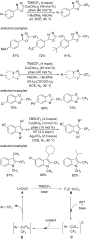
Scheme 5: Attempted synthesis of bianfugecine (6) via directed remote metalation and subsequent trapping of t...
Scheme 6: Outcome of a D2O quenching experiment after metalation of amide 12.
Scheme 7: Synthesis of 1-arylnaphthalene analogues 15 and 16.
Scheme 8: Outcome of a D2O quenching experiment after metalation of amide 16 with LDA.
Scheme 9: Synthesis of the alkaloids menisporphine (2) and dauriporphine (3) by O-methylation of the alkaloid...
Beilstein J. Org. Chem. 2017, 13, 1518–1523, doi:10.3762/bjoc.13.151
Graphical Abstract
Figure 1: Brominating reagents.
Scheme 1: Optimization of the substituents of the amide group. Reactions were run using 1 (0.1 mmol), 3a (0.0...
Scheme 2: Substrate scope. Reactions were run using 1 (0.1 mmol), 3a (0.01 mmol), and 4a (0.3 mmol) in EtOAc ...
Scheme 3: Reactions of substrates with substituted phenols.
Scheme 4: Reactions of monobrominated substrates.
Scheme 5: Rotational barriers of substrates and intermediates calculated at the B3YLP/6-31G(d) level of theor...
Scheme 6: Reaction of substrate with protected phenol.
Beilstein J. Org. Chem. 2017, 13, 1139–1144, doi:10.3762/bjoc.13.113