


Search results
Search for "acetylation" in Full Text gives 255 result(s) in Beilstein Journal of Organic Chemistry. Showing first 200.
Nucleophilic and electrophilic cyclization of N-alkyne-substituted pyrrole derivatives: Synthesis of pyrrolopyrazinone, pyrrolotriazinone, and pyrrolooxazinone moieties
Beilstein J. Org. Chem. 2017, 13, 825–834, doi:10.3762/bjoc.13.83
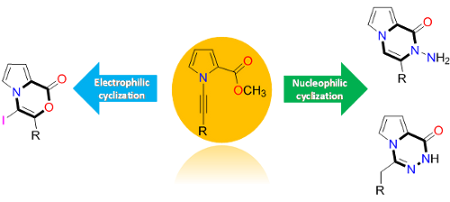
- starting compound 8 was synthesized via a slightly modified route by acetylation of pyrrole with trichloroacetyl chloride in 89% yield [19][23]. The reaction of 8 with NaOMe in methanol gave pyrrole ester 9 (Scheme 1) [19][24]. It is essential to use bromoalkynes for N-alkyne substitution of pyrrole ester
- aromatic o-carbon atoms at 128.8 ppm indicating the structure 13c. For further proof of the structure, 12c was submitted to an acetylation reaction with acetic anhydride in pyridine to give the acetylated compound 14 in 97% yield (Scheme 2). The NH- proton resonance was now shifted to lower field (9.12 ppm
- energies shown for 20, TS1, and 21). Synthesis of N-alkyne substituted methyl 1H-pyrrole-2-carboxylate derivatives 7a–d. Nucleophilic cyclization reaction of compounds 7a–d and acetylation of 12c. Synthesis of 16. Proposed reaction mechanism of nucleophilic cyclization reaction of 7. Electrophilic




Synthesis of D-manno-heptulose via a cascade aldol/hemiketalization reaction
Beilstein J. Org. Chem. 2017, 13, 795–799, doi:10.3762/bjoc.13.79

- to synthesize the 2-OH-protected C4 aldehyde for the assembly of the seven-carbon skeleton. Thus, acetylation of the 2-OH group in 7 with acetic anhydride and DMAP in dichloromethane provided ester 8 in 86% yield. The positions of the 2-acetyl and 3-PMB groups were determined by 1H, 13C and 2D NMR
- -hydroxy group in 14 followed by treatment with DDQ could yield the desired 5-hydroxy product in high yield. Indeed, acetylation of alcohol 14 with acetic anhydride delivered ester 15 in 91% yield. Removal of the PMB group in 15 with DDQ resulted in a very clean reaction, affording alcohol 16 in an


NMR reaction monitoring in flow synthesis
Beilstein J. Org. Chem. 2017, 13, 285–300, doi:10.3762/bjoc.13.31
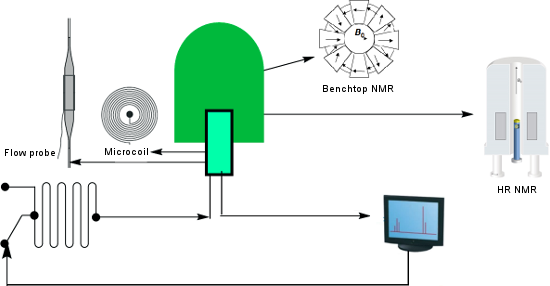
- experimental setup of the flow system. (a) Microfluidic probe. (b) Microreactor holder. (c) Stripline NMR chip holder. (d) Arrangement of the microfluidic chip in the holder. Reproduced with permission from reference [44]. Copyright 2009 The American Chemical Society. Acetylation of benzyl alcohol. Spectra at


Total synthesis of a Streptococcus pneumoniae serotype 12F CPS repeating unit hexasaccharide
Beilstein J. Org. Chem. 2017, 13, 164–173, doi:10.3762/bjoc.13.19
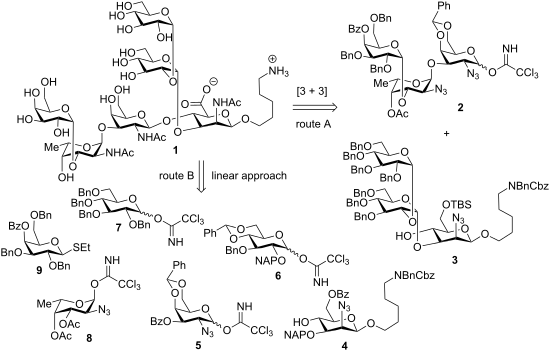
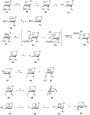
- steps from known galactosylazide selenide 23 [29]. Acetylation of the C3 hydroxy group of 23 furnished fully differentially protected selenoglycoside 24 in 82% yield. Hydrolysis of the selenoglycoside using NIS in aqueous THF produced hemiacetal 25 that was silylated prior to selective saponification of


O-Alkylated heavy atom carbohydrate probes for protein X-ray crystallography: Studies towards the synthesis of methyl 2-O-methyl-L-selenofucopyranoside
Beilstein J. Org. Chem. 2016, 12, 2828–2833, doi:10.3762/bjoc.12.282

- sodium acetate as base. From this acetylation reaction, a chromatographically inseparable mixture of isomeric per-O-acetylated pyranosides 9α/9β and a single furanoside 10 in a ratio of 9α/9β/10 = 3:1:3 was obtained in 42% yield over the two steps (Scheme 2). The isomeric mixture of acetates was then
- benzyl ether protecting group in O-2 position [42]. By varying the reaction conditions during the acetylation step, the authors were able to reduce the formation of furanoses but complete suppression was not achieved. Therefore, our strategy was to block the hydroxy group in position 4 and, thus, to
- cleavage and in situ acetylation resulted in the pyranose mixture 9αβ with excellent yield (90%, 9α/9β = 4:1) and prevention of unwanted furanoside side products. The seleno moiety was then introduced as described before and 13αβ (13α/13β = 1:3) was obtained in 78% yield. Further Lewis acid catalyzed


Useful access to enantiomerically pure protected inositols from carbohydrates: the aldohexos-5-uloses route
Beilstein J. Org. Chem. 2016, 12, 2343–2350, doi:10.3762/bjoc.12.227

- good agreement with what has been reported before on similar compounds [45]. The structure and stereochemistry of inositols 13–19 were confirmed by 1H, 13C and 2D NMR experiments directly or after per-acetylation of the reduction product and/or through comparison with previously reported compounds


Tunable microwave-assisted method for the solvent-free and catalyst-free peracetylation of natural products
Beilstein J. Org. Chem. 2016, 12, 2222–2233, doi:10.3762/bjoc.12.214
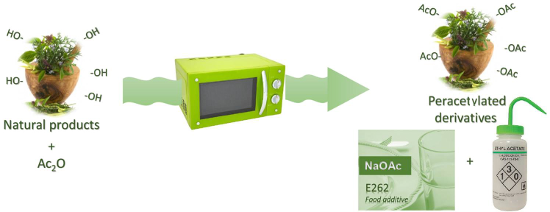
- green acetylation of hydrophilic biological molecules, potentially easily scalable for industrial applications, including pharmaceutical, cosmetic and food industry. Keywords: catalyst-free; microwaves; peracetylation; polyhydroxylated compounds; solvent-free; Introduction Peracetylation of alcohols
- hydroxy groups are unstable in neutral, slight alkaline or oxidative environments [4]. Furthermore, acetylation is a chemical modification well accepted in a biological environment, being the N-acetylation, N,O-acyl transfer and the deacetylation some of the metabolic processes mediated by cytosolic and
- heterogeneous or supported catalysts [15][16][17], solid nanopowders or nanoparticles [18][19], non-metal-based heterogeneous acetylation catalysts [20][21][22], as well as natural marine clays instead of homogeneous catalysts as reaction activators [23]. Even if these methods allow a complete peracetylation of


Solvent-free synthesis of novel para-menthane-3,8-diol ester derivatives from citronellal using a polymer-supported scandium triflate catalyst
Beilstein J. Org. Chem. 2016, 12, 2046–2054, doi:10.3762/bjoc.12.193
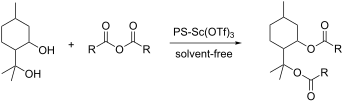
- complex reaction mixtures. When considering the diester selectivity (Figure 2), a rapid acetylation of the secondary hydroxy group is evident at short reaction times and lower reaction temperatures between 50 and 60 °C [12]. Further increase in the reaction time leads to the acetylation of the less
- an acetylation reaction with 2:1 molar ratio, the reaction affords the same results as when excess anhydride 5 is used. Moreover, the minimum use of the acetylating reagent helps to reduce the formation of carboxylic acid as the by-product. As a consequence, a more cost-effective and environmentally


Synthesis of the C8’-epimeric thymine pyranosyl amino acid core of amipurimycin
Beilstein J. Org. Chem. 2016, 12, 1765–1771, doi:10.3762/bjoc.12.165
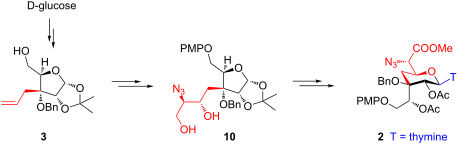
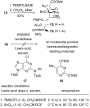
- ester 15. Acetylation of 15 with acetic anhydride in pyridine gave acetate derivative 16 in 95% yield. Having fully functionalized intermediate 16 in hand, we thought to incorporate the purine nucleobase using Vorbrüggen conditions. Thus, reaction of glycosyl donor 16 with bis(trimethylsilyl)-2-(N






Biosynthesis of oxygen and nitrogen-containing heterocycles in polyketides
Beilstein J. Org. Chem. 2016, 12, 1512–1550, doi:10.3762/bjoc.12.148
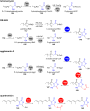
- agglomerin A (147) biosynthesis proceeds as a two-step process [143]. An initial acyl transferase Agg4-catalysed acetylation of the primary hydroxy group in 158 is followed by dehydratase Agg5-catalysed acetic acid elimination, leading to olefin 147 (Scheme 22). This mechanism was confirmed by gene knockout
- analogous acetylation–elimination process was experimentally confirmed for quartromicin D1 (151) biosynthesis (Scheme 22) [145]. VstJ has been identified as a probable candidate for the enzyme-catalysed [4 + 2] cycloaddition in versipelostatin A (153) biosynthesis by heterologous expression, gene knockout






Synthesis of 2-substituted tetraphenylenes via transition-metal-catalyzed derivatization of tetraphenylene
Beilstein J. Org. Chem. 2016, 12, 1302–1308, doi:10.3762/bjoc.12.122
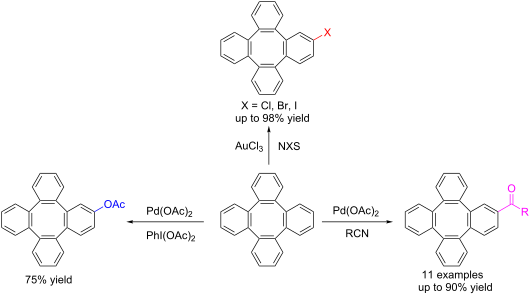
- substituted ones. Although direct bromination [22], nitration [22], and acetylation [45] of tetraphenylene via electrophilic aromatic substitution have been reported, it is still desirable to develop new methods for the derivatization of tetraphenylenes. Herein we report several synthetic protocols for the


Reactions of N,3-diarylpropiolamides with arenes under superelectrophilic activation: synthesis of 4,4-diaryl-3,4-dihydroquinolin-2(1H)-ones and their derivatives
Beilstein J. Org. Chem. 2016, 12, 950–956, doi:10.3762/bjoc.12.93

- -acetylation reactions were carried out. Compounds 2a,d,e and h were N-formylated in the system POCl3–DMF–CHCl3 under the Vilsmeier–Haack reaction conditions with formation of compounds 5a–d (Scheme 2). Apart from that, dihydroquinolinones 2a,e–h were acetylated into derivatives 6a–e (Scheme 2). Then reactions


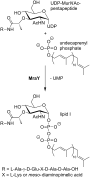
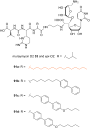
Muraymycin nucleoside-peptide antibiotics: uridine-derived natural products as lead structures for the development of novel antibacterial agents
Beilstein J. Org. Chem. 2016, 12, 769–795, doi:10.3762/bjoc.12.77
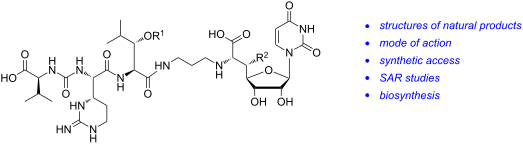
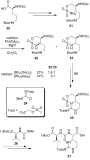
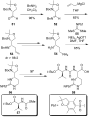
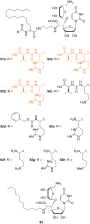
- . Acetylation of the thus formed primary alcohol resulted in compound 38. This was followed by benzyl and Cbz deprotection and the subsequent urea formation with the imidazolium salt 39 to furnish tripeptide 40. After Boc deprotection, the resultant amine was guanidinylated using isothiourea 41. The thus













Synthesis and in vitro cytotoxicity of acetylated 3-fluoro, 4-fluoro and 3,4-difluoro analogs of D-glucosamine and D-galactosamine
Beilstein J. Org. Chem. 2016, 12, 750–759, doi:10.3762/bjoc.12.75
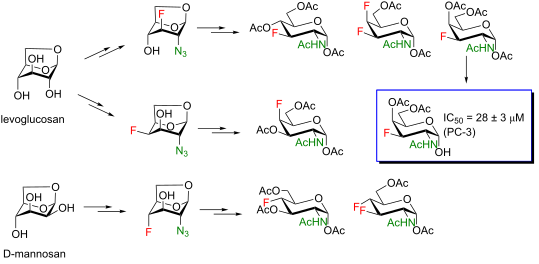
- in terms of product purity. Hydrogenolysis of 42 on palladium in ethanol/HCl followed by acetylation of the amino group furnished the target acetylated 3-fluoro-D-GlcNAc 5 as a chromatographically separable mixture of anomers (Table 1). Addition of HCl was found necessary to effect a clean





Elucidation of a masked repeating structure of the O-specific polysaccharide of the halotolerant soil bacteria Azospirillum halopraeferens Au4
Beilstein J. Org. Chem. 2016, 12, 636–642, doi:10.3762/bjoc.12.62
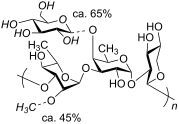
- -methylglucose, 2,4-di-O-methylrhamnose, 2,4-di-O-methylfucose, 2-O-methylfucose, and 3,4-di-O-methylxylose were identified by GLC–MS of partially methylated alditol acetates derived after methylation of the OPS with MeI followed by hydrolysis and acetylation [14]. Therefore, the OPS contains 3-substituted Rha
- afforded complementary oligosaccharides, which identification shed light on the nature of the OPS irregularity and, combined with chemical analysis and NMR spectroscopic analysis data, enabled the structure elucidation of the OPS. Chemical modifications of the OPS, such as O-methylation or O-acetylation
- -stoichiometric substituents in the OPS has been reported for phytopathogens Pseudomonas syringae [29] and Xanthomonas campestris [30] as well as for beneficial rhizobacteria, including free-living Azospirillum spp. [31][32][33][34][35] and root-nodulating Rhizobium spp. [24]. Moreover, the degree of acetylation


Regiodefined synthesis of brominated hydroxyanthraquinones related to proisocrinins
Beilstein J. Org. Chem. 2016, 12, 531–536, doi:10.3762/bjoc.12.52
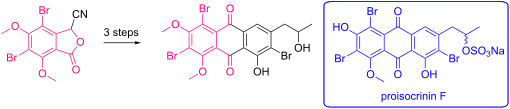
- lactol 34 with methylmagnesium bromide afforded diol 35 in 72% yield. Selective oxidation of the allylic alcohol group in 35 with MnO2, followed by acetylation of the secondary hydroxy group with acetyl chloride, triethylamine and DMAP furnished cyclohexenone 36 (Scheme 5). The Hauser annulation of


A selective and mild glycosylation method of natural phenolic alcohols
Beilstein J. Org. Chem. 2016, 12, 524–530, doi:10.3762/bjoc.12.51

- commercial p-hydroxyphenylcarbaldehydes 4a–c which are less expensive than the corresponding p-hydroxybenzyl alcohols (Scheme 1). The conventional acetylation of 4a–c with acetic anhydride in pyridine gave p-acetoxyphenylcarbaldehydes 5a–c in more than 98% yields. Subsequently the aldehyde function was
- corresponding alcohols, tyrosol and coniferyl alcohol. Therefore p-O-acetylated tyrosol (9) and p-O-acetylated coniferyl alcohol (12) were prepared from acids 7 and 10 by a two-step sequence: acid-catalysed acetylation of the phenolic hydroxy group (isolated yields >94%) followed by the reduction of the


Diastereoselective synthesis of new O-alkylated and C-branched inositols and their corresponding fluoro analogues
Beilstein J. Org. Chem. 2016, 12, 353–361, doi:10.3762/bjoc.12.39

- rather contradictory concerning the acetylation of this tertiary alcohol using acetic anhydride [50][51]. With regard to a PET application, the protection of this hydroxy group is of paramount importance since the free hydroxy group could impair the incorporation of the radioactive fluorine. Therefor
- several methods of acetylation were carried out on myo-14, which was used as model. The best results for the acetylation of the tertiary alcohol in good yield was obtained with the transesterification method using isopropenyl acetate as acylating agent and p-toluenesulfonic acid as catalyst at 80 °C for 2
- stage. For this, compounds myo-20 and scyllo-20 were reacted with tosyl chloride in the presence of a catalytic amount of triethylamine at room temperature for 3 h to give tosylated myo-22 and scyllo-22 in 70 and 71% yield, respectively. Next, acetylation of the tertiary alcohol was performed before


Study on the synthesis of the cyclopenta[f]indole core of raputindole A
Beilstein J. Org. Chem. 2016, 12, 334–342, doi:10.3762/bjoc.12.36

- propargylacetates 46 and 47 (Scheme 7), which were obtained by Sonogashira alkynylations of N-TIPS-6-iodoindoline (39), followed by acetylation (for experimental procedures, see Supporting Information File 1). Xuegong She and coworkers had obtained indanone derivatives from arylpropargylic esters in a Pt(II




Mycothiol synthesis by an anomerization reaction through endocyclic cleavage
Beilstein J. Org. Chem. 2016, 12, 328–333, doi:10.3762/bjoc.12.35

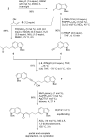
- -disaccharide 2 in 90% yield (Scheme 4). After removing the phthaloyl and acetyl groups by using ethylenediamine in dimethylformamide (DMF), a carbamate group was introduced using triphosgene in the presence of NaHCO3. Acetylation of both the hydroxy and carbamate groups was carried out using acetic anhydride


Supramolecular structures based on regioisomers of cinnamyl-α-cyclodextrins – new media for capillary separation techniques
Beilstein J. Org. Chem. 2016, 12, 97–109, doi:10.3762/bjoc.12.11
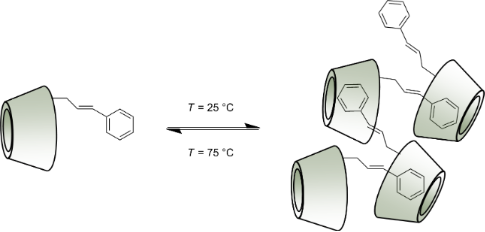
- previously prepared and characterized by our research group, but our attempts to separate the single 2-O- and 3-O-regioisomers without further modification were unsuccessful [10]. In order to isolate the single regioisomers using this published method, exhaustive per-O-acetylation of the mixture of
- regioisomers, chromatographic separation of the per-O-acetylated derivatives and the de-O-acetylation of the separated per-O-acetylated regioisomers would be necessary. This three-step reaction procedure makes the large scale preparation of the single regioisomers expensive and time-consuming. For α-CD we were


Genicunolide A, B and C: three new triterpenoids from Euphorbia geniculata
Beilstein J. Org. Chem. 2015, 11, 2707–2712, doi:10.3762/bjoc.11.291

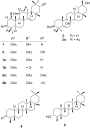
- 2.03 (s, 3H), δC 170.2, 21.3], a trisubstituted double bond [νmax 1630, 1042, 880 cm−1, δ 5.56 (d, J = 5.2 Hz, 1H, H-15)] [36] and a secondary equatorial hydroxy group [νmax 3500 cm−1] whose carbinylic proton resonated at δ 3.16 (dd, J = 8.1 Hz, 1H, H-3). On acetylation with Ac2O–C5H5N, at room
- –1, δ 3.17 (dd, J = 11.1 Hz, 1H)]. Its presence was confirmed by acetylation of 2 to 2a [δ 2.05 (s, 9H), δC 170.1, 170.7 and 170.8] and oxidation to diacetoxy ketone 2b [νmax 1736, 1730, 1680 cm–1, δC 170.5, 170.6, 215.2 (C-21)]. The mass spectrum of compound 2 exhibited RDA fragment ions at m/z 416
- , H-3, 1H)]. On acetylation with Ac2O–C5H5N, at room temperature, it afforded monoacetate 3a [1735, δ 2.05 (s, 3H), δC 170.5] and on oxidation with CrO3–C5H5N, it yielded a ketone which gave a positive Zimmermann test for 3-keto group [37] confirming the presence of the C-3 equatorial secondary

Stereochemistry of ring-opening/cross metathesis reactions of exo- and endo-7-oxabicyclo[2.2.1]hept-5-ene-2-carbonitriles with allyl alcohol and allyl acetate
Beilstein J. Org. Chem. 2015, 11, 1893–1901, doi:10.3762/bjoc.11.204

- compounds 6E and 10E were deacetylated (MeOH/KCN) [24] to give 8E and 12E. The samples 7Z, 8Z, 8E, and 12Z were subjected to acetylation (Py/Ac2O) to give 5Z, 6Z, 6E and 10Z, respectively. The acetates were directly characterized by GC–MS. Based on retention indices and literature data (MS spectra identity


Towards inhibitors of glycosyltransferases: A novel approach to the synthesis of 3-acetamido-3-deoxy-D-psicofuranose derivatives
Beilstein J. Org. Chem. 2015, 11, 1547–1552, doi:10.3762/bjoc.11.170

- starting material was recovered. Next, the azide 3 (contaminated with some elimination products) was subjected to reduction with powdered Zn and NH4Cl as reducing agents [23] followed by acetylation to afford 3-acetamido-3-deoxy-1,2:4,5-di-O-isopropylidene-6-O-pivaloyl-D-altritol (4) in a good yield. It
- 63% yield. The β-anomer was detected in a negligible amount and could not be separated from the above-mentioned byproduct. Acetylation of the 4-hydroxy group in derivative 10 under standard conditions yielded fully protected 3-acetamido-4-O-acetyl-3-deoxy-1,2-O-isopropylidene-6-O-pivaloyl-α-D


Cross-metathesis reaction of α- and β-vinyl C-glycosides with alkenes
Beilstein J. Org. Chem. 2015, 11, 1392–1397, doi:10.3762/bjoc.11.150

- quantitatively the same mixture of epimeric 1-(D-galactopyranosyl)prop-2-enes that were dissolved in ethanol and treated with ether. This allowed the α-epimer to precipitate and it could afterwards be isolated as a pure crystalline product in 60% yield [42]. Its acetylation afforded 1-(tetra-O-acetyl-α-D





