Search for "alkaloid" in Full Text gives 231 result(s) in Beilstein Journal of Organic Chemistry. Showing first 200.
Beilstein J. Org. Chem. 2016, 12, 2280–2292, doi:10.3762/bjoc.12.221
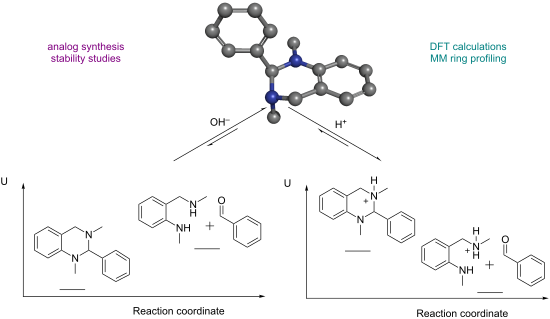
Graphical Abstract
Figure 1: Compounds described in the literature containing an aminal core for various applications. The amina...
Scheme 1: Synthetic approaches for the formation of the tetrahydroquinazoline moiety. Dashed lines indicate b...
Scheme 2: Oxidation and reduction reactions of tetrahydroquinazolines. Dashed lines indicate both cyclized or...
Figure 2: Hydrolysis of the aminal core of tetrahydroquinazolines 1 into the corresponding diamines 2 and ald...
Scheme 3: Reagents and conditions: (i) MeI, DIPEA, DMAc, 40 °C, 24 h; (ii) R1-NH2 or MeNH3Cl and Et3N, DMF, 4...
Scheme 4: Reagents and conditions: (a) (i) MeNH3Cl, Et3N, DMF, 70 °C, 3 h; (ii) AcOH, 70 °C, 4 h; (iii) n-PrB...
Figure 3: pH-Stability test of the aminal core toward hydrolysis in dependency of different substitution patt...
Figure 4: Kinetic analysis of hydrolysis of reference compound 8a in dependency of different pH values and ca...
Figure 5: Differences in energy along the reaction coordinate using the functional B3LYP-D3 for the hydrolysi...
Figure 6: Reaction equilibrium between tetrahydroquinazoline 1, the corresponding diamine 2 and aldehyde 3 in...
Figure 7: Minimum energy conformers in their neutral form with (a) an axial orientation of the phenyl system ...
Beilstein J. Org. Chem. 2016, 12, 1870–1876, doi:10.3762/bjoc.12.176
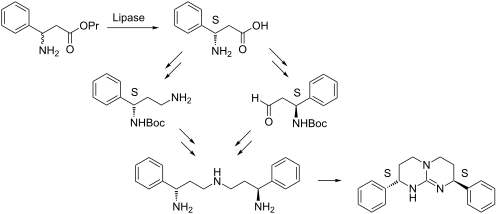
Graphical Abstract
Figure 1: Structure of guanidines 1–10.
Scheme 1: Synthesis of guanidine 10. Conditions: (a) 1 equiv HOOC-CH2-COOH, 2 equiv NH4OAc, EtOH, 78 °C, 5 h,...
Figure 2: Crystal structure of guanidine 10 as a benzoate salt. Only one of the ion pairs is shown for the sa...
Scheme 2: Reaction of anthrones and N-arylmaleimides catalyzed by guanidine 10. The guanidine deprotonates an...
Figure 3: A) Chromatogram of rac-25 after incubation with 0.1 equiv of 10 in THF at −15 °C for 64 h. The fast...
Scheme 3: Assignment of the absolute configurations by chemical correlation. The R configuration of compound ...
Beilstein J. Org. Chem. 2016, 12, 1551–1556, doi:10.3762/bjoc.12.149
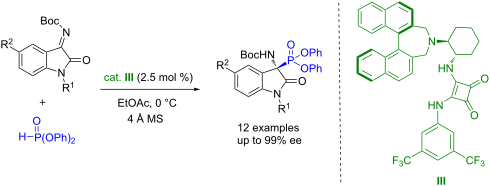
Graphical Abstract
Figure 1: Structure of chiral bifunctional organocatalysts.
Figure 2: Proposed stereochemical model.
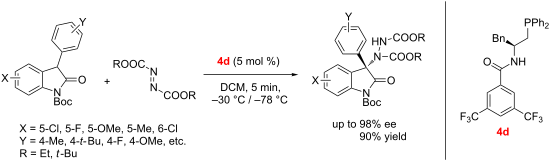
Scheme 1: Gram scale addition of ketimine 1a and diphenyl phosphonate (2).
Beilstein J. Org. Chem. 2016, 12, 1512–1550, doi:10.3762/bjoc.12.148
Graphical Abstract
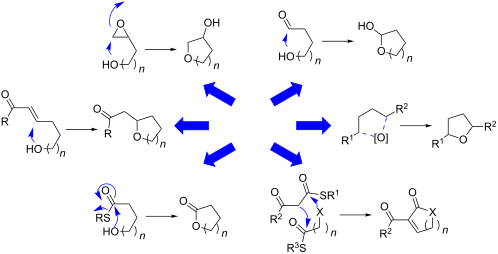
Scheme 1: Schematic description of the cyclisation reaction catalysed by TE domains. In most cases, the nucle...
Scheme 2: Mechanisms for the formation of oxygen heterocycles. The degree of substitution can differ from tha...
Scheme 3: Pyran-ring formation in pederin (24) biosynthesis. Incubation of recombinant PedPS7 with substrate ...
Scheme 4: The domain AmbDH3 from ambruticin biosynthesis catalyses the dehydration of 25 and subsequent cycli...
Scheme 5: SalBIII catalyses dehydration of 29 and subsequent cyclisation to tetrahydropyran 30 [18].
Figure 1: All pyranonaphtoquinones contain either the naphtha[2,3-c]pyran-5,10-dione (32) or the regioisomeri...
Scheme 6: Pyran-ring formation in actinorhodin (34) biosynthesis. DNPA: 4-dihydro-9-hydroxy-1-methyl-10-oxo-3H...
Scheme 7: Pyran formation in granaticin (36) biosynthesis. DNPA: 4-dihydro-9-hydroxy-1-methyl-10-oxo-3H-napht...
Scheme 8: Pyran formation in alnumycin (37) biosynthesis. Adapted from [21].
Scheme 9: Biosynthesis of pseudomonic acid A (61). The pyran ring is initially formed in 57 after dehydrogena...
Scheme 10: Epoxidation–cyclisation leads to the formation of the tetrahydropyran ring in the western part of t...
Scheme 11: a) Nonactin (70) is formed from heterodimers of (−)(+)-dimeric nonactic acid and (+)(−)-dimeric non...
Figure 2: Pamamycins (73) are macrodiolide antibiotics containing three tetrahydrofuran moieties, which are a...
Scheme 12: A PS domain homolog in oocydin A (76) biosynthesis is proposed to catalyse furan formation via an o...
Scheme 13: Mechanism of oxidation–furan cyclisation by AurH, which converts (+)-deoxyaureothin (77) into (+)-a...
Scheme 14: Leupyrrin A2 (80) and the proposed biosynthesis of its furylidene moiety [69,70].
Scheme 15: Asperfuranone (93) biosynthesis, adapted from [75].
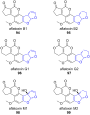
Figure 3: The four major aflatoxins produced by Aspergilli are the types B1, B2, G1 and G2 (94–97). In the di...
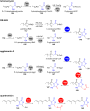
Scheme 16: Overview on aflatoxin B1 (94) biosynthesis. HOMST = 11-hydroxy-O-methylsterigmatocystin [78,79,82-106].
Scheme 17: A zipper mechanism leads to the formation of oxygen heterocycles in monensin biosynthesis [109-111].
Scheme 18: Formation of the 2,6-dioxabicyclo[3.2.1]octane (DBO) ring system in aurovertin B (118) biosynthesis ...
Figure 4: Structures of the epoxide-containing polyketides epothilone A (119) and oleandomycin (120) [123-125].
Scheme 19: Structures of phoslactomycin B (121) (a) and jerangolid A (122) (b). The heterocycle-forming steps ...
Scheme 20: a) Structures of rhizoxin (130) and cycloheximide (131). Model for the formation of δ-lactones (b) ...
Scheme 21: EncM catalyses a dual oxidation sequence and following processing of the highly reactive intermedia...
Figure 5: Mesomeric structures of tetronates [138,139].
Figure 6: Structures of tetronates for which gene clusters have been sequenced. The tetronate moiety is shown...
Scheme 22: Conserved steps for formation and processing in several 3-acyl-tetronate biosynthetic pathways were...
Scheme 23: In versipelostatin A (153) biosynthesis, VstJ is a candidate enzyme for catalysing the [4 + 2] cycl...
Scheme 24: a) Structures of some thiotetronate antibiotics. b) Biosynthesis of thiolactomycin (165) as propose...
Scheme 25: Aureusidine synthase (AS) catalyses phenolic oxidation and conjugate addition of chalcones leading ...
Scheme 26: a) Oxidative cyclisation is a key step in the biosynthesis of spirobenzofuranes 189, 192 and 193. b...
Scheme 27: A bicyclisation mechanism forms a β-lactone and a pyrrolidinone and removes the precursor from the ...
Scheme 28: Spontaneous cyclisation leads to off-loading of ebelactone A (201) from the PKS machinery [163].
Scheme 29: Mechanisms for the formation of nitrogen heterocycles.
Scheme 30: Biosynthesis of highly substituted α-pyridinones. a) Feeding experiments confirmed the polyketide o...
Scheme 31: Acridone synthase (ACS) catalyses the formation of 1,3-dihydroxy-N-methylacridone (224) by condensa...
Scheme 32: A Dieckmann condensation leads to the formation of a 3-acyl-4-hydroxypyridin-2-one 227 and removes ...
Scheme 33: a) Biosynthesis of the pyridinone tenellin (234). b) A radical mechanism was proposed for the ring-...
Scheme 34: a) Oxazole-containing PKS–NRPS-derived natural products oxazolomycin (244) and conglobatin (245). b...
Scheme 35: Structure of tetramic acids 251 (a) and major tautomers of 3-acyltetramic acids 252a–d (b). Adapted...
Scheme 36: Equisetin biosynthesis. R*: terminal reductive domain. Adapted from [202].
Scheme 37: a) Polyketides for which a similar biosynthetic logic was suggested. b) Pseurotin A (256) biosynthe...
Figure 7: Representative examples of PTMs with varying ring sizes and oxidation patterns [205,206].
Scheme 38: Ikarugamycin biosynthesis. Adapted from [209-211].
Scheme 39: Tetramate formation in pyrroindomycin aglycone (279) biosynthesis [213-215].
Scheme 40: Dieckmann cyclases catalyse tetramate or 2-pyridone formation in the biosynthesis of, for example, ...
Beilstein J. Org. Chem. 2016, 12, 1096–1100, doi:10.3762/bjoc.12.104
Graphical Abstract
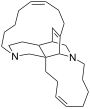
Figure 1: Keramaphidin B (1).
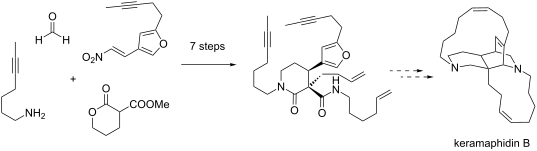
Figure 2: Retrosynthetic analysis of keramaphidin B.
Scheme 1: Enantio- and diastereoselective bifunctional thiourea 12 organocatalysed Michael addition. (a) CO(O...
Scheme 2: Synthesis of bis alkene 5. (a) 12 (20 mol %), toluene, −20 °C, 36 h, 95:5 dr, 92% yield; (b) aq HCH...
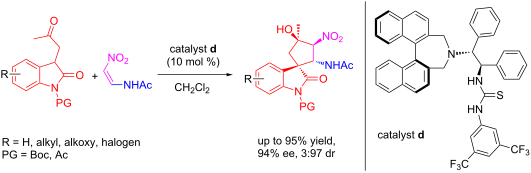
Beilstein J. Org. Chem. 2016, 12, 1000–1039, doi:10.3762/bjoc.12.98
Graphical Abstract
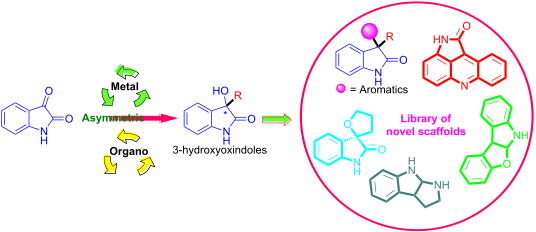
Figure 1: 3-Hydroxyoxindole-containing natural products and biologically active molecules.
Scheme 1: Chiral CNN pincer Pd(II) complex 1 catalyzed asymmetric allylation of isatins.
Scheme 2: Asymmetric allylation of ketimine catalyzed by the chiral CNN pincer Pd(II) complex 2.
Scheme 3: Pd/L1 complex-catalyzed asymmetric allylation of 3-O-Boc-oxindoles.
Scheme 4: Cu(OTf)2-catalyzed asymmetric direct addition of acetonitrile to isatins.
Scheme 5: Chiral tridentate Schiff base/Cu complex catalyzed asymmetric Friedel–Crafts alkylation of isatins ...
Scheme 6: Guanidine/CuI-catalyzed asymmetric alkynylation of isatins with terminal alkynes.
Scheme 7: Asymmetric intramolecular direct hydroarylation of α-ketoamides.
Scheme 8: Plausible catalytic cycle for the direct hydroarylation of α-ketoamides.
Scheme 9: Ir-catalyzed asymmetric arylation of isatins with arylboronic acids.
Scheme 10: Enantioselective decarboxylative addition of β-ketoacids to isatins.
Scheme 11: Ruthenium-catalyzed hydrohydroxyalkylation of olefins and 3-hydroxy-2-oxindoles.
Scheme 12: Proposed catalytic mechanism and stereochemical model.
Scheme 13: In-catalyzed allylation of isatins with stannylated reagents.
Scheme 14: Modified protocol for the synthesis of allylated 3-hydroxyoxindoles.
Scheme 15: Hg-catalyzed asymmetric allylation of isatins with allyltrimethylsilanes.
Scheme 16: Enantioselective additions of organoborons to isatins.
Scheme 17: Asymmetric aldol reaction of isatins with cyclohexanone.
Scheme 18: Enantioselective aldol reactions of aliphatic aldehydes with isatin derivatives and the plausible t...
Scheme 19: Enantioselective aldol reaction of isatins and 2,2-dimethyl-1,3-dioxan-5-one.
Scheme 20: Asymmetric aldol reactions between ketones and isatins.
Scheme 21: Phenylalanine lithium salt-catalyzed asymmetric synthesis of 3-alkyl-3-hydroxyoxindoles.
Scheme 22: Aldolization between isatins and dihydroxyacetone derivatives.
Scheme 23: One-pot asymmetric synthesis of convolutamydine A.
Scheme 24: Asymmetric aldol reactions of cyclohexanone and acetone with isatins.
Scheme 25: Aldol reactions of acetone with isatins.
Scheme 26: Aldol reactions of ketones with isatins.
Scheme 27: Enantioselective allylation of isatins.
Scheme 28: Asymmetric aldol reaction of trifluoromethyl α-fluorinated β-keto gem-diols with isatins.
Scheme 29: Plausible mechanism proposed for the asymmetric aldol reaction.
Scheme 30: Asymmetric aldol reaction of 1,1-dimethoxyacetone with isatins.
Scheme 31: Enantioselective Friedel-Crafts reaction of phenols with isatins.
Scheme 32: Enantioselective addition of 1-naphthols with isatins.
Scheme 33: Enantioselective aldol reaction between 3-acetyl-2H-chromen-2-ones and isatins.
Scheme 34: Stereoselective Mukaiyama–aldol reaction of fluorinated silyl enol ethers with isatins.
Scheme 35: Asymmetric vinylogous Mukaiyama–aldol reaction between 2-(trimethylsilyloxy)furan and isatins.
Scheme 36: β-ICD-catalyzed MBH reactions of isatins with maleimides.
Scheme 37: β-ICD-catalyzed MBH reactions of 7-azaisatins with maleimides and activated alkenes.
Scheme 38: Enantioselective aldol reaction of isatins with ketones.
Scheme 39: Direct asymmetric vinylogous aldol reactions of allyl ketones with isatins.
Scheme 40: Enantioselective aldol reactions of ketones with isatins.
Scheme 41: The MBH reaction of isatins with α,β-unsaturated γ-butyrolactam.
Scheme 42: Reactions of tert-butyl hydrazones with isatins followed by oxidation.
Scheme 43: Aldol reactions of isatin derivatives with ketones.
Scheme 44: Enantioselective decarboxylative cyanomethylation of isatins.
Scheme 45: Catalytic kinetic resolution of 3-hydroxy-3-substituted oxindoles.
Scheme 46: Lewis acid catalyzed Friedel–Crafts alkylation of 3-hydroxy-2-oxindoles with electron-rich phenols.
Scheme 47: Lewis acid catalyzed arylation of 3-hydroxyoxindoles with aromatics.
Scheme 48: Synthetic application of 3-arylated disubstituted oxindoles in the construction of core structures ...
Scheme 49: CPA-catalyzed dearomatization and arylation of 3-indolyl-3-hydroxyoxindoles with tryptamines and 3-...
Scheme 50: CPA-catalyzed enantioselective decarboxylative alkylation of β-keto acids with 3-hydroxy-3-indolylo...
Scheme 51: BINOL-derived imidodiphosphoric acid-catalyzed enantioselective Friedel–Crafts reactions of indoles...
Scheme 52: CPA-catalyzed enantioselective allylation of 3-indolylmethanols.
Scheme 53: 3-Indolylmethanol-based substitution and cycloaddition reactions.
Scheme 54: CPA-catalyzed asymmetric [3 + 3] cycloaddtion reactions of 3-indolylmethanols with azomethine ylide...
Scheme 55: CPA-catalyzed three-component cascade Michael/Pictet–Spengler reactions of 3-indolylmethanols and a...
Scheme 56: Acid-promoted chemodivergent and stereoselective synthesis of diverse indole derivatives.
Scheme 57: CPA-catalyzed asymmetric formal [3 + 2] cycloadditions.
Scheme 58: CPA-catalyzed enantioselective cascade reactions for the synthesis of C7-functionlized indoles.
Scheme 59: Lewis acid-promoted Prins cyclization of 3-allyl-3-hydroxyoxindoles with aldehydes.
Scheme 60: Ga(OTf)3-catalyzed reactions of allenols and phenols.
Scheme 61: I2-catalyzed construction of pyrrolo[2.3.4-kl]acridines from enaminones and 3-indolyl-3-hydroxyoxin...
Scheme 62: CPA-catalyzed asymmetric aza-ene reaction of 3-indolylmethanols with cyclic enaminones.
Scheme 63: Asymmetric α-alkylation of aldehydes with 3-indolyl-3-hydroxyoxindoles.
Scheme 64: Organocatalytic asymmetric α-alkylation of enolizable aldehydes with 3-indolyl-3-hydroxyoxindoles a...
Beilstein J. Org. Chem. 2016, 12, 725–731, doi:10.3762/bjoc.12.72
Graphical Abstract
Scheme 1: The mimetic activation mode of Mitsunobu reaction.
Scheme 2: Scale-up of the reaction and deprotection of the product.
Figure 1: The 31P NMR spectra research in CD2Cl2.
Scheme 3: Proposed transition-state model.
Beilstein J. Org. Chem. 2016, 12, 505–523, doi:10.3762/bjoc.12.50
Graphical Abstract
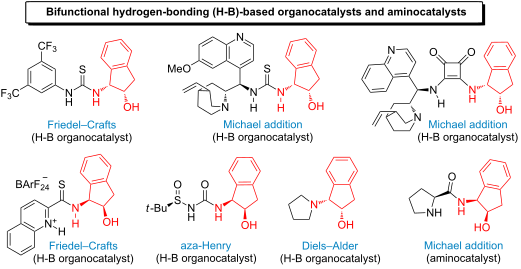
Figure 1: Different configurations of 1,2-aminoindanol 1a–d.
Scheme 1: Asymmetric F–C alkylation catalyzed by thiourea 4.
Figure 2: Results for the F–C reaction carried out with catalyst 4 and the structurally modified analogues, 4'...
Figure 3: (a) Transition state TS1 originally proposed for the F–C reaction catalyzed by thiourea 4 [18]. (b) Tra...
Scheme 2: Asymmetric F–C alkylation catalyzed by thiourea ent-4 in the presence of D-mandelic acid as a Brøns...
Figure 4: Transition state TS2 proposed for the activation of the thiourea-based catalyst ent-4 by an externa...
Scheme 3: Friedel–Crafts alkylation of indoles catalyzed by the chiral thioamide 6.
Scheme 4: Scalable tandem C2/C3-annulation of indoles, catalyzed by the thioamide ent-6.
Scheme 5: Plausible tandem process mechanism for the sequential, double Friedel–Crafts alkylation, which invo...
Scheme 6: One-pot multisequence process that allows the synthesis of interesting compounds 14. The pharmacolo...
Scheme 7: Reaction pathway proposed for the preparation of the compounds 14.
Scheme 8: The enantioselective synthesis of cis-vicinal-substituted indane scaffolds 21, catalyzed by ent-6.
Scheme 9: Asymmetric domino procedure (Michael addition/Henry cyclization), catalyzed by the thioamide ent-6 ...
Scheme 10: The enantioselective addition of indoles 2 to α,β-unsaturated acyl phosphonates 24, a) screening of...
Figure 5: Proposed transition state TS7 for the Friedel–Crafts reaction of indole and α,β-unsaturated acyl ph...
Scheme 11: Study of aliphatic β,γ-unsaturated α-ketoesters 26 as substrates in the F–C alkylation of indoles c...
Figure 6: Possible transition states TS8 and TS9 in the asymmetric addition of indoles 2 to the β,γ-unsaturat...
Figure 7: Transition state TS10 proposed for the asymmetric addition of dialkylhydrazone 28 to the β,γ-unsatu...
Scheme 12: Different β-hydroxylamino-based catalysts tested in a Michael addition, and the transition state TS...
Scheme 13: Enantioselective addition of acetylacetone (36a) to nitroalkenes 3, catalyzed by 37 and the propose...
Scheme 14: Addition of 3-oxindoles 39 to 2-amino-1-nitroethenes 40, catalyzed by 41.
Scheme 15: Michael addition of 1,3-dicarbonyl compounds 36 to the nitroalkenes 3 catalyzed by the squaramide 43...
Scheme 16: Asymmetric aza-Henry reaction catalyzed by the aminoindanol-derived sulfinyl urea 50.
Figure 8: Results for the aza-Henry reaction carried out with the structurally modified catalysts 50–50''.
Scheme 17: Diels–Alder reaction catalyzed by the aminoindanol derivative ent-41.
Scheme 18: Asymmetric Michael addition of 3-pentanone (55a) to the nitroalkenes 3 through aminocatalysis.
Scheme 19: Substrate scope extension for the asymmetric Michael addition between the ketones 55 and the nitroa...
Scheme 20: A possible reaction pathway in the presence of the catalyst 56 and the plausible transition state T...
Beilstein J. Org. Chem. 2016, 12, 462–495, doi:10.3762/bjoc.12.48
Graphical Abstract
Scheme 1: Activation of carbonyl compounds via enamine and iminium intermediates [2].
Scheme 2: Electronic and steric interactions present in enamine activation mode [2].
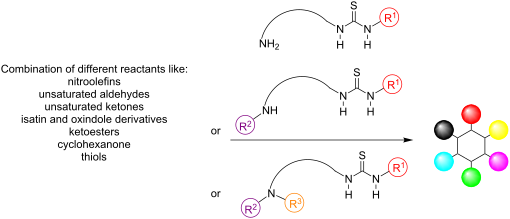
Scheme 3: Electrophilic activation of carbonyl compounds by a thiourea moiety.
Scheme 4: Asymmetric synthesis of dihydro-2H-pyran-6-carboxylate 3 using organocatalyst 4 [16].
Scheme 5: Possible hydrogen-bonding for the reaction of (E)-methyl 2-oxo-4-phenylbut-3-enoate [16].
Scheme 6: Asymmetric desymmetrization of 4,4-cyclohexadienones using the Michael addition reaction with malon...
Scheme 7: The enantioselective synthesis of α,α-disubstituted cycloalkanones using catalyst 11 [18].
Scheme 8: The enantioselective synthesis of indolo- and benzoquinolidine compounds through aza-Diels–Alder re...
Scheme 9: Enantioselective [5 + 2] cycloaddition [20].
Scheme 10: Asymmetric synthesis of oxazine derivatives 26 [21].
Scheme 11: Asymmetric synthesis of bicyclo[3.3.1]nonadienone, core 30 present in (−)-huperzine [22].
Scheme 12: Asymmetric inverse electron-demand Diels-Alder reaction catalyzed by amine-thiourea 34 [23].
Scheme 13: Asymmetric entry to morphan skeletons, catalyzed by amine-thiourea 37 [24].
Scheme 14: Asymmetric transformation of (E)-2-nitroallyl acetate [25].
Scheme 15: Proposed way of activation.
Scheme 16: Asymmetric synthesis of nitrobicyclo[3.2.1]octan-2-one derivatives [26].
Scheme 17: Asymmetric tandem Michael–Henry reaction catalyzed by 50 [27].
Scheme 18: Asymmetric Diels–Alder reactions of 3-vinylindoles 51 [29].
Scheme 19: Proposed transition state and activation mode of the asymmetric Diels–Alder reactions of 3-vinylind...
Scheme 20: Desymmetrization of meso-anhydrides by Chin, Song and co-workers [30].
Scheme 21: Desymmetrization of meso-anhydrides by Connon and co-workers [31].
Scheme 22: Asymmetric intramolecular Michael reaction [32].
Scheme 23: Asymmetric addition of malonate to 3-nitro-2H-chromenes 67 [33].
Scheme 24: Intramolecular desymmetrization through an intramolecular aza-Michael reaction [34].
Scheme 25: Enantioselective synthesis of (−)-mesembrine [34].
Scheme 26: A novel asymmetric Michael–Michael reaction [35].
Scheme 27: Asymmetric three-component reaction catalyzed by Takemoto’s catalyst 77 [46].
Scheme 28: Asymmetric domino Michael–Henry reaction [47].
Scheme 29: Asymmetric domino Michael–Henry reaction [48].
Scheme 30: Enantioselective synthesis of derivatives of 3,4-dihydro-2H-pyran 89 [49].
Scheme 31: Asymmetric addition of α,α-dicyano olefins 90 to 3-nitro-2H-chromenes 91 [50].
Scheme 32: Asymmetric three-component reaction producing 2,6-diazabicyclo[2.2.2]octanones 95 [51].
Scheme 33: Asymmetric double Michael reaction producing substituted chromans 99 [52].
Scheme 34: Enantioselective synthesis of multi-functionalized spiro oxindole dienes 106 [53].
Scheme 35: Organocatalyzed Michael aldol cyclization [54].
Scheme 36: Asymmetric synthesis of dihydrocoumarins [55].
Scheme 37: Asymmetric double Michael reaction en route to tetrasubstituted cyclohexenols [56].
Scheme 38: Asymmetric synthesis of α-trifluoromethyl-dihydropyrans 121 [58].
Scheme 39: Tyrosine-derived tertiary amino-thiourea 123 catalyzed Michael hemiaketalization reaction [59].
Scheme 40: Enantioselective entry to bicyclo[3.2.1]octane unit [60].
Scheme 41: Asymmetric synthesis of spiro[4-cyclohexanone-1,3’-oxindoline] 126 [61].
Scheme 42: Kinetic resolution of 3-nitro-2H-chromene 130 [62].
Scheme 43: Asymmetric synthesis of chromanes 136 [63].
Scheme 44: Wang’s utilization of β-unsaturated α-ketoesters 87 [64,65].
Scheme 45: Asymmetric entry to trifluoromethyl-substituted dihydropyrans 144 [66].
Scheme 46: Phenylalanine-derived thiourea-catalyzed domino Michael hemiaketalization reaction [67].
Scheme 47: Asymmetric synthesis of α-trichloromethyldihydropyrans 149 [68].
Scheme 48: Takemoto’s thiourea-catalyzed domino Michael hemiaketalization reaction [69].
Scheme 49: Asymmetric synthesis of densely substituted cyclohexanes [70].
Scheme 50: Enantioselective synthesis of polysubstituted chromeno [4,3-b]pyrrolidine derivatines 157 [71].
Scheme 51: Enantioselective synthesis of spiro-fused cyclohexanone/5-oxazolone scaffolds 162 [72].
Scheme 52: Utilizing 2-mercaptobenzaldehydes 163 in cascade processes [73,74].
Scheme 53: Proposed transition state of the initial sulfa-Michael step [74].
Scheme 54: Asymmetric thiochroman synthesis via dynamic kinetic resolution [75].
Scheme 55: Enantioselective synthesis of thiochromans [76].
Scheme 56: Enantioselective synthesis of chromans and thiochromans synthesis [77].
Scheme 57: Enantioselective sulfa-Michael aldol reaction en route to spiro compounds [78].
Scheme 58: Enantioselective synthesis of 4-aminobenzo(thio)pyrans 179 [79].
Scheme 59: Asymmetric synthesis of tetrahydroquinolines [80].
Scheme 60: Novel asymmetric Mannich–Michael sequence producing tetrahydroquinolines 186 [81].
Scheme 61: Enantioselective synthesis of biologically interesting chromanes 190 and 191 [82].
Scheme 62: Asymmetric tandem Henry–Michael reaction [83].
Scheme 63: An asymmetric synthesis of substituted cyclohexanes via a dynamic kinetic resolution [84].
Scheme 64: Three component-organocascade initiated by Knoevenagel reaction [85].
Scheme 65: Asymmetric Michael reaction catalyzed by catalysts 57 and 211 [86].
Scheme 66: Proposed mechanism for the asymmetric Michael reaction catalyzed by catalysts 57 and 211 [86].
Scheme 67: Asymmetric facile synthesis of hexasubstituted cyclohexanes [87].
Scheme 68: Dual activation catalytic mechanism [87].
Scheme 69: Asymmetric Michael–Michael/aldol reaction catalyzed by catalysts 57, 219 and 214 [88].
Scheme 70: Asymmetric synthesis of substituted cyclohexane derivatives, using catalysts 57 and 223 [89].
Scheme 71: Asymmetric synthesis of substituted piperidine derivatives, using catalysts 223 and 228 [90].
Scheme 72: Asymmetric synthesis of endo-exo spiro-dihydropyran-oxindole derivatives catalyzed by catalyst 232 [91]....
Scheme 73: Asymmetric synthesis of carbazole spiroxindole derivatives, using catalyst 236 [92].
Scheme 74: Enantioselective formal [2 + 2] cycloaddition of enal 209 with nitroalkene 210, using catalysts 23 ...
Scheme 75: Asymmetric synthesis of polycyclized hydroxylactams derivatives, using catalyst 242 [94].
Scheme 76: Asymmetric synthesis of product 243, using catalyst 246 [95].
Scheme 77: Formation of the α-stereoselective acetals 248 from the corresponding enol ether 247, using catalys...
Scheme 78: Selective glycosidation, catalyzed by Shreiner’s catalyst 23 [97].
Beilstein J. Org. Chem. 2016, 12, 429–443, doi:10.3762/bjoc.12.46
Graphical Abstract
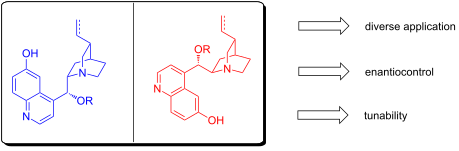
Figure 1: The structural diversity of the cinchona alkaloids, along with cupreine, cupreidine, β-isoquinidine...
Scheme 1: The original 6’-OH cinchona alkaloid organocatalytic MBH process, showing how the free 6’-OH is ess...
Scheme 2: Use of β-ICPD in an aza-MBH reaction.
Scheme 3: (a) The isatin motif is a common feature for MBH processes catalyzed by β-ICPD, as demonstrated by ...
Scheme 4: (a) Chen’s asymmetric MBH reaction. Good selectivity was dependent upon the presence of (R)-BINOL (...
Scheme 5: Lu and co-workers synthesis of a spiroxindole.
Scheme 6: Kesavan and co-workers’ synthesis of spiroxindoles.
Scheme 7: Frontier’s Nazarov cyclization catalyzed by β-ICPD.
Scheme 8: The first asymmetric nitroaldol process catalyzed by a 6’-OH cinchona alkaloid.
Scheme 9: A cupreidine derived catalyst induces a dynamic kinetic asymmetric transformation.
Scheme 10: Cupreine derivative 38 has been used in an organocatalytic asymmetric Friedel–Crafts reaction.
Scheme 11: Examples of 6’-OH cinchona alkaloid catalyzed processes include: (a) Deng’s addition of dimethyl ma...
Scheme 12: A diastereodivergent sulfa-Michael addition developed by Melchiorre and co-workers.
Scheme 13: Melchiorre’s vinylogous Michael addition.
Scheme 14: Simpkins’s TKP conjugate addition reactions.
Scheme 15: Hydrocupreine catalyst HCPN-59 can be used in an asymmetric cyclopropanation.
Scheme 16: The hydrocupreine and hydrocupreidine-based catalysts HCPN-65 and HCPD-67 demonstrate the potential...
Scheme 17: Jørgensen’s oxaziridination.
Scheme 18: Zhou’s α-amination using β-ICPD.
Scheme 19: Meng’s cupreidine catalyzed α-hydroxylation.
Scheme 20: Shi’s biomimetic transamination process for the synthesis of α-amino acids.
Scheme 21: β-Isocupreidine catalyzed [4 + 2] cycloadditions.
Scheme 22: β-Isocupreidine catalyzed [2+2] cycloaddition.
Scheme 23: A domino reaction catalyst by cupreidine catalyst CPD-30.
Scheme 24: (a) Dixon’s 6’-OH cinchona alkaloid catalyzed oxidative coupling. (b) An asymmetric oxidative coupl...
Beilstein J. Org. Chem. 2016, 12, 334–342, doi:10.3762/bjoc.12.36
Graphical Abstract
Figure 1: Bisindole alkaloid raputindole A (1) from the Amazonian tree Raputia simulans.
Scheme 1: Investigated synthetic precursors B–E of the cyclopenta[f]indole moiety (A) of raputindole A (1), a...
Scheme 2: 6-Iodoindole (2) serves twice as starting material towards indole-6-yl-substituted enone 8, obtaine...
Scheme 3: Assembly of 5-oxygenated bisindolylpentenones. DMB: 3,4-dimethoxybenzyl, DMFDMA: N,N-dimethylformal...
Scheme 4: Benzylic oxidation as side reaction of DMB removal.
Scheme 5: Hydroxyalkylation of N-protected indoles with β-cyclocitral and SnCl4-induced cyclization.
Scheme 6: Behavior of indolines after SnCl4-induced generation of allyl cations.
Scheme 7: Pt(II) and Au(I)-catalyzed cyclizations of propargylacetates 46 and 47 afforded cyclopenta[f]indoli...
Beilstein J. Org. Chem. 2015, 11, 2696–2706, doi:10.3762/bjoc.11.290
Graphical Abstract
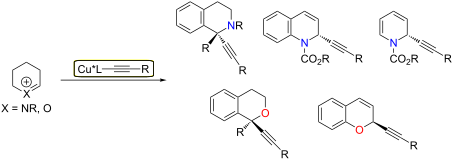
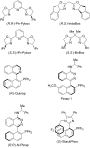
Figure 1: Chiral ligands utilized in copper-catalyzed alkynylations of cyclic iminium and oxocarbenium ions.
Scheme 1: Li’s alkynylation of acyclic N-arylimines.
Scheme 2: Knochel’s alkynylation of acyclic N-alkylenamines.
Scheme 3: Li’s CDC of tetrahydroisoquinolines and alkynes.
Scheme 4: Li’s alkynylation of N-aryldihydroisoquinolinium ions.
Scheme 5: Schreiber’s alkynylation of N-alkylisoquinolinium ions.
Scheme 6: Ma’s alkynylation of pyridium ions.
Scheme 7: Arndtsen’s alkynylation of cyclic iminium ions.
Scheme 8: Maruoka’s alkynylation of azomethine imines.
Scheme 9: Su’s CDC of tetrahydroisoquinolines and alkynes under ball milling conditions.
Scheme 10: Ma’s A3-coupling.
Scheme 11: Li’s CDC reaction using photoredox catalysis.
Scheme 12: Liu’s CDC reaction of N-carbamoyltetrahydroisoquinolines. T+BF4– = 2,2,6,6-tetramethylpiperidine N-...
Scheme 13: Aponick’s alkynylation of N-carbomoylquinolinium ions using StackPhos as ligand.
Scheme 14: Carreira’s enantioselective, catalytic alkynylation of aldehydes.
Scheme 15: Watson’s alkynylation of isochroman oxocarbenium ions.
Scheme 16: Watson’s alkynylation of chromene oxocarbenium ions.
Scheme 17: Watson’s alkynylation to set diaryl tetrasubstituted stereocenters.
Beilstein J. Org. Chem. 2015, 11, 2591–2599, doi:10.3762/bjoc.11.279
Graphical Abstract
Figure 1: Some chiral, bioactive isoindolinones.
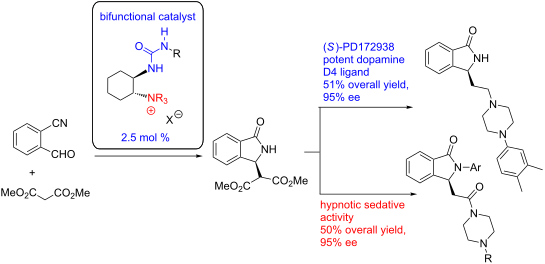
Scheme 1: This work: 1) trans-1,2-cyclohexane diamine-based bifunctional ammonium salts 8 in the asymmetric s...
Scheme 2: Asymmetric cascade, crystallization and decarboxylation reaction.
Scheme 3: Proposed racemization pathways of isoindolinones 9 via retro-Michael process.
Scheme 4: Asymmetric synthesis of (S)-PD172938.
Scheme 5: Coupling of chiral acid 9 with p-tolylpiperazine and CuI arylation of chiral isoindolinones.
Beilstein J. Org. Chem. 2015, 11, 2493–2508, doi:10.3762/bjoc.11.271
Graphical Abstract
Figure 1: Structures of lovastatin (1), aflatoxin B1 (2) and amphotericin B (3).
Scheme 1: a) Structure of rhizoxin (4). b) Two possible mechanisms of chain branching catalysed by a branchin...
Scheme 2: Structure of coelimycin P1 (8) and proposed biosynthetic formation from the putative PKS produced a...
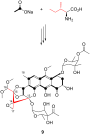
Scheme 3: Structure of trioxacarcin A (9) with highlighted carbon origins of the polyketide core from acetate...
Scheme 4: Proposed biosynthetic assembly of clostrubin A (12). Bold bonds show intact acetate units.
Figure 2: Structure of forazoline A (13).
Figure 3: Structures of tyrocidine A (14) and teixobactin (15).
Figure 4: Top: Structure of the NRPS product kollosin A (16) with the sequence N-formyl-D-Leu-L-Ala-D-Leu-L-V...
Scheme 5: Proposed biosynthesis of aspirochlorine (20) via 18 and 19.
Scheme 6: Two different macrocyclization mechanisms in the biosynthesis of pyrrocidine A (24).
Figure 5: Structure of thiomarinol A (27). Bold bonds indicate carbon atoms derived from 4-hydroxybutyrate.
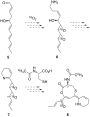
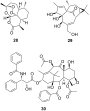
Figure 6: Structures of artemisinin (28), ingenol (29) and paclitaxel (30).
Figure 7: The revised (31) and the previously suggested (32) structure of hypodoratoxide and the structure of...
Figure 8: Structure of the two interconvertible conformers of (1(10)E,4E)-germacradien-6-ol (34) studied with...
Scheme 7: Proposed cyclization mechanism of corvol ethers A (42) and B (43) with the investigated reprotonati...
Scheme 8: Predicted (top) and observed (bottom) 13C-labeling pattern in cyclooctatin (45) after feeding of [U-...
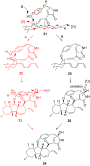
Scheme 9: Proposed mechanism of the cyclooctat-9-en-7-ol (52) biosynthesis catalysed by CotB2. Annotated hydr...
Scheme 10: Cyclization mechanism of sesterfisherol (59). Bold lines indicate acetate units; black circles repr...
Scheme 11: Cyclization mechanisms to pentalenene (65) and protoillud-6-ene (67).
Scheme 12: Reactions of chorismate catalyzed by three different enzyme subfamilies. Oxygen atoms originating f...
Scheme 13: Incorporation of sulfur into tropodithietic acid (72) via cysteine.
Scheme 14: Biosynthetic proposal for the starter unit of antimycin biosynthesis. The hydrogens at positions R1...
Beilstein J. Org. Chem. 2015, 11, 2334–2342, doi:10.3762/bjoc.11.254
Graphical Abstract
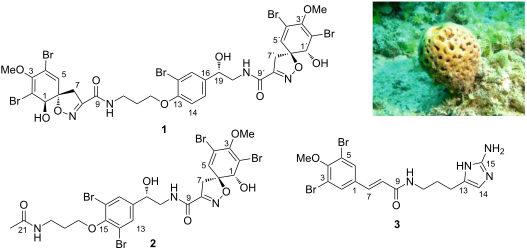
Figure 1: Three new bromotyrosine derivatives isolated from sponge Aplysina lacunosa: 14-debromo-11-deoxyfist...
Figure 2: Bromotyrosine alkaloids and brominated compounds isolated from the sponge Aplysina lacunosa.
Figure 3: 1,1-ADEQUATE spectrum of 14-debromo-11-deoxyfistularin-3 (1).
Figure 4: The tissue damage induced chemical conversion from fistularin-3 (5) to 19 by an undefined enzyme in...
Figure 5: Diacetylhexadellin B (20) isolated from sponge Hexadella sp.
Figure 6: Bromotyrosine alkaloid (21) isolated from the sponge Verongula sp.
Beilstein J. Org. Chem. 2015, 11, 2223–2241, doi:10.3762/bjoc.11.241
Graphical Abstract
Figure 1: Some ruthenium catalysts for metathesis reactions.
Scheme 1: Decomposition of methylidenes 1 and 2.
Scheme 2: Deactivation of G-HII in the presence of ethylene.
Scheme 3: Reaction between GI/GII and n-BuNH2.
Scheme 4: Reaction of GII with amines a–d.
Scheme 5: Amine-induced decomposition of GII methylidene 2.
Scheme 6: Amine-induced decomposition of GII in RCM conditions.
Scheme 7: Deactivation of methylidene 2 in the presence of pyridine.
Scheme 8: Reaction of G-HII with various amines.
Scheme 9: Formation of olefin 22 from styrene.
Scheme 10: Hypothetic deactivation pathway of G-HII.
Scheme 11: RCM of dienic pyridinium salts.
Scheme 12: Synthesis of polycyclic scaffolds using RCM.
Scheme 13: Enyne ring-closing metathesis.
Scheme 14: Synthesis of (R)-(+)-muscopyridine using a RCM strategy.
Scheme 15: Synthesis of a tris-pyrrole macrocycle.
Scheme 16: Synthesis of a bicyclic imidazole.
Scheme 17: RCM using Schrock’s catalyst 44.
Scheme 18: Synthesis of 1,6-pyrido-diazocine 46 by using a RCM.
Scheme 19: Synthesis of fused pyrimido-azepines through RCM.
Scheme 20: RCM involving alkenes containing various N-heteroaromatics.
Scheme 21: Synthesis of dihydroisoquinoline using a RCM.
Scheme 22: Formation of tricyclic compound 59.
Scheme 23: RCM in the synthesis of normuscopyridine.
Scheme 24: Synthesis of macrocycle 64.
Scheme 25: Synthesis of macrocycles possessing an imidazole group.
Scheme 26: Retrosynthesis of an analogue of erythromycin.
Scheme 27: Retrosynthesis of haminol A.
Scheme 28: CM involving 3-vinylpyridine 70 with 71 and vinylpyridine 70 with 73.
Scheme 29: Revised retrosynthesis of haminol A.
Scheme 30: CM between 78 and crotonaldehyde.
Scheme 31: Hypothesized deactivation pathway.
Scheme 32: CM involving an allyl sulfide containing a quinoline.
Scheme 33: CM involving allylic sulfide possessing a quinoxaline or a phenanthroline.
Scheme 34: CM between an acrylate and a 2-methoxy-5-bromo pyridine.
Scheme 35: Successful CM of an alkene containing a 2-chloropyridine.
Scheme 36: Variation of the substituent on the pyridine ring.
Scheme 37: CM involving alkenes containing a variety of N-heteroaromatics.
Beilstein J. Org. Chem. 2015, 11, 2029–2037, doi:10.3762/bjoc.11.220
Graphical Abstract
Figure 1: Selected pyrrole-imidazole alkaloids (1–4, 6–11, and 13–20), and agelongine analogues (5, 12, and 21...
Figure 2: Selected 1H,1H-COSY (blue bonds), 1H,1H-NOESY (blue arrows), 1H,13C-HMBC, and 1H,15N-HMBC (both red...
Figure 3: Selected 1H,1H-COSY (blue bonds), 1H,1H-NOESY (blue arrows), 1H,13C-HMBC, and 1H,15N-HMBC (both red...
Figure 4: Selected 1H,1H-COSY (blue bonds), 1H,1H-NOESY (blue arrows), and 1H,13C-HMBC (red arrows) correlati...
Figure 5: Selected 1H,1H-COSY (blue bonds), 1H,1H-NOESY (blue arrows), 1H,13C-HMBC, and 1H,15N-HMBC (both red...
Figure 6: Selected 1H,1H-COSY (blue bonds), 1H,13C-HMBC, and 1H,15N-HMBC (both red arrows) correlations for N...
Beilstein J. Org. Chem. 2015, 11, 1881–1885, doi:10.3762/bjoc.11.202
Graphical Abstract
Scheme 1: Synthesis of the asymmetric rotor 1.
Scheme 2: Synthesis of dirotors 6 and 10.
Scheme 3: Synthesis of the tertiary amide 12.
Scheme 4: Synthesis of the extended alkaloid ligand 14.
Beilstein J. Org. Chem. 2015, 11, 1833–1864, doi:10.3762/bjoc.11.199
Graphical Abstract
Figure 1: Ruthenium alkylidene catalysts used in RRM processes.
Figure 2: General representation of various RRM processes.
Figure 3: A general mechanism for RRM process.
Scheme 1: RRM of cyclopropene systems.
Scheme 2: RRM of cyclopropene with catalyst 2. (i) catalyst 2 (2.5 mol %), ethylene (24, 1 atm), (ii) toluene...
Scheme 3: RRM of various cyclopropene derivatives with catalyst 2. (i) catalyst 2 (2.5 mol %), CH2Cl2 (c = 0....
Scheme 4: RRM of substituted cyclopropene system with catalyst 2.
Scheme 5: RRM of cyclobutene system with catalyst 2.
Scheme 6: RRM approach to various bicyclic compounds.
Scheme 7: RRM approach to erythrina alkaloid framework.
Scheme 8: ROM–RCM sequence to lactone derivatives.
Scheme 9: RRM protocol towards the synthesis of lactone derivative 58.
Scheme 10: RRM protocol towards the asymmetric synthesis of asteriscunolide D (61).
Scheme 11: RRM strategy towards the synthesis of various macrolide rings.
Scheme 12: RRM protocol to dipiperidine system.
Scheme 13: RRM of cyclopentene system to generate the cyclohexene systems.
Scheme 14: RRM of cyclopentene system 74.
Scheme 15: RRM approach to compound 79.
Scheme 16: RRM approach to spirocycles.
Scheme 17: RRM approach to bicyclic dihydropyrans.
Scheme 18: RCM–ROM–RCM cascade using non strained alkenyl heterocycles.
Scheme 19: First ROM–RCM–ROM–RCM cascade for the synthesis of trisaccharide 97.
Scheme 20: RRM of cyclohexene system.
Scheme 21: RRM approach to tricyclic spirosystem.
Scheme 22: RRM approach to bicyclic building block 108a.
Scheme 23: ROM–RCM protocol for the synthesis of the bicyclo[3.3.0]octene system.
Scheme 24: RRM protocol to bicyclic enone.
Scheme 25: RRM protocol toward the synthesis of the tricyclic system 118.
Scheme 26: RRM approach toward the synthesis of the tricyclic enones 122a and 122b.
Scheme 27: Synthesis of tricyclic and tetracyclic systems via RRM protocol.
Scheme 28: RRM protocol towards the synthesis of tetracyclic systems.
Scheme 29: RRM of the propargylamino[2.2.1] system.
Scheme 30: RRM of highly decorated bicyclo[2.2.1] systems.
Scheme 31: RRM protocol towards fused tricyclic compounds.
Scheme 32: RRM protocol to functionalized tricyclic systems.
Scheme 33: RRM approach to functionalized polycyclic systems.
Scheme 34: Sequential RRM approach to functionalized tricyclic ring system 166.
Scheme 35: RRM protocol to functionalized CDE tricyclic ring system of schintrilactones A and B.
Scheme 36: Sequential RRM approach to 7/5 fused bicyclic systems.
Scheme 37: Sequential ROM-RCM protocol for the synthesis of bicyclic sugar derivatives.
Scheme 38: ROM–RCM sequence of the norbornene derivatives 186 and 187.
Scheme 39: RRM approach toward highly functionalized bridge tricyclic system.
Scheme 40: RRM approach toward highly functionalized tricyclic systems.
Scheme 41: Synthesis of hexacyclic compound 203 by RRM approach.
Scheme 42: RRM approach toward C3-symmetric chiral trimethylsumanene 209.
Scheme 43: Triquinane synthesis via IMDA reaction and RRM protocol.
Scheme 44: RRM approach to polycyclic compounds.
Scheme 45: RRM strategy toward cis-fused bicyclo[3.3.0]carbocycles.
Scheme 46: RRM protocol towards the synthesis of bicyclic lactone 230.
Scheme 47: RRM approach to spiro heterocyclic compounds.
Scheme 48: RRM approach to spiro heterocyclic compounds.
Scheme 49: RRM approach to regioselective pyrrolizidine system 240.
Scheme 50: RRM approach to functionalized bicyclic derivatives.
Scheme 51: RRM approach to tricyclic derivatives 249 and 250.
Scheme 52: RRM approach to perhydroindoline derivative and spiro system.
Scheme 53: RRM approach to bicyclic pyran derivatives.
Scheme 54: RRM of various functionalized oxanorbornene systems.
Scheme 55: RRM to assemble the spiro fused-furanone core unit. (i) 129, benzene, 55 °C, 3 days; (ii) Ph3P=CH2B...
Scheme 56: RRM protocol to norbornenyl sultam systems.
Scheme 57: Ugi-RRM protocol for the synthesis of 2-aza-7-oxabicyclo system.
Scheme 58: Synthesis of spiroketal systems via RRM protocol.
Scheme 59: RRM approach to cis-fused heterotricyclic system.
Scheme 60: RRM protocol to functionalized bicyclic systems.
Scheme 61: ROM/RCM/CM cascade to generate bicyclic scaffolds.
Scheme 62: RCM of ROM/CM product.
Scheme 63: RRM protocol to bicyclic isoxazolidine ring system.
Scheme 64: RRM approach toward the total synthesis of (±)-8-epihalosaline (300).
Scheme 65: Sequential RRM approach to decalin 304 and 7/6 fused 305 systems.
Scheme 66: RRM protocol to various fused carbocyclic derivatives.
Scheme 67: RRM to cis-hydrindenol derivatives.
Scheme 68: RRM protocol towards the cis-hydrindenol derivatives.
Scheme 69: RRM approach toward the synthesis of diversed polycyclic lactams.
Scheme 70: RRM approach towards synthesis of hexacyclic compound 324.
Scheme 71: RRM protocol to generate luciduline precursor 327 with catalyst 2.
Scheme 72: RRM protocol to key building block 330.
Scheme 73: RRM approach towards the synthesis of key intermediate 335.
Scheme 74: RRM protocol to highly functionalized spiro-pyran system 339.
Scheme 75: RRM to various bicyclic polyether derivatives.
Beilstein J. Org. Chem. 2015, 11, 1667–1699, doi:10.3762/bjoc.11.183
Graphical Abstract
Figure 1: Fragments produced by the FAB–MS of dehydrokuanoniamine B (20) [42].
Figure 2: Fragments produced by the EIMS of sagitol (26) [55].
Figure 3: Fragments produced by the EIMS of styelsamine B (4) [45].
Figure 4: Fragments produced by the EIMS of styelsamine D (6) [45].
Figure 5: Fragments produced by the EIMS of subarine (37) [40].
Scheme 1: Synthesis of styelsamine B (4) and cystodytin J (1) [58].
Scheme 2: Synthesis of sebastianine A (38) and its regioisomer 39 [59].
Scheme 3: Synthesis route A of neoamphimedine (12) [61].
Scheme 4: Synthesis route B of neoamphimedine (12) [62].
Scheme 5: Synthesis of arnoamines A (40) and B (41) [63].
Scheme 6: Synthesis of ascididemin (42) [65].
Scheme 7: Synthesis of subarine (37) [66,67].
Scheme 8: Synthesis of demethyldeoxyamphimedine (9) [68].
Scheme 9: Synthesis of pyridoacridine analogues related to ascididemin (42) [70].
Scheme 10: Synthesis of analogues of meridine (56) [71].
Scheme 11: Synthesis of bulky pyridoacridine as eilatin (58) [72].
Scheme 12: Synthesis of AK37 (59), analogue of kuanoniamine A (60) [73].
Figure 6: Biosynthesis pathway I [74].
Figure 7: Reaction illustrating catechol and kynuramine as possible biosynthetic precursors [75].
Figure 8: Biosynthesis pathway B deduced from the feeding experiment A using labelled precursors [76].
Figure 9: Proposed biosynthesis pathway [47].
Figure 10: 4H-Pyrido[2,3,4-kl]acridin-4-one as a cytotoxic pharmacophore.
Figure 11: 7H-Pyrido[2,3,4-kl]acridine as a cytotoxic pharmacophore.
Figure 12: 9H-Quinolino[4,3,2-de][1,10]phenanthrolin-9-one as a cytotoxic pharmacophore.
Figure 13: 8H-Benzo[b]pyrido[4,3,2-de][1,7]phenanthrolin-8-one as a cytotoxic pharmacophore.
Figure 14: Pyrido[4,3,2-mn]pyrrolo[3,2,1-de]acridine as a cytotoxic pharmacophore.
Figure 15: 9H-Pyrido[4,3,2-mn]thiazolo[4,5-b]acridin-9-one and 8H-pyrido[4,3,2-mn]thiazolo[4,5-b]acridine: cyt...
Figure 16: 9H-quinolino[4,3,2-de][1,10]phenanthrolin-9-one as an anti-mycobacterial pharmacophore.
Figure 17: 9H-Quinolino[4,3,2-de][1,10]phenanthrolin-9-one as an antibacterial pharmacophore.
Figure 18: Saturated and less saturated pyridine moieties as aspartyl inhibitor cores.
Figure 19: Iminobenzoquinone and acridone cores as intercalating and TOPO inhibitor motifs found in pyridoacri...
Beilstein J. Org. Chem. 2015, 11, 1649–1655, doi:10.3762/bjoc.11.181
Graphical Abstract
Figure 1: (a) Radical reactions of ene-sulfonamides give diverse isolated products; (b) these products are of...
Figure 2: Isolation of stable imines strengthens the case for sulfonyl radical elimination.
Scheme 1: Cyclizations of N-sulfonylindole 3 occur with retention or elimination of the sulfonyl group depend...
Scheme 2: Aryl radical cyclization to N-sulfonylindoles.
Figure 3: Mechanistic aspects of cyclizations shown in Scheme 2; (a) mechanism for formation of 7; (b) possible reaso...
Figure 4: Substrate design by swapping radical precursor and acceptor.
Scheme 3: Synthesis and cyclization of precursors 22–24.
Figure 5: ORTEP representation of the crystal structure of 27.
Figure 6: Proposed hydration/retro-Claisen path to formamides.
Beilstein J. Org. Chem. 2015, 11, 1583–1595, doi:10.3762/bjoc.11.174
Graphical Abstract
Scheme 1: Activated derivatives of dicarboxylic acids.
Figure 1: Example of natural compounds selectively acylated with dicarboxylic esters.
Figure 2: C6-dicarboxylic acid diesters derivatives of NAG-thiazoline.
Figure 3: Sylibin dimers obtained by CAL-B catalyzed trans-acylation reactions.
Scheme 2: Biocatalyzed synthesis of paclitaxel derivatives.
Figure 4: 5-Fluorouridine derivatives obtained by CAL-B catalysis.
Scheme 3: Biocatalyzed synthesis of hybrid diesters 17 and 18.
Scheme 4: Hybrid derivatives of sylibin.
Figure 5: Bolaamphiphilic molecules containing (L)- and/or (D)-isoascorbic acid moieties.
Figure 6: Doxorubicin (29) trapped in a polyester made of glycolate, sebacate and 1,4-butandiol units.
Figure 7: Polyesters containing functionalized pentofuranose derivatives.
Figure 8: Polyesters containing disulfide moieties.
Figure 9: Polyesters containing epoxy moieties.
Figure 10: Biocatalyzed synthesis of polyesters containing glycerol.
Figure 11: Iataconic (34) and malic (35) acid.
Figure 12: Oxidized poly(hexanediol-2-mercaptosuccinate) polymer.
Figure 13: C-5-substituted isophthalates.
Figure 14: Curcumin-based polyesters.
Figure 15: Silylated polyesters.
Figure 16: Polyesters containing reactive ether moieties.
Figure 17: Polyesters obtained by CAL-B-catalyzed condensation of dicarboxylic esters and N-substituted dietha...
Figure 18: Polyesters comprising mexiletine (38) moieties.
Figure 19: Poly(amide-co-ester)s comprising a terminal hydroxy moiety.
Figure 20: Polymer comprising α-oxydiacid moieties.
Figure 21: Telechelics with methacrylate ends.
Figure 22: Telechelics with allyl-ether ends.
Figure 23: Telechelics with ends functionalized as epoxides.
Beilstein J. Org. Chem. 2015, 11, 1360–1366, doi:10.3762/bjoc.11.146
Graphical Abstract
Figure 1: Naturally occurring β-carbolinones.
Scheme 1: Preparation of starting substrate.
Scheme 2: Synthesis of various β-carbolinone derivatives.
Figure 2: ORTEP diagram of 5h.
Scheme 3: Proposed mechanistic pathway.
Beilstein J. Org. Chem. 2015, 11, 1274–1331, doi:10.3762/bjoc.11.142
Graphical Abstract
Figure 1: General representation of cyclophanes.
Figure 2: cyclophanes one or more with heteroatom.
Figure 3: Metathesis catalysts 12–17 and C–C coupling catalyst 18.
Figure 4: Natural products containing the cyclophane skeleton.
Figure 5: Turriane family of natural products.
Scheme 1: Synthesis of [3]ferrocenophanes through Mannich reaction. Reagents and conditions: (i) excess HNMe2...
Scheme 2: Synthesis of cyclophanes through Michael addition. Reagents and conditions: (i) xylylene dibromide,...
Scheme 3: Synthesis of normuscopyridine analogue 37 through an oxymercuration–oxidation strategy. Reagents an...
Scheme 4: Synthesis of tribenzocyclotriyne 39 through Castro–Stephens coupling reaction. Reagents and conditi...
Scheme 5: Synthesis of cyclophane 43 through Glaser–Eglinton coupling. Reagents and conditions: (i) 9,10-bis(...
Scheme 6: Synthesis of the macrocyclic C-glycosyl cyclophane through Glaser coupling. Reagents and conditions...
Scheme 7: Synthesis of cyclophane-containing complex 49 through Glaser–Eglinton coupling reaction. Reagents a...
Scheme 8: Synthesis of cyclophane 53 through Glaser–Eglinton coupling. Reagents and conditions: (i) K2CO3, ac...
Figure 6: Cyclophanes 54–56 that have been synthesized through Glaser–Eglinton coupling.
Figure 7: Synthesis of tetrasubstituted [2.2]paracyclophane 57 and chiral cyclophyne 58 through Eglinton coup...
Scheme 9: Synthesis of cyclophane through Glaser–Hay coupling reaction. Reagents and conditions: (i) CuCl2 (1...
Scheme 10: Synthesis of seco-C/D ring analogs of ergot alkaloids through intramolecular Heck reaction. Reagent...
Scheme 11: Synthesis of muscopyridine 73 via Kumada coupling. Reagents and conditions: (i) 72, THF, ether, 20 ...
Scheme 12: Synthesis of the cyclophane 79 via McMurry coupling. Reagents and conditions: (i) 75, decaline, ref...
Scheme 13: Synthesis of stilbenophane 81 via McMurry coupling. Reagents and conditions: (i) TiCl4, Zn, pyridin...
Scheme 14: Synthesis of stilbenophane 85 via McMurry coupling. Reagents and conditions: (i) NBS (2 equiv), ben...
Figure 8: List of cyclophanes prepared via McMurry coupling reaction as a key step.
Scheme 15: Synthesis of paracyclophane by cross coupling involving Pd(0) catalyst. Reagents and conditions: (i...
Scheme 16: Synthesis of the cyclophane 112 via the pinacol coupling and 113 by RCM. Reagents and conditions: (...
Scheme 17: Synthesis of cyclophane derivatives 122a–c via Sonogoshira coupling. Reagents and conditions: (i) C...
Scheme 18: Synthesis of cyclophane 130 via Suzuki–Miyaura reaction as a key step. Reagents and conditions: (i)...
Scheme 19: Synthesis of the mycocyclosin via Suzuki–Miyaura cross coupling. Reagents and conditions: (i) benzy...
Scheme 20: Synthesis of cyclophanes via Wurtz coupling reaction Reagents and conditions: (i) PhLi, Et2O, C6H6,...
Scheme 21: Synthesis of non-natural glycophanes using alkyne metathesis. Reagents and conditions: (i) G-I (12)...
Figure 9: Synthesis of cyclophanes via ring-closing alkyne metathesis.
Scheme 22: Synthesis of crownophanes by cross-enyne metathesis. Reagents and conditions: (i) G-II (13), 5 mol ...
Scheme 23: Synthesis of (−)-cylindrocyclophanes A (156) and (−)-cylindrocyclophanes F (155). Reagents and cond...
Scheme 24: Synthesis of cyclophane 159 derivatives via SM cross-coupling and RCM. Reagents and conditions: (i)...
Scheme 25: Sexithiophene synthesis via cross metathesis. Reagents and conditions: (i) 161, Pd(PPh3)4, K2CO3, T...
Scheme 26: Synthesis of pyrrole-based cyclophane using enyne metathesis. Reagents and conditions: (i) Se, chlo...
Scheme 27: Synthesis of macrocyclic derivatives by RCM. Reagents and conditions: (i) G-I/G-II, CH2Cl2, 0.005 M...
Scheme 28: Synthesis of enantiopure β-lactam-based dienyl bis(dihydrofuran) 179. Reagents and conditions: (i) ...
Scheme 29: Synthesis of a [1.1.6]metaparacyclophane derivative 183 via SM cross coupling. Reagents and conditi...
Scheme 30: Synthesis of a [1.1.6]metaparacyclophane derivative 190 via SM cross coupling. Reagents and conditi...
Scheme 31: Template-promoted synthesis of cyclophanes involving RCM. Reagents and conditions: (i) acenaphthene...
Scheme 32: Synthesis of [3.4]cyclophane derivatives 200 via SM cross coupling and RCM. Reagents and conditions...
Figure 10: Examples for cyclophanes synthesized by RCM.
Scheme 33: Synthesis of the longithorone C framework assisted by fluorinated auxiliaries. Reagents and conditi...
Scheme 34: Synthesis of the longithorone framework via RCM. Reagents and conditions: (i) 213, NaH, THF, rt, 10...
Scheme 35: Synthesis of floresolide B via RCM as a key step. Reagents and conditions: (i) G-II (13, 0.1 equiv)...
Scheme 36: Synthesis of normuscopyridine (223) by the RCM strategy. Reagents and condition: (i) Mg, THF, hexen...
Scheme 37: Synthesis of muscopyridine (73) via RCM. Reagents and conditions: (i) 225, NaH, THF, 0 °C to rt, 1....
Scheme 38: Synthesis of muscopyridine (73) via RCM strategy. Reagents and conditions: (i) NaH, n-BuLi, 5-bromo...
Scheme 39: Synthesis of pyridinophane derivatives 223 and 245. Reagents and conditions: (i) PhSO2Na, TBAB, CH3...
Scheme 40: Synthesis of metacyclophane derivatives 251 and 253. Reagents and conditions: (i) 240, NaH, THF, rt...
Scheme 41: Synthesis of normuscopyridine and its higher analogues. Reagents and conditions: (i) alkenyl bromid...
Scheme 42: Synthesis of fluorinated ferrocenophane 263 via a [2 + 2] cycloaddition. Reagents and conditions: (...
Scheme 43: Synthesis of [2.n]metacyclophanes 270 via a [2 + 2] cycloaddition. Reagents and conditions: (i) Ac2...
Scheme 44: Synthesis of metacyclophane 273 by a [2 + 2 + 2] co-trimerization. Reagents and conditions: (i) [Rh...
Scheme 45: Synthesis of paracyclophane 276 via a [2 + 2 + 2] cycloaddition reaction. Reagents and conditions: ...
Scheme 46: Synthesis of cyclophane 278 via a [2 + 2 + 2] cycloaddition reaction. Reagents and conditions: (i) ...
Scheme 47: Synthesis of cyclophane 280 via a [2 + 2 + 2] cycloaddition. Reagents and conditions: (i) [(Rh(cod)(...
Scheme 48: Synthesis of taxane framework by a [2 + 2 + 2] cycloaddition. Reagents and conditions: (i) Cp(CO)2 ...
Scheme 49: Synthesis of cyclophane 284 and 285 via a [2 + 2 + 2] cycloaddition reaction. Reagents and conditio...
Scheme 50: Synthesis of pyridinophanes 293a,b and 294a,b via a [2 + 2 + 2] cycloaddition. Reagents and conditi...
Scheme 51: Synthesis of pyridinophanes 296 and 297 via a [2 + 2 + 2] cycloaddition. Reagents and conditions: (...
Scheme 52: Synthesis of triazolophane by a 1,3-dipolar cycloaddition. Reagents and conditions: (i) propargyl b...
Scheme 53: Synthesis of glycotriazolophane 309 by a click reaction. Reagents and conditions: (i) LiOH, H2O, Me...
Figure 11: Cyclophanes 310 and 311 prepared via click chemistry.
Scheme 54: Synthesis of cyclophane via the Dötz benzannulation. Reagents and conditions: (i) THF, 100 °C, 12 h...
Scheme 55: Synthesis of [6,6]metacyclophane by a Dötz benzannulation. Reagents and conditions: (i) THF, 100 °C...
Scheme 56: Synthesis of cyclophanes by a Dötz benzannulation. Reagents and conditions: (i) THF, 65 °C, 3 h; (i...
Scheme 57: Synthesis of muscopyridine (73) via an intramolecular DA reaction of ketene. Reagents and condition...
Scheme 58: Synthesis of bis[10]paracyclophane 336 via Diels–Alder reaction. Reagents and conditions: (i) DMAD,...
Scheme 59: Synthesis of [8]paracyclophane via DA reaction. Reagents and conditions: (i) maleic anhydride, 3–5 ...
Scheme 60: Biomimetic synthesis of (−)-longithorone A. Reagents and conditions: (i) Me2AlCl, CH2Cl2, −20 °C, 7...
Scheme 61: Synthesis of sporolide B (349) via a [4 + 2] cycloaddition reaction. Reagents and conditions: (i) P...
Scheme 62: Synthesis of the framework of (+)-cavicularin (352) via a [4 + 2] cycloaddition. Reagents and condi...
Scheme 63: Synthesis of oxazole-containing cyclophane 354 via Beckmann rearrangement. Reagents and conditions:...
Scheme 64: Synthesis of cyclophanes 360a–c via benzidine rearrangement. Reagents and conditions: (i) 356a–d, K2...
Scheme 65: Synthesis of cyclophanes 365a–c via benzidine rearrangement. Reagents and conditions: (i) BocNHNH2,...
Scheme 66: Synthesis of metacyclophane 367 via Ciamician–Dennstedt rearrangement. Reagents and conditions: (i)...
Scheme 67: Synthesis of cyclophane by tandem Claisen rearrangement and RCM as key steps. Reagents and conditio...
Scheme 68: Synthesis of cyclophane derivative 380. Reagents and conditions: (i) K2CO3, CH3CN, allyl bromide, r...
Scheme 69: Synthesis of metacyclophane via Cope rearrangement. Reagents and conditions: (i) MeOH, NaBH4, rt, 1...
Scheme 70: Synthesis of cyclopropanophane via Favorskii rearrangement. Reagents and conditions: (i) Br2, CH2Cl2...
Scheme 71: Cyclophane 389 synthesis via photo-Fries rearrangement. Reagents and conditions: (i) DMAP, EDCl/CHCl...
Scheme 72: Synthesis of normuscopyridine (223) via Schmidt rearrangement. Reagents and conditions: (i) ethyl s...
Scheme 73: Synthesis of crownophanes by tandem Claisen rearrangement. Reagents and conditions: (i) diamine, Et3...
Scheme 74: Attempted synthesis of cyclophanes via tandem Claisen rearrangement and RCM. Reagents and condition...
Scheme 75: Synthesis of muscopyridine via alkylation with 2,6-dimethylpyridine anion. Reagents and conditions:...
Scheme 76: Synthesis of cyclophane via Friedel–Craft acylation. Reagents and conditions: (i) CS2, AlCl3, 7 d, ...
Scheme 77: Pyridinophane 418 synthesis via Friedel–Craft acylation. Reagents and conditions: (i) 416, AlCl3, CH...
Scheme 78: Cyclophane synthesis involving the Kotha–Schölkopf reagent 421. Reagents and conditions: (i) NBS, A...
Scheme 79: Cyclophane synthesis involving the Kotha–Schölkopf reagent 421. Reagents and conditions: (i) BEMP, ...
Scheme 80: Cyclophane synthesis by coupling with TosMIC. Reagents and conditions: (i) (a) ClCH2OCH3, TiCl4, CS2...
Scheme 81: Synthesis of diaza[32]cyclophanes and triaza[33]cyclophanes. Reagents and conditions: (i) DMF, NaH,...
Scheme 82: Synthesis of cyclophane 439 via acyloin condensation. Reagents and conditions: (i) Na, xylene, 75%;...
Scheme 83: Synthesis of multibridged binuclear cyclophane 442 by aldol condensation. Reagents and conditions: ...
Scheme 84: Synthesis of various macrolactones. Reagents and conditions: (i) iPr2EtN, DMF, 77–83%; (ii) TBDMSCl...
Scheme 85: Synthesis of muscone and muscopyridine via Yamaguchi esterification. Reagents and conditions: (i) 4...
Scheme 86: Synthesis of [5]metacyclophane via a double elimination reaction. Reagents and conditions: (i) LiBr...
Figure 12: Cyclophanes 466–472 synthesized via Hofmann elimination.
Scheme 87: Synthesis of cryptophane via Baylis–Hillman reaction. Reagents and conditions: (i) methyl acrylate,...
Scheme 88: Synthesis of cyclophane 479 via double Chichibabin reaction. Reagents and conditions: (i) excess 478...
Scheme 89: Synthesis of cyclophane 483 via double Chichibabin reaction. Reagents and conditions: (i) 481, OH−;...
Scheme 90: Synthesis of cyclopeptide via an intramolecular SNAr reaction. Reagents and conditions: (i) TBAF, T...
Scheme 91: Synthesis of muscopyridine (73) via C-zip ring enlargement reaction. Reagents and conditions: (i) H...
Figure 13: Mechanism of the formation of compound 494.
Scheme 92: Synthesis of indolophanetetraynes 501a,b using the Nicholas reaction as a key step. Reagents and co...
Scheme 93: Synthesis of cyclophane via radical cyclization. Reagents and conditions: (i) cyclododecanone, phen...
Scheme 94: Synthesis of (−)-cylindrocyclophanes A (156) and (−)-cylindrocyclophanes F (155). Reagents and cond...
Scheme 95: Cyclophane synthesis via Wittig reaction. Reagents and conditions: (i) LiOEt (2.1 equiv), THF, −78 ...
Figure 14: Representative examples of cyclophanes synthesized via Wittig reaction.
Scheme 96: Synthesis of the [6]paracyclophane via isomerization of Dewar benzene. Reagents and conditions: (i)...
Beilstein J. Org. Chem. 2015, 11, 1000–1007, doi:10.3762/bjoc.11.112
Graphical Abstract
Figure 1: Natural and synthetic derivatives of thieno[2,3-b]indole.
Scheme 1: Synthetic routes to thieno[2,3-b]indoles.
Scheme 2: Synthesis and thionation of indodin-2-ones 11.
Scheme 3: Synthetic paths to thieno[2,3-b]indole 12a. LR = Lawesson's reagent
Figure 2: Mercury [34] representation of the X-ray crystal structure of 12a. Thermal ellipsoids of 50% probabilit...
Scheme 4: Two-step synthesis of 2-(hetero)aryl substituted thieno[2,3-b]indoles 12.
Scheme 5: Synthesis of mono- and dibromo-substituted thieno[2,3-b]indoles 12n,o.