


Search results
Search for "flow chemistry" in Full Text gives 129 result(s) in Beilstein Journal of Organic Chemistry.
Controlling hazardous chemicals in microreactors: Synthesis with iodine azide
Beilstein J. Org. Chem. 2009, 5, No. 30, doi:10.3762/bjoc.5.30
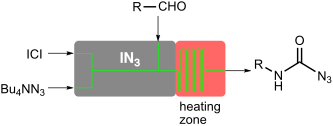
- reaction conditions in microreactors. Keywords: azide; flow chemistry; hazardous reagents; microreactor; rearrangement; Introduction Microstructured devices have already found their way into organic synthesis, because they offer various advantages over traditional large-scale chemistry performed in


Continuous flow based catch and release protocol for the synthesis of α-ketoesters
Beilstein J. Org. Chem. 2009, 5, No. 23, doi:10.3762/bjoc.5.23
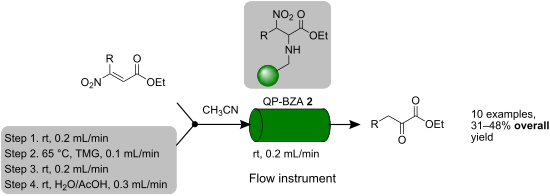
- impacting on the way we assemble molecules. Of these, flow chemistry technologies are becoming especially important [3][4][5][6][7][8][9][10][11][12][13][14]. For many years, our group [15][16][17][18][19][20][21][22] has been focussed on using immobilised systems [23][24][25][26][27][28][29] to more
- -ketoester product 4 by flowing aqueous acetic acid (step 4) through the in-line column. The overall route constitutes a new flow chemistry example of the catch-react-and-release concept that we have used successfully in other synthesis programmes [101][102][103]. The nitroolefinic esters 1 were originally
- Uniqsis FlowSyn™ unit to achieve multi-step organic synthesis under continuous flow-chemistry conditions. This was accomplished by adapting the device to incorporate immobilised reagents packed in flow tubes, enabling clean transformations without recourse to conventional product work-up or purification


Asymmetric reactions in continuous flow
Beilstein J. Org. Chem. 2009, 5, No. 19, doi:10.3762/bjoc.5.19
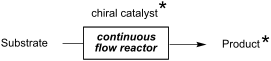
- materials as solid-supports for catalysts and reagents have been found to be particularly well-suited for flow chemistry [34][35][36]. These rigid structures have large surface areas, leading to improved mass-transfer between the supported catalyst with the liquid phase and do not suffer from large pressure


A biphasic oxidation of alcohols to aldehydes and ketones using a simplified packed- bed microreactor
Beilstein J. Org. Chem. 2009, 5, No. 17, doi:10.3762/bjoc.5.17
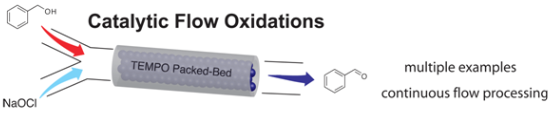
- 100 trials without showing any loss of catalytic activity. Keywords: alcohol oxidation; flow chemistry; heterogeneous catalysis; microreactors; TEMPO; Introduction Microreactors have gained attention because they can help run chemical transformations more efficiently, more selectively, and with a
- functionalized with a range of catalysts and works well as packing material for flow chemistry [39]. In this report, we demonstrate the immobilization of TEMPO and its use in a flow system using the Anelli-Montanari protocol for the oxidation of primary and secondary alcohols [30][40]. Our simplified reactor is




Other Beilstein-Institut Open Science Activities



