


Search results
Search for "olefination" in Full Text gives 150 result(s) in Beilstein Journal of Organic Chemistry.
Alkenes from β-lithiooxyphosphonium ylides generated by trapping α-lithiated terminal epoxides with triphenylphosphine
Beilstein J. Org. Chem. 2012, 8, 1896–1900, doi:10.3762/bjoc.8.219

- access ylides [26], although phosphonium ylides for carbonyl-olefination chemistry are usually prepared by deprotonation of phosphonium salts [1][2][3][4]. In fact, phosphine trapping of lithium carbenoids followed by carbonyl olefination has been little studied since Seyferth and Wittig independently
- their utility in Wittig–Schlosser and SCOOPY-type stereoselective olefination reactions [1][2][3][4][5][6][7][8][9][10][11][12][13][14][15][16][17][18][19]. Here we have shown a new and concise method to such valuable intermediates, directly from readily available terminal epoxides. Significantly, the


A new approach toward the total synthesis of (+)-batzellaside B
Beilstein J. Org. Chem. 2012, 8, 1831–1838, doi:10.3762/bjoc.8.210

- well known [25][26]; however, we selected stereoselective olefination through deprotonation of 10 with LDA followed by the addition of phenylselenyl bromide [27] and subsequent oxidative elimination of the resulting phenylseleno group with m-CPBA according to our previous report [28], which gave E


A Wittig-olefination–Claisen-rearrangement approach to the 3-methylquinoline-4-carbaldehyde synthesis
Beilstein J. Org. Chem. 2012, 8, 1725–1729, doi:10.3762/bjoc.8.197

- important 3-methylquinoline-4-carbaldehydes 6a–h from o-nitrobenzaldehydes 1a–h employing a Wittig-olefination–Claisen-rearrangement protocol. The Wittig reaction of o-nitrobenzaldehydes with crotyloxymethylene triphenylphosphorane afforded crotyl vinyl ethers 2a–h, which on heating under reflux in xylene
- -carbaldehydes 6a–h in excellent yields. Therefore, an efficient method was developed for the preparation of 3-methylquinoline-4-carbaldehydes from o-nitrobenzaldehydes in a simple five-step procedure. Keywords: acetal; Claisen rearrangement; oxidative cleavage; ring-closure; Wittig olefination; Introduction
- method for the synthesis of 3-methylquinoline-4-carbaldehyde. It was considered that a properly substituted 2-(2-nitrophenyl)pent-4-enal [25][26][27] could be a fitting intermediate for this purpose. Such an intermediate is easily accessible through the Wittig-olefination–Claisen-rearrangement protocol


Highly selective synthesis of (E)-alkenyl-(pentafluorosulfanyl)benzenes through Horner–Wadsworth–Emmons reaction
Beilstein J. Org. Chem. 2012, 8, 1185–1190, doi:10.3762/bjoc.8.131
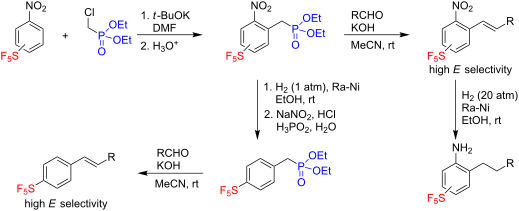
- reaction is a modification of the Wittig olefination in which a phosphoryl-stabilized carbanion reacts with an aldehyde or ketone to form an alkene and a water-soluble phosphate ester [23][24][25]. In general, this reaction preferentially gives more stable E-disubstituted alkenes, although several


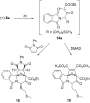
Intramolecular carbenoid ylide forming reactions of 2-diazo-3-keto-4-phthalimidocarboxylic esters derived from methionine and cysteine
Beilstein J. Org. Chem. 2012, 8, 433–440, doi:10.3762/bjoc.8.49
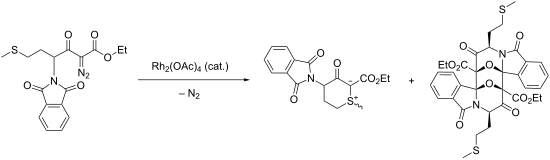
- epoxidation, aziridination and olefination reactions [12][13] are common reaction channels. The intramolecular formation of sulfonium ylides from α-diazocarbonyl compounds tethered with alkylthio or arylthio groups has been studied by the research groups of Davies [14], Moody [15], and West [16]. From α-diazo



Synthesis of fused tricyclic amines unsubstituted at the ring-junction positions by a cascade condensation, cyclization, cycloaddition then decarbonylation strategy
Beilstein J. Org. Chem. 2012, 8, 107–111, doi:10.3762/bjoc.8.11
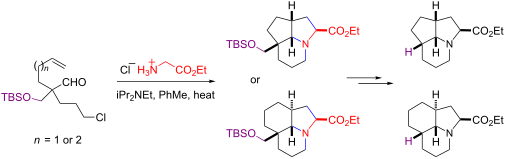
- without the need for protecting groups and to carry out the Wittig reaction at an earlier stage, as shown in Scheme 6. Olefination of aldehyde 6 with the anion formed from methyltriphenylphosphonium bromide gave alkene 17, which was reduced with DIBAL-H to give aldehyde 18. Heating this aldehyde with


Novel fatty acid methyl esters from the actinomycete Micromonospora aurantiaca
Beilstein J. Org. Chem. 2011, 7, 1697–1712, doi:10.3762/bjoc.7.200
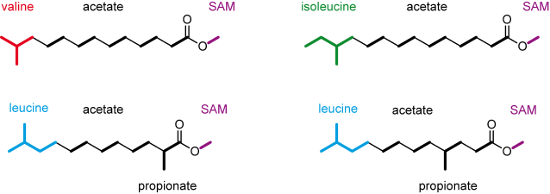
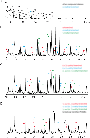
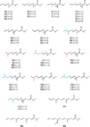
- methyl 4,11-dimethyldodecanoate (110) from 24 by its reduction to the aldehyde 123a, Horner–Wadsworth–Emmons olefination to 124a, and catalytic hydrogenation (Scheme 3). The synthetic material was identical to the natural compound 110. A related group of compounds (Figure 3D, blue) proved to have very
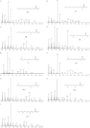
- DIBAH to the aldehyde 123c, Horner–Wadsworth–Emmons olefination to 124c, and final catalytic hydrogenation afforded 112. The product exhibited the same mass spectrum and retention index (I = 1441) as the natural FAME. The slight deviations between the calculated and measured retention indices for



A new phenylethyl alkyl amide from the Ambrostoma quadriimpressum Motschulsky
Beilstein J. Org. Chem. 2011, 7, 1342–1346, doi:10.3762/bjoc.7.158

- chain was accomplished by the selective protection of the hydroxy groups and two-time implementation of the Wittig olefination reaction. Keywords: asymmetric synthesis; beetle; fatty acid amide; isolation; Introduction The leaf beetle Ambrostoma quadriimpressum Motschulsky (Coleoptera: Chrysomelidae
- disconnected into two fragments, 2 and 3. The intermediate fragment 2 would be readily prepared from the commercially available ε-caprolactone. The crucial fragment 3 would be constructed from the intermediate 4 through Wittig olefination. The polyhydroxy compound 4 would be obtained from L-glutamic acid by
- , resulted in the deprotection of the TBDPS group. Alternatively, the alcohol 9 could be obtained by reduction with diisobutylaluminium hydride (Dibal-H) in 86% yield, which was then converted to the corresponding aldehyde 10 by oxidation with PCC. Wittig olefination of aldehyde 10 with n


Toward an integrated route to the vernonia allenes and related sesquiterpenoids
Beilstein J. Org. Chem. 2011, 7, 937–943, doi:10.3762/bjoc.7.104
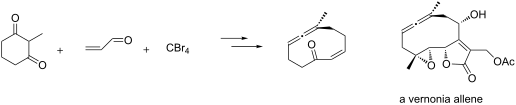
- bromomethyltriphenylphosphonium bromide under these strongly basic conditions, and the poor solubility of reactive species in THF, account for these results [63]. Alternatively, the Z-vinyl bromide 21 was readily obtained via dibromo-olefination of the aldehyde followed by selective removal of the (E)-bromide with n-Bu3SnH and
- -olefination products from diketone aldehyde 19. Computed torsion angles for potential C–C fragmentation substrates.a Supporting Information Supporting Information File 130: General experimental methods and analytical data, 1H and 13C NMR spectra of compounds 18–25 and computed structural coordinates for


Intraannular photoreactions in pseudo-geminally substituted [2.2]paracyclophanes
Beilstein J. Org. Chem. 2011, 7, 658–667, doi:10.3762/bjoc.7.78

- trans,trans-10 by a Wittig olefination, appears to be unstable in the solid state at room temperature, but in the refrigerator at −20 °C or in dilute (~0.1 M) solution in dichloromethane or chloroform it can be stored in the dark for at least 3 months without any detectable decomposition or
- product after 2 h of irradiation with a halogen 1 kW lamp, it appeared to be very unstable even below 0 °C, although it was stable enough for NMR identification. Wittig olefination of the irradiated mixture gave the divinylcyclobutane derivative 14 as the sole product and was isolable by column


The preparation of 3-substituted-1,5-dibromopentanes as precursors to heteracyclohexanes
Beilstein J. Org. Chem. 2011, 7, 386–393, doi:10.3762/bjoc.7.49
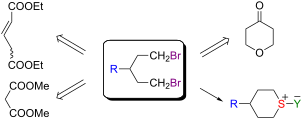
- addition of a Grignard reagent to tetrahydro-4H-pyran-4-one, elimination of water, and hydrogenation of the olefin (Method 2A). Typical yields for Method 2A range from 20–30% [39][40]. The second route is the Wittig olefination of tetrahydro-4H-pyran-4-one followed by hydrogenation (Method 2B). Yields for
- the Wittig olefination of tetrahydro-4H-pyran-4-one range from 35–75% [41][42][43]. The third route (Method 2C) begins from tetrahydropyran-4-carboxylic acid: The acid chloride is reacted with a Grignard reagent, and the resulting ketone reduced under Wolff–Kischner conditions. Typical yields for this
- olefination (Method 2B, Scheme 2). These routes promise the minimal number of steps and ease of chemical transformations. Results Preparation of dibromides Dibromides 1a–1d were prepared in 67–91% yield in refluxing 48% HBr with tributylhexadecylphosphonium bromide [44] as a phase-transfer catalyst either


Rh-Catalyzed rearrangement of vinylcyclopropane to 1,3-diene units attached to N-heterocycles
Beilstein J. Org. Chem. 2011, 7, 298–303, doi:10.3762/bjoc.7.39

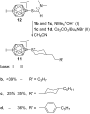
- the construction of other heterocyclic compounds by selective elaboration of the α-oxocyclopropane functionality, for example, to vinylcyclopropane (VCP) by simple Wittig olefination. The rearrangement of VCPs to cyclopentenes and dienes are well known processes [18][19][20][21][22][23][24][25] that
- influence of the N-heterocyclic system on the rearrangement, some model VCPs were generated by Wittig olefination of the α-oxocyclopropane group of functionalized oligocyclic spirocyclopropane-tetrahydropyridones and converted into the corresponding 1,3-dienes by treatment with Rh(PPh3)3Cl. Results and
- File 1 for full experimental data). The two diastereomeric indolizidinones anti-12 and syn-12 are formed by the thermal rearrangement of the cycloadducts anti-(3-t-BuO)-11 and syn-(3-t-BuO)-11, respectively. Wittig olefination of ketones 8, anti-12 and 16 [43] with MePPh3Br/t-BuOK in THF at room


Total synthesis of (±)-coerulescine and (±)-horsfiline
Beilstein J. Org. Chem. 2010, 6, 876–879, doi:10.3762/bjoc.6.103

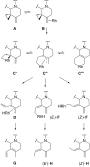
- Mukund G. Kulkarni Attrimuni P. Dhondge Sanjay W. Chavhan Ajit S. Borhade Yunnus B. Shaikh Deekshaputra R. Birhade Mayur P. Desai Nagorao R. Dhatrak Department of Chemistry, University of Pune, Ganeshkhind, Pune-411 007, Maharashtra, India 10.3762/bjoc.6.103 Abstract Wittig olefination–Claisen
- rearrangement protocol was applied to obtain 3-allyl oxindole. This oxindole was then converted to (±)-coerulescine and (±)-horsfiline. Keywords: alkaloids; Claisen rearrangement; Jones oxidation; spiro-oxindole; Wittig olefination; Introduction The spiro[pyrrolidin-3,3′-oxindole] ring system is a widely
- [31], dimethyldioxirane (DMDO) mediated oxidation [32], and by tandem intramolecular photocycloaddition–retro-Mannich reaction [33]. The Wittig olefination–Claisen rearrangement protocol [35] provides a ready access to 4-pentenals, which have served as versatile intermediates for the synthesis of a


Fused bicyclic piperidines and dihydropyridines by dearomatising cyclisation of the enolates of nicotinyl-substituted esters and ketones
Beilstein J. Org. Chem. 2010, 6, No. 22, doi:10.3762/bjoc.6.22
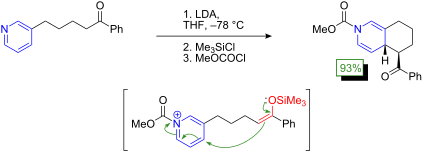
- deficient pyridines in the presence of trimethylsilyl triflate, tetrabutylammonium fluoride or a montmorillonite clay. The cyclisation precursor was synthesised by using the procedure of Hayashi [48] employing a Horner–Wadsworth–Emmons olefination between nicotinaldehyde and phosphonate 10. The resulting


Enantioselective synthesis of tricyclic amino acid derivatives based on a rigid 4-azatricyclo[5.2.1.02,6]decane skeleton
Beilstein J. Org. Chem. 2009, 5, No. 81, doi:10.3762/bjoc.5.81

- oxidation of the alkene rac-13 (Scheme 3), which was available from the ketone rac-9 either by Wittig reaction or by a Tebbe-type olefination [31] using Mg, TiCl4, and CH2Cl2. Hydroboration/oxidation of rac-13 occurred highly diastereoselectively on the exo-side providing the desired endo-alcohol rac-14, as
- , for example with MeO2CCH=PPh3 or MeO2CCH2P(O)(OEt)2/n-BuLi, failed. By contrast, Peterson-type olefination using TMSCH2CO2Et/LDA cleanly afforded the α,β-unsaturated ester 20 as a 77:23 mixture of the E/Z-isomers in 50% yield. The reduction of the conjugated double bond with Mg in methanol furnished


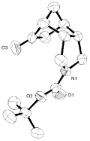


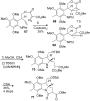
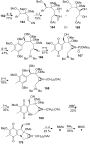
Mitomycins syntheses: a recent update
Beilstein J. Org. Chem. 2009, 5, No. 33, doi:10.3762/bjoc.5.33






Catalytic synthesis of (E)-α,β-unsaturated esters from aldehydes and 1,1-diethoxyethylene
Beilstein J. Org. Chem. 2009, 5, No. 3, doi:10.3762/bjoc.5.3
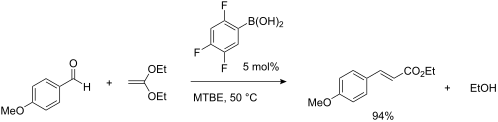
- for catalyst screening. Olefination of different aldehydes. Acknowledgements Generous support from the Max-Planck-Society, and the Fonds der Chemischen Industrie is gratefully acknowledged. R.M. thanks the Ministerio de Ciencia e Innovación for a predoctoral fellowship (FPU).


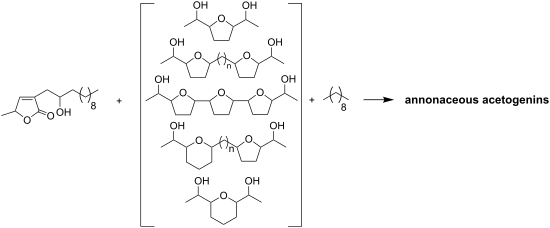
Recent progress on the total synthesis of acetogenins from Annonaceae
Beilstein J. Org. Chem. 2008, 4, No. 48, doi:10.3762/bjoc.4.48


Total synthesis of the indolizidine alkaloid tashiromine
Beilstein J. Org. Chem. 2008, 4, No. 8, doi:10.1186/1860-5397-4-8
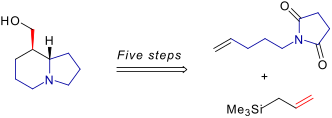
- = OMs). This, in turn, was prepared in four steps by alkylation of an acetylide anion with commercially available iodomethyltrimethylsilane, followed by partial reduction of the alkyne. Alternative synthetic approaches to 4 (X = OMs, I) involve olefination of aldehydes using the Seyferth-Fleming


Combining two-directional synthesis and tandem reactions, part 11: second generation syntheses of (±)-hippodamine and (±)-epi-hippodamine
Beilstein J. Org. Chem. 2008, 4, No. 4, doi:10.1186/1860-5397-4-4
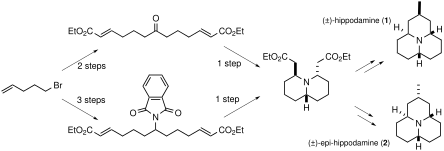
- reaction was preferable, and gave a good 75% yield of the doubly homologated compound 6 after purification by column chromatography. Whilst this process did allow us to produce multigram quantities of 6, this sequence of reactions had the drawbacks that the olefination reaction needed to be carried out


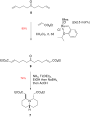
Knorr- Rabe partial reduction of pyrroles: Application to the synthesis of indolizidine alkaloids
Beilstein J. Org. Chem. 2008, 4, No. 3, doi:10.1186/1860-5397-4-3

- reduction with DIBAl-H followed by an in situ Wadsworth-Emmons olefination [18]. The alkene 20 was then hydrogenated to the γ-pyrrolic ester 21 and cyclised to give α-ketopyrrole 18 in 67% overall yield from 19. The modified Knorr-Rabe reduction of 18 gave the desired pyrroline 22 in near quantitative yield


Tether- directed synthesis of highly substituted oxasilacycles via an intramolecular allylation employing allylsilanes
Beilstein J. Org. Chem. 2007, 3, No. 6, doi:10.1186/1860-5397-3-6
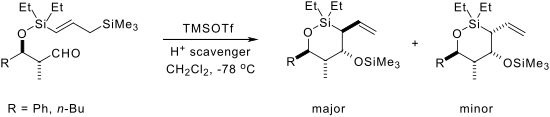
- amount of the corresponding side-product diene syn-13a and syn-13b (the diene may be formed in a variety of ways; we favour a mechanism involving a vinylogous silicon-mediated olefination as this best accounts for the excellent (E)-stereoselectivity observed). [25][26][27] The relative stereochemistry of


Contemporary organosilicon chemistry
Beilstein J. Org. Chem. 2007, 3, No. 4, doi:10.1186/1860-5397-3-4
- . Notwithstanding the earlier, pioneering work of chemists such as Eaborn, 1968 was notable for many innovations we now take for granted, including the development of silyl enol ether chemistry by Stork and Hudrlik, and the eponymous olefination reaction by Peterson. These landmark papers triggered a massive growth
An efficient synthesis of tetramic acid derivatives with extended conjugation from L-Ascorbic Acid
Beilstein J. Org. Chem. 2006, 2, No. 24, doi:10.1186/1860-5397-2-24

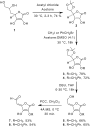
- aldehydes. Wittig olefination followed by reaction of the resulting tetranolactonyl dienyl esters with different amines resulted in the respective 5-hydroxy lactams. Subsequent dehydration of the hydroxy lactams with p-toluene sulphonic acid afforded the dienyl tetramic acid derivatives. All reactions were
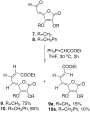
- compounds were determined on the basis of their spectroscopic data (Supporting Information File 1). Wittig olefination of aldehydes 7 and 8 with carbethoxymethylene triphenylphosphorane in THF at ambient temperature led to the formation of the respective exo-dienyl esters of the tetronolactones as a mixture
- studies. In such an earlier study, [37] with BuLi at -78°C used as the base for the Wittig olefination, lower yields and poor stereoselection was observed as compared to our uncatalysed ambient temperature reaction where ZZ isomers were predominantly formed. The Z configuration of the allylic alcohol was



Synthesis of highly substituted allenylsilanes by alkylidenation of silylketenes
Beilstein J. Org. Chem. 2005, 1, No. 5, doi:10.1186/1860-5397-1-5
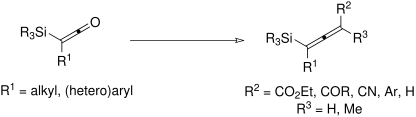
- allenylsilane product. We have not as yet examined the use of the more reactive Tebbe reagent which may function effectively at lower temperatures and hence offer a solution to this current limitation. Additionally, it will be of future interest to investigate the chromium-based Takai procedures for olefination





