Search results
Search for "optical properties" in Full Text gives 160 result(s) in Beilstein Journal of Organic Chemistry.
New palladium–oxazoline complexes: Synthesis and evaluation of the optical properties and the catalytic power during the oxidation of textile dyes
Beilstein J. Org. Chem. 2015, 11, 1175–1186, doi:10.3762/bjoc.11.132
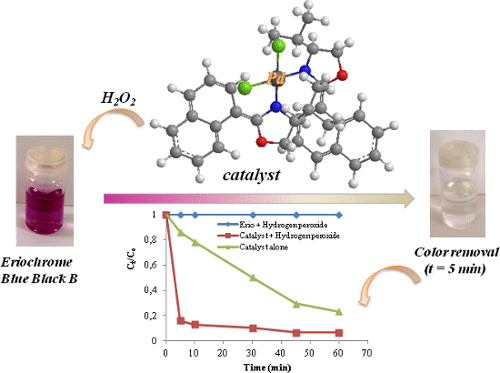
- %). The oxazolines were prepared from enantiomerically pure α-aminoalcohols. The structures of the synthesized palladium complexes were confirmed by NMR, FTIR, TOFMS, UV–visible spectroscopic analysis and X–ray diffraction. The optical properties of the complexes were evaluated by the determination of the
- determined. Keywords: aminoalcohols; catalysis; dye decolorization; optical properties; oxazolines; palladium complexes; Introduction Palladium complexes have been used as starting materials to prepare polymers [1], agrochemicals [2], pharmaceuticals [3], flavors and fragrances [4]. They have also been
- PdII ions, leading to the adsorption of dyes. Moreover, the decolorization of the solution by Pd and Pd complexes has also been applied [23]. In this paper, we report the synthesis and characterization of some new palladacycles. Optical properties were determined and the catalytic activity of these


Thiazole-induced rigidification in substituted dithieno-tetrathiafulvalene: the effect of planarisation on charge transport properties
Beilstein J. Org. Chem. 2015, 11, 1148–1154, doi:10.3762/bjoc.11.129
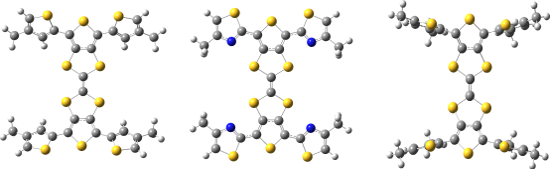
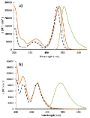
- incomplete reaction of all the bromine atoms), and this is attributed to the increased solubility of the intermediates, which in turn increases their statistical likelihood of reacting further. Optical and electrochemical properties The optical properties of TTFs 1 and 2 were analysed by solution state UV



Glycoluril–tetrathiafulvalene molecular clips: on the influence of electronic and spatial properties for binding neutral accepting guests
Beilstein J. Org. Chem. 2015, 11, 1023–1036, doi:10.3762/bjoc.11.115
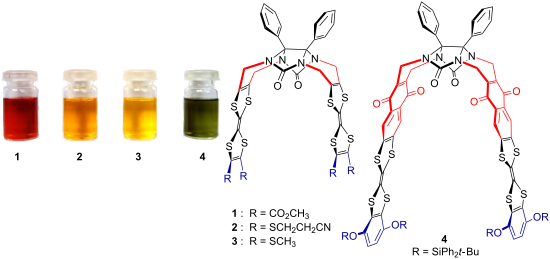
- supports the graphical representation of the stepwise oxidation of molecular clips 1, 2 and 3 (Scheme 3). Optical and spectroelectrochemical properties The optical properties of oxidized states of molecular clip 1 were monitored by UV–vis–NIR spectroscopy, by successive aliquot addition of NOSbF6 (5 × 10⁻³




Discrete multiporphyrin pseudorotaxane assemblies from di- and tetravalent porphyrin building blocks
Beilstein J. Org. Chem. 2015, 11, 748–762, doi:10.3762/bjoc.11.85
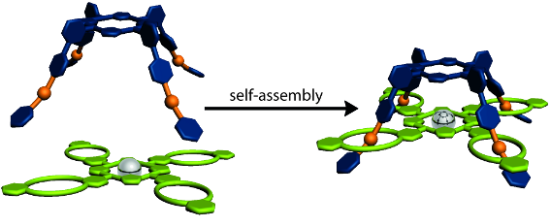
- being a mere spacer and scaffold connecting the binding sites, porphyrins also offer interesting physical and optical properties [51][52]. Therefore, they have played a pivotal role in supramolecular chemistry [53][54][55][56][57][58][59][60][61][62][63][64][65][66], for example as potential candidates





Design, synthesis and photochemical properties of the first examples of iminosugar clusters based on fluorescent cores
Beilstein J. Org. Chem. 2015, 11, 659–667, doi:10.3762/bjoc.11.74
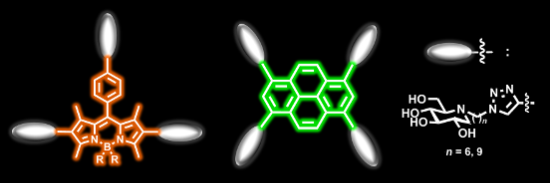
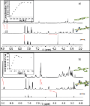
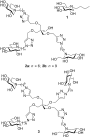
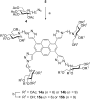
- state. In addition, they can be easily derivatized [31][32][33][34][35][36][37]. If the optical properties of BODIPY are very sensitive to modification of the pyrrole core [38][39], they are less sensitive to the substitution of the central pseudo meso position [40][41]. Additionally, the fluorine



Trifluoromethyl-substituted tetrathiafulvalenes
Beilstein J. Org. Chem. 2015, 11, 647–658, doi:10.3762/bjoc.11.73
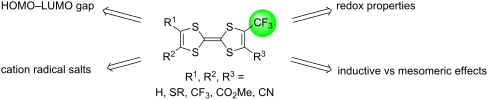
- derivatives described here is shown in Figure 1 and demonstrates that the trifluoromethyl group anodic shift observed in the order CO2Me < CF3 < CN correlate well with the σmeta Hammet constant. Optical properties The evolution of the lowest energy absorption bands is also reported for the different TTF
- introduced on the dithiole ring upon substitution with the CN and CO2Me (−M) EWG are not offset by the competing CF3 group, confirming its much weaker mesomeric effect on the conjugated dithiole core. Optical properties and theoretical calculations have shown that the HOMO–LUMO gap is not much modified in




Photocatalytic nucleophilic addition of alcohols to styrenes in Markovnikov and anti-Markovnikov orientation
Beilstein J. Org. Chem. 2015, 11, 568–575, doi:10.3762/bjoc.11.62
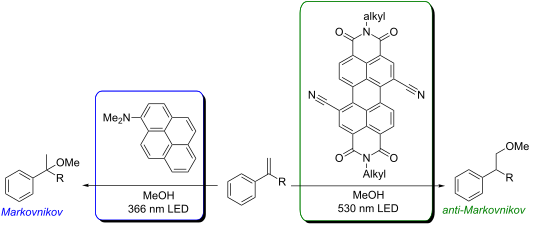
- photocatalytic process was used also for intramolecular additions. For the oxidative mode towards the anti-Markovnikov-type regioselectivety, PDI was a highly suitable photocatalyst based on its electrochemical and optical properties. Photocatalytic additions of a variety of alcohols to styrene derivatives gave


Synthesis and chemosensing properties of cinnoline-containing poly(arylene ethynylene)s
Beilstein J. Org. Chem. 2015, 11, 373–384, doi:10.3762/bjoc.11.43

- Optical sensors provide an efficient and sensitive approach for the rapid detection and identification of a wide range of chemical substrates by measuring the changes of optical properties such as absorbance, reflectance, luminescence, or fluorescence [1]. Among them a type of sensors based on conjugated
- connects head-to-tail oriented cinnoline units (orange–purple) the additional splitting was observed (for zoom copies of NMR spectra see Supporting Information File 2). Optical properties and metal-sensing ability of cinnoline-containing PAEs The absorption spectrum in the UV–vis range of THF solutions of
- the cinnoline ring means that the conjugation extension in the repeating unit that comes from the triple bond is more important for the collective quenching effect than the degree of polymerization. In order to prove that the observed changes in optical properties of PAEs 10a,b were induced by Pd2


IR and electrochemical synthesis and characterization of thin films of PEDOT grown on platinum single crystal electrodes in [EMMIM]Tf2N ionic liquid
Beilstein J. Org. Chem. 2015, 11, 348–357, doi:10.3762/bjoc.11.40
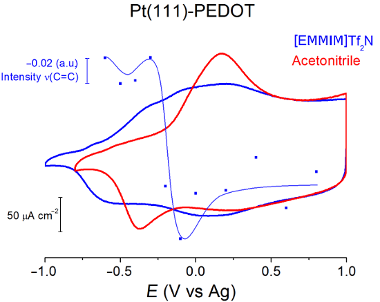
- reaction of PEDOT were studied using in situ FTIR spectroscopy. Keywords: AFM; [EMMIM]Tf2N ionic liquid; in situ IR; PEDOT; Pt single crystals; Introduction Conducting polymers have been subject of an intense research during the last decades because they exhibit high conductivity and interesting optical
- properties. These properties allow their use in several electronic devices [1][2]. The poly(3,4-ethylenedioxythiophene) (PEDOT) is one of the most conducting and stable (thermal and chemical) conducting polymer. For these reasons PEDOT thin films have been extensively studied [3]. Special attention has been




Functionalized branched EDOT-terthiophene copolymer films by electropolymerization and post-polymerization “click”-reactions
Beilstein J. Org. Chem. 2015, 11, 335–347, doi:10.3762/bjoc.11.39
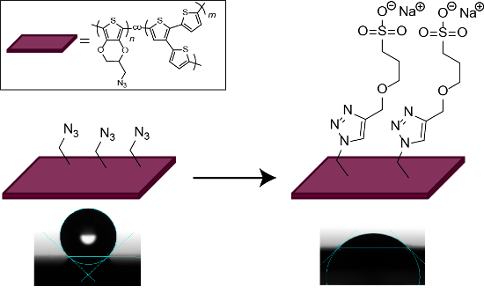
- broad spectral shapes with maxima around 530 nm. From the spectra of the neutral compounds a clear distinction between the copolymer and the blend is not possible. Monitoring the optical properties during the electrochemical oxidation process by in situ spectroelectrochemistry, however, gives further






Come-back of phenanthridine and phenanthridinium derivatives in the 21st century
Beilstein J. Org. Chem. 2014, 10, 2930–2954, doi:10.3762/bjoc.10.312

- fluorescence change in the complex with DNA, while two amino groups in 3,8-position result in a weak fluorescence with strong emission increase upon DNA binding [52][53][56]. A pronounced influence of the substituent at phenanthridine position 6 on the optical properties of the chromophore also had significant




Synthesis and properties of novel star-shaped oligofluorene conjugated systems with BODIPY cores
Beilstein J. Org. Chem. 2014, 10, 2704–2714, doi:10.3762/bjoc.10.285

- molecular bromine which was used previously [33]. Thermal, electrochemical and optical properties TGA and DSC analyses All of the final target compounds showed good thermal stability. Thermogravimetric analysis (TGA) revealed decomposition temperatures in the range 396–442 °C (Table 1, Figure S1, Supporting
- levels for both families are similar, whereas, in general, the LUMO levels of the Y-Bn family are lower, leading to narrower electrochemical HOMO–LUMO gaps. Optical properties The optical properties of the oligomers were studied in dichloromethane solutions. An image of toluene solutions of both families
- under ambient conditions and UV-illumination is presented in Figure 2. The effect of the substitution pattern of the BODIPY core with fluorene arms (either at the α- or β-positions) on the optical properties of the materials can be observed with the naked eye. The compounds of the Y-Bn (n = 1–4) series



Solution processable diketopyrrolopyrrole (DPP) cored small molecules with BODIPY end groups as novel donors for organic solar cells
Beilstein J. Org. Chem. 2014, 10, 2683–2695, doi:10.3762/bjoc.10.283
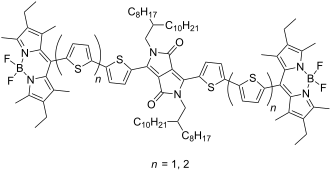
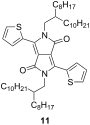
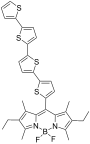
- . Electrochemical and optical properties The oxidation and reduction processes of 9 and 10 in solution are shown in Figure 2 and Table 1 summarises the corresponding electrochemical data. Upon oxidation, 9 shows two reversible peaks at +0.42 and +0.73 V and 10 shows three reversible processes at +0.37, +0.57 and
- expected to obtain a lower HOMO–LUMO energy gap value for 10. On the contrary, compound 9 displays a slightly lower energy gap both in solution and in the solid state. This difference is unusual for a system with extended conjugation and is addressed later. The optical properties of compounds 9 and 10 were




Host–guest-driven color change in water: influence of cyclodextrin on the structure of a copper complex of poly((4-hydroxy-3-(pyridin-3-yldiazenyl)phenethyl)methacrylamide-co-dimethylacrylamide)
Beilstein J. Org. Chem. 2014, 10, 2480–2483, doi:10.3762/bjoc.10.259
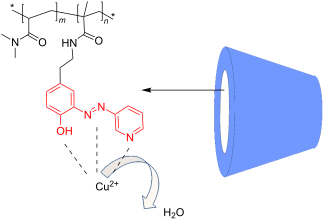
- studied extensively, causing for example a blue to red color transition of polydiacetylenes (PDAS) due to the formation of inclusion complexes [6][7]. Azo dyes, with their remarkable ability to form stable azo–metal chelate complexes with outstanding thermal and optical properties have been studied widely


Synthesis and optical properties of pyrrolidinyl peptide nucleic acid carrying a clicked Nile red label
Beilstein J. Org. Chem. 2014, 10, 2166–2174, doi:10.3762/bjoc.10.224
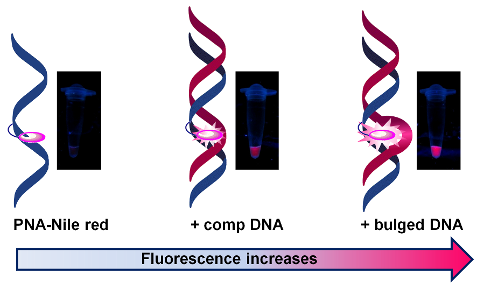
- , pyrrolidinyl peptide nucleic acid (acpcPNA) was labeled at its backbone with Nile red, a solvatochromic benzophenoxazine dye, by means of click chemistry. The optical properties of the Nile red-labeled acpcPNA were investigated by UV–vis and fluorescence spectroscopy in the absence and in the presence of DNA
- . Melting temperature data and optical properties of the Nile red-labeled acpcPNAs and their hybrids with various DNA are summarized in Table 2. Thermal denaturation experiments suggest that the Nile red-labeled acpcPNA 10mer-Nr can form a stable hybrid with complementary DNA. In contrast to some other
- addition of cyclodextrin, which indicates possible interactions between the groove-bound Nile red and cyclodextrin. To better understand the effect of neighboring bases on the optical properties of the Nile red-labeled acpcPNA and its duplexes with DNA, four Nile red-labeled acpcPNA sequences (11merAA-Nr


The effect of permodified cyclodextrins encapsulation on the photophysical properties of a polyfluorene with randomly distributed electron-donor and rotaxane electron-acceptor units
Beilstein J. Org. Chem. 2014, 10, 2145–2156, doi:10.3762/bjoc.10.222
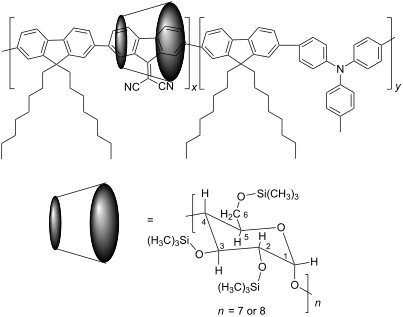
- used to synthesize copolymers with smaller electrochemical and optical band gaps, so that materials with improved electronic and optical properties can be obtained [17]. The construction of mechanically interlocked molecules such as rotaxanes and polyrotaxanes with native cyclodextrins (CDs) as
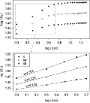
- polyrotaxanes. The roughness exponent α calculated as the slope of log(Sq) versus log(Lsc) for the reference 4, 4a and 4b polyrotaxanes. Molecular weight (Mn in g∙mol−1), polydispersity index (Mw/Mn), coverage ratio, and thermal properties of the copolymers. Optical properties of copolymers. The redox


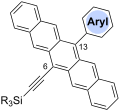
Aryl substitution of pentacenes
Beilstein J. Org. Chem. 2014, 10, 1692–1705, doi:10.3762/bjoc.10.178
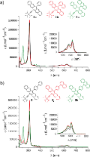
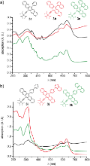
- nucleophilic addition (yields given are for the pentacene product 3, over the two steps from either 4a or 4b). Functionalization of iodoaryl pentacene 3g using the Suzuki–Miyaura cross-coupling reaction. Optical properties of pentacenes 3a–k, unsubstituted pentacene (PEN), and TIPSPc. Thermal properties of a




Synthesis of new, highly luminescent bis(2,2’-bithiophen-5-yl) substituted 1,3,4-oxadiazole, 1,3,4-thiadiazole and 1,2,4-triazole
Beilstein J. Org. Chem. 2014, 10, 1596–1602, doi:10.3762/bjoc.10.165

- their extended conjugation and frequently have to be rendered soluble by introducing long alkyl- or alkoxy-type side substituents. This functionalisation opens up an additional route to modifying their redox, electronic and optical properties by using side substituents with different electron accepting
- ]-1,3,4-oxadiazole [16]. Similarly, the position of the substitution with solubilising groups and the length of the side chains lead to a significant change of the quantum yield [11]. The effect of the central ring nature on the optical properties of 13–15 and 18 is clearly observed. In Figure 2


Synthesis and spectroscopic properties of 4-amino-1,8-naphthalimide derivatives involving the carboxylic group: a new molecular probe for ZnO nanoparticles with unusual fluorescence features
Beilstein J. Org. Chem. 2013, 9, 1311–1318, doi:10.3762/bjoc.9.147

- addition of ZnO NPs (solid curve). Excitation wavelength: 325 nm. The inset shows the same normalized spectra. Synthesis and structures of 1,8-naphthalimides. Possible ionization and complexation of 4 in ethanol. Optical properties of derivatives 1–4, 6 in ethanol. Solvent-dependent optical properties of


Superstructures of fluorescent cyclodextrin via click-reaction
Beilstein J. Org. Chem. 2013, 9, 827–831, doi:10.3762/bjoc.9.94
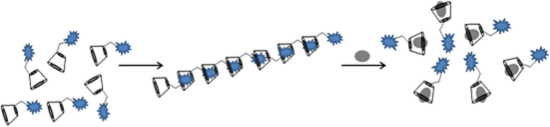
- fluorescent nature [1][2]. These optical properties can be used for the development of sensor molecules, blue emitting dyes, luminescent materials or as donor–(π-conjugated-bridge)–acceptor-type dyes in dye-sensitized solar cells [3][4][5]. The etherification of 4-hydroxythiazole by using propargyl bromide


Spin state switching in iron coordination compounds
Beilstein J. Org. Chem. 2013, 9, 342–391, doi:10.3762/bjoc.9.39
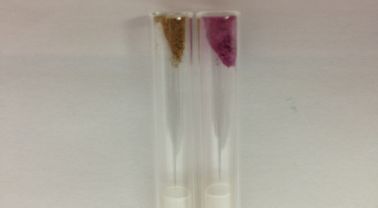
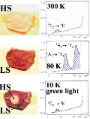
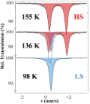
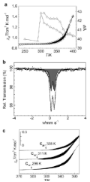
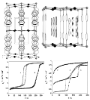
- exhibit thermally induced spin transition, known as spin crossover, depending on the nature of the coordinating ligand sphere. Spin transition in such compounds also occurs under pressure and irradiation with light. The spin states involved have different magnetic and optical properties suitable for their




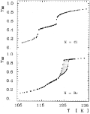

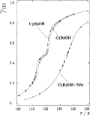


![[Graphic 1]](/bjoc/content/inline/1860-5397-9-39-i3.png?max-width=637&scale=1.18182) ) modes versus the anion volu...
) modes versus the anion volu...






Synthesis and characterization of low-molecular-weight π-conjugated polymers covered by persilylated β-cyclodextrin
Beilstein J. Org. Chem. 2012, 8, 1505–1514, doi:10.3762/bjoc.8.170
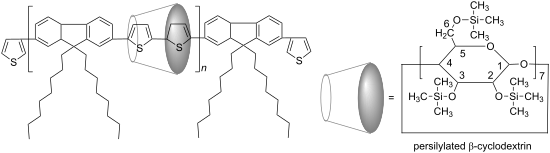
- polymeric architectures. Moreover, the fabrication of mechanically interlocked molecules, such as polyrotaxanes, has been investigated as a method for the further improvement of thermal and electro-optical properties through the insulating backbones of conjugated polymers [20][21][22][23][24]. The studies
- reduced interchain interactions, which allow the polyrotaxane chains to pack densely. A better quality of the film, with higher uniformity, flatness, and better mechanical properties, is always desirable for optoelectronic applications. The optical properties of the PDOF-BT and PDOF-BTc compounds (not



Recent advances towards azobenzene-based light-driven real-time information-transmitting materials
Beilstein J. Org. Chem. 2012, 8, 1003–1017, doi:10.3762/bjoc.8.113
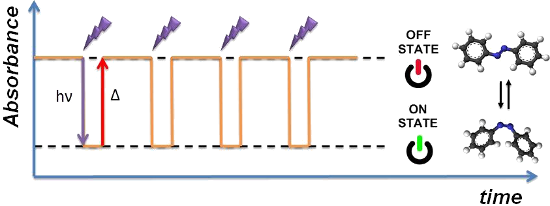
- information beyond the time scale of microseconds, as well as to produce molecular materials with high oscillation frequencies in their optical properties. In addition, the possible design of such materials in such a way that they would be soluble in water (an environmentally friendly solvent) could be a







Diarylethene-modified nucleotides for switching optical properties in DNA
Beilstein J. Org. Chem. 2012, 8, 905–914, doi:10.3762/bjoc.8.103
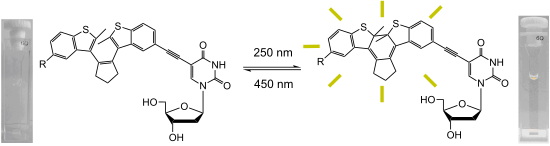
- switching of optical properties in DNA can be achieved selectively at 310 nm (forward) and 450 nm (backward); both wavelengths are outside the normal nucleic acid absorption range. Moreover, this nucleoside was proven to be photochemically stable and allows switching back and forth several times. These
- . Diarylethenes have been applied in a noncovalent chiroptical photoswitchable DNA complex [33] and combined with 7-deazaadenosine to obtain a nucleosidic diarylethene switch [34]. Recently, we reported, very preliminarily, the preparation and optical properties of nucleoside 4 [30]. Herein, we give a full
- intermediate 16 yielding phosphoramidite 17. By automated DNA synthesis on a solid phase we prepared a set of four oligonucleotides in order to report preliminarily the optical properties of 4 in DNA. The sequences were identical except for the base pairs that surround the position of nucleoside 4. The




Synthesis and characterization of a novel carboxyl group containing (co)polyimide with sulfur in the polymer backbone
Beilstein J. Org. Chem. 2012, 8, 776–786, doi:10.3762/bjoc.8.88

- area of separation processes or optical applications, due to their excellent mechanical-, thermal- and optical properties, their superior processability and the ability to adapt their properties to a wide range of special applications. Therefore, two series of novel (co)polyimides containing
- air leading to a change in optical properties, which often causes undesired optical aberrations [9]. It has been shown that cross-linking can significantly inhibit swelling phenomena in membranes prepared from DABA (3,5-diaminobenzoic acid) functionalized (co)polyimides [10][11][12]. This approach is
- -containing (co)polyimides. These (co)polyimides, which were synthesized from a combination of different monomers with special properties, show excellent solubilities, very low water sorptions, and very good optical properties, making them highly attractive for optical applications. Results and Discussion