


Search results
Search for "oxime" in Full Text gives 141 result(s) in Beilstein Journal of Organic Chemistry.
Approaches to α-amino acids via rearrangement to electron-deficient nitrogen: Beckmann and Hofmann rearrangements of appropriate carboxyl-protected substrates
Beilstein J. Org. Chem. 2012, 8, 1393–1399, doi:10.3762/bjoc.8.161

- ), their carboxyl groups being masked as a 2,4,10-trioxaadamantane unit (an orthoacetate). The oxime mesylates have been rearranged with basic Al2O3 in refluxing CHCl3, and the malonamic acids with phenyliodoso acetate and KOH/MeOH. Both routes are characterized by excellent overall yields. Structure
- 3a and the corresponding amide product 5a by X-ray diffraction measurements (Figure 1 and Table 2) [18]. The observed oxime stereochemistry (Z) is possibly due to (putative) steric repulsion between the two bulky α-substituents (R and trioxaadamantyl) and the hydroxy group in the alternative E isomer
- . Oximation of 2 to 3. Alkylketones 2 were converted to the corresponding oximes 3 with NH2OH·HCl-pyridine by standard procedures [26] and purified by crystallization (solids). Oxime methanesulfonates 4. Oximes 3 (1.0 mmol) in CH2Cl2 (3.0 mL) were cooled to −10 °C and treated with Et3N (1.2 mmol) followed by


Screening of ligands for the Ullmann synthesis of electron-rich diaryl ethers
Beilstein J. Org. Chem. 2012, 8, 1105–1111, doi:10.3762/bjoc.8.122

- , phosphinites, phosphonates, imines, diimines, oximes, oxime ethers and diketones were selected for the screening (Figure 2). Several of these compounds have been employed in diaryl ether syntheses before [22][23][24]. As a starting point, N,N-dimethylglycine (L1) introduced by Ma et al. [22][25] in combination
- screening, as can be seen by comparison of L28, L32, and L33. Furthermore, oxime ethers, which, to the best of our knowledge, represent a new class of ligands for Ullmann-type couplings, were also screened in the model reaction. All tested oxime ethers and oximes showed catalytic activity, although the
- substrate conversion was lower compared to the amino acid-derived ligands. The catalytic activities of the oximes did not, however, differ from those of the oxime ethers. On the other hand, the salicyl aldehyde-derived oxime ether and oxime ligands [31] showed only poor substrate conversions in comparison


Multistep organic synthesis of modular photosystems
Beilstein J. Org. Chem. 2012, 8, 897–904, doi:10.3762/bjoc.8.102
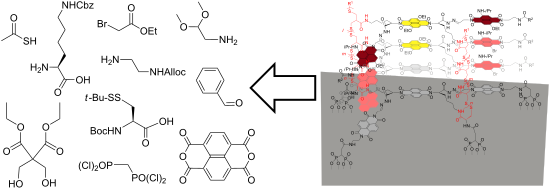
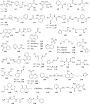
- (Scheme 5). The chemoorthogonality of disulfide and hydrazone exchange has been demonstrated previously by several groups [28][29][30][31]. Benzaldehyde removal as oxime was followed by HPLC. The hydrazide-rich pores produced in the resulting architecture 52 were first filled by reversible covalent
- continuing SOSIP. The obtained ladderphane 50 is then treated with propagator 4. Ring-opening disulfide exchange SOSIP via intermediates 56 leads to photosystem 51 with a two-component redox gradient in the π-stack. Post-SOSIP stack exchange is then initiated by benzaldehyde removal as oxime 57. The giant
- pores drilled into photosystem 52 are first filled completely with red cNDI 5. Subsequently, the partial removal of the new stack in photosystem 53 as oxime 58 and covalent capture of 6 in the more shallow pores in photosystem 54 affords the desired double-gradient photosystem 1. Conclusion The


Aryl nitrile oxide cycloaddition reactions in the presence of pinacol boronic acid ester
Beilstein J. Org. Chem. 2012, 8, 606–612, doi:10.3762/bjoc.8.67
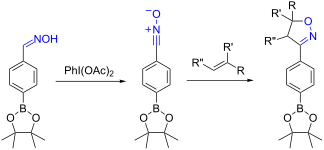
- (PFK) as the reference compound. Accurate masses were measured on the 11B ions. (Z)-4-(4,4,5,5-tetramethyl-1,3,2-dioxaborolan-2-yl)benzaldehyde oxime (5): To a stirred solution of 4-formylphenylboronic acid pinacol ester 4 (100 g, 0.43 mol) in diethyl ether (400 mL) was added 50% hydroxylamine in H2O
- -tetramethyl-1,3,2-dioxaborolan-2-yl)benzaldehyde oxime (5) (125 mg, 0.5 mmol) in methanol (3 mL), dropwise over 10 min followed by three drops of trifluoroacetic acid. The pale yellow solution was allowed to warm to room temperature and stirred for 2 h then concentrated under reduced pressure. The residue was
- . Acknowledgements The authors wish to thank Dr Roger Mulder of CSIRO for NMR assistance, and Mr Daniel Marcuccio of Advanced Molecular Technologies for a sample of 4-(4,4,5,5-tetramethyl-1,3,2-dioxaborolan-2-yl)benzaldehyde oxime.


Synthesis of heteroglycoclusters by using orthogonal chemoselective ligations
Beilstein J. Org. Chem. 2012, 8, 421–427, doi:10.3762/bjoc.8.47
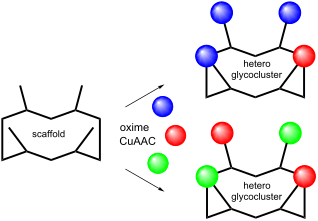
- combinations of carbohydrates. By using both oxime ligation and copper(I)-catalyzed alkyne–azide cycloaddition, two series of compounds bearing binary combinations of αMan, αFuc or βLac in an overall tetravalent presentation, and either 2:2 or 3:1 relative proportions, have been prepared. Keywords
- : chemoselective ligation; click chemistry; cyclopeptide; heteroglycocluster; oxime; Introduction Multivalent interactions between carbohydrates and proteins play key roles in diverse biological events, including fertilization, cell–cell communication, host–pathogen interactions, immune response and cancer
- methods, we decided to explore two chemoselective strategies to achieve this purpose. We first selected the oxime ligation since we have previously used this approach successfully for the preparation of sophisticated molecular systems, such as synthetic vaccines [27][28], immunomodulators [29], lectin



Highly efficient cyclosarin degradation mediated by a β-cyclodextrin derivative containing an oxime-derived substituent
Beilstein J. Org. Chem. 2011, 7, 1543–1554, doi:10.3762/bjoc.7.182
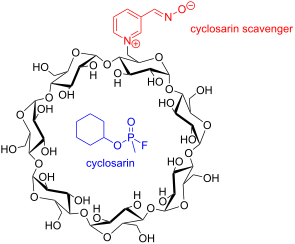
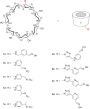
- derivatives with a substituent along the wider rim of the cavity, bearing a nucleophilic group in the form of an iodosylbenzoate [23][24][25] or an oxime [26], efficiently react with paraoxon, cyclosarin (GF), and tabun thus reducing the inhibitory effects of these OPs on the key target of OP toxicity
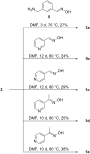
- nucleophile then afforded the functionalized products (Scheme 3, route A). Compound 1a was prepared by the reaction of 3 with 3-(aminomethyl)benzaldehyde oxime (5) (Scheme 4), the latter of which was synthesized from isophtalaldehyde, as shown in Scheme 5. Compounds 1b–e were obtained from 3 and the
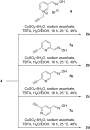
- corresponding pyridine aldoximes or ketoximes (Scheme 4) all of which are easily accessible from the commercially available aldehydes or ketones by reaction with hydroxylamine [32]. Attempts to also prepare the analogous derivative with the oxime group in the 2-position of the pyridinium ring, by reaction of 3







Recent advances in the gold-catalyzed additions to C–C multiple bonds
Beilstein J. Org. Chem. 2011, 7, 897–936, doi:10.3762/bjoc.7.103
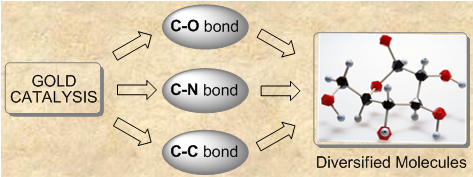
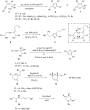
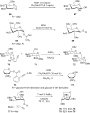
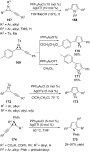
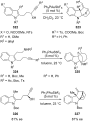
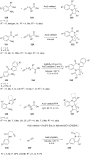
- arylidene group transfer were developed as a method for the preparation of 4-arylidene isoxazol-5(4H)-ones [62]. For example, (E)-benzaldehyde O-3-phenylpropioloyl oxime 132 was reacted in acetonitrile at 25 °C in the presence of AuPPh3NTf2 (5 mol %) to give 4-benzylidene-3-phenylisoxazol-5(4H)-one 133 in
- -arylhydroxylamines with 1,3-dicarbonyl compounds in situ) to give 3-carbonylated benzofuran derivatives 300 [153]. Trisubstituted isoxazoles 303 were obtained from alkynyl oxime ether 301 through a gold-catalyzed domino reaction involving cyclization and subsequent Claisen-type rearrangement [154]. The presence of












Gold-catalyzed propargylic substitutions: Scope and synthetic developments
Beilstein J. Org. Chem. 2011, 7, 866–877, doi:10.3762/bjoc.7.99

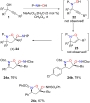
- and oxime cyclization gave, in a one-pot sequence, the corresponding isoxazoles 40 in good yields (Scheme 20) [86]. Conclusion In conclusion, we have developed gold(III)-catalyzed direct propargylic (allylic, benzylic) substitutions which have proved efficient with a great number of nucleophiles under




An overview of the key routes to the best selling 5-membered ring heterocyclic pharmaceuticals
Beilstein J. Org. Chem. 2011, 7, 442–495, doi:10.3762/bjoc.7.57
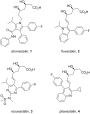
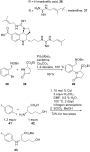
- ] (Figure 3). Structurally, this medication consists of a complex pyrrole-substituted 2-indolinone core which can be prepared by a late stage aldol condensation between a 2-indolinone fragment 42 with the corresponding pyrrole aldehyde 41 (Scheme 7). The oxime functionality in compound 38, which is obtained
- oxime 38 under reductive conditions. Deprotection and decarboxylation of the remaining tert-butyl ester produces the desired pyrrole intermediate, which upon treatment with Vilsmeier reagent undergoes a formal acylation. This product is not isolated but reacted directly with 41 in an aldol condensation







Palladium- and copper-mediated N-aryl bond formation reactions for the synthesis of biological active compounds
Beilstein J. Org. Chem. 2011, 7, 59–74, doi:10.3762/bjoc.7.10

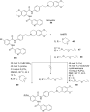
- -carboxylate (39) and 2-bromobenzaldehyde O-benzyl oxime (38), and only a moderate yield (53%) using CuI [59]. Targeting the same product, Ma et al. used copper catalysis some years previously. The coupling of 1,4-diiodobenzene (41) and (S)-ethyl 3-amino-6-hydroxyhexanoate (42), and subsequent esterification




A surprising new route to 4-nitro-3-phenylisoxazole
Beilstein J. Org. Chem. 2010, 6, No. 68, doi:10.3762/bjoc.6.68

- include the reaction of aromatic α,β-unsaturated aldehydes with dinitrogen trioxide [11][12], the nitration of 3-phenyl-isoxazole [13][14], and the hydrolysis of methyl 4-nitro-3-phenyl-5-carboxylate, obtained by reaction of α-nitroacetophenone oxime and methoxalyl chloride [15]. In conclusion, a very


Mitomycins syntheses: a recent update
Beilstein J. Org. Chem. 2009, 5, No. 33, doi:10.3762/bjoc.5.33

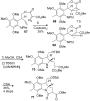
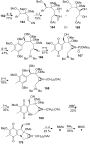
- activity [136]. Starting with the tricyclic ketone 181 [137][138] a low yielding bromination reaction was undertaken followed by an acetate displacement of the resulting α-bromoketone to give 182 (Scheme 50). The amine was introduced by formation of an oxime followed by catalytic hydrogenation in the






The role of an aromatic group in remote chiral induction during conjugate addition of α-sulfonylallylic carbanions to ethyl crotonate
Beilstein J. Org. Chem. 2008, 4, No. 32, doi:10.3762/bjoc.4.32

- for orthogonality between the planar function and the aromatic nucleus in the nitrogen derivatives of 9-acylanthracenes has been corroborated spectroscopically (lack of conjugation in the semicarbazide and the oxime). Furthermore, steric hindrance to attack at the cyano group of anthracene-9


Sordarin, an antifungal agent with a unique mode of action
Beilstein J. Org. Chem. 2008, 4, No. 31, doi:10.3762/bjoc.4.31

- abovementioned pathogens with respect to the first GM generation. Toxicity studies on mammalian (including human) cell lines revealed a lower in vitro toxicity than the clinically used compound, amphotericin B. Oxime 57, isoxazoline 58 and isoxazole 59 derivatives were prepared in the Bristol-Myers Squibb


Synthesis of 2-substituted 9-oxa-guanines {5-aminooxazolo[5,4-d]pyrimidin- 7(6H)-ones} and 9-oxa-2-thio- xanthines {5-mercaptooxazolo[5,4-d]pyrimidin- 7(6H)-ones}
Beilstein J. Org. Chem. 2008, 4, No. 26, doi:10.3762/bjoc.4.26

- prepared from the (acylamino)cyanoacetates 5b,c, which in turn were derived from ethyl cyanoglyoxylate oxime (4) by reduction followed by acylation by isobutyric anhydride or azidoacetyl chloride (Figure 3). Reaction of the aminooxazoles 3b,c with benzoylisothiocyanate afforded the thioureas 6b,c. Direct


Novel base catalysed rearrangement of sultone oximes to 1,2-benzisoxazole- 3-methane sulfonate derivatives
Beilstein J. Org. Chem. 2007, 3, No. 20, doi:10.1186/1860-5397-3-20

- from the spectral data and physical properties (Table 2). Although conversion of sultone oxime 5 into 3-alkyl-1,2-benzisoxazole derivatives [2][3] proved to be difficult using NaOH and KOH under different conditions, it was found that the rearrangement proceeded smoothly with either NaOH in ethylene





