


Search results
Search for "small molecules" in Full Text gives 240 result(s) in Beilstein Journal of Organic Chemistry. Showing first 200.
On the design principles of peptide–drug conjugates for targeted drug delivery to the malignant tumor site
Beilstein J. Org. Chem. 2018, 14, 930–954, doi:10.3762/bjoc.14.80
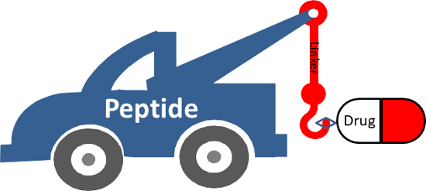
- PDCs that have been developed utilizing peptides as tumor targeting elements that selectively bind to specific receptors and small molecules as anticancer agents that have reached phase III clinical trials (Table 3) for the treatment of various types of cancer. ClinicalTrials.gov have also announced
- are other types of PDCs that do not consist of peptides as targeting moieties and small molecules as drugs and have reached even up to phase III clinical trials. These PDCs are summarized in Table 4. Notably, there is only one PDC in the market designated 111In-DTPA-d-Phe1-octreotide, which is
- -d-Phe-1-Asp0-d-Phe1-octreotide, has been evaluated and presented enhanced tumor accumulation in pancreatic tumor cells and simultaneously lower renal radioactivity [119]. Herein, we will analyze in depth the two PDCs in clinical trials consisted of peptides and small molecules (Table 3), as also


Phosphodiester models for cleavage of nucleic acids
Beilstein J. Org. Chem. 2018, 14, 803–837, doi:10.3762/bjoc.14.68
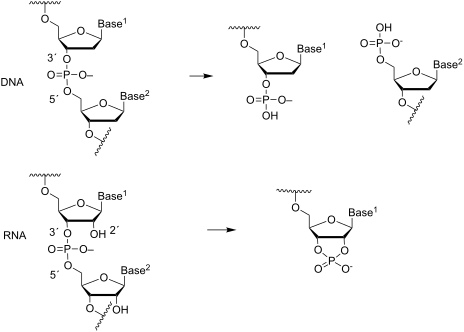
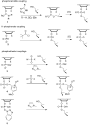
- of nucleases by pH-rate dependency, X-ray crystallography, amino acid/nucleotide substitution and computational approaches, experimental and theoretical studies with small molecular model compounds still play a role. With small molecules, the importance of various elementary processes, such as proton
- computational methods [11][12][13][14]. Still, experimental studies with small molecular model compounds play an essential role in mechanistic studies of the enzymatic cleavage of nucleic acids. With small molecules, the importance of various elementary processes, such as proton transfer and metal ion binding
- synergistic participation of several catalytic entities. Similar studies are not possible with enzymes, since even a minor change in the structure of enzyme or substrate may have a dramatic effect on the structure and stability of the enzyme–substrate complex. In addition, the kinetic data obtained with small



Nanoreactors for green catalysis
Beilstein J. Org. Chem. 2018, 14, 716–733, doi:10.3762/bjoc.14.61
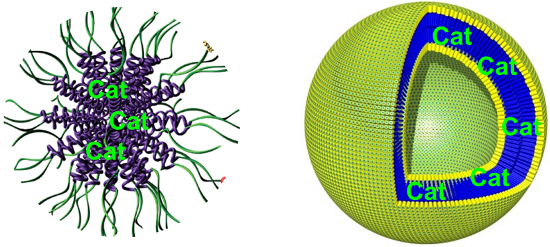
- permeability of the cross-linked membrane allowed for substrate/product diffusion, but at basic pH the membrane collapsed and prevented any transport of small molecules. Two different activity tests were performed: 1) GOx and Myo were both entrapped inside the polymersome lumen; 2) GOx and Myo were


Fluorogenic PNA probes
Beilstein J. Org. Chem. 2018, 14, 253–281, doi:10.3762/bjoc.14.17
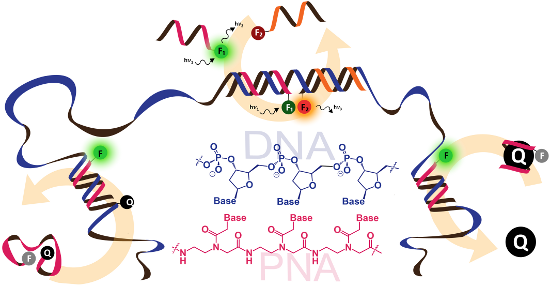
- to specific biomolecular targets, including nucleic acids as well as non-nucleic acid targets, such as proteins and small molecules, have applications in various important areas. These include diagnostics, drug development and as tools for studying biomolecular interactions in situ and in real time




Polarization spectroscopy methods in the determination of interactions of small molecules with nucleic acids – tutorial
Beilstein J. Org. Chem. 2018, 14, 84–105, doi:10.3762/bjoc.14.5
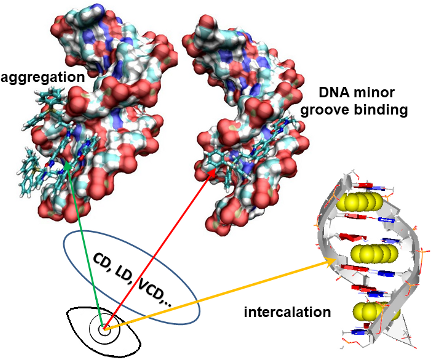
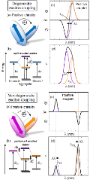
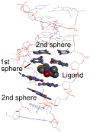
- non-covalent complexes between nucleic acids and small molecules (ligands) is of a paramount significance to bioorganic research. Highly informative methods about nucleic acid/ligand complexes such as single crystal X-ray diffraction or NMR spectroscopy cannot be performed under biologically
- nucleic acids, whose helices are normally elongated in a single direction [2]. In this context one of the most common approaches is to monitor the changes in the ECD or LD spectrum upon binding of a ligand to DNA or RNA [6]. Non-covalent interactions of small molecules (ligands) with DNA and RNA are of
- aim of this review is to summarize in one tutorial all required information and practical advice for performing experiments with the most common polarized spectroscopy methods: ECD, LD, VCD, FDCD and CPL with the goal of an accurate determination of interactions of small molecules with nucleic acids






Recent progress in the racemic and enantioselective synthesis of monofluoroalkene-based dipeptide isosteres
Beilstein J. Org. Chem. 2017, 13, 2637–2658, doi:10.3762/bjoc.13.262
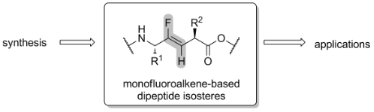
- applications of those compounds will also be presented. Keywords: dipeptide isosteres; monofluoroalkene-based amide bonds; monofluoroalkenes; peptides; synthesis; Introduction Nowadays, the pharmaceutical industry is interested in the development of new categories of drugs. While small molecules were the


Hydrolysis, polarity, and conformational impact of C-terminal partially fluorinated ethyl esters in peptide models
Beilstein J. Org. Chem. 2017, 13, 2442–2457, doi:10.3762/bjoc.13.241
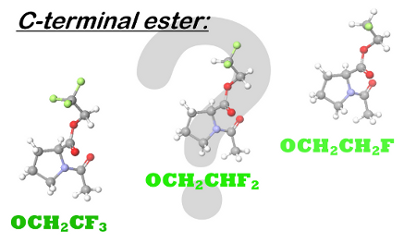
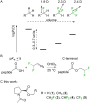
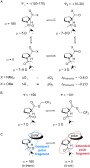
- fluorinated alkyl groups on the polarity of small molecules was recently investigated in a series of model studies by Huchet and others [41][42][43][44]. These investigations demonstrated the checkmark-shape of the lipophilicity (logP) changes upon increasing the number of fluorine atoms in the terminal
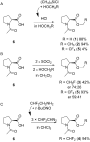
- biomacromolecular functionalization as well [49]. As an example, we recently discovered the selective formation of 2,2-difluoroethyl esters upon treatment of small molecules and peptide substrates with 2,2-difluorodiazoethane (Figure 1B) [46]. The transformation was carried out in chloroform, which certainly







Exploring mechanochemistry to turn organic bio-relevant molecules into metal-organic frameworks: a short review
Beilstein J. Org. Chem. 2017, 13, 2416–2427, doi:10.3762/bjoc.13.239
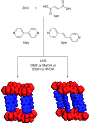
- promising candidate to biomedical applications [8]. Indeed, ZIF-8 has been largely used to encapsulate APIs such as doxorubicin, an anticancer drug [96][142] or even as an efficient pH-sensitive drug-delivery system [92][95][143][144]. Usually, the encapsulation of small molecules into MOFs involves two
- steps: i) the synthesis of the framework and ii) the encapsulation of the small molecule by soaking and diffusion methods under mild conditions [96]. However, there are some one-pot syntheses reported for the encapsulation of small molecules into ZIF-8. Liédana et al. disclosed the in situ encapsulation
- of caffeine into ZIF-8 [98] and Zhuang et al. proposed a method to synthesize nanosized ZIF-8 spheres with encapsulation of small molecules into the framework during synthesis [95]. Also, Zheng et al. proposed a fast, single step synthesis of ZIF-8 with direct incorporation of small molecules




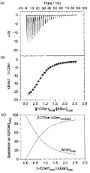
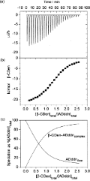
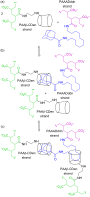
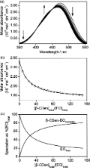
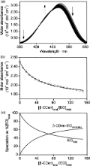
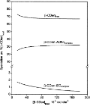
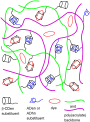
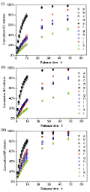
β-Cyclodextrin- and adamantyl-substituted poly(acrylate) self-assembling aqueous networks designed for controlled complexation and release of small molecules
Beilstein J. Org. Chem. 2017, 13, 1879–1892, doi:10.3762/bjoc.13.183
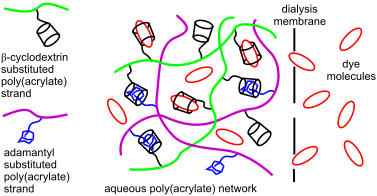
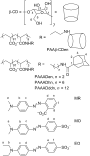
- Research School of Chemistry, Australian National University, Canberra, ACT 0200, Australia 10.3762/bjoc.13.183 Abstract Three aqueous self-assembling poly(acrylate) networks have been designed to gain insight into the factors controlling the complexation and release of small molecules within them. These




Mechanochemical synthesis of thioureas, ureas and guanidines
Beilstein J. Org. Chem. 2017, 13, 1828–1849, doi:10.3762/bjoc.13.178
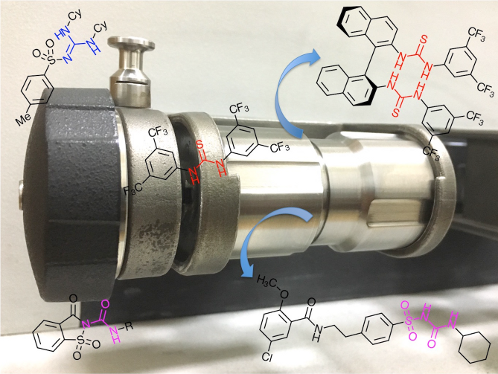
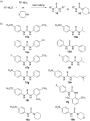
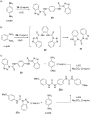
- the molecules presented herein testify that mechanochemistry can be utilized to successfully cope with the challenges of modern synthetic organic chemistry, in terms of quantitative conversion of chiral substrates, desymmetrization of small molecules, metal-catalyzed reactions and molecular






Chemical systems, chemical contiguity and the emergence of life
Beilstein J. Org. Chem. 2017, 13, 1551–1563, doi:10.3762/bjoc.13.155
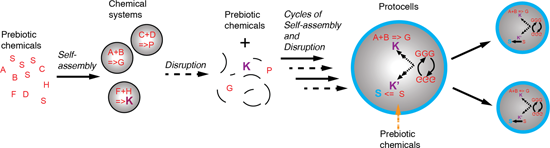
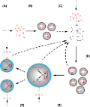
- research groups have demonstrated their abilities to induce formation of evolved protocell systems. For instance, they have been shown to be capable of accumulating small molecules on their charged surfaces (electrostatic interactions) [49] or within pores and brines by thermophoresis and convection


Grip on complexity in chemical reaction networks
Beilstein J. Org. Chem. 2017, 13, 1486–1497, doi:10.3762/bjoc.13.147
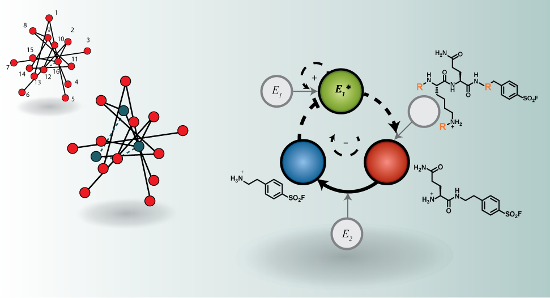
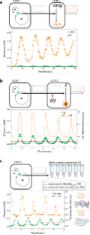
- reactions combined with the tuning of the reaction rates in (small) molecules [94]. The initial point of the design was to select a network motif for which the steady state output is known. Our network combines a positive and a delayed negative feedback loop (Figure 5a) that is built around a key enzyme E1
- nonlinear, and like most artificial complex systems, analytically unsolvable. The construction of the network combined the design of small molecules with a mathematical simulation of the complete network. Nonlinear mathematical problems that comprise more than three variables are typically difficult, if not
- alters the steady state behavior of the CRN under identical conditions. The qualitative changes in the final state shown here are called bifurcations and show that the subtle changes in the small molecules influence the out-of-equilibrium behavior of the CRN. This analysis is expanded in Figure 7c to




A speedy route to sterically encumbered, benzene-fused derivatives of privileged, naturally occurring hexahydropyrrolo[1,2-b]isoquinoline
Beilstein J. Org. Chem. 2017, 13, 1413–1424, doi:10.3762/bjoc.13.138
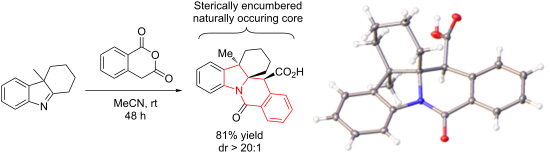
- small molecules with protein targets and lower off-target effects. The presence of quaternary carbons is characteristic of the natural products domain and is also gaining prominence in medicinal chemistry [30]. Herein, we disclose the results obtained and observations made in the course of our attempt


Synthesis of oligonucleotides on a soluble support
Beilstein J. Org. Chem. 2017, 13, 1368–1387, doi:10.3762/bjoc.13.134
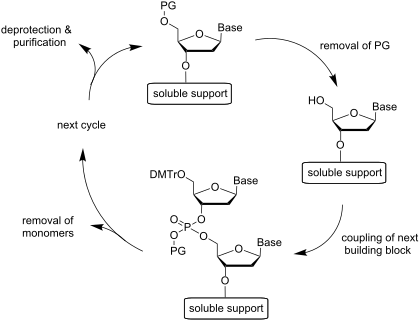
- needed. Spectroscopic studies on structure, dynamics and recognition of ONs by other biopolymers, small molecules or metal complexes, for example, may consume ONs in amounts that cannot be conveniently reached by lab-scale solid-phase synthesizers. In addition to synthesis on a soluble support
- organic solvents has offered an entirely new paradigm for the soluble-supported synthesis of oligonucleotides. The underlying idea is that on passing the reaction mixture by high pressure through a membrane, small molecules pass through the membrane, while the support is too bulky to escape through the






Characterization of non-heme iron aliphatic halogenase WelO5* from Hapalosiphon welwitschii IC-52-3: Identification of a minimal protein sequence motif that confers enzymatic chlorination specificity in the biosynthesis of welwitindolelinones
Beilstein J. Org. Chem. 2017, 13, 1168–1173, doi:10.3762/bjoc.13.115
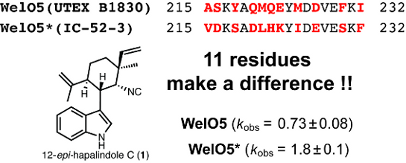
- rational engineering of these enzymes for tailoring small molecules beyond hapalindole-type alkaloids. Experimental Protein expression and purification: Genes coding WelO5*, WelO5-var proteins were synthesized and ligated into pQTEV vector by BioBasic Inc. Heterologous expressions of WelO5* and WelO5-var
- that can oxidatively monochlorinate aliphatic carbon centers in freestanding molecules, typified by WelO5 protein in the biogenesis of welwitindolinones [17]. This discovery provided a new opportunity to utilize protein catalysts for late-stage halogenations of unactivated carbons in bioactive small
- molecules. Although the initially characterized WelO5 has a restricted substrate scope [17], we have recently shown its homolog, AmbO5, in the biogenesis of ambiguines is capable of modifying seven structurally distinct hapalindole-type alkaloids [18]. The biochemical characterizations of WelO5/AmbO5


From chemical metabolism to life: the origin of the genetic coding process
Beilstein J. Org. Chem. 2017, 13, 1119–1135, doi:10.3762/bjoc.13.111
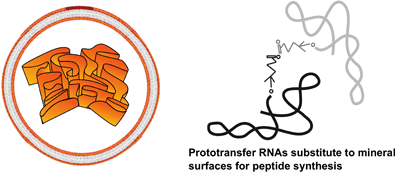
- -identified operations: compartmentalisation, metabolism, manipulation and memorisation. The former two operations are performed mainly by small molecules (carbon-based and comprising a few tens of atoms), whereas the latter two are carried out by macromolecules (nucleic acids and proteins, made of a limited
- surface-bound swinging arm may have produced a variety of metabolites. Manipulation In contrast to metabolism and compartmentalisation, manipulation and memorisation involve entities that are not small molecules but molecules made of thousands, millions, sometimes billions of atoms. These processes



An eco-compatible strategy for the diversity-oriented synthesis of macrocycles exploiting carbohydrate-derived building blocks
Beilstein J. Org. Chem. 2017, 13, 1106–1118, doi:10.3762/bjoc.13.110
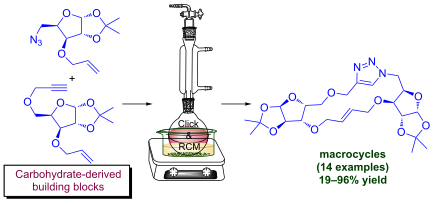
- domain shuffling has been used for the synthesis of small molecules and macrocyclic libraries. Further, several DOS strategies based around build/couple/pair (B/C/P) were developed for the synthesis of compound libraries including macrocycles [18][55]. Carbohydrates as building blocks are inexpensive and


DMAP-assisted sulfonylation as an efficient step for the methylation of primary amine motifs on solid support
Beilstein J. Org. Chem. 2017, 13, 806–816, doi:10.3762/bjoc.13.81
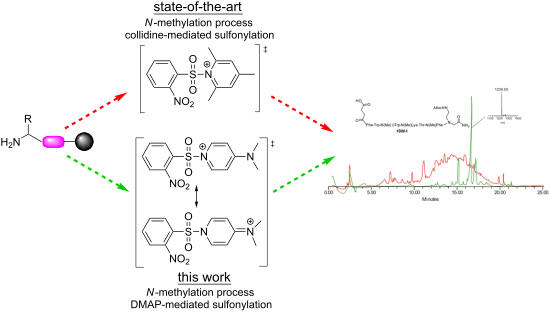
- Methylated amines and amides are common motifs found in natural and synthetic compounds, e.g., small molecules, peptides, and oligonucleotides [1][2][3][4][5][6][7][8]. Methylation of amines and amides has found many applications in the fields of pharmacological research, materials science, and in synthetic
- peptides, proteins, and small molecules on solid support, in addition to other organic compounds in solution phase [22][24][25][27]. We found that the introduction of a single methyl group to an amine adjacent to a hindered moiety using the state-of-the-art strategies is extremely challenging (Figure 1A



A chemoselective and continuous synthesis of m-sulfamoylbenzamide analogues
Beilstein J. Org. Chem. 2017, 13, 303–312, doi:10.3762/bjoc.13.33
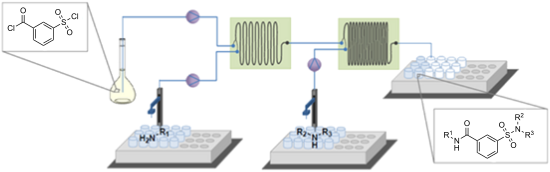
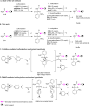
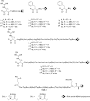
- Systems Biology, VIB, Ghent University, Technologiepark 927, B-9000 Ghent, Belgium Department of Plant Biotechnology and Bioinformatics, Ghent University, Technologiepark 927, B-9052 Ghent, Belgium 10.3762/bjoc.13.33 Abstract For the synthesis of m-sulfamoylbenzamide analogues, small molecules which are
- suitable for automation, thus allowing the fast synthesis of compound libraries, but as opposed to, e.g., combinatorial chemistry, the developed protocols are directly useful for scale-up. A class of small molecules where these principles can apply for are m-sulfamoylbenzamides. These compounds proved to
- , 15 analogues were synthesized, using similar conditions, with yields ranging between 65 and 99%. This is the first automated and chemoselective synthesis of m-sulfamoylbenzamide analogues. Keywords: flow chemistry; medium-throughput synthesis; m-sulfamoylbenzamide analogues; Introduction Small


NMR reaction monitoring in flow synthesis
Beilstein J. Org. Chem. 2017, 13, 285–300, doi:10.3762/bjoc.13.31
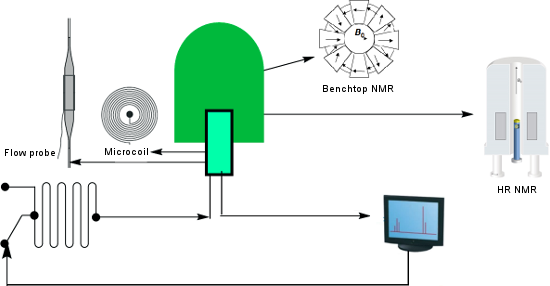
- varying magnetic field strengths. Danielli et al. [40] described the application of Benchtop NMR spectroscopy in flow reactions (SpinSolve from Magritek at 60 MHz). They considered that the field homogeneity and sensitivity that compact NMR spectrometers provide is sufficient to analyze small molecules at


Continuous-flow synthesis of highly functionalized imidazo-oxadiazoles facilitated by microfluidic extraction
Beilstein J. Org. Chem. 2017, 13, 239–246, doi:10.3762/bjoc.13.26
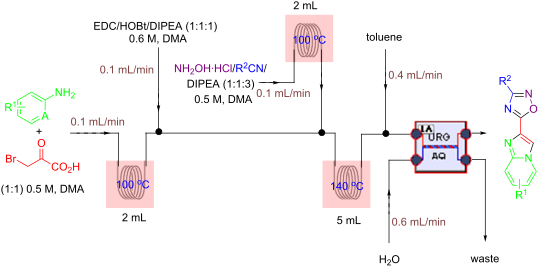
- ; microreactor; 1,2,4-oxadiazole; Introduction The design and execution of scalable and economically viable processes for the preparation of biologically active small molecules is a major hurdle in modern organic synthesis. The development of batch processes that combine multiple reactions into “one-pot” have


Dynamics and interactions of ibuprofen in cyclodextrin nanosponges by solid-state NMR spectroscopy
Beilstein J. Org. Chem. 2017, 13, 182–194, doi:10.3762/bjoc.13.21
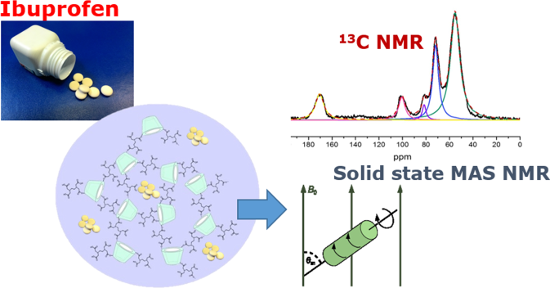
- -mono-6-amino-6-deoxy-β-CD (GMA-NH2-β-CD) co-polymerized with ethylene dimethacrylate [32]. The corresponding cross-linked polymers are thus decorated with cyclodextrin units, easily accessible to small molecules to give rise to inclusion complexes. This type of polymers showed excellent efficiency as


A new class of organogelators based on triphenylmethyl derivatives of primary alcohols: hydrophobic interactions alone can mediate gelation
Beilstein J. Org. Chem. 2017, 13, 138–149, doi:10.3762/bjoc.13.17
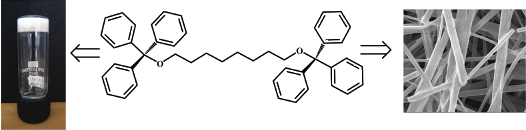
- [38][39]. Hence, small molecules based molecular gels have recently emerged as a new class of materials which can be used in the removal of water-soluble toxic dyes. We reasoned that TPM-G12 gel (being non-polar) can perhaps be utilized for removal of water-soluble dyes having appreciable hydrophobic







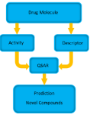
Computational methods in drug discovery
Beilstein J. Org. Chem. 2016, 12, 2694–2718, doi:10.3762/bjoc.12.267
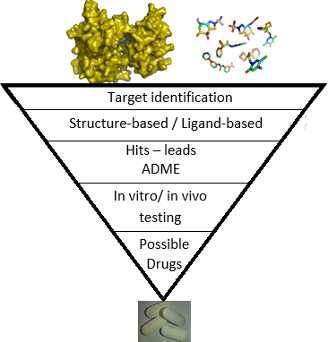
- molecules and target proteins. PubChem, a small molecule repository is available through NIH which contains millions of biologically relevant small molecules [78]. ZINC is a virtual high-throughput screening compound library which is a free public resource [79][80]. This database contains over 35 million
- molecules that are purchasable and are available in 3D formats. These molecules have all been pre-processed and are ready for docking. DrugBank has about 5000 small molecules and more than 3000 of these are experimental drugs [81]. There are over 800 compounds in DrugBank that are FDA approved. The Protein
- points. Binding pocket identification and volume calculation Once a protein’s three-dimensional structure is known, finding binding pockets on that protein is an important next step in structure-based drug discovery. It can give indications of where small molecules can bind to target structures, which



Inhibition of peptide aggregation by means of enzymatic phosphorylation
Beilstein J. Org. Chem. 2016, 12, 2462–2470, doi:10.3762/bjoc.12.240
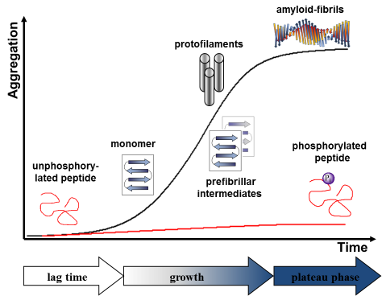
- Pmel17 amyloid templates and accelerates the covalent polymerization of reactive small molecules into melanin, an important biopolymer that protects against a broad range of cytotoxic insults, including UV and oxidative damage [11]. While amyloid morphologies and events which induce amyloid formation are





