


Search results
Search for "stereocenters" in Full Text gives 153 result(s) in Beilstein Journal of Organic Chemistry.
New hydrogen-bonding organocatalysts: Chiral cyclophosphazanes and phosphorus amides as catalysts for asymmetric Michael additions
Beilstein J. Org. Chem. 2014, 10, 224–236, doi:10.3762/bjoc.10.18
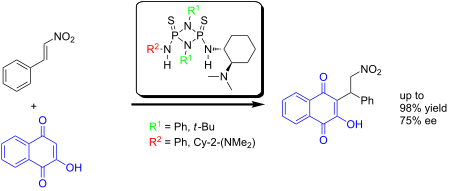
- cyclodiphosphazane, respectively. This is similar to the mechanism proposed by Takemoto [9] for the addition of diethylmalonate to β-nitrostyrene. As 2-hydroxynaphthoquinone is not symmetric, two stereocenters are created in the addition step, which gives rise to four different isomers. As with the foregoing


The regioselective synthesis of spirooxindolo pyrrolidines and pyrrolizidines via three-component reactions of acrylamides and aroylacrylic acids with isatins and α-amino acids
Beilstein J. Org. Chem. 2014, 10, 117–126, doi:10.3762/bjoc.10.8
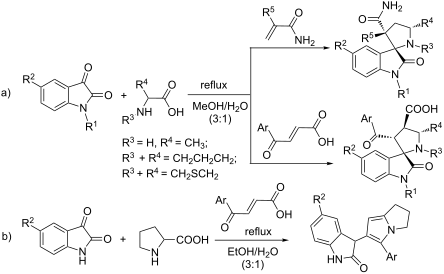
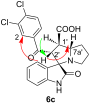
- 6 stereoselectively despite the presense of several stereocenters in the molecules (Figure 6). For assigning structures of byproducts we carried out the reaction of isatins 1, aroylacrylic acids 5 and proline in a boiling mixture of EtOH and water, which resulted in the formation and isolation of




Plakilactones G and H from a marine sponge. Stereochemical determination of highly flexible systems by quantitative NMR-derived interproton distances combined with quantum mechanical calculations of 13C chemical shifts
Beilstein J. Org. Chem. 2013, 9, 2940–2949, doi:10.3762/bjoc.9.331
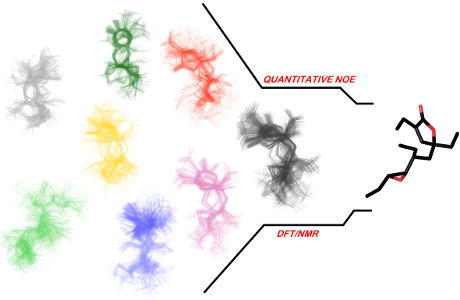
- extend the application of NMR-derived interproton distances to a highly flexible molecular system with simultaneous assignment of four non-contiguous stereocenters. Chemical derivatization and quantum mechanical calculations of 13C on plakilactone G along with a plausible biogenetic interconversion
- -dehydroderivative (3) [23], that is likely the biosynthetic precursor of all side-chain-oxidized derivatives belonging to this family, this information was not considered for the validation of our protocol and all four stereocenters for plakilactones G and H have been investigated. Plakilactone G (1) was isolated
- stereocenters under investigation. For 2a, we observed an error of 25.3% for the distance between H-16–H-8 and 12.2% for the protons H-3–H-13a. The calculated interproton distance H-3–H-6 presents an error of 14.7%, whereas the distance H-15b–H-6 has an error of 11.8%. It is noteworthy that 2a has the key


Garner’s aldehyde as a versatile intermediate in the synthesis of enantiopure natural products
Beilstein J. Org. Chem. 2013, 9, 2641–2659, doi:10.3762/bjoc.9.300
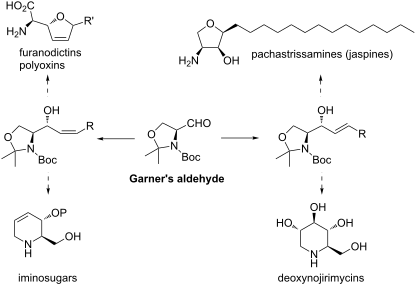
- . Models are presented for understanding the factors affecting the stability of the stereocenters, as well as those affecting diastereoselectivity in the generation of the new stereocenter. Review Philip Garner was the first to report a synthesis for 1,1-dimethylethyl 4-formyl-2,2-dimethyloxazolidine-3





Bidirectional cross metathesis and ring-closing metathesis/ring opening of a C2-symmetric building block: a strategy for the synthesis of decanolide natural products
Beilstein J. Org. Chem. 2013, 9, 2544–2555, doi:10.3762/bjoc.9.289
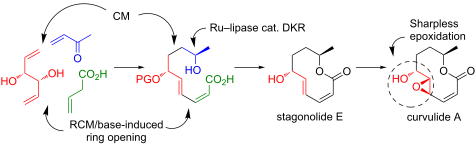
- stereocenters. The crucial (2Z,4E)-configuration of the diene moiety was constructed via Still–Gennari olefination [31] or via RCM of an acrylate with an E-configured diene at the opposite terminus [32]. Curvulide A has, to the best of our knowledge, not been synthesized previously. Results and Discussion We
- suggest the (4R,5R,6R,9R)-configuration shown for 39b (Scheme 11). While the R-configuration assigned to C6 and C9 is unequivocally established, because these stereocenters originate from stagonolide E, there still remains an uncertainty for the absolute configurations at C4 and C5. While the relative
- trans-configuration at these stereocenters is evident from a small 3J(H4–H5) value of 2.2 Hz and from the E-configuration of the precursor, the relative configuration of C6 and C5, and hence the absolute configurations at C4 and C5, can not be assigned with absolute reliability. However, a comparatively






Synthesis of the spiroketal core of integramycin
Beilstein J. Org. Chem. 2013, 9, 2446–2450, doi:10.3762/bjoc.9.282
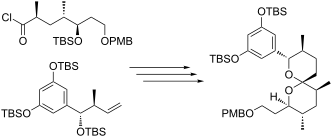
- ). Subsequent Leighton crotylation [7] using commercially available (R,R)-E-Crotyl-Mix was employed to introduce the two stereocenters at C25/C26 with anti-relationship in excellent yield and enatioselectivity. The enantiomeric excess of the crotylation product was estimated by esterification with (R)-α
- optimization of this reaction. In summary, an efficient route to the C16–C35 spiroketal fragment of integramycin was developed. The key step of the synthesis is a Cu-catalysed coupling of an acid chloride with an alkyl zirconium species. The stereocenters were introduced using Leighton crotylation, Sharpless


A protecting group-free synthesis of the Colorado potato beetle pheromone
Beilstein J. Org. Chem. 2013, 9, 2374–2377, doi:10.3762/bjoc.9.273
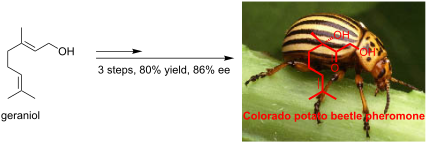
- prohibitively high costs. The selective introduction of stereocenters and the number of steps are the main reasons. In 2002, Oliver described the first synthesis of both enantiomers of 1 from (R)- and (S)-linalool, and also the synthesis of its racemate from geraniol, to establish the absolute configuration


Gold(I)-catalyzed enantioselective cycloaddition reactions
Beilstein J. Org. Chem. 2013, 9, 2250–2264, doi:10.3762/bjoc.9.264
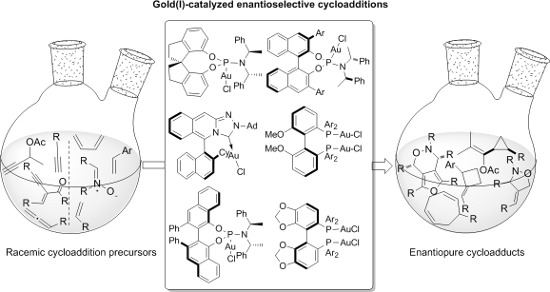
- complex, encompasses internally monosubstituted allenes, as well as disubstituted counterparts, offering a direct entry to 5,7 bicyclic systems including those with all-carbon quaternary stereocenters at the ring fusion. In contrast to the intramolecular counterpart, gold-catalyzed intermolecular


Post-Ugi gold-catalyzed diastereoselective domino cyclization for the synthesis of diversely substituted spiroindolines
Beilstein J. Org. Chem. 2013, 9, 2097–2102, doi:10.3762/bjoc.9.246
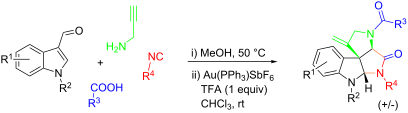
- trapping is possible. After deprotonation and protodeauration the desired spiroindoline 6a is formed with the stereochemistry of two new stereocenters S. Conclusion In conclusion we have developed a diversity-oriented post-Ugi gold-catalyzed intramolecular hydroarylation domino cyclization sequence for the


The chemistry of isoindole natural products
Beilstein J. Org. Chem. 2013, 9, 2048–2078, doi:10.3762/bjoc.9.243
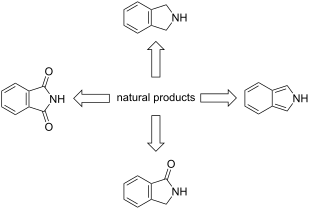
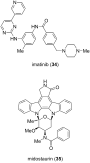
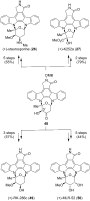
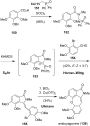
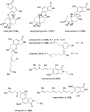
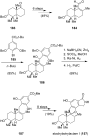
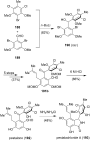
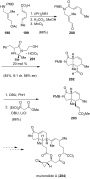
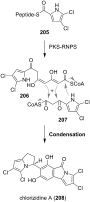
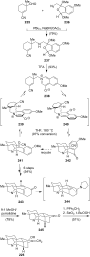
- the three remaining double bonds, functionalize the full carbon skeleton and set the remaining stereocenters. Five steps, including the exchange of protecting groups and one oxidation, completed the synthesis of cytochalasin D (70). In comparison to the syntheses mentioned before (Stork, Thomas, Trost
















A scalable synthesis of the (S)-4-(tert-butyl)-2-(pyridin-2-yl)-4,5-dihydrooxazole ((S)-t-BuPyOx) ligand
Beilstein J. Org. Chem. 2013, 9, 1637–1642, doi:10.3762/bjoc.9.187

- insensitive to oxygen atmosphere, highly tolerant of water [25], and provides cyclic ketones bearing β-benzylic quaternary stereocenters in high yields and enantioselectivities. While the reaction itself proved to be amenable to multi-gram scale, the ligand is not yet commercially available and no reliable


Exploration of an epoxidation–ring-opening strategy for the synthesis of lyconadin A and discovery of an unexpected Payne rearrangement
Beilstein J. Org. Chem. 2013, 9, 1179–1184, doi:10.3762/bjoc.9.132
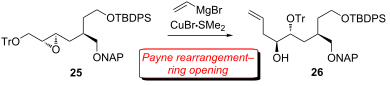
- addition to its interesting bioactivity, lyconadin A presents a significant synthetic challenge by virtue of its unique pentacyclic skeleton, which contains six stereocenters and a pyridone ring. It is therefore not surprising that 1 has attracted the attention of the organic synthesis community. The first


Cascade radical reaction of substrates with a carbon–carbon triple bond as a radical acceptor
Beilstein J. Org. Chem. 2013, 9, 1148–1155, doi:10.3762/bjoc.9.128
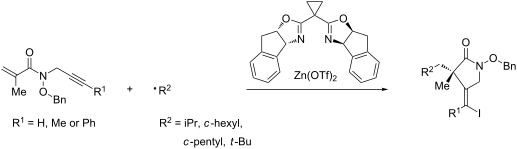
- bulky substituent R1 leading to the dissociation of the chiral Lewis acid. In these studies, the absolute configuration at newly generated stereocenters has been not determined. We recently reported in detail the cascade addition–cyclization–trapping reaction of substrates with carbon–carbon double
- conditions, an outstanding level of enantioselectivity was observed on employing the bulky tert-butyl iodide as a radical precursor (Table 1, entry 14). A good yield of the product 9Bd was obtained with 92% ee and high Z-selectivity. The absolute configuration at the newly generated stereocenters of 9Aa–Bd
- for preparing functionalized cyclic compounds with multiple stereocenters. These studies offer opportunities for further exploration of fascinating possibilities in the realm of cascade radical reactions. Cascade bond formation based on radical reactions. Our method for controlling the geometry of




Asymmetric synthesis of a highly functionalized bicyclo[3.2.2]nonene derivative
Beilstein J. Org. Chem. 2013, 9, 655–663, doi:10.3762/bjoc.9.74
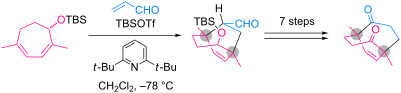
- (+)-2 from racemic 6 generated the unnecessary antipode. Therefore, development of an alternative asymmetric route to 1 was planned to further improve the overall practicality. Here we report an asymmetric Diels–Alder reaction for simultaneous installation of the C1- and C5-stereocenters using the
- expected to stereoselectively introduce the C1, C5 and C12 stereocenters to afford bicyclo[3.2.2]nonene 8. The C11-aldehyde of 8 was then to be utilized as a handle for the ring expansion to access 1. To the best of our knowledge, construction of the two quaternary carbons by the intermolecular Diels–Alder


The diketopiperazine-fused tetrahydro-β-carboline scaffold as a model peptidomimetic with an unusual α-turn secondary structure
Beilstein J. Org. Chem. 2013, 9, 147–154, doi:10.3762/bjoc.9.17
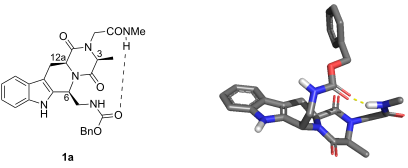
- of the THBC-DKP scaffold also in solution, compound 6 was converted into the N-methyl carboxyamide derivative 1a, by a two-step procedure (0.5 M LiOH, 0 °C, then MeNH2, TBTU, DIPEA), which was carefully conducted in order to avoid the easy epimerization of the C3 and C12a stereocenters. Spin-system


A new approach toward the total synthesis of (+)-batzellaside B
Beilstein J. Org. Chem. 2012, 8, 1831–1838, doi:10.3762/bjoc.8.210

- prepared through a separate route (Scheme 1) [19]. In this approach involving nucleophilic cyclization of acyclic aldehyde in situ generated from olefin 2 for constructing the piperidine ring system, proper synthetic manipulation of the three inherent stereocenters contained in the chiral source was a key


Asymmetric desymmetrization of meso-diols by C2-symmetric chiral 4-pyrrolidinopyridines
Beilstein J. Org. Chem. 2012, 8, 1778–1787, doi:10.3762/bjoc.8.203
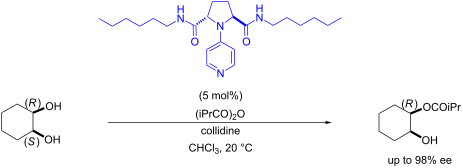
- functionality and chirality of catalyst side chains do not affect the absolute configuration of the monoacylate obtained by the asymmetric desymmetrization while they influence the extent of the enantioselectivity. Accordingly, the configuration of the stereocenters in C(2) and C(5) position bearing the amide


Organocatalytic tandem Michael addition reactions: A powerful access to the enantioselective synthesis of functionalized chromenes, thiochromenes and 1,2-dihydroquinolines
Beilstein J. Org. Chem. 2012, 8, 1668–1694, doi:10.3762/bjoc.8.191

- , which afforded versatile succinimide-containing benzothiopyrans 43 with the generation of three stereocenters in one single operation (Scheme 22). The method provides a general approach to the preparation of a range of substituted benzothiopyrans containing three stereocenters, with high enantiomeric
- acid additive (Scheme 23). Avoiding the dehydration step, it is possible by this protocol to obtain thiochromans 45 bearing three contiguous stereocenters and a tertiary aldol structural motif with excellent enantioselectivities (96–99% ee) and yields (71–98%), and with good diastereocontrol (10:1 to
- (up to 98% de). Later on the same group [71] developed another hydrogen-bond-mediated catalysis for the synthesis of tetrasubstituted thiochromans having three continuous stereocenters 49 following domino thio-Michael–Knoevenagel reaction between 2-mercaptobenzaldehydes 34 and benzylidenemalonates 48






Chiral multifunctional thiourea-phosphine catalyzed asymmetric [3 + 2] annulation of Morita–Baylis–Hillman carbonates with maleimides
Beilstein J. Org. Chem. 2012, 8, 1098–1104, doi:10.3762/bjoc.8.121
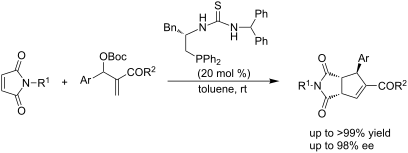
- (MBH) carbonates with maleimides, which can efficiently construct functionalized cyclopentenes bearing three contiguous stereocenters in moderate to excellent yields and excellent diastereo- and enantioselectivities. A plausible mechanism has been also proposed on the basis of control experiments and
- + 2] annulation of MBH carbonates with maleimides, which can efficiently construct functionalized cyclopentene derivatives bearing three contiguous stereocenters in moderate to excellent yields along with excellent diastereo- and enantioselectivities. Results and Discussion In our previous work, it
- product 4c containing five stereocenters was produced in 69% yield and good diastereoselectivity on the basis of NMR spectroscopic data (dr = 20:1, see Supporting Information File 1). Conclusion In conclusion, we have developed a novel multifunctional thiourea-phosphine catalyzed asymmetric [3 + 2




Recent advances in the gold-catalyzed additions to C–C multiple bonds
Beilstein J. Org. Chem. 2011, 7, 897–936, doi:10.3762/bjoc.7.103




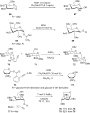


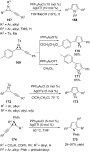


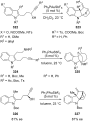
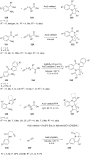




When gold can do what iodine cannot do: A critical comparison
Beilstein J. Org. Chem. 2011, 7, 847–859, doi:10.3762/bjoc.7.97
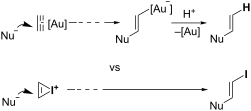
- stereocenters, including a quaternary carbon. As in the previous examples, the gold-catalyzed cyclization benefits strongly from a stabilizing substituent at C2 to direct the 6-endo mode of cyclization. Subsequent to the success of the gold-catalyzed cycloisomerization in trapping the developing carbocation




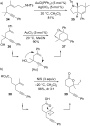


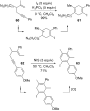
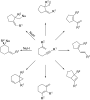


High chemoselectivity in the phenol synthesis
Beilstein J. Org. Chem. 2011, 7, 794–801, doi:10.3762/bjoc.7.90
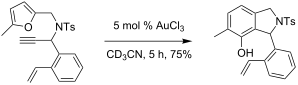
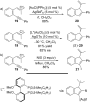
- dinuclear gold(I) complex 36 [44] gave the same result (Figure 3). When the catalyst was changed to platinum(II) chloride in acetone, a complex mixture of inseparable products was obtained. Since the two diastereoisomers 28a and 28b with the propargylic stereocenters were separable, we investigated the gold


The arene–alkene photocycloaddition
Beilstein J. Org. Chem. 2011, 7, 525–542, doi:10.3762/bjoc.7.61
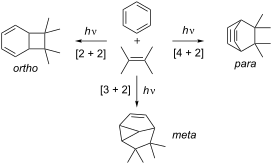
- , the complexity of the products is considerably increased with respect to that of the reactants, as a new ring and up to four new stereocenters are formed. The first “classical” [2π + 2π] photocycloaddition of benzene was described by Angus and Bryce-Smith in 1959 [7]. However, Ayer, Bradford and Büchi
- stereocenters in a single step from planar achiral starting materials. If substituents are added to the arene and the complexity of the olefin is increased, a great diversity of products can be created. However, not all of these products are accessible via such a photocycloaddition, as many possibilities can be


Brønsted acid-promoted azide–olefin [3 + 2] cycloadditions for the preparation of contiguous aminopolyols: The importance of disiloxane ring size to a diastereoselective, bidirectional approach to zwittermicin A
Beilstein J. Org. Chem. 2010, 6, 1206–1210, doi:10.3762/bjoc.6.138

- particularly intrigued by the possibility of a substrate controlled anti-diastereoselective azide–olefin reaction performed in a bidirectional fashion [13][14] to establish the requisite stereocenters of the C9–C15 C2 symmetric core of the natural product [11] as outlined in Scheme 1. Diastereoselective


Novel tetracyclic structures from the synthesis of thiolactone-isatin hybrids
Beilstein J. Org. Chem. 2010, 6, No. 78, doi:10.3762/bjoc.6.78

- in the tetracycles 4 was further sparked by the ease and simplicity of their preparation, and the novelty of their architecture as revealed by single X-ray crystal structure analysis. Attractive structural features of 4 include two vicinal quaternary stereocenters and a complex, bicyclic ring system





