Search results
Search for "crystal structure" in Full Text gives 605 result(s) in Beilstein Journal of Organic Chemistry. Showing first 200.
Breaking paracyclophane: the unexpected formation of non-symmetric disubstituted nitro[2.2]metaparacyclophanes
Beilstein J. Org. Chem. 2021, 17, 1518–1526, doi:10.3762/bjoc.17.109
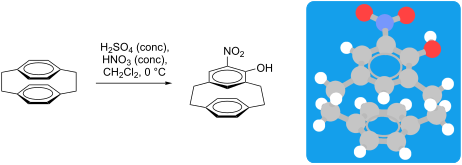
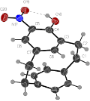
- cyclophane (6, Figure 3). The former is, to the best of our knowledge, the first example of a crystal structure of a non-symmetric [2.2]metaparacyclophane. The structure of the disubstituted [2.2]metaparacyclophane (5) is analogous to that of the unsubstituted [2.2]metaparacyclophane (3). The angle between
- –208 °C; Rf: 0.25 (30% EtOAc, 70% hexane). The common [2.2]cyclophanes. Crystal structure of 5. Ellipsoids are drawn at a 50% probability level [63][64][65][66]. Crystal structure of 6. Ellipsoids are drawn at a 50% probability level [63]. Crystal structure of 14. Ellipsoids are drawn at a 50
- % probability level [63]. Crystal structure of 15. Ellipsoids are drawn at a 50% probability level [63]. Possible origin of stereoselectivity. Nitration of [2.2]paracyclophane (1) and the synthesis of 4-hydroxy-5-nitro[2.2]metaparacyclophane (5) and the cyclohexadienone cyclophane 6 (average yield from more




A straightforward conversion of 1,4-quinones into polycyclic pyrazoles via [3 + 2]-cycloaddition with fluorinated nitrile imines
Beilstein J. Org. Chem. 2021, 17, 1509–1517, doi:10.3762/bjoc.17.108
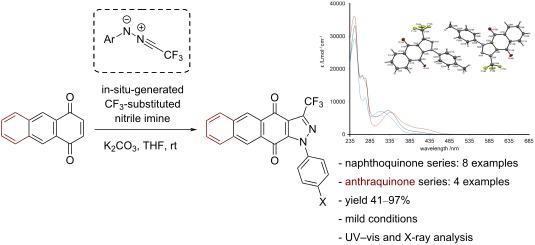
- nitrile imine 7a generated from 8a. Supporting Information Supporting Information File 246: General information and experimental data of all isolated products, details of the crystal structure determination, and copies of 1H and 13C NMR spectra for all products. Funding Financial support by the


Cascade intramolecular Prins/Friedel–Crafts cyclization for the synthesis of 4-aryltetralin-2-ols and 5-aryltetrahydro-5H-benzo[7]annulen-7-ols
Beilstein J. Org. Chem. 2021, 17, 1481–1489, doi:10.3762/bjoc.17.104
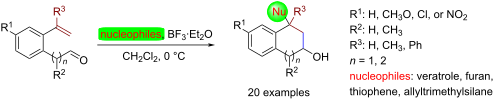
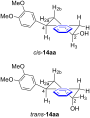
- stereostructures of compound cis-14aa and trans-14aa. Crystal structure of the tosylate 21. The displacement ellipsoids are drawn at the 30% probability level. Reported strategies for the synthesis of tetralin-2-ol ring systems. Designed cascade reactions to 4-substituted tetralin-2-ols. The documented synthesis




Total synthesis of ent-pavettamine
Beilstein J. Org. Chem. 2021, 17, 1440–1446, doi:10.3762/bjoc.17.99
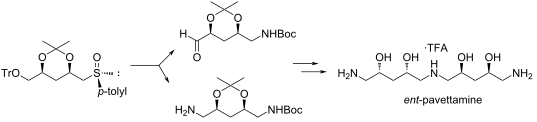
- close to the OTBS center. At this point, it was crucial to conclusively characterize the unexpected product 9. Fortuitously, we were able to obtain crystals for this compound after several recrystallization attempts. The crystal structure for 9 (Figure 2) very surprisingly showed the OTBS group on the
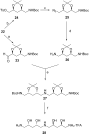
- pavettamine, in order to obtain the enantiomer. The final deprotection step proved particularly efficient, with two protecting groups being removed simultaneously to unveil the desired target. Structure of pavettamine 1 and its enantiomer 2. Crystal structure of compound 9. Single crystal X-ray structure of
- %; f) 95% TFA, 2.5% H2O, 2.5% triisopropylamine, rt, overnight, quantitative yield. Supporting Information Detailed experimental methods and NMR spectra for all compounds prepared and crystal structure data for compounds 4 and 9 is available as supporting information. Supporting Information File 178


Analogs of the carotane antibiotic fulvoferruginin from submerged cultures of a Thai Marasmius sp.
Beilstein J. Org. Chem. 2021, 17, 1385–1391, doi:10.3762/bjoc.17.97
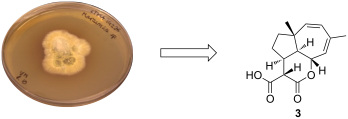
- of potential pharmaceutical interest. Klein et al. obtained a crystal structure of fulvoferruginin (1) [8], as did Huneck et al. for hercynolactone [9], verifying their relative configuration. Huo et al. have further confirmed the absolute configuration of compound 1 by utilizing the CD exciton



Structural effects of meso-halogenation on porphyrins
Beilstein J. Org. Chem. 2021, 17, 1149–1170, doi:10.3762/bjoc.17.88
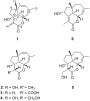
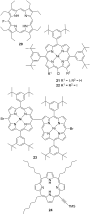
- the crystallographic structural characteristics of 13 mesox-halo-substituted porphyrins. Data obtained from the CSD crystal structure database accompanied by data obtained from our group are discussed [25]. Furthermore, any general structural motif that appears consistent among the mesox-halo
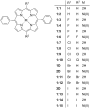
- further exploration of the ground state geometries and concurrently frontier molecular orbitals (FMOs) and sigma-holes have been displayed. Results and Discussion Crystal structure analyses 5-Halo-substituted porphyrins First, considering the 5-halo-10,20-diphenylporphyrins (Figure 1); in this series, we
- the tolyl group breaks the high-ordered packing previously observed. The chlorine atom does not appear to have any substantial interactions present in the crystal structure. The structure of compound 5 only differs from the structure of compound 1 by the addition of a phenyl moiety. In this structure




Synthesis of functionalized imidazo[4,5-e]thiazolo[3,2-b]triazines by condensation of imidazo[4,5-e]triazinethiones with DMAD or DEAD and rearrangement to imidazo[4,5-e]thiazolo[2,3-c]triazines
Beilstein J. Org. Chem. 2021, 17, 1141–1148, doi:10.3762/bjoc.17.87
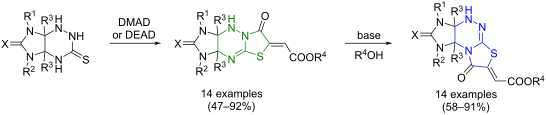
- further transformations in basic media, are continuing. Biologically active compounds having thiazolidin-4-one and thiazolo-1,2,4-triazine units. 1H NMR spectra of compounds 4h and 5h in DMSO-d6 in the region of 3.5–8.8 ppm. X-ray crystal structure of compound 5i. Regioselectivity of the cyclization of 3
- conditionsa. Supporting Information Supporting Information File 167: Experimental and analytical data. Supporting Information File 168: CIF file for compound 5i. Acknowledgements Crystal structure determination was performed in the Department of Structural Studies of the N. D. Zelinsky Institute of Organic


Beyond ribose and phosphate: Selected nucleic acid modifications for structure–function investigations and therapeutic applications
Beilstein J. Org. Chem. 2021, 17, 908–931, doi:10.3762/bjoc.17.76
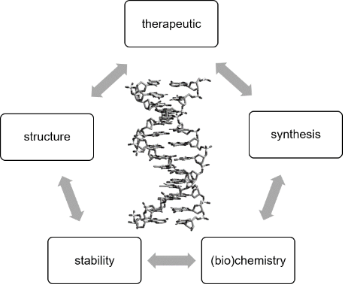
- nuclease-resistant probes for studying RNA–protein interactions [70]. To better elucidate the structural features of 3'-NP DNA responsible for this enhanced selective binding and stability, the Egli group determined the crystal structure of the fully modified 3'-NP DNA duplex with the sequence 5'-d
- necessary protecting groups are present on the nucleobase and sugar moieties [76][77]. Unlike the phosphodiester linkage of natural DNA, the AM1 modification is an example of a non-ionic backbone. The crystal structure of a 13-mer RNA duplex with a single central AM1 modification revealed that this
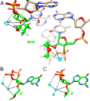
- increase in silencing activity for AM1-modified siRNAs with amide linkages at specific sites [75]. Structural insight into this observation was obtained using the crystal structure of the complex between Bacillus halodurans RNase H and the r(GAC ACC UGA UAM1UC) - d(GAA TCA GGT GTC) hybrid duplex [73




α,γ-Dioxygenated amides via tandem Brook rearrangement/radical oxygenation reactions and their application to syntheses of γ-lactams
Beilstein J. Org. Chem. 2021, 17, 688–704, doi:10.3762/bjoc.17.58
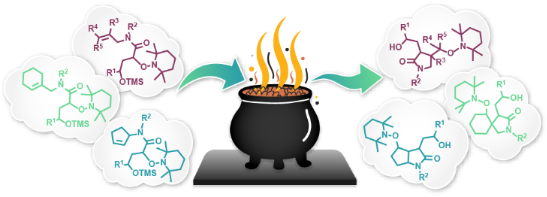
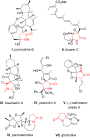
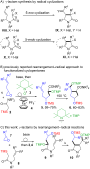
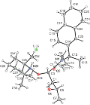
- /EtOAc 10:1 to 1:1) to give keto lactam 13. Selected alkaloids containing the pyrrolidone motif. X-ray crystal structure of the major (2R,4S)-alkoxyamine hydrochloride derived from 9j. Displacement ellipsoids at 30% probability level and a disordered CHCl3 solvent molecule is not shown for clarity. X-ray
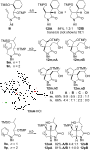
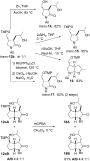
- crystal structure of the minor cis-diastereomers of the keto lactam 13j (left) and the hydroxy lactam 12k (right). Displacement ellipsoids are drawn at the 30% probability level. A) Classical γ-lactam synthesis by atom transfer radical cyclizations; B) previously developed tandem epoxide opening/Brook







Synthesis, structural characterization, and optical properties of benzo[f]naphtho[2,3-b]phosphoindoles
Beilstein J. Org. Chem. 2021, 17, 671–677, doi:10.3762/bjoc.17.56
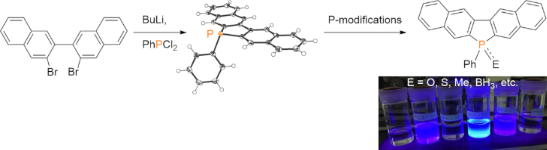
- isomers, in which the position of the fused benzene rings is different; of these, three are shown in Figure 1. The synthesis, crystal structure, and dynamic behavior of benzo[e]naphtho[2,1-b]phosphindole (A) with the C2 symmetry axis on the binaphthyl skeleton have been reported [9][10][11]. Synthetic
- of the phosphorus atom. X-ray crystal analysis showed that the parent trivalent phosphole has a considerably planar benzonaphthophosphoindole skeleton in its crystal structure. 1H and 13C NMR observations revealed that all the phospholes obtained in this study had a highly symmetric structure in
- functional π-electron materials for organic electronics applications is under progress, and the results will be reported in due time. Benzonaphthophosphindoles. Crystal structure of 2: different views. a) Absorption spectra and b) normalized fluorescence spectra for selected compounds in CHCl3. The spatial


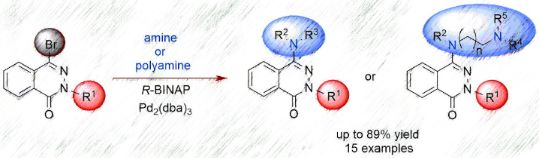
Amino- and polyaminophthalazin-1(2H)-ones: synthesis, coordination properties, and biological activity
Beilstein J. Org. Chem. 2021, 17, 558–568, doi:10.3762/bjoc.17.50
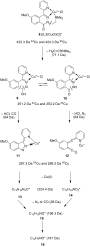
- and 424.3 Da for 65Cu followed the same fragmentation pattern for both ions. The proposal of the fragmentation pathway, based on the X-ray crystal structure of the Cu(II) complex with 7 (L3) (Figure 4, vide infra), is shown in Scheme 3. The MS/MS fragmentation analysis of the [(L3)Cu(II)Cl]+ complex 8
- unit. Their geometry was fully optimized in vacuum using the DFT method with the crystal structure coordinates as the input geometry (optimized at the CAM-B3LYP/6–311++G(d,p)/LanL2DZ(Cu) level of theory). However, due to the convergence failure during the geometry optimization of the dimer of molecules
- angles equal to 27.61 and 28.71°, respectively, and moreover, the methyl groups of the methoxy substituents are directed opposite and towards to the pyridin-2-yl substituents, respectively. The crystal structure of complex 17 is stabilized with a 3D intermolecular hydrogen bond network (Figure S1a






Biochemistry of fluoroprolines: the prospect of making fluorine a bioelement
Beilstein J. Org. Chem. 2021, 17, 439–460, doi:10.3762/bjoc.17.40
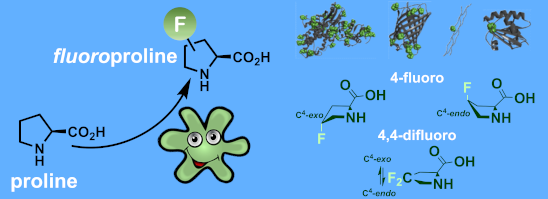
- crystal structure of the protein (all residues were in the trans-amide conformation). The structure showed the R-Flp and S-Mep residues adopting exo- and endo-pucker conformations, respectively. This arrangement created a tight packing between the R-Flp and S-Mep side-chains, as shown in Figure 12B. The
- -Flp. The protein containing R-Flp exhibited a slightly lowered stability compared to the parent enzyme. The crystal structure depicts R-Flp at 32 different positions (Figure 12C), including two proline residues forming cis-amide bonds (positions 300 and 579) and two oligoproline stretches (positions
- 300–302 and 368–369). A defined pucker could be observed clearly in 28 out of 32 residues; 26 residues out of this set were in the exo-pucker conformation. In contrast, the crystal structure of the wild-type protein showed 18 residues adopting single pucker conformations, and only 7 from this set were


Mesoionic tetrazolium-5-aminides: Synthesis, molecular and crystal structures, UV–vis spectra, and DFT calculations
Beilstein J. Org. Chem. 2021, 17, 385–395, doi:10.3762/bjoc.17.34
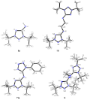
- their complexation. In salt 9, the bromide ions are held in the crystal structure by hydrogen bonds N15–H15···Br1b [D···A = 3.2774(17) Å, D–H···A = 142°; symmetry code: (b) –x + y + 1/3, −x + 2/3, z + 2/3] and N25–H25···Br2 (D···A = 3.2654(17) Å, D–H···A = 144°). There are also intramolecular hydrogen




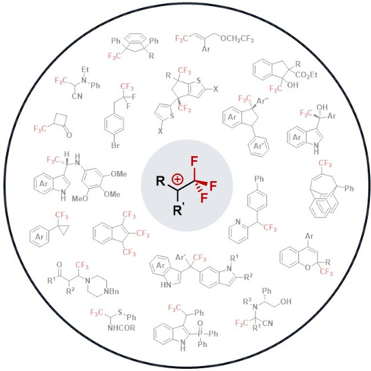
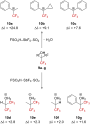
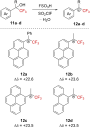
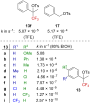
CF3-substituted carbocations: underexploited intermediates with great potential in modern synthetic chemistry
Beilstein J. Org. Chem. 2021, 17, 343–378, doi:10.3762/bjoc.17.32










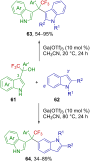



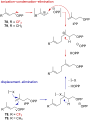


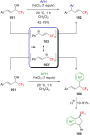
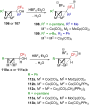
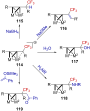
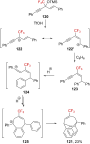
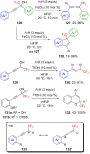
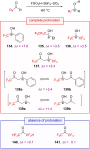


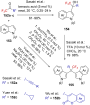

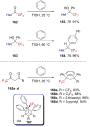


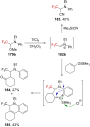


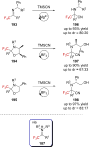
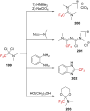


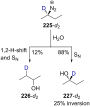


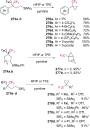


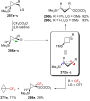


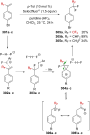


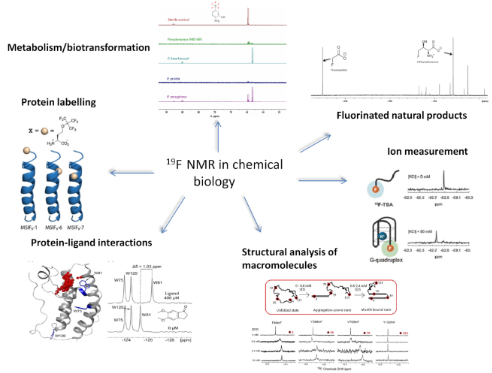
19F NMR as a tool in chemical biology
Beilstein J. Org. Chem. 2021, 17, 293–318, doi:10.3762/bjoc.17.28


Exploring the possibility of using fluorine-involved non-conjugated electron-withdrawing groups for thermally activated delayed fluorescence emitters by TD-DFT calculation
Beilstein J. Org. Chem. 2021, 17, 210–223, doi:10.3762/bjoc.17.21
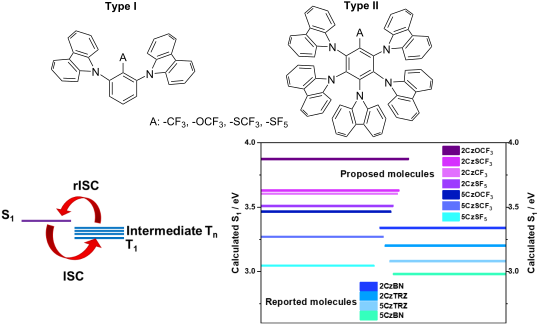
- emitters possessing a diphenyltriazine as the acceptor and different regiochemistry of the carbazole donors; the ΔESTs increased to 0.10 eV for 2,4-2CzTRZ and 0.29 eV for 3,4-2CzTRZ. The single crystal structure of 2,6-2CzTRZ revealed a highly twisted structure with large torsions (81.0o and 76.3o) between


Synthesis of tetrafluorinated piperidines from nitrones via a visible-light-promoted annelation reaction
Beilstein J. Org. Chem. 2020, 16, 3104–3108, doi:10.3762/bjoc.16.260
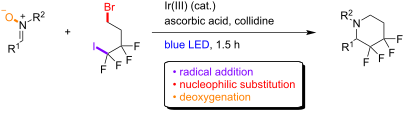
- experimental details, compound characterization, X-ray data, and copies of NMR spectra. Supporting Information File 507: Crystallographic information file for compound 3f. Supporting Information File 508: Crystallographic information file for compound 3h. Acknowledgements The crystal structure determination


Naphthalonitriles featuring efficient emission in solution and in the solid state
Beilstein J. Org. Chem. 2020, 16, 2960–2970, doi:10.3762/bjoc.16.246
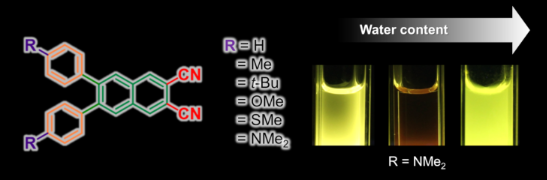
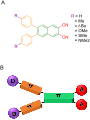
- -electron donating capability. Interestingly, upon aggregation in water-containing media, H, Me and t-Bu show a slight red-shift of the emission and a blue-shift is observed for OMe, SMe and NMe2. The crystal structure of Me allowed a detailed discussion of the structure–property relationship. Clearly, N



Construction of pillar[4]arene[1]quinone–1,10-dibromodecane pseudorotaxanes in solution and in the solid state
Beilstein J. Org. Chem. 2020, 16, 2954–2959, doi:10.3762/bjoc.16.245
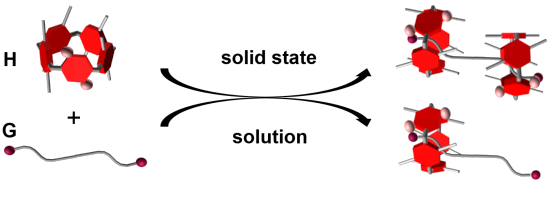
- crystallography revealed that two host molecules complex one guest molecule, forming a [3]pseudorotaxane in the solid state (Figure 1). In the crystal structure, the alkyl chain of the guest is threaded through the cavities of two host molecules, which is stabilized by multiple CH∙∙∙π interactions and hydrogen


Ultrasound-assisted Strecker synthesis of novel 2-(hetero)aryl-2-(arylamino)acetonitrile derivatives
Beilstein J. Org. Chem. 2020, 16, 2929–2936, doi:10.3762/bjoc.16.242
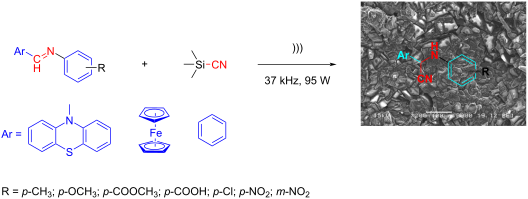
- are related to the possibility of controlling the crystal structure properties of the final product in nanomaterials syntheses [5]. For this reason, theoretical scientific research is currently directed towards the understanding of the physical phenomena involved in sonocrystallization mechanisms [6
- angle of 64.5°. The intermolecular distances are situated in the range 2.3–2.6 Å disclosing the lack of intermolecular interactions in the crystal structure. Scanning electron microscopy (SEM) analysis Besides process intensification leading to a shorter reaction time, another advantage of the
- diethyl ether. After evaporation of the organic solvent the solid product was collected and purified by recrystallization from a suitable solvent. Crystal structure of 2-phenothiazinyl-2-(p-tolylamino)acetonitrile 2a. a) ORTEP plot and b) crystallographic cell unit. SEM images recorded at 200× for the raw


Synthesis of purines and adenines containing the hexafluoroisopropyl group
Beilstein J. Org. Chem. 2020, 16, 2739–2748, doi:10.3762/bjoc.16.224
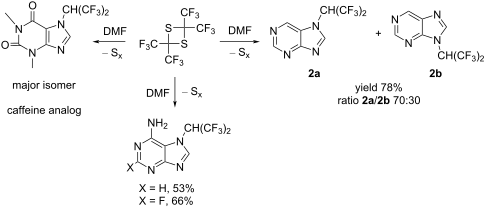
- of the material was confirmed by powder diffraction data and compared to simulated powder diffraction data from the single crystal diffraction experiment. The reaction conditions, mass spectrometry, and NMR data are given in Table 1 and Table 3. Crystal structure of 2a, with the thermal ellipsoids
- drawn at 30% probability. Crystal structure of 7a, with the thermal ellipsoids drawn at 30% probability. Top: 19F NMR spectra of 3a acquired over a sample temperature range of 223–373 K. Left: Fitted plot of integrated intensity vs interpulse delay time from the experiment inverting the minor rotamer of



Vicinal difluorination as a C=C surrogate: an analog of piperine with enhanced solubility, photostability, and acetylcholinesterase inhibitory activity
Beilstein J. Org. Chem. 2020, 16, 2663–2670, doi:10.3762/bjoc.16.216
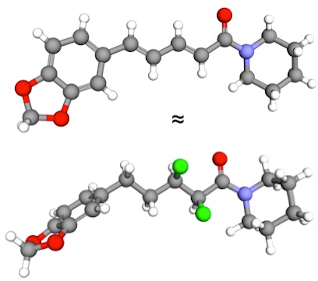
- populated in solution. A similar situation occurs for piperine itself; an indirect evidence for this comes from the crystal structure of 1 (Figure 1), where there is a second molecule in the unit cell (not shown) that has the alternative ring pucker [14]. The next-higher energy calculated structure of 2
- twisted to a lesser degree in that case (8° away from planarity). It is interesting that in the crystal structure of piperine itself (1, Figure 1) [14], the amide bond is also twisted by 15° away from planarity. In this case the distortion might be attributable to a H···H clash (1.99 Å). Structure 2f
- for this work; the crystal structure is shown [14]. In this work, a hypothetical analog 2 was designed to mimic parent compound 1. The predicted low-energy rotamers of 2 about the F–C–C–F and F–C–C=O bonds are shown; rotamers I and IV give the best mimicry of 1. Conformational analysis of 2 by DFT and


Thermodynamic and electrochemical study of tailor-made crown ethers for redox-switchable (pseudo)rotaxanes
Beilstein J. Org. Chem. 2020, 16, 2576–2588, doi:10.3762/bjoc.16.209
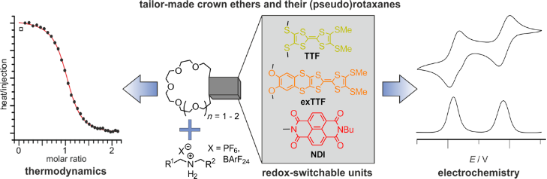
- synthesized in moderate yields of 24% and 26%, respectively, over three steps from the same two building blocks, the ditosylate 5 and the monobutyl-protected NDI precursor 7 (Scheme 1). The connectivity and conformation of exTTFC7 was observed in the crystal structure obtained from crystals generated through
- slow evaporation of a CH2Cl2/CH3CN solution. The structure of the exTTF unit does not exhibit any significant changes upon incorporation into the crown ether [48]. No intermolecular stacking between the exTTF units was observed in the crystal structure of exTTFC7 (Figure 2a and section 2 in Supporting
- the experiment. The folded structure observed in the crystal structure hints towards a possible “side-on” complex, where the ammonium axle is not threading through the ring of the macrocycle, yet still forms hydrogen bonds to the crown ether [24][25] (see spectroelectrochemical measurements below




Synthesis of novel fluorinated building blocks via halofluorination and related reactions
Beilstein J. Org. Chem. 2020, 16, 2562–2575, doi:10.3762/bjoc.16.208
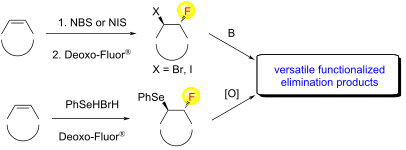
- fine-tuning the reaction conditions of other halofluorination and fluoroselenation reactions are currently being studied in our research group. Crystal structure of (rac)-11b. Crystal structure of the product (rac)-15a. Crystal structure of the product (rac)-15b. Proposed outcome of the


Comparative ligand structural analytics illustrated on variably glycosylated MUC1 antigen–antibody binding
Beilstein J. Org. Chem. 2020, 16, 2540–2550, doi:10.3762/bjoc.16.206
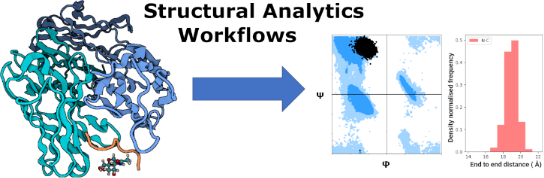
- S6 in Supporting Information File 1). Movahedin et al. hypothesized that the glycan modulates the conformation of the peptide portion of the Tn-antigen and does not bind directly, noting that in the crystal structure GalNAc is positioned 4 Å away from the side chain of Tyr100, and indicating that any