


Search results
Search for "hypervalent" in Full Text gives 158 result(s) in Beilstein Journal of Organic Chemistry.
Molecular rearrangements of superelectrophiles
Beilstein J. Org. Chem. 2011, 7, 346–363, doi:10.3762/bjoc.7.45
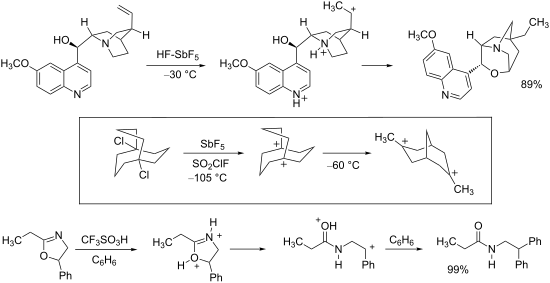
- different than monocationic electrophiles. Superelectrophiles may also involve hypervalent species, such as protosolvated tert-butyl cation (7). Superelectrophiles are characterized by several types of reactions [8]. As very powerful electrophiles, they are best known for their reactions with weak


Kinetics and mechanism of vanadium catalysed asymmetric cyanohydrin synthesis in propylene carbonate
Beilstein J. Org. Chem. 2010, 6, 1043–1055, doi:10.3762/bjoc.6.119
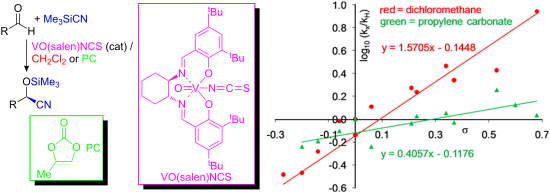
- established that the asymmetric addition of TMSCN to aldehydes can be catalysed by both Lewis acids and Lewis bases [1]. A Lewis acid catalyst activates the aldehyde by formation of an aldehyde-Lewis acid complex (e.g., 4) whilst a Lewis base catalyst activates the TMSCN through formation of a hypervalent






Shelf-stable electrophilic trifluoromethylating reagents: A brief historical perspective
Beilstein J. Org. Chem. 2010, 6, No. 65, doi:10.3762/bjoc.6.65
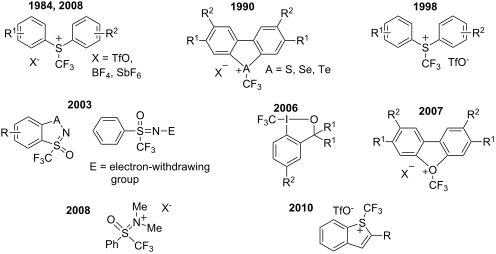
- family of hypervalent iodine(III)-CF3 reagents as mild electrophilic trifluoromethylating agents suitable for reactions with carbon- and heteroatom-centered nucleophiles. These reagents further demonstrated generality in trifluoromethylation of a wide range of nucleophiles including the
- , enamines, and thiolate anions with these reagents, albeit in low to moderate yields [28]. Neutral hypervalent iodine(III)–CF3 reagent Initial attempts by Yagupolskii and Umemoto to synthesize iodonium salts with a trifluoromethyl group were unsuccessful. Whilst iodonium salts including p
- stability compared to the intermediates with Rf groups with more than one carbon atom. In 2006 Togni and co-workers reported a new family of hypervalent iodine compounds in which the CF3 group is bonded directly to the iodine atom. The overall synthetic protocol depends on a formal umpolung of the CF3 group


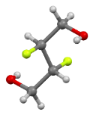
Synthesis and crystallographic analysis of meso-2,3-difluoro-1,4-butanediol and meso-1,4-dibenzyloxy-2,3-difluorobutane
Beilstein J. Org. Chem. 2010, 6, No. 62, doi:10.3762/bjoc.6.62

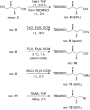
- hypervalent iodine species [21]. Such approaches often display poor stereoselectivity or result in rearrangement products. Treatment of 1,2-diols with SF4 [22][23], DAST [24], or deoxofluor [25] also leads to vicinal difluorides. Reaction with vicinal triflates has also been successful in some cases [7][26





Benzyne arylation of oxathiane glycosyl donors
Beilstein J. Org. Chem. 2010, 6, No. 19, doi:10.3762/bjoc.6.19
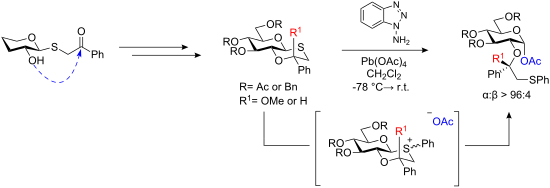
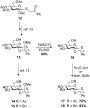
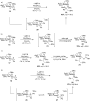
- with external alcohols would be easier to achieve if the phenyl sulfonium ion was formed with a less reactive counter ion. However, oxidation of 1-ABT in the presence of ketal 14 with NIS [33], or hypervalent iodine (III) with either bis(acetoxy)iodobenzene [PhI(OAc)2] [34] or bis(trifluoroacetoxy


Controlling hazardous chemicals in microreactors: Synthesis with iodine azide
Beilstein J. Org. Chem. 2009, 5, No. 30, doi:10.3762/bjoc.5.30
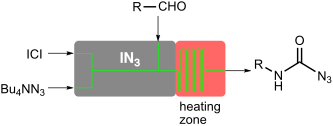
- 4a reacted with n-butyllithium to give amide 6 in quantitative yields as shown in Scheme 2. Another way to form a stable iodine–azide bonds are hypervalent iodine compounds [30][31]. This source of reagent has indeed been used for radical azidonations in flask reactions [18] and resulted in an


Trifluoromethyl ethers – synthesis and properties of an unusual substituent
Beilstein J. Org. Chem. 2008, 4, No. 13, doi:10.3762/bjoc.4.13

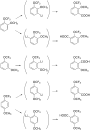
- scale. Togni managed very recently to circumvent these difficulties by using hypervalent iodine compounds such as 5 [33][34][35]. When 2,4,6-trimethylphenol was treated with the hypervalent iodine compound depicted below, the corresponding trifluoromethyl ether was obtained beside C-trifluoromethylation
- trifluoromethyl ethers. Mechanism of the oxidative desulfurization-fluorination. Umemoto's O-(trifluoromethyl)dibenzofuranium salts 4 as CF3-transfer agents. Togni's approach using hypervalent iodine compounds as CF3-transfer agents. TAS OCF3 as a nucleophilic OCF3-transfer agent. Nitration of trifluoromethoxy




m-Iodosylbenzoic acid – a convenient recyclable reagent for highly efficient aromatic iodinations
Beilstein J. Org. Chem. 2007, 3, No. 19, doi:10.1186/1860-5397-3-19
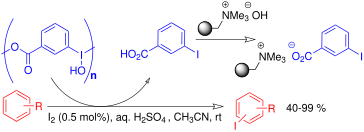
- recycling of the iodine reagent is concerned. The broad use of hypervalent iodine reagents is still hampered by tedious purification and recycling protocols. Commonly, purification relies on chromatography. Recently, tagging strategies for reagents and catalysts have widely been investigated that allow easy
- but could potentially be applied to most other iodine(III)-mediated reactions. Hypervalent iodine reagents 1 – 6. Iodine(III)-promoted iodination of arenes and concept of purification. Proposed intermediates. Monoiodination of arenes with m-iodosylbenzoic acid 6 (see Supporting Information File 1 for


Other Beilstein-Institut Open Science Activities



