


Search results
Search for "optical properties" in Full Text gives 160 result(s) in Beilstein Journal of Organic Chemistry.
Thiophene-based donor–acceptor co-oligomers by copper-catalyzed 1,3-dipolar cycloaddition
Beilstein J. Org. Chem. 2012, 8, 683–692, doi:10.3762/bjoc.8.76

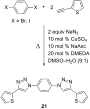
- -shifted in comparison to that of 12 (λmax = 337 nm) and 13 (λmax = 339 nm). This band is not ascribed to individual bithienyl subunits, but to a weak conjugation through the triazole ring, caused by the donor–acceptor–donor system. Maarseveen et al. recently published synthesis and optical properties of
- of 6 to 14% were determined which are rather high for bithiophenes (1.8%) [40] and increased with increasing molecular size and conjugation. Obviously, the 1,2,3-triazole ring stabilizes the excited state by decreasing the probability of non-radiative deactivation. Comparable to the optical
- properties, cyclic voltammetry of 5, 6, and 10–14 revealed redox transitions of the individual thiophene moieties (Table 3). Thus, cyclic voltammograms (CV) of 5 and 10 (5 × 10⁻³ M in dichloromethane/tetrabutylammonium hexafluorophosphate (TBAPF6, 0.1 M, 100 mV s−1) showed characteristic oxidation waves of




Liquid-crystalline heterodimesogens and ABA-heterotrimesogens comprising a bent 3,5-diphenyl-1,2,4-oxadiazole central unit
Beilstein J. Org. Chem. 2012, 8, 472–485, doi:10.3762/bjoc.8.54
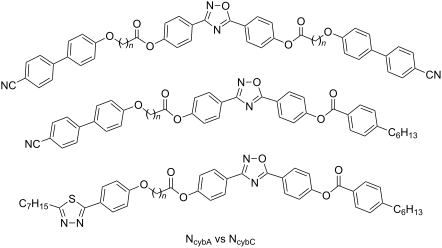
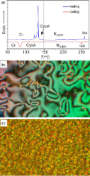
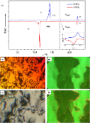
- anchoring determines the optical properties of the investigated samples. If the surface layer is nontilted (SmA-like) then the sample adopts a homeotropic alignment, which appears completely dark. Indeed for compounds CB-Ox/n with a NcybA–CybA transition the birefringent Schlieren texture disappears upon




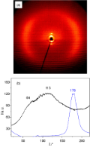
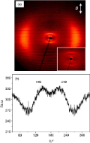
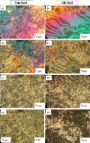
Perhydroazulene-based liquid-crystalline materials with smectic phases
Beilstein J. Org. Chem. 2012, 8, 403–410, doi:10.3762/bjoc.8.44
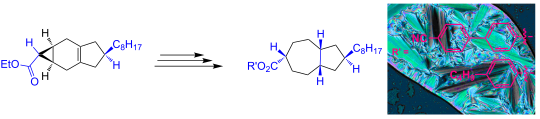
- molecular design of new liquid crystals, electro-optical properties can now be predicted quite precisely based on molecular modeling [1][2]. However, full evaluation of the value of a new structure is still only possible after synthesis. In the past few years many attempts have been made to improve the


Imidazole as a parent π-conjugated backbone in charge-transfer chromophores
Beilstein J. Org. Chem. 2012, 8, 25–49, doi:10.3762/bjoc.8.4
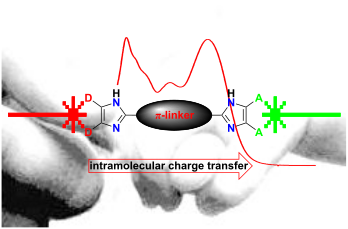
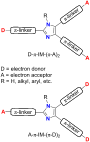
- intramolecular charge transfer (ICT) are reviewed. Design, synthetic pathways, linear and nonlinear optical properties, electrochemistry, structure–property relationships, and the prospective application of such D-π-A organic materials are described. This review focuses on Y-shaped imidazoles, bi- and
- due to a more difficult synthesis. The purpose of this article is to review the recent progress in the design, development, and investigation of imidazole-derived charge-transfer chromophores. Synthetic pathways, linear and nonlinear optical properties, electrochemistry, and the prospective
- investigated in terms of their synthesis and basic (non)linear optical properties [42][43][44][45][46]. Wu et al. utilized 4,5-bis(4-aminophenyl)imidazole as a suitable donor moiety for the construction of the nitro C2-substituted imidazole push–pull systems with extended and varied π-conjugated pathway 15a–g




Sexithiophenes as efficient luminescence quenchers of quantum dots
Beilstein J. Org. Chem. 2011, 7, 1722–1731, doi:10.3762/bjoc.7.202

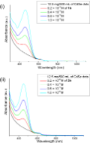
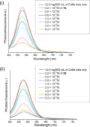
- separation potentials of 1b in the solid state compared to 2b. The HOMO–LUMO gap was determined from the difference in the onsets for the reduction and first-oxidation processes. Comparison of the optical properties of 1a, 1b, 2a and 2b in solution and solid state. The HOMO–LUMO gap was determined from the


Synthesis and self-assembly of 1-deoxyglucose derivatives as low molecular weight organogelators
Beilstein J. Org. Chem. 2011, 7, 234–242, doi:10.3762/bjoc.7.31
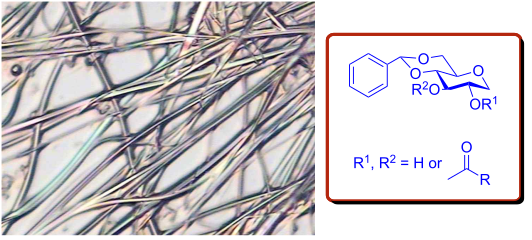
- gels into another stable conformation. The study indicated that the formation of diacetylene gel is an effective method to obtain polydiacetylenes with interesting optical properties. Conclusion We have synthesized a series of 1-deoxy glucose derived esters, and screened their gelation in several





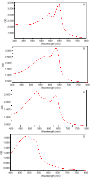
Conjugated polymers containing diketopyrrolopyrrole units in the main chain
Beilstein J. Org. Chem. 2010, 6, 830–845, doi:10.3762/bjoc.6.92
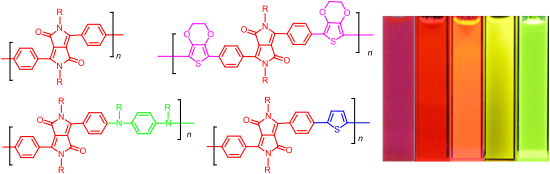
- -position). While the optical properties were quite similar, the EL properties were inferior. This was ascribed to a reduced conjugation length in these polymers. Novel vinyl ether-functionalized polyfluorenes for active incorporation in common photoresist materials were described by Kühne et al. [35] Among
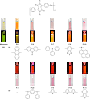
- versus voltage of polymer light-emitting diode containing P-5: ITO/P-5/OXD7/Ca/Mg:Al:Zn (from [28]). Optical properties of some diphenylDPP-based conjugated polymers. Optical properties of copolymers P-21 and P-22 based on two isomeric diphenylDPP monomer units (from [48]). Absorption




Polar tagging in the synthesis of monodisperse oligo(p-phenyleneethynylene)s and an update on the synthesis of oligoPPEs
Beilstein J. Org. Chem. 2010, 6, No. 57, doi:10.3762/bjoc.6.57
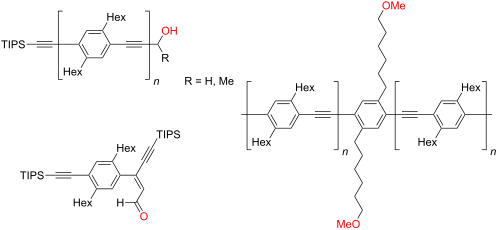
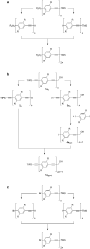
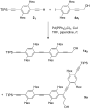
- inserted remote from the polyconjugated backbone in order not to change the optical properties of the oligomers. Polar tagging with e.g. the rather inert ether moiety within the side chains at a site distant from the backbone appears to us a generally useful concept for the synthesis of mesoscopic




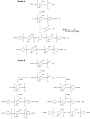
Synthetic incorporation of Nile Blue into DNA using 2′-deoxyriboside substitutes: Representative comparison of (R)- and (S)-aminopropanediol as an acyclic linker
Beilstein J. Org. Chem. 2010, 6, No. 13, doi:10.3762/bjoc.6.13
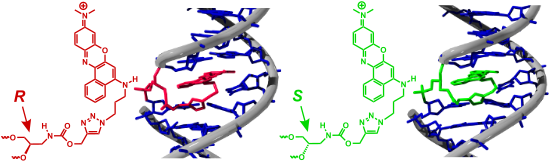
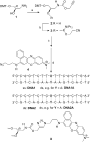
- (Scheme 1). However, we have shown that the ethidium dye connected to D-threoninol as a linker bearing three carbon atoms between the phosphodiester bridges has nearly the same optical properties as the shorter (S)-3-amino-1,2-propanediol linker [38]. It is important to point out, however, that chirality
- explore how important the chirality of the 3-amino-1,2-propanediol linker is with respect to the optical properties of an attached fluorophore. We chose Nile Blue as the fluorescent probe for these experiments since the redox properties of this phenoxazinium label exhibit a potential sufficient for
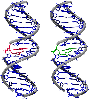
- has no significant influence on the optical properties since the absorption spectra are remarkably similar. The latter result is similar to the S-configured linker [16]. All results together indicate once more that it does not matter if an S- or R-configured acyclic linker system is used to attach




Synthesis of indolo[3,2-b]carbazole-based new colorimetric receptor for anions: A unique color change for fluoride ions
Beilstein J. Org. Chem. 2010, 6, No. 12, doi:10.3762/bjoc.6.12
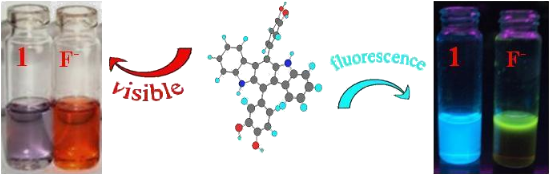
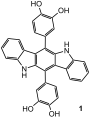
- ), and not hydrogen bonding to it, is responsible for the drastic color change [47], as a result of a change in the optical properties of chromogenic indolocarbazole skeleton. This is in agreement with the NMR titration data. Such deprotonation was related to the acidity of the H-bond donor site and the




Other Beilstein-Institut Open Science Activities



