


Search results
Search for "terminal alkyne" in Full Text gives 156 result(s) in Beilstein Journal of Organic Chemistry.
Low temperature enantiotropic nematic phases from V-shaped, shape-persistent molecules
Beilstein J. Org. Chem. 2009, 5, No. 73, doi:10.3762/bjoc.5.73
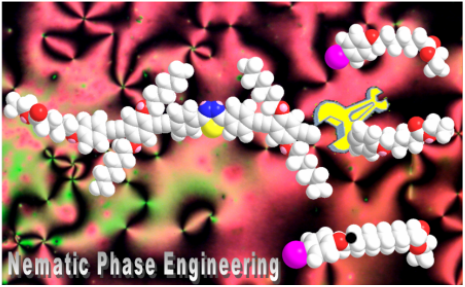
- were evaluated using the datasqueeze software (http://www.datasqueezesoftware.com/). General method for preparation of intermediate products 3a–e The mixture of 1.0 equiv of thiadiazole 7, 1.0 equiv of the corresponding terminal alkyne 6a–e, 0.1 equiv of Pd(PPh3)4 and 0.05 equiv of CuI in piperidine is



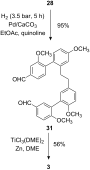
Ring strain and total syntheses of modified macrocycles of the isoplagiochin type
Beilstein J. Org. Chem. 2009, 5, No. 71, doi:10.3762/bjoc.5.71
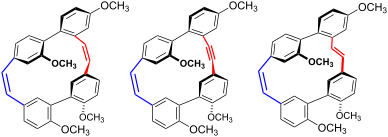
- [22]. The aldehyde 13 was transformed into the terminal alkyne 14 by chain extension [23] (Scheme 3). The coupling of the terminal alkyne 14 with the iodoarene 15 [24] as the “c” building block using a typical Sonogashira protocol [Pd(PPh3)4, CuI, Et3N] gave – even under an argon–hydrogen atmosphere
- , (*): configurationally semi-stable; o: configurationally unstable). Strategy of synthesis for the macrocycles 5–7. Preparation of the terminal alkyne 13 as a–b part (TBATB = tetrabutylammonium tribromide). Sonogashira-type coupling to the tolane 16. Synthesis of the d building blocks 21 and 26. aThe original procedure




Pd/C-mediated synthesis of α-pyrone fused with a five-membered nitrogen heteroaryl ring: A new route to pyrano[4,3-c]pyrazol-4(1H)-ones
Beilstein J. Org. Chem. 2009, 5, No. 64, doi:10.3762/bjoc.5.64

- reaction of amine 4 to introduce the iodo group on the pyrazole ring followed by hydrolysis of the ester 5 yielded the desired acid 1. Our study started with the reaction of iodo acid 1 with a terminal alkyne, e.g. 1-hexyne (2a) and the results are summarized in Table 1. Due to our earlier success in the
- , all the terminal alkynes participated well in this coupling-cyclization reaction affording the desired products in moderate to good yields. Various substituents such as alkyl, hydroxyalkyl or aryl groups present in the terminal alkyne were well tolerated. The use of arylalkynes (Entries 7 and 8, Table
- reaction proceeds via a C–C bond forming reaction between the halide 1 and the terminal alkyne 2 in the presence of Pd(0) generated in situ. The resulting alkyne Z (Scheme 3) thus formed subsequently undergoes 6-endo-dig ring closure in an intramolecular fashion to give the desired product 3. A favorable


Pd/C- Mediated synthesis of indoles in water
Beilstein J. Org. Chem. 2009, 5, No. 46, doi:10.3762/bjoc.5.46

- -iodoanilide 1 was treated with terminal alkyne 2 (3.0 equiv) in water in the presence of 10% Pd/C (0.03 equiv), PPh3 (0.12 equiv), CuI (0.06 equiv) and 2-aminoethanol (3.0 equiv) under nitrogen, 2-substituted indoles 3 were obtained in good yields (Scheme 1). The details of this study are summarized in Table
- entry 1, Table 1) confirming the requirement for an excess amount of terminal alkyne to achieve the best yield of the desired product. We have also examined the use of a basic iodoaniline such as N-methyl substituted 2-iodoaniline in the present coupling reaction with terminal alkynes. Isolation of 2


Regioselective alkynylation followed by Suzuki coupling of 2,4-dichloroquinoline: Synthesis of 2-alkynyl- 4-arylquinolines
Beilstein J. Org. Chem. 2009, 5, No. 32, doi:10.3762/bjoc.5.32

- . (a) arylation at C-4 followed by alkynylation at C-2 or (b) alkynylation at C-2 followed by arylation at C-4. Methodologies based on strategy ‘a’ have been reported earlier. For example, Sonogashira coupling of a terminal alkyne with 2-chloro-4-aryl substituted quinoline [3] in the presence of (PPh3


The use of silicon- based tethers for the Pauson- Khand reaction
Beilstein J. Org. Chem. 2007, 3, No. 21, doi:10.1186/1860-5397-3-21
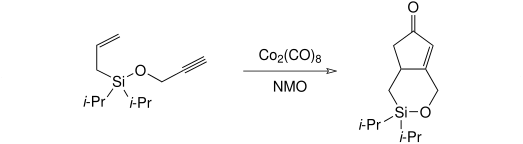
- low yields could be improved by optimizing the reaction conditions and finding a better way to add the second arm to the acetal, such as a catalytic method, avoiding the need for the bromosilane intermediate. This reaction was repeated using 3-butyn-1-ol to yield the isomeric, terminal alkyne product


Other Beilstein-Institut Open Science Activities



