


Search results
Search for "transition-metal-catalyzed" in Full Text gives 270 result(s) in Beilstein Journal of Organic Chemistry. Showing first 200.
Palladium-catalyzed ortho-halogenations of acetanilides with N-halosuccinimides via direct sp2 C–H bond activation in ball mills
Beilstein J. Org. Chem. 2018, 14, 430–435, doi:10.3762/bjoc.14.31
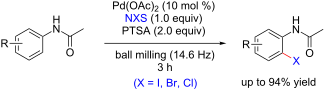
- construction of C–X bonds. With the development of transition-metal-catalyzed cross-coupling reactions, a series of halogenations at the ortho-position of the directing groups have been disclosed [5][6][7][8][9][10][11][12][13][14][15][16][17][18]. Nevertheless, from the viewpoint of green chemistry, the


Comparative profiling of well-defined copper reagents and precursors for the trifluoromethylation of aryl iodides
Beilstein J. Org. Chem. 2017, 13, 2297–2303, doi:10.3762/bjoc.13.225
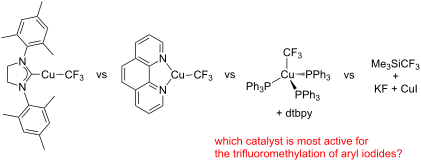
- bear the trifluoromethyl group have great importance in the life sciences and materials fields as well as discovery chemistry in general [1][2][3]. Consequently, transition-metal-catalyzed methods for preparing aromatic trifluoromethyl compounds from readily available aryl halides are an area that has


Synthesis of substituted Z-styrenes by Hiyama-type coupling of oxasilacycloalkenes: application to the synthesis of a 1-benzoxocane
Beilstein J. Org. Chem. 2017, 13, 2122–2127, doi:10.3762/bjoc.13.209

- ; palladium; silicon; Introduction The development of transition metal-catalyzed cross-coupling technologies over the last four decades revolutionized the synthetic chemistry. Indeed, the importance of Pd-catalyzed coupling was recognized with the 2010 Nobel Prize awarded to Heck, Negishi and Suzuki [1][2


Difunctionalization of alkenes with iodine and tert-butyl hydroperoxide (TBHP) at room temperature for the synthesis of 1-(tert-butylperoxy)-2-iodoethanes
Beilstein J. Org. Chem. 2017, 13, 2023–2027, doi:10.3762/bjoc.13.200
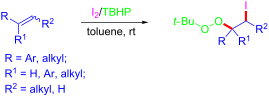
- starting materials in a single operation [1][2][3][4][5][6]. Traditional studies have mainly focused on transition-metal-catalyzed direct vicinal difunctionalization of alkenes by installing two substituents across the C=C double bond to form two new bonds or two new functional groups [7][8][9], such as


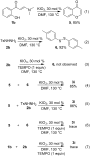
Transition-metal-free synthesis of 3-sulfenylated chromones via KIO3-catalyzed radical C(sp2)–H sulfenylation
Beilstein J. Org. Chem. 2017, 13, 2017–2022, doi:10.3762/bjoc.13.199

- . Presently, the most popular approaches in constructing a C(sp2)–S bond are the transition-metal-catalyzed Ullmann C–S coupling reaction [4][5][6][7][8], Chan–Lam cross-coupling reaction [9][10][11][12] as well as the transition-metal-catalyzed C–H bond activation [13][14][15]. Recently, as a new trend, the


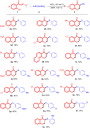

Solvent-free and room temperature synthesis of 3-arylquinolines from different anilines and styrene oxide in the presence of Al2O3/MeSO3H
Beilstein J. Org. Chem. 2017, 13, 1977–1981, doi:10.3762/bjoc.13.193
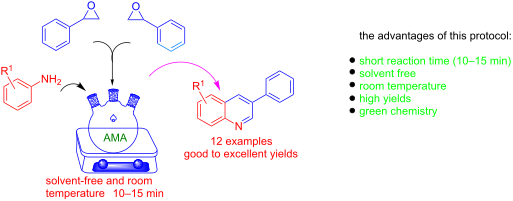
- ]. Transition metal-catalyzed processes [5][6][7][8] and metal-free paths [9][10][11] are two general approaches for the synthesis of this type of compounds. However, the existing methods suffer from complicated multistep processes, limited availability of substrates, toxic organic solvents, long reaction times


Mechanochemical synthesis of small organic molecules
Beilstein J. Org. Chem. 2017, 13, 1907–1931, doi:10.3762/bjoc.13.186
- ]. Advantageously this methodology was applicable for both solid and liquid olefins. Mechanochemical C–H functionalization Transition-metal-catalyzed activation and functionalization of inert C–H bonds of organic molecules provides a broad avenue in the synthesis of wide range of compounds. In 2015, Bolm and co


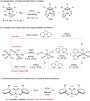


Synthesis of benzothiophene and indole derivatives through metal-free propargyl–allene rearrangement and allyl migration
Beilstein J. Org. Chem. 2017, 13, 1866–1870, doi:10.3762/bjoc.13.181

- (Figure 1) [7][8][9]. Moreover, benzothiophenes have extensive applications in materials science. Besides the traditional methods of transition metal-catalyzed cyclization of alkyne substrates [10][11][12], the synthesis of benzothiophenes via metal-free conditions has recently aroused much attention [13




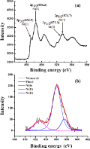
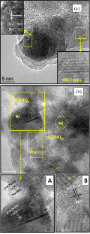
Ni nanoparticles on RGO as reusable heterogeneous catalyst: effect of Ni particle size and intermediate composite structures in C–S cross-coupling reaction
Beilstein J. Org. Chem. 2017, 13, 1796–1806, doi:10.3762/bjoc.13.174

- showing comparative catalytic efficiency and NP sizes). Mechanistically, the transition-metal-catalyzed C–S cross-coupling reaction, using mainly Pd, Cu or Ni species, is believed to proceed through three major steps; viz. the initial oxidative addition, then substitution by thiolate anion and finally the




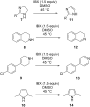
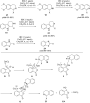
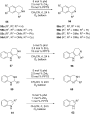
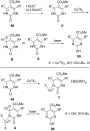
Oxidative dehydrogenation of C–C and C–N bonds: A convenient approach to access diverse (dihydro)heteroaromatic compounds
Beilstein J. Org. Chem. 2017, 13, 1670–1692, doi:10.3762/bjoc.13.162
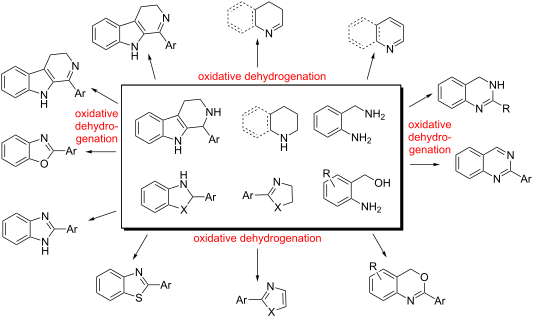
- section we turn our attention to transition metal-catalyzed aerobic dehydrogenation of C–C and C–N bonds. Molecular oxygen is well established as an oxidant for oxidative dehydrogenation of heterocycles. These reactions occur under open air or excess oxygen pressure. They are classified as aerobic










Encaging palladium(0) in layered double hydroxide: A sustainable catalyst for solvent-free and ligand-free Heck reaction in a ball mill
Beilstein J. Org. Chem. 2017, 13, 1661–1668, doi:10.3762/bjoc.13.160
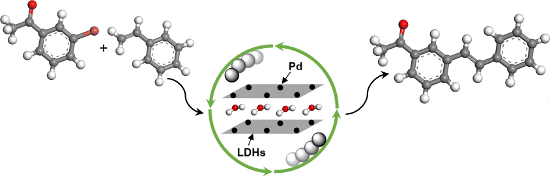
- easily recovered and reused for at least five times without significant loss of catalytic activity. Keywords: ball milling; Heck reaction; layer double hydroxides; solvent-free; supported Pd catalyst; Introduction High-speed ball milling (HSBM)-assisted transition metal-catalyzed cross-coupling reactions


Base-promoted isomerization of CF3-containing allylic alcohols to the corresponding saturated ketones under metal-free conditions
Beilstein J. Org. Chem. 2017, 13, 1507–1512, doi:10.3762/bjoc.13.149

- -unsaturated ketones (E)-5 was successfully extended to the transformation of allylic alcohols (E)-6 to saturated ketones 7. Different from the previously reported transition metal-catalyzed protocols by Cahard [8][9][13] and Liu [10][11][12], our transformation nicely proceeded with such a convenient and


Synthesis of novel 13α-estrone derivatives by Sonogashira coupling as potential 17β-HSD1 inhibitors
Beilstein J. Org. Chem. 2017, 13, 1303–1309, doi:10.3762/bjoc.13.126

- . There are literature reports about similar transition-metal-catalyzed cyclizations of o-alkynylphenols to construct benzofurans [34][35]. These heterocycles are important structural units in a variety of biologically active natural or synthetic compounds [36][37]. Full hydrogenation of the 2- or 4


Strategies toward protecting group-free glycosylation through selective activation of the anomeric center
Beilstein J. Org. Chem. 2017, 13, 1239–1279, doi:10.3762/bjoc.13.123

- . What will certainly be interesting in the future if a more in depth mechanism can be discerned. 3.4 Transition metal-catalyzed glycosylation The metal-catalyzed activation of the anomeric center has been employed in carbohydrate chemistry for many decades and continues to be a very rapidly expanding
- this section we highlight some very elegant examples of transition metal-catalyzed glycosylation strategies that have been successful even in the presence of other unprotected hydroxy groups in the molecules. 3.4.1 Au(III)–alkynyl complexation: The Finn group [62] developed a protecting-group-free Au


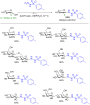
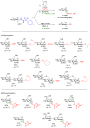


An eco-compatible strategy for the diversity-oriented synthesis of macrocycles exploiting carbohydrate-derived building blocks
Beilstein J. Org. Chem. 2017, 13, 1106–1118, doi:10.3762/bjoc.13.110
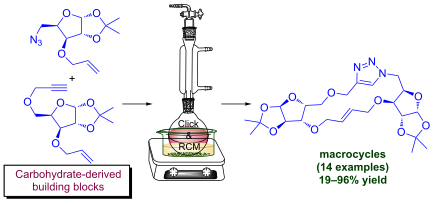
- transition-metal-catalyzed coupling reactions [19]. Recently, ring-closing alkyne metathesis (RCAM) [20][21] and ring closing metathesis (RCM) [22][23][24][25][26][27][28][29][30][31] have emerged as very powerful tools for macrocyclization including for the preparation of peptidomimetic [17][18][32


α-Acetoxyarone synthesis via iodine-catalyzed and tert-butyl hydroperoxide-mediateded self-intermolecular oxidative coupling of aryl ketones
Beilstein J. Org. Chem. 2017, 13, 1079–1084, doi:10.3762/bjoc.13.107

- transition-metal-catalyzed direct oxidative coupling reactions of carbonyl compounds with carboxylic acids (or their surrogates) [8][9]. Recently, robust approaches using organohypervalent iodine reagents and peroxide-mediated oxidative coupling have been developed [10][11]. Although impressive progress has


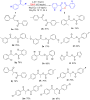


Transition-metal-catalyzed synthesis of phenols and aryl thiols
Beilstein J. Org. Chem. 2017, 13, 589–611, doi:10.3762/bjoc.13.58

- building blocks in organic synthesis and final products with interesting biological activities. Over the past decades, substantial progress has been made in transition-metal-catalyzed coupling reactions, which resulted in the emergence of new methods for the synthesis of phenols and aryl thiols. Aryl
- methods for the synthesis of these two important classes of compounds. Herein, we review the recent developments on transition-metal-catalyzed syntheses of phenols from aryl halides and arenes, and aryl thiols from aryl halides. Review 1 Transition-metal-catalyzed synthesis of phenols In early times
- , high temperatures, a narrow substrate scope, low selectivity, and/or low yields. Inspired by the classic Ullmann reaction [15][16], the development of a transition-metal-catalyzed C–O coupling reaction provides various strategies to synthesize C–O-coupled products including ethers and phenols. On the


Effect of the ortho-hydroxy group of salicylaldehyde in the A3 coupling reaction: A metal-catalyst-free synthesis of propargylamine
Beilstein J. Org. Chem. 2017, 13, 552–557, doi:10.3762/bjoc.13.53

- known as A3 coupling reaction, remains the most common and straightforward method for the synthesis of propargylamine. The A3 coupling reaction is reported under transition-metal-catalyzed conditions using copper [12][17][18][19], gold [17][20][21], silver [17][22], zinc [17][23], nickel [24], iron [25


The reductive decyanation reaction: an overview and recent developments
Beilstein J. Org. Chem. 2017, 13, 267–284, doi:10.3762/bjoc.13.30
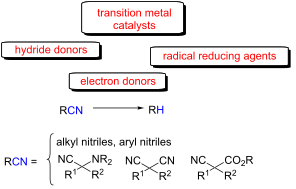
- charge on the carbon adjacent to the cyano group [76][77]. Transition-metal-catalyzed reductive decyanation Hydrogenation of α-aminonitriles The decyanation of α-aminonitriles with hydrogen present in an excess of Raney nickel was described by Husson and co-workers on oxazolidine derivatives [83][84
- on transition-metal-catalyzed reactions focuses on selected examples that show the wide scope of reduced substrates including alkyl cyanides, challenging substrates due to their propensity to undergo β-hydride elimination from alkylmetal intermediates. Nakazawa et al. reported the photoinduced C–CN
- [9], new and convenient synthetic methods have now emerged. Classical metal dissolving conditions are still used but the method, while it works, shows that the course of the reaction may strongly depend on reaction conditions. The transition-metal-catalyzed defunctionalization reactions cover a wide


Copper-catalyzed asymmetric sp3 C–H arylation of tetrahydroisoquinoline mediated by a visible light photoredox catalyst
Beilstein J. Org. Chem. 2016, 12, 2636–2643, doi:10.3762/bjoc.12.260
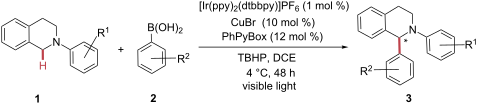
- providing extremely important tools for potential transition-metal-catalyzed enantioselective reactions of sp3 C–H bonds, which could be carried out at low temperature and under mild reaction conditions [13][14]. We envisioned that combining photoredox catalysis with typical cross-coupling methods will


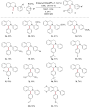


Rapid regio- and multi-coupling reactivity of 2,3-dibromobenzofurans with atom-economic triarylbismuths under palladium catalysis
Beilstein J. Org. Chem. 2016, 12, 2065–2076, doi:10.3762/bjoc.12.195

- ambipolar materials (CZBDF, Figure 1c) [16]. To note, synthetic functionalization under transition-metal-catalyzed conditions allows the preparation of multi-substituted benzofurans in a facile manner [23][24][25][26][27][28]. Langer et al. reported the site-selective Suzuki–Miyaura reaction of 2,3


Unusual reactions of diazocarbonyl compounds with α,β-unsaturated δ-amino esters: Rh(II)-catalyzed Wolff rearrangement and oxidative cleavage of N–H-insertion products
Beilstein J. Org. Chem. 2016, 12, 1904–1910, doi:10.3762/bjoc.12.180
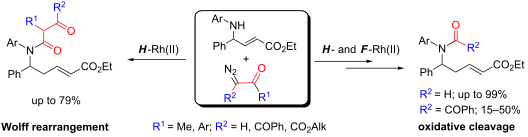
- ; transition-metal-catalyzed reactions; Wolff rearrangement; Introduction Transition-metal-catalyzed reactions of diazocarbonyl compounds (DCC) with different organic substrates comprise a powerful tool of organic synthesis [1][2][3][4][5][6][7][8]. Of prime importance was found to be the ability of reactive
- bonds in the structure of α-aminocarbonyl compounds is also a well-known transition-metal-catalyzed process, which gives rise to the occurrence of formamides and carboxylic acids [26][29]. In this case the system O2/TEMPO is used as a catalyst for the cleavage process, but the reaction also proceeds


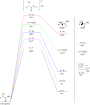
On the cause of low thermal stability of ethyl halodiazoacetates
Beilstein J. Org. Chem. 2016, 12, 1590–1597, doi:10.3762/bjoc.12.155

- transition metal-catalyzed reactions [5]. A large number of diazo esters have been synthesized and an order has been arranged for α-substituents that increase the stability of the diazoesters [3]. Halogen substituents are completely absent from this list of α-substituents. Hence, the relative position of




One-pot synthesis of 4′-alkyl-4-cyanobiaryls on the basis of the terephthalonitrile dianion and neutral aromatic nitrile cross-coupling
Beilstein J. Org. Chem. 2016, 12, 1577–1584, doi:10.3762/bjoc.12.153

- acylation–reduction–halogenation–cyanodehalogenation (Scheme 1) [15], are currently being replaced with methods based on transition-metal-catalyzed biaryl cross-coupling [16][17][18][19][20][21]. This methodology is well developed, compatible with different substituents in the substrate and opens up a new


Synthesis of 2-substituted tetraphenylenes via transition-metal-catalyzed derivatization of tetraphenylene
Beilstein J. Org. Chem. 2016, 12, 1302–1308, doi:10.3762/bjoc.12.122
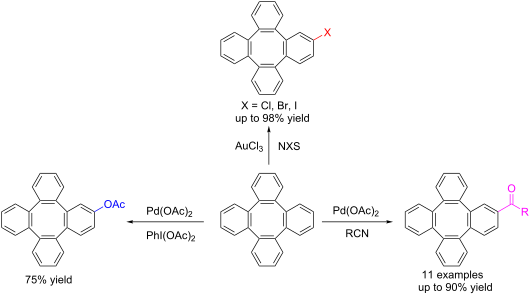
- tetraphenylenes through a transition-metal-catalyzed derivatization has been developed. Three types of functionalities, including OAc, X (Cl, Br, I) and carbonyl, were introduced onto tetraphenylene, which allows the easy access to a variety of monosubstituted tetraphenylenes. These reactions could accelerate
- ][29][30][31][32][33][34][35][36][37][38][39][40][41][42]. While most of these traditional approaches suffer from harsh conditions or complicated procedures, a novel strategy via transition-metal-catalyzed C–H activation has attracted great attention and emerged as a powerful methodology for the
- transition-metal-catalyzed derivatization of tetraphenylene, which provide a new method for the synthesis of 2-substituted tetraphenylenes. Results and Discussion The acetoxy group is an important functional group because it can be transformed into a variety of other functionalities [46][47], thus making the





