


Search results
Search for "chemoselectivity" in Full Text gives 190 result(s) in Beilstein Journal of Organic Chemistry.
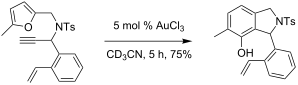
High chemoselectivity in the phenol synthesis
Beilstein J. Org. Chem. 2011, 7, 794–801, doi:10.3762/bjoc.7.90


Palladium- and copper-mediated N-aryl bond formation reactions for the synthesis of biological active compounds
Beilstein J. Org. Chem. 2011, 7, 59–74, doi:10.3762/bjoc.7.10

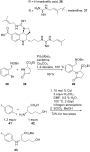
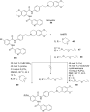
- the required stoichiometric amount of copper and the long reaction time of 3 days [42]. For detailed insight into the structural requirements of active antimycobacterial purines 90, an easy access to 9-N-arylpurines 93 was required. Complete regioselectivity, and in most cases high chemoselectivity




The allylic chalcogen effect in olefin metathesis
Beilstein J. Org. Chem. 2010, 6, 1219–1228, doi:10.3762/bjoc.6.140
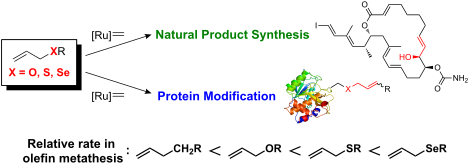
- is even compatible with amine and sulfur containing building blocks. Together with its high stability in various media and excellent chemoselectivity, olefin metathesis has been used on peptide substrates for various applications in chemical biology [5][6][7][8]. The development of water-soluble
- methyl acrylate with very high yield [25]. Remarkably, none of the possible RCM products of the diene were detected. This observed chemoselectivity was ascribed to hydrogen-bonding of the allylic hydroxy to the chloride ligand of the catalyst resulting in an intermediate alkylidene 17 which has a


Suzuki–Miyaura cross-coupling reaction of 1-aryltriazenes with arylboronic acids catalyzed by a recyclable polymer-supported N-heterocyclic carbene–palladium complex catalyst
Beilstein J. Org. Chem. 2010, 6, No. 70, doi:10.3762/bjoc.6.70
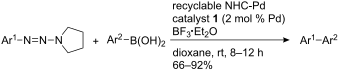
- . Various aryltriazenes were investigated as electrophilic substrates at room temperature to give biaryls in good to excellent yields and showed good chemoselectivity over aryl halides in the reactions. Keywords: 1-aryltriazenes; N-heterocyclic carbene–palladium complex; polymer-supported catalyst
- 5, entries 5, 6). Notably, good reactivity and chemoselectivity were achieved with 1-(4-bromophenyl)- and 1-(4-iodophenyl)-2-(pyrrolidin-1-yl)diazene (Table 5, entries 5, 6), showing that triazenes were more active than the corresponding aryl bromides and iodides under these reaction conditions
- , while the homogeneous Pd-phosphine catalyst system gave very low product yields with these substrates [29]. The good reactivity and chemoselectivity may allow haloaryltriazenes to be used as substrates for differential cross-coupling reactions in the same way as haloarenediazonium salts [33]. Conclusion


A short and efficient synthesis of valsartan via a Negishi reaction
Beilstein J. Org. Chem. 2010, 6, No. 27, doi:10.3762/bjoc.6.27

- , the use of organozinc compounds provides better transmetalation activity than that obtained by the use of organoboron reagents as well as good chemoselectivity since most common functional groups are not attacked by organozinc species. Although preparations of several biphenyl ring systems related to


Mitomycins syntheses: a recent update
Beilstein J. Org. Chem. 2009, 5, No. 33, doi:10.3762/bjoc.5.33

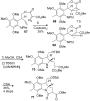
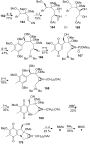
- molecule, provides the desired steroselectivity. An uncommon transformation was then accomplished: the reduction, with L-Selectride, of a lactam in the presence of a ketone. There are several causes for the unusual chemoselectivity of this reduction. The lone pair electrons of the amide nitrogen in






The development and evaluation of a continuous flow process for the lipase- mediated oxidation of alkenes
Beilstein J. Org. Chem. 2009, 5, No. 27, doi:10.3762/bjoc.5.27
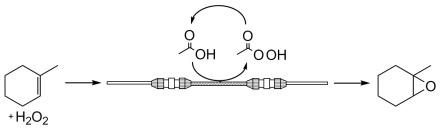
- reduced chemoselectivity observed in strongly acidic media. As a means of addressing these problems, the past 20 years has seen a series of authors investigate the use of a chemo-enzymatic process for the oxidation of olefins, based on the enzymatic formation of peracids from carboxylic acids and oxidants





N-acylation of ethanolamine using lipase: a chemoselective catalyst
Beilstein J. Org. Chem. 2009, 5, No. 10, doi:10.3762/bjoc.5.10
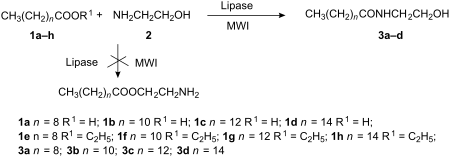
- irradiation has advantages over conventional heating (CH), in the control of reaction rate, yield, stereoselectivity or chemoselectivity [15]. Microwave assisted heating under controlled conditions is an invaluable technology for organic synthesis because it often dramatically reduces reaction times


Chemoselective reduction of aldehydes by ruthenium trichloride and resin- bound formates
Beilstein J. Org. Chem. 2008, 4, No. 53, doi:10.3762/bjoc.4.53

- ® resins; chemoselectivity; hydrogen transfer; reduction of carbonyl group; ruthenium chloride; Introduction Reduction of carbonyl functionality by transition metal-catalyzed transfer hydrogenation (CTH) with the aid of a suitable hydrogen donor is a valuable synthetic tool and has proved to be a viable


Total synthesis of the indolizidine alkaloid tashiromine
Beilstein J. Org. Chem. 2008, 4, No. 8, doi:10.1186/1860-5397-4-8
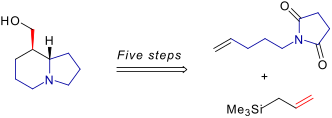
- potentially act as nucleophiles themselves in the acidic medium of the electrophilic cyclisation, and the investigation of such chemoselectivity issues provided a further impetus for this study. Acylsilane 13 was therefore prepared from propargyl alcohol in four steps then subjected to asymmetric reduction


Knorr- Rabe partial reduction of pyrroles: Application to the synthesis of indolizidine alkaloids
Beilstein J. Org. Chem. 2008, 4, No. 3, doi:10.1186/1860-5397-4-3

- was consumed to give the hexahydroindolizidine 9 as the only observable product in ~80% yield. The chemoselectivity using these modified conditions is noteworthy while the carbonyl group is fully reduced the pyrrole group is selectively and partially reduced to the 3-pyrroline. This result was


The enantiospecific synthesis of (+)-monomorine I using a 5-endo- trig cyclisation strategy
Beilstein J. Org. Chem. 2007, 3, No. 39, doi:10.1186/1860-5397-3-39
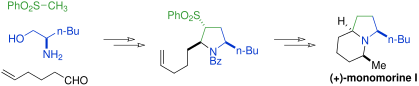
- )aziridine 9 by ring-opening with 1 followed by protecting group interchange. Although this strategy was not as elegant as utilising an N-benzoylaziridine directly, we deemed it prudent not to subject such a species to nucleophilic attack due to reported issues with chemoselectivity. [17] Careful




Microwave assisted synthesis of triazoloquinazolinones and benzimidazoquinazolinones
Beilstein J. Org. Chem. 2007, 3, No. 11, doi:10.1186/1860-5397-3-11
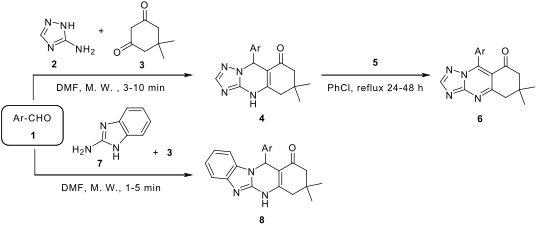
- . Analysis of the 1H NMR spectra of 4a-d provided answers on the chemoselectivity of the cyclocondensation. The δ values of the most carbon signals could be determined and assigned to the corresponding carbon atoms. For example, the 13C NMR spectrum of compound 4b revealed fourteen distinctive carbon signals


Hydrogenation of aromatic ketones, aldehydes, and epoxides with hydrogen and Pd(0)EnCat™ 30NP
Beilstein J. Org. Chem. 2006, 2, No. 15, doi:10.1186/1860-5397-2-15
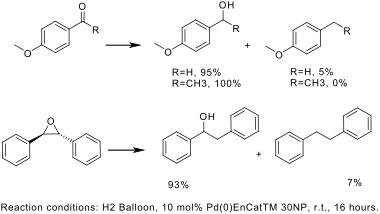
- ]. For these kind of substrates, catalysts based on Ni, Pd, and Pt have been used, and further efforts are directed toward improving the chemoselectivity and regioselectivity of this ring-opening reaction. [18][19] We now demonstrate that aryl aldehydes and ketones as well as aryl epoxides can also

Synthesis of 2,6-trans- disubstituted 5,6-dihydropyrans from (Z)-1,5-syn-endiols
Beilstein J. Org. Chem. 2005, 1, No. 7, doi:10.1186/1860-5397-1-7

- the cyclodehydration reactions of diol substrates were complicated by selectivity and reactivity issues (Figure 1 and Figure 2), we turned to an alternative strategy which would not rely on chemoselectivity in the cyclodehydration step. To this end, mesylates 11 were synthesized (Scheme 3). Treatment





