Search results
Search for "cycloadditions" in Full Text gives 259 result(s) in Beilstein Journal of Organic Chemistry. Showing first 200.
Chiral phosphines in nucleophilic organocatalysis
Beilstein J. Org. Chem. 2014, 10, 2089–2121, doi:10.3762/bjoc.10.218
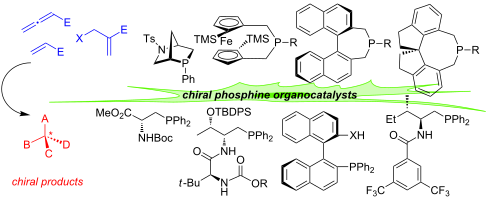
- synthesized a series of ferrocene-modified planar chiral phosphines featuring a new skeleton (Figure 3) [44][45]. Among these compounds, the P-cyclohexyl phosphine C1 proved to be the most efficient catalyst for [3 + 2] cycloadditions of ethyl 2,3-butadienoate with activated enones, fumarate esters, and
- methylenebenzofuranone derivatives, constructing a variety of complex polysubstituted spirocyclopentenebenzofuranones in high yields with good to excellent enantioselectivities [75]. Using the amino acid-derived chiral phosphine H2, Lu and co-workers explored asymmetric [3 + 2] cycloadditions between MBH carbonates and


Triazol-substituted titanocenes by strain-driven 1,3-dipolar cycloadditions
Beilstein J. Org. Chem. 2014, 10, 1630–1637, doi:10.3762/bjoc.10.169

- the synthesis of triazole-substituted titanocenes via strain-driven 1,3-dipolar cycloadditions between azide-functionalized titanocenes and cyclooctyne has been developed. It features the first synthesis of titanocenes containing azide groups. These compounds constitute ‘second-generation
- active complexes allows the identification of structural features essential for biological activity. Keywords: azides; click-chemistry; cycloadditions; cytotoxicity; titanocenes; Introduction Group 4 metallocenes and derivatives of Cp2TiCl2, in particular, continue to be in the focus of contemporary
- nucleophiles. We decided to address these issues by employing cationic amide-substituted titanocenes as building blocks and strain-driven 1,3-dipolar cycloadditions [34][35][36][37][38][39][40] as synthetic methodology for the preparation of such ‘second-generation’ functional titanocenes. This line of action


Synthesis of the first examples of iminosugar clusters based on cyclopeptoid cores
Beilstein J. Org. Chem. 2014, 10, 1406–1412, doi:10.3762/bjoc.10.144
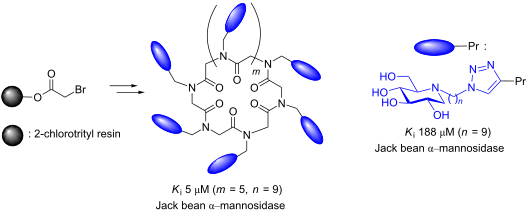
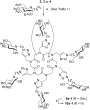
- with different valency and alkyl spacer lengths by means of Cu(I)-catalysed azide–alkyne cycloadditions. Evaluation of these compounds as α-mannosidase inhibitors led to significant multivalent effects and further demonstrated the decisive influence of scaffold rigidity on binding affinity enhancements




Molecular recognition of surface-immobilized carbohydrates by a synthetic lectin
Beilstein J. Org. Chem. 2014, 10, 1354–1364, doi:10.3762/bjoc.10.138
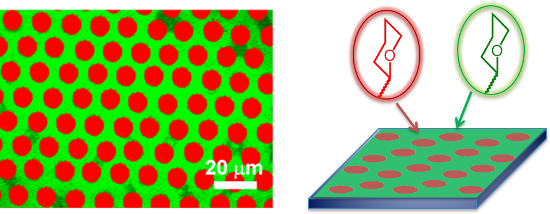
- -terminated SAMs [33], by Diels–Alder reaction of cyclopentadienes and furans on maleimide-terminated SAMs [34], by thiol–ene click reaction of functionalized thiols on alkene-terminated SAMs [35] as well as by strain promoted cycloadditions on azide- and nitriloxide-terminated SAMs [36] using μCP. Homogenous


Cyclization–endoperoxidation cascade reactions of dienes mediated by a pyrylium photoredox catalyst
Beilstein J. Org. Chem. 2014, 10, 1272–1281, doi:10.3762/bjoc.10.128
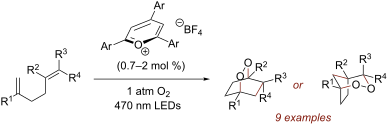
- challenges. Classical approaches to the introduction of cyclic peroxides typically rely on cycloadditions of alkenes and dienes with singlet oxygen. However, ene processes can often compete, leading to complex mixtures of hydroperoxide adducts [1][6][7][8]. More recently, cyclization reactions of


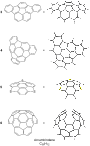
Site-selective covalent functionalization at interior carbon atoms and on the rim of circumtrindene, a C36H12 open geodesic polyarene
Beilstein J. Org. Chem. 2014, 10, 956–968, doi:10.3762/bjoc.10.94
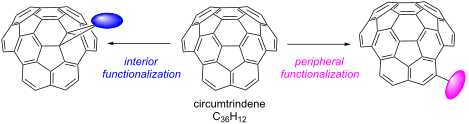
- side electronically more favorable for a nucleophilic attack. Prato reaction Cycloadditions to the π-system constitute another major family of fullerene reactions. In particular, 1,3-dipolar reagents readily add to the 6:6-bond of fullerene C60, which acts as a good dipolarophile. Among such [3 + 2
- ] cycloadditions, the reaction with azomethine ylides has found great popularity, because it leads to versatile pyrrolidine derivatives of C60. The sources of the ylide can be iminium salts, aziridines, oxazolidines or silylated iminium compounds. In 1993, Prato and coworkers developed the protocol that is now




N-Alkylated dinitrones from isosorbide as cross-linkers for unsaturated bio-based polyesters
Beilstein J. Org. Chem. 2014, 10, 902–909, doi:10.3762/bjoc.10.88

- electron spin traps [1] and in cycloaddition reactions [2]. As nitrones undergo 1,3-dipolar cycloadditions under mild conditions with a variety of unsaturated substances with a catalyst [3][4] or without a catalyst [5] they are important for the synthetic accessibility of five-membered heterocycles
- isoxazolidines 5a/b (Scheme 3). From the NMR spectra it could be determined that only the 5-substituted isoxazolidine was formed with a ratio of 60/40 of Z/E. Although 1,3-dipolar cycloadditions of nitrones with alkenes are controlled by molecular orbital interactions, the steric character of the molecular
- . 1,3-dipolar cycloadditions of model nitrones with dimethyl itaconate confirmed the proposed mechanism of cross-linking. Experimental Materials Acryloyl chloride (97%), crotonic acid (98%), itaconic acid (IA, 97%), methyl acrylate (99%), methyl crotonate (98%), succinic acid (SA, 99%), p


Aza-Diels–Alder reaction between N-aryl-1-oxo-1H-isoindolium ions and tert-enamides: Steric effects on reaction outcome
Beilstein J. Org. Chem. 2014, 10, 848–857, doi:10.3762/bjoc.10.81
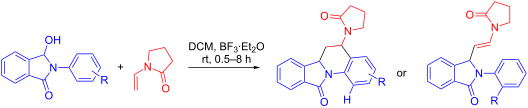
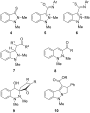
- isoindolo[2,1-a]quinolone derivatives involves N-acyliminium ions or appropriate electron-deficient Schiff bases and subsequent [4 + 2] inverse-demand hetero-Diels–Alder cycloadditions with alkenes [11][12][13][14][15][16][17]. Vinylic systems from isoeugenol [11], cyclopentadiene [12], enones [13], vinyl


Dimerisation, rhodium complex formation and rearrangements of N-heterocyclic carbenes of indazoles
Beilstein J. Org. Chem. 2014, 10, 832–840, doi:10.3762/bjoc.10.79
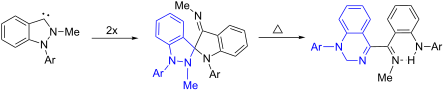
- betaines by inter- or intramolecular cycloadditions are typical reactions [18][19]. To prove the initial formation of an N-heterocyclic carbene in this reaction we tried trapping reactions starting from 12a and 12e with carbonylbis(triphenylphosphine)rhodium(I) chloride under otherwise unchanged reaction






Domino reactions of 2H-azirines with acylketenes from furan-2,3-diones: Competition between the formation of ortho-fused and bridged heterocyclic systems
Beilstein J. Org. Chem. 2014, 10, 784–793, doi:10.3762/bjoc.10.74

- ]. In particular, unsubstituted acylketenes, the reactivity of which towards azirines is until now unknown, cannot be generated from diazo compounds. An alternative source of acylketenes can be furan-2,3-diones, which have been used in reactions with nucleophiles and various cycloadditions [30][31][32


Isocyanide-based multicomponent reactions towards cyclic constrained peptidomimetics
Beilstein J. Org. Chem. 2014, 10, 544–598, doi:10.3762/bjoc.10.50

- subsequent transformations [19][22][26]. Examples of IMCR orthogonal species or functionalities are alkenes, alkynes and azides which may give the cyclic analogues via subsequent ring closing metathesis (RCM) or 1,3-dipolar cycloadditions. In contrast, protected functional groups first require a deprotection


Preparation of new alkyne-modified ansamitocins by mutasynthesis
Beilstein J. Org. Chem. 2014, 10, 535–543, doi:10.3762/bjoc.10.49
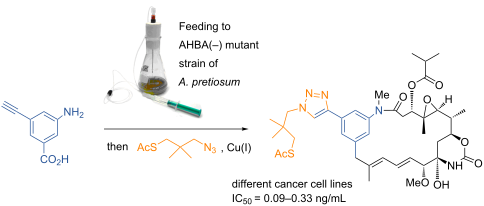
- cycloadditions better known as “copper mediated Click-chemistry” while alkenes, especially vinyl- and allylbenzoic systems, are predestined for being utilized in cross metathesis reactions. Therefore a series of aminobenzoic acids 9–20 (Figure 1) were prepared (see Supporting Information File 1). We expected


Silver and gold-catalyzed multicomponent reactions
Beilstein J. Org. Chem. 2014, 10, 481–513, doi:10.3762/bjoc.10.46
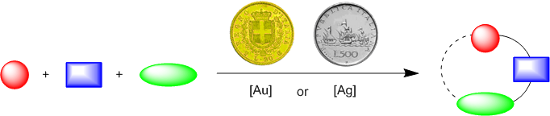
- -type reactions, hetero Diels–Alder reactions, 1,3-dipolar cycloadditions and nitroso aldol reactions [93]. The process was firstly accomplished with preformed aryl-substituted aldimines [94] and then developed as a MCR for less stable alkyl-substituted aldimines, which were prepared in situ from


Additive-assisted regioselective 1,3-dipolar cycloaddition of azomethine ylides with benzylideneacetone
Beilstein J. Org. Chem. 2014, 10, 352–360, doi:10.3762/bjoc.10.33

- Chuqin Peng Jiwei Ren Jun-An Xiao Honggang Zhang Hua Yang Yiming Luo School of Chemistry and Chemical Engineering, Central South University,Changsha, Hunan 410083, P. R. China 10.3762/bjoc.10.33 Abstract 1,3-Dipolar cycloadditions of isatins, benzylamine and benzylideneacetones were studied to
- employed as starting materials to conduct 1,3-dipolar cycloadditions to yield spirooxindole core structures [16][17][18][19][20]. Owing to the ease of preparation, the azomethine ylides generated from isatin with α-amino acids or amines were frequently chosen as important 1,3-dipolar intermediates to react
- -constructed pyrrolidine. However, unsaturated ketones with α-hydrogens such as benzylideneacetone, which have attracted great interest due to their synthetic potential [40][41][42], have not been exhaustively studied as suitable dipolarophiles for 1,3-dipolar cycloadditions of azomethine ylides to prepare




Boron-substituted 1,3-dienes and heterodienes as key elements in multicomponent processes
Beilstein J. Org. Chem. 2014, 10, 237–250, doi:10.3762/bjoc.10.19

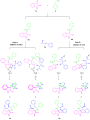
- studies on the synthesis of 2-boron-substituted 1,3-dienes and their reactivity in tandem reactions, concentrating mainly upon [4 + 2]-cycloadditions followed by cross-coupling reactions. Potassium and tetra-n-butylammonium buta-1,3-dienyl-2-trifluoroborates 15 were synthesized in good yields from
- /palladium cross-coupling sequences of a 2-diethanolaminoboron-substituted 1,3-diene 16 were investigated [52]. This diene has proved to be significantly more reactive and more regioselective in [4 + 2]-cycloadditions compared to the corresponding trifluoroborate. The cycloadducts were then efficiently cross
- ]-cycloadditons, can further be engaged in an allylation reaction that significantly increased the structural diversity of the final products (Scheme 24). As 3-boronoacrolein esters which have been used in metal-catalyzed inverse electron demand [4 + 2]-cycloadditions, 32 reacted with ethyl vinyl ether in the


Synthesis of new enantiopure poly(hydroxy)aminooxepanes as building blocks for multivalent carbohydrate mimetics
Beilstein J. Org. Chem. 2014, 10, 213–223, doi:10.3762/bjoc.10.17
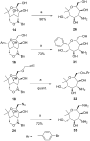
- reduction of the carbonyl group [43] and TBS cleavage, propargylic ether 18 was obtained (88% yield over two steps) [44]. The alkyne moiety provides options for further transformations, e.g. Sonogashira reactions, Glaser couplings or 1,3-dipolar cycloadditions (click reactions) [45]. We were also interested


Advancements in the mechanistic understanding of the copper-catalyzed azide–alkyne cycloaddition
Beilstein J. Org. Chem. 2013, 9, 2715–2750, doi:10.3762/bjoc.9.308
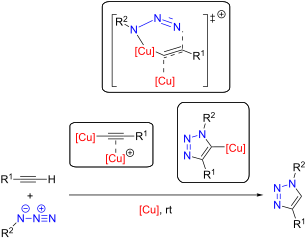
- also part of the dissertation of one of the authors [17]. The use of ligands in copper-catalyzed [3 + 2] azide–alkyne cycloadditions has recently been excellently reviewed [15][16]. Nonetheless, we will give a short outline of the reagent mixtures and copper(I) complexes commonly employed in order to




One-pot cross-enyne metathesis (CEYM)–Diels–Alder reaction of gem-difluoropropargylic alkynes
Beilstein J. Org. Chem. 2013, 9, 2688–2695, doi:10.3762/bjoc.9.305
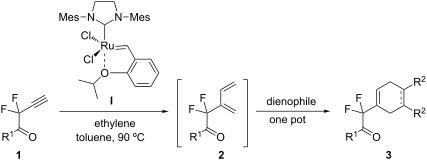
- reactions for the preparation of different difluoropropargylamides and ketones, having been subjected to intramolecular hydroaminations [23], cascade RCEYM–Diels–Alder reactions [24], [2 + 2 + 2] cycloadditions and gold-mediated dimerization reactions [25]. Although the CEYM reaction has been found to be


Synthetic scope and DFT analysis of the chiral binap–gold(I) complex-catalyzed 1,3-dipolar cycloaddition of azlactones with alkenes
Beilstein J. Org. Chem. 2013, 9, 2422–2433, doi:10.3762/bjoc.9.280
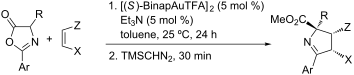
- different purposes [11][12][13][14][15][16][17]. These substrates can be easily transformed in münchnones, which are potential 1,3-dipoles, after deprotonation and imine-activation with a chiral Lewis acid. Despite of the easy access to this mesoionic heterocycles their enantioselective cycloadditions with
- additional TS’s). The computed transition structures correspond to concerted but highly asynchronous cycloadditions (Figure 4). Our calculations show that there is a different overlap between the accessible-solvent surface of the catalyst and the one of the incoming dipolarophile. That implies an increase of
- transition structures associated with the formation of C2–Cα and C5–Cβ bonds (TS11exo, TS11ent and TS11endo) correspond to concerted but highly asynchronous cycloadditions. On the other hand, TS12 is associated with a stepwise mechanism. As possible applications of the resulting pyrrolines 7aa, it was



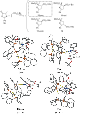


An overview of the synthetic routes to the best selling drugs containing 6-membered heterocycles
Beilstein J. Org. Chem. 2013, 9, 2265–2319, doi:10.3762/bjoc.9.265
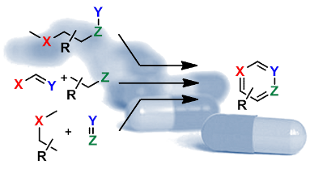
- methods utilising cycloadditions of electron-rich oxazoles and acrylates [17][18] tri- and tetrazines with alkenes/alkynes [19] or pyrones with nitriles [20] have been used successfully to access specifically functionalised pyridines which are difficult to prepare by the more direct condensation routes. A


Gold(I)-catalyzed enantioselective cycloaddition reactions
Beilstein J. Org. Chem. 2013, 9, 2250–2264, doi:10.3762/bjoc.9.264
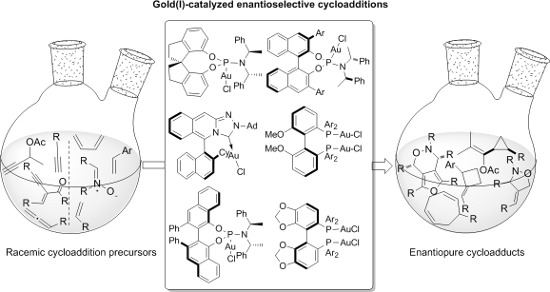
- , aldol reactions, 1,3-dipolar cycloadditions, and cyclizations [13][14][15]. Other gold-promoted asymmetric induction strategies rely on the use of chiral counterions. Indeed, it has been shown that a tight chiral ion pair with the gold cation is able to induce excellent levels of asymmetry in certain
- , cycloadditions are atom economical, and usually take place with high levels of regio- and stereocontrol. Especially relevant in terms of synthetic practicality are cycloadditions which are catalyzed by transition metal complexes [19][20][21][22][23]. In particular, gold(I) complexes, owing to their high
- carbophilicity, low oxophilicity and high oxidation potential between gold(I) and gold(III) have shown a unique potential to unveil novel types of chemoselective and stereoselective cycloadditions involving alkynes, allenes or alkenes [24][25][26]. A lot of interest has been directed to the development of these


Microflow photochemistry: UVC-induced [2 + 2]-photoadditions to furanone in a microcapillary reactor
Beilstein J. Org. Chem. 2013, 9, 2015–2021, doi:10.3762/bjoc.9.237
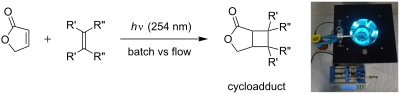
- , Takayama-cho, Ikoma, Nara 630-0101, Japan 10.3762/bjoc.9.237 Abstract [2 + 2]-Cycloadditions of cyclopentene and 2,3-dimethylbut-2-ene to furanone were investigated under continuous-flow conditions. Irradiations were conducted in a FEP-microcapillary module which was placed in a Rayonet chamber
- smaller diameter, the light transmission in the microcapillary was still superior with 53%, compared to 0.3% in the test tube. [2 + 2]-Cycloadditions with cyclopentene The photoaddition of cyclopentene (2) to 1 was subsequently investigated in detail under batch and microflow conditions (Scheme 2, Table 1
- isolation of product 3 by column chromatography was also challenging as fractions had to be analyzed by material-consuming NMR spectroscopy. [2 + 2]-Cycloadditions with 2,3-dimethylbut-2-ene Subsequent cycloadditions were performed using 2,3-dimethylbut-2-ene (4) as a reagent (Scheme 3, Table 2) [39]. In


[3 + 2]-Cycloadditions of nitrile ylides after photoactivation of vinyl azides under flow conditions
Beilstein J. Org. Chem. 2013, 9, 1745–1750, doi:10.3762/bjoc.9.201
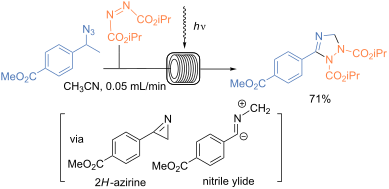
- azides 1 from alkenes 6 under flow conditions [9]. Schematic presentation of the flow set-up for the synthesis of 2H-azirines 2 under inductive heating (IH, left) and photochemical (hν, right) conditions. Photoinduced cycloadditions of vinyl azides 1a–f and electron-deficient alkenes 4a–d. All


Efficient continuous-flow synthesis of novel 1,2,3-triazole-substituted β-aminocyclohexanecarboxylic acid derivatives with gram-scale production
Beilstein J. Org. Chem. 2013, 9, 1508–1516, doi:10.3762/bjoc.9.172
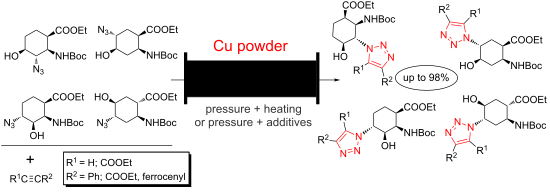
- –alkyne cycloadditions. Gramm-scale CF synthesis of triazole 22 under conditions B. CF synthesis of 1,2,3-triazole-substituted alicyclic β-amino acid derivatives. Copper contents in the triazole products after column chromatographic purification on silica gel. Supporting Information Supporting



Dipolar addition to cyclic vinyl sulfones leading to dual conformation tricycles
Beilstein J. Org. Chem. 2013, 9, 1419–1425, doi:10.3762/bjoc.9.159

- coupling partners for these cycloadditions, and in many cases the reaction rate can be enhanced through the addition of a Lewis acid that can coordinate to the carbonyl function, thereby lowering the energy of the olefin LUMO. By contrast, vinyl sulfones (with the exception of simple aryl vinyl sulfone
- species [13][14][15][16][17][18][19][20][21]) have been less-frequently employed as acceptors in 1,3-dipolar cycloadditions [22][23][24][25]. Indeed, we are only aware of a single prior example of a cyclic alkyl vinyl sulfone participating in a dipolar addition with an azomethine ylide [26]. In part, this
- pathways are open to the reactants. The additional aromatic substituent in 7 (relative to 4) once again contributed to significant broadening in both the 1H and 13C NMR spectra. Conclusion Our results comprise the first syntheses of tricyclic sulfones by 1,3-dipolar cycloadditions of azomethine imines with