


Search results
Search for "key intermediate" in Full Text gives 287 result(s) in Beilstein Journal of Organic Chemistry. Showing first 200.
Synthesis of cyclic N1-pentylinosine phosphate, a new structurally reduced cADPR analogue with calcium-mobilizing activity on PC12 cells
Beilstein J. Org. Chem. 2015, 11, 2689–2695, doi:10.3762/bjoc.11.289

- allowed the removal of both the OCE phosphate protecting groups together with the acetate function, thus obtaining the key intermediate 18 as triethylammonium salt after HPLC purification. The derivate 18, dissolved in DMF at the final concentration of 2 mM was treated with EDC (1.2 equiv) and the


Catalytic asymmetric formal synthesis of beraprost
Beilstein J. Org. Chem. 2015, 11, 2654–2660, doi:10.3762/bjoc.11.285
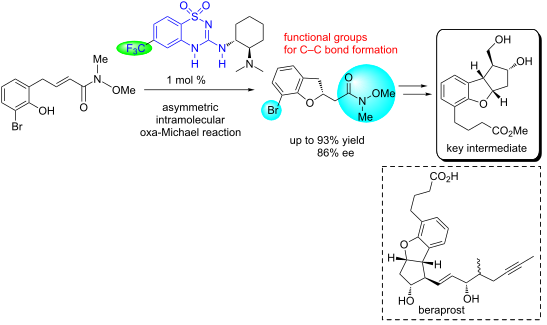
- Yusuke Kobayashi Ryuta Kuramoto Yoshiji Takemoto Graduate School of Pharmaceutical Sciences, Kyoto University, Yoshida, Sakyo-ku, Kyoto 606-8501, Japan 10.3762/bjoc.11.285 Abstract The first catalytic asymmetric synthesis of the key intermediate for beraprost has been achieved through an
- clinical application of 1, as well as the development of more active derivatives. Due to the unique tricyclic core of 1, which bears four contiguous stereocenters, various approaches for the synthesis of key intermediate 2 (Scheme 1) have been reported [14][15][16][17][18][19][20][21][22][23], including a
- few asymmetric syntheses relying on the optical resolution of racemic intermediates [16][17][18][23]. Herein we report the first catalytic asymmetric synthesis of the key intermediate 2 through organocatalyzed-enantioselective intramolecular oxa-Michael reaction [24][25][26]. Results and Discussion



Synthesis of Xenia diterpenoids and related metabolites isolated from marine organisms
Beilstein J. Org. Chem. 2015, 11, 2521–2539, doi:10.3762/bjoc.11.273
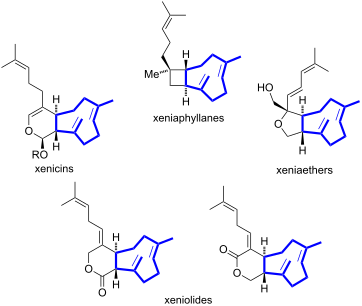
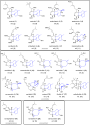
- tertiary amide was then formed by sequential reaction of carboxylic acid 53 with oxalyl chloride and N-methylaniline derivative 54. The following two-step debenzylation sequence afforded alcohol 55 which was converted to the corresponding mesylate, serving as a key intermediate for the construction of the
- afforded coraxeniolide A (10) in 38% yield over three steps. Additionally, the enantioselective total synthesis of β-caryophyllene was realized starting from key intermediate 80. The route commenced with conjugate addition of silyl ketene acetal 81b to enone 80 from the sterically less hindered re-face
- proceed via the chair-like transition state 104, afforded key intermediate 105 with high diastereo- and enantioselectivity. Preparation of the δ-lactone 106 of the A ring of xeniolide F was then realized by treatment of Claisen product 105 with the methylene Wittig reagent, followed by desilylation and







Versatile synthesis and biological evaluation of novel 3’-fluorinated purine nucleosides
Beilstein J. Org. Chem. 2015, 11, 2509–2520, doi:10.3762/bjoc.11.272

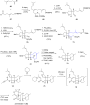
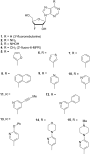
- -ribofuranose (25) was then obtained in 33.13% overall yield after further treatment with acetic anhydride–acetic acid–sulfuric acid system. More than 200 g scale was achieved for the synthesis, and high purity (98%) product was obtained. This key intermediate 25 can be used to synthesize a variety of 3’-fluoro
- provide the desired protected key intermediate 26 in 90% yield (Scheme 1). To construct the first series of fluorinated purine analogues, compound 26 was treated with a saturated solution of ammonia in methanol, which resulted in the amination at the 6-position and deprotection of the protecting groups to
- -3’-fluoro-6-methylpurine riboside 4, the analogue of biologically active natural product, 6-methylpurine-β-D-riboside (6-β-D-MPR). We constructed 3’-deoxy-3’-fluororibofuranosylpurine nucleosides 5–11 with various aromatic and heterocyclic moieties at position 6 from the key intermediate 26 by



Synthesis of D-fructose-derived spirocyclic 2-substituted-2-oxazoline ribosides
Beilstein J. Org. Chem. 2015, 11, 2289–2296, doi:10.3762/bjoc.11.249

- to explore the scope of the synthesis and isolation of spirooxazolines. Thus, the required key intermediate D-psicofuranose 2a was synthesized in four steps from the readily available starting material D-fructose following the literature procedure [42][47]. The C6–OH group of D-psicofuranose was


Molecular-oxygen-promoted Cu-catalyzed oxidative direct amidation of nonactivated carboxylic acids with azoles
Beilstein J. Org. Chem. 2015, 11, 2158–2165, doi:10.3762/bjoc.11.233
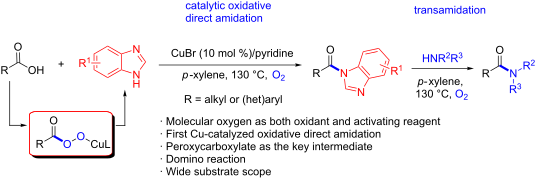
- scope. The mechanistic studies reveal that oxygen plays an essential role in the success of the amidation reactions with copper peroxycarboxylate as the key intermediate. Transamidation occurs smoothly between azole amide and a variety of amines. Keywords: amidation; azoles; Cu-catalyzed; molecular
- key intermediate to make the subsequent amide formation feasible (Scheme 1b). In our work, azoles have been chosen as the amines due to their special bioactivity [31]. To the best of our knowledge, Cu salt has not yet been used for catalyzed, oxidative direct amide formation. We report the first
- amidation reaction from carboxylic acids with peroxycarboxylate as the key intermediate, which represents a novel activation mode with molecular oxygen as the activating reagent. Most remarkably, in sharp contrast to previous reports (which used complex N-containing ligands to form copper superoxide




C–H bond halogenation catalyzed or mediated by copper: an overview
Beilstein J. Org. Chem. 2015, 11, 2132–2144, doi:10.3762/bjoc.11.230
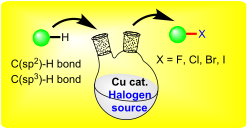
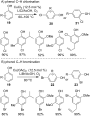
- -halosuccinimide, X = Cl or Br). The application of different acids which participated in the in situ formation of acyl hypohalites enabled the selective generation of products 2 and 7 (Scheme 5). Notably, the C–H iodinated product of type 2 was also observed as key intermediate in the copper-catalyzed pyridinyl




Stereoselective synthesis of hernandulcin, peroxylippidulcine A, lippidulcines A, B and C and taste evaluation
Beilstein J. Org. Chem. 2015, 11, 2117–2124, doi:10.3762/bjoc.11.228

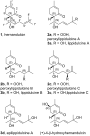
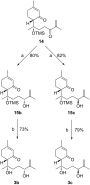
- the synthesis optimisation of the key intermediate 4 that can be prepared starting from (−)-isopulegol by two different approaches: i) oxidation of the hydroxy group to give (S)-isopulegone, which in turn is reduced stereospecifically into the desired cis diastereoisomer; or ii) by inversion of C(1



Synthesis, antimicrobial and cytotoxicity evaluation of new cholesterol congeners
Beilstein J. Org. Chem. 2015, 11, 1922–1932, doi:10.3762/bjoc.11.208

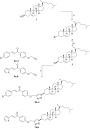
- each other. Conclusion In conclusion, cholesterol was successfully converted into 3β-azidocholest-5-ene (3) in good yield. This key intermediate, besides 3β-(prop-2-yn-1-yloxy)cholest-5-ene (10) were involved in a series of CuAAC reactions to afford a set of new modified cholesterols. The chalcone




Recent applications of ring-rearrangement metathesis in organic synthesis
Beilstein J. Org. Chem. 2015, 11, 1833–1864, doi:10.3762/bjoc.11.199
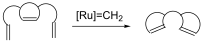
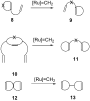
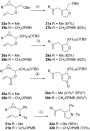
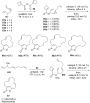
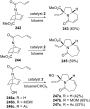
- and co-workers [70] have described a total synthesis of norhalichondrin B in 37 steps from β-furylethanol. Interesting feature of this synthetic sequence is the tactical utilization of tandem ROM–RCM protocol towards the synthesis of the key intermediate 335. In this reaction, the required RRM
- precursor 333 was obtained from diazo ester 331 in five steps. Further, the RRM of 333 with catalyst 2 furnished the required pyran derivative 334 (71%). Next, the fused ether 334 was transformed into the desired intermediate 335 in eight steps, which is a key intermediate required for the synthesis of










The simple production of nonsymmetric quaterpyridines through Kröhnke pyridine synthesis
Beilstein J. Org. Chem. 2015, 11, 1781–1785, doi:10.3762/bjoc.11.193

- (2) in the presence of ammonium acetate and gave 6-acetyl-2,2’:6’,2’’-terpyridine (4). This intermediate was cited by Potts [28] but to our knowledge, was not described. During the preparation of nonsymmetric quaterpyridines, 6-acetyl-2,2’:6’,2’’-terpyridine (4) is the key intermediate. Recently


Dimethylamine as the key intermediate generated in situ from dimethylformamide (DMF) for the synthesis of thioamides
Beilstein J. Org. Chem. 2015, 11, 1721–1726, doi:10.3762/bjoc.11.187

- ., Haidian District, Beijing 100875, P. R. China; Tel: +86-15010928428 10.3762/bjoc.11.187 Abstract An improved and efficient method for the synthesis of thioamides is presented. For this transformation, dimethylamine as the key intermediate is generated in situ from dimethylformamide (DMF). All the tested


Towards inhibitors of glycosyltransferases: A novel approach to the synthesis of 3-acetamido-3-deoxy-D-psicofuranose derivatives
Beilstein J. Org. Chem. 2015, 11, 1547–1552, doi:10.3762/bjoc.11.170

- protected open-chain form of 3-acetamido-3-deoxy-D-psicose, namely 3-acetamido-3-deoxy-4,5-O-isopropylidene-6-O-pivaloyl-1-O-trityl-D-psicose (7) in an excellent yield (Scheme 1). This compound represents the key intermediate for the further synthesis of 3-acetamido-3-deoxy-D-psicofuranose derivatives


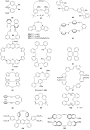
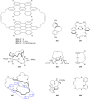
Selected synthetic strategies to cyclophanes
Beilstein J. Org. Chem. 2015, 11, 1274–1331, doi:10.3762/bjoc.11.142






The synthesis of active pharmaceutical ingredients (APIs) using continuous flow chemistry
Beilstein J. Org. Chem. 2015, 11, 1194–1219, doi:10.3762/bjoc.11.134
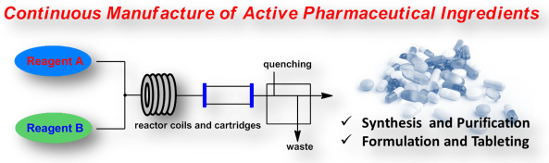
- worked well. As seen above, avoiding detrimental exotherms in scale up campaigns is a common reason for developing a continuous flow process. This approach is also demonstrated in the synthesis of the pyrrolotriazinone 73 via a exothermic oxidative rearrangement from 75, a key intermediate towards
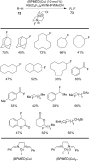
- key intermediate 83 at pilot-scale, a flow-based asymmetric hydrogenation was chosen as an economically more viable option compared to establishing a high-pressure batch process. As depicted in Scheme 14, solutions of the substrate 84 and a zinc triflate additive were combined with the rhodium


Advances in the synthesis of functionalised pyrrolotetrathiafulvalenes
Beilstein J. Org. Chem. 2015, 11, 1112–1122, doi:10.3762/bjoc.11.125
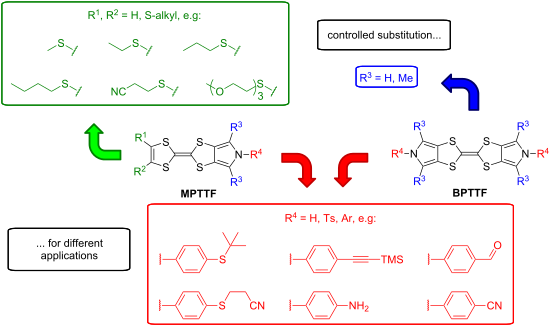
- ) are versatile functional groups in many areas of chemistry. The large-scale synthesis of the key intermediate 6 improves the accessibility of these species and their derivatives. The related species 7 can be used to prepare further analogues. Compounds 6 and 7 can both be used to prepare BPTTFs and


A hybrid electron donor comprising cyclopentadithiophene and dithiafulvenyl for dye-sensitized solar cells
Beilstein J. Org. Chem. 2015, 11, 1052–1059, doi:10.3762/bjoc.11.118
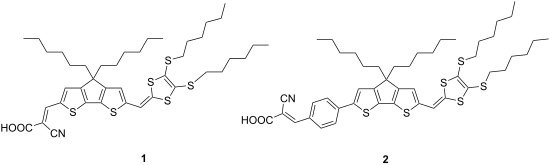
- , the synthesis of the key intermediate 7 involves the protection of one aldehyde group as an acetal using pinacol prior to HWE reaction of 5 with 4,5-bis(hexylthio)-1,3-dithiole-2-thione, followed by deprotection under acidic conditions. Aldehyde 5 was readily obtained by palladium-catalyzed Suzuki


Photocatalytic nucleophilic addition of alcohols to styrenes in Markovnikov and anti-Markovnikov orientation
Beilstein J. Org. Chem. 2015, 11, 568–575, doi:10.3762/bjoc.11.62
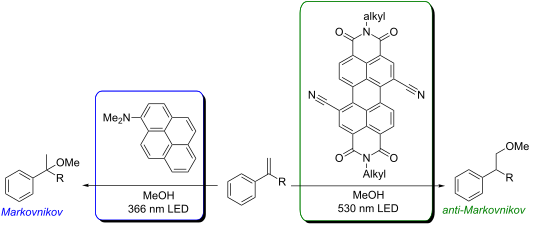
- additive. Photocatalytic additions of a variety of alcohols gave the corresponding products in good to excellent yields. The proposed photocatalytic electron transfer mechanism was supported by detection of the PDI radical anion as key intermediate and by comparison of two intramolecular reactions with
- protonated rapidly to the neutral radical that is the key intermediate to explain the Markovnikov selectivity of this route. Both steps, electron transfer and protonation, could also occur in one proton-coupled electron transfer step. Back electron transfer to the photocatalyst finishes the photocatalytic
- the corresponding products in good to excellent yields. Similar to the reductive mode, the oxidative nucleophilic addition needed the additive Ph–SH as electron and proton shuttle. The proposed photocatalytic electron transfer mechanism was supported by the observation of the PDI radical anion as key


Diastereoselective and enantioselective conjugate addition reactions utilizing α,β-unsaturated amides and lactams
Beilstein J. Org. Chem. 2015, 11, 530–562, doi:10.3762/bjoc.11.60

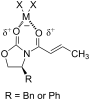
- and co-workers performed the rhodium-catalyzed ECA of 51 to yield 4-arylpiperidinone 52. Compound 52 is a key intermediate in the synthesis of the pharmaceutical agent, (−)-paroxetine [142] (Scheme 13). In 2001, Sakuma and Miyaura reported the first rhodium-catalyzed asymmetric 1,4-addition of α,β




Copper-catalyzed cascade reactions of α,β-unsaturated esters with keto esters
Beilstein J. Org. Chem. 2015, 11, 213–218, doi:10.3762/bjoc.11.23

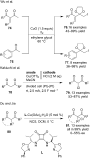
- conjugate reduction of the α,β-unsaturated diester with newly generated copper hydride, followed by aldol reaction to yield the key intermediate alkoxide A, which is subjected to further lactonization to form the lactone. Lam’s group has furnished a cobalt-catalyzed conjugate reductive aldolization
- of γ-carboxy-γ-lactones via a copper-catalyzed cascade reaction. Considering that the reported conjugate addition–aldolization–lactonization cascade reactions proceed via the key intermediate A in Figure 1, we envisioned that the conjugate reduction of a methacrylate and the following aldol reaction


Electrochemical selenium- and iodonium-initiated cyclisation of hydroxy-functionalised 1,4-dienes
Beilstein J. Org. Chem. 2015, 11, 174–183, doi:10.3762/bjoc.11.18

- which takes place exclusively at the internal carbon of the double bond of the terminal alkene (C2) and C4 of the 1-aryl-substituted 1,3-diene. The key intermediate A in the reaction mechanism is proposed to be a cobaltacycle which only allows the double bond generated from the 1,3-diene component to


A carbohydrate approach for the formal total synthesis of (−)-aspergillide C
Beilstein J. Org. Chem. 2014, 10, 3122–3126, doi:10.3762/bjoc.10.329

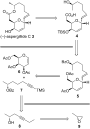
- achieved the formal total synthesis of (−)-aspergillide C. Conclusion In conclusion, a formal total synthesis of (−)-aspergillide C has been achieved through a concise, stereocontrolled synthesis of the known key intermediate 4 in 8 steps with an overall yield of 36.9% starting from commercially available




The Shono-type electroorganic oxidation of unfunctionalised amides. Carbon–carbon bond formation via electrogenerated N-acyliminium ions
Beilstein J. Org. Chem. 2014, 10, 3056–3072, doi:10.3762/bjoc.10.323
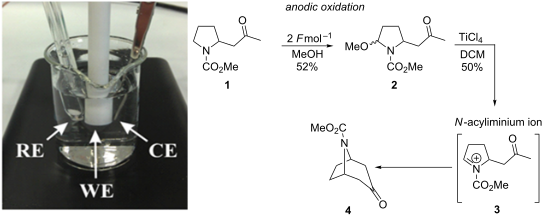
- α-amino nitrile, reinstalled the N-acyliminium ion. Reduction of the N-acyliminium afforded the major diastereoisomer as shown in Scheme 14 in 79% after column chromatography. Further synthetic modification of this key intermediate afforded the total synthesis of (+)-myrtine (66) in a further 5


First chemoenzymatic stereodivergent synthesis of both enantiomers of promethazine and ethopropazine
Beilstein J. Org. Chem. 2014, 10, 3038–3055, doi:10.3762/bjoc.10.322

- , mainly associated with periodontitis and osteoporosis. Moreover, kinetic resolution of the enantiomers of the key intermediate 1-(10H-phenothiazin-10-yl)propan-2-ol may simultaneously provide access to another valuable compound in enantioenriched form, that is: ethopropazine (profenamine). In turn, this




Synthetic strategies for the fluorescent labeling of epichlorohydrin-branched cyclodextrin polymers
Beilstein J. Org. Chem. 2014, 10, 3007–3018, doi:10.3762/bjoc.10.319
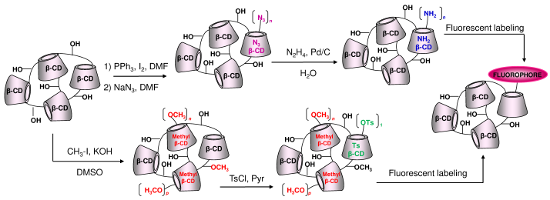
- (i.e., RBIT, NBF-Cl, FITC) or nucleophilic fluorescent dye (i.e., coumarin) into the polymers, respectively. The key intermediate azido-modified polymers have been used as precursor of the amino-modified polymers, but they can be considered as versatile substrates for cycloaddition reactions as well





