


Search results
Search for "labeling" in Full Text gives 189 result(s) in Beilstein Journal of Organic Chemistry.
Synthesis of fluorinated maltose derivatives for monitoring protein interaction by 19F NMR
Beilstein J. Org. Chem. 2012, 8, 448–455, doi:10.3762/bjoc.8.51
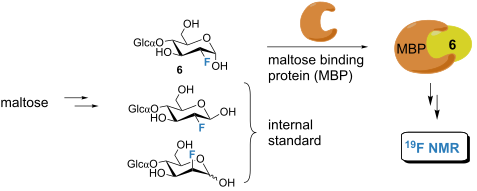
- be probed by following the NMR relaxation changes of the ligand (e.g., selective T1 or T2, which reflect the effective molecular weight). Due to this indirect detection scheme no isotope labeling of the protein interaction partners is required and consumption of protein material is reduced. The
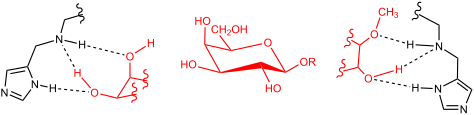
- in the binding pocket of the complex between MBP and maltose (PDB ID code 1ANF); hydrogen bonds are shown as dashed lines. 2-19F-Maltose reporter system: Nonstereoselective fluorine labeling at the 2-position of maltose leads to a 2/1 mixture of two epimeric forms [left: gluco-type; right: manno-type


Synthesis of highly functionalized β-aminocyclopentanecarboxylate stereoisomers by reductive ring opening reaction of isoxazolines
Beilstein J. Org. Chem. 2012, 8, 100–106, doi:10.3762/bjoc.8.10
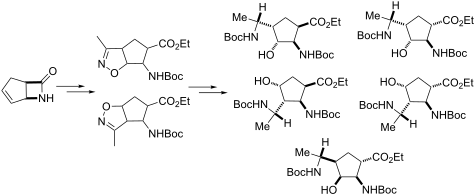
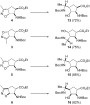
- labeling scheme. The thermal ellipsoids are drawn at the 20% probability level. Isoxazoline-fused β-aminocyclopentanecarboxylate regio- and stereoisomers [8]. Treatment of isoxazoline-fused amino ester 2 with NaBH4. Reduction with Pd/C in the presence of HCO2NH4. Transformation of isoxazoline-fused


Continuous flow photolysis of aryl azides: Preparation of 3H-azepinones
Beilstein J. Org. Chem. 2011, 7, 1124–1129, doi:10.3762/bjoc.7.129
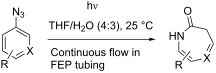
- tools, both for preparative heterocycle synthesis [16][17] and for photoaffinity labeling of proteins [18][19][20]. The photolysis of aryl azide 1 [21], a well-studied and widely used reaction [22][23][24][25][26][27][28][29][30], generates the singlet aryl nitrene intermediate 12 (Scheme 1). Ring


Recent advances in the gold-catalyzed additions to C–C multiple bonds
Beilstein J. Org. Chem. 2011, 7, 897–936, doi:10.3762/bjoc.7.103
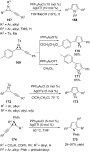
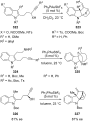
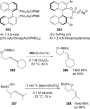
- sp3-hybridized C–H bond can be achieved by undergoing 1,3-addition to a vinyl–carbenoid intermediate [142]. The bicyclo[3.2.1]oct-6-en-2-ones 265 and 267 could be synthesized stereoselectively by this method. Deuterium labeling experiments indicated the cyclization involved an unprecedented 1,3
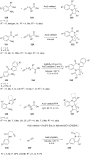
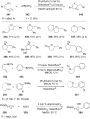
- via oxidative gold catalysis and provided expedient access to various substituted N- or O-heterocycles (344–351) (Scheme 57). Deuterium labeling experiments were carried out to unveil the reaction mechanism. The results established the anti nature of the alkene functionalization and the indispensable












When gold can do what iodine cannot do: A critical comparison
Beilstein J. Org. Chem. 2011, 7, 847–859, doi:10.3762/bjoc.7.97
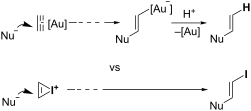
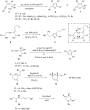
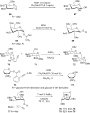
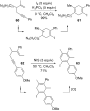
- selectivity and 90% yield (Scheme 9a) [91]. Labeling experiments showed that the proposed mechanism where the cation is trapped by the nucleophile and subsequent loss of the proton and protodemetallation is viable. A more elaborate study of 5-endo hydroxy- and alkoxycyclizations of 1,5-enynes was described by








Gold-catalyzed heterocyclizations in alkynyl- and allenyl-β-lactams
Beilstein J. Org. Chem. 2011, 7, 622–630, doi:10.3762/bjoc.7.73
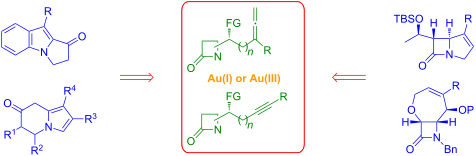
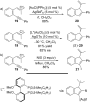
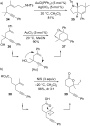
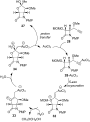
- reveal, 5-exo oxyauration via 16 is restricted by the steric hindrance between the (methoxymethyl)oxy group and the substituents at the quaternary stereocenter. With the aim of trapping the organo–gold intermediate to confirm the mechanism of this reaction, deuterium labeling studies with deuterium oxide



Construction of cyclic enones via gold-catalyzed oxygen transfer reactions
Beilstein J. Org. Chem. 2011, 7, 606–614, doi:10.3762/bjoc.7.71
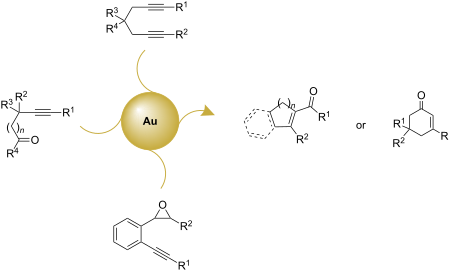
- labeling experiment was designed to elucidate the pathway responsible for the gold-catalyzed intramolecular oxygen transfer of 2-alkynyl-1,5-diketones (Scheme 8). By introducing an 18O atom into one of the carbonyls of the substrate, and using the 13C NMR spectra of the substrate and product to locate the
- cyclization of alkynyl ketones. Gold-catalyzed cyclization of terminal alkynyl ketones. Gold-catalyzed tandem oxygen transfer/Nazarov cyclizations. TfOH-mediated cyclization of alkynyl ketones. Gold-catalyzed cyclizations of 2-alkynyl-1,5-diketones. Designed isotopic labeling experiment for mechanistic
- cyclization of internal diynes. Proposed solvolysis/cyclization mechanism. Gold-catalyzed cyclization of alkynyl epoxides and the 18O isotopic labeling experiment. Proposed oxygen transfer mechanism. Gold or silver-catalyzed cyclization of alkynyl epoxides and the corresponding deuterium labeling experiment.




Unusual behavior in the reactivity of 5-substituted-1H-tetrazoles in a resistively heated microreactor
Beilstein J. Org. Chem. 2011, 7, 503–517, doi:10.3762/bjoc.7.59
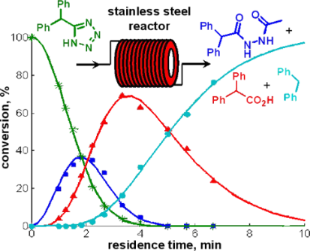
- from the resulting azido group and a subsequent 1,2-migration of the acylimido group from carbon to nitrogen to give the same nitrilimine intermediate was ruled out by Herbst via 15N labeling studies [44]. The degradative acylation of 5-substituted-1H-tetrazoles with acyl halides is in fact an elegant


En route to photoaffinity labeling of the bacterial lectin FimH
Beilstein J. Org. Chem. 2010, 6, 810–822, doi:10.3762/bjoc.6.91
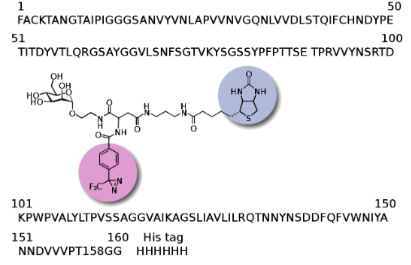
- FimH that can complex α-D-mannosides. However, as the precise nature of the ligand–receptor interactions in mannose-specific adhesion is not yet fully understood, it is of interest to identify carbohydrate recognition domains on the fimbrial lectin also in solution. Photoaffinity labeling serves as an
- appropriate methodology in this endeavour and hence biotin-labeled photoactive mannosides were designed and synthesized for photoaffinity labeling of FimH. So far, the photo-crosslinking properties of the new photoactive mannosides could be detailed with the peptide angiotensin II and labeling of FimH was
- shown both by MS/MS studies and by affino dot–blot analysis. Keywords: diazirines; FimH; lectins; MS/MS analysis; photoactive mannoside ligands; photoaffinity labeling; Introduction Photoaffinity labeling is a technique by which ligand binding sites of a receptor protein can be identified in solution



Novel tetracyclic structures from the synthesis of thiolactone-isatin hybrids
Beilstein J. Org. Chem. 2010, 6, No. 78, doi:10.3762/bjoc.6.78

- from MeOH at room temperature and subjected to crystallographic analysis (see Supporting Information File 2 for crystallographic data). Figure 3 shows the molecular structure and atom labeling for 4a. The crystals are triclinic with space group P−1 and contains four molecules per unit cell. The crystal
- repulsive steric interaction between the relatively bulky hydroxyl group at C7A and the adjacent methyl group at C5A. Figure 4 shows the molecular structure atom labeling for 4b–c. Both compounds crystallized in the centrosymmetric monoclinic space group P21/n with 4 molecules in the unit cell. Similar to


Synthetic incorporation of Nile Blue into DNA using 2′-deoxyriboside substitutes: Representative comparison of (R)- and (S)-aminopropanediol as an acyclic linker
Beilstein J. Org. Chem. 2010, 6, No. 13, doi:10.3762/bjoc.6.13
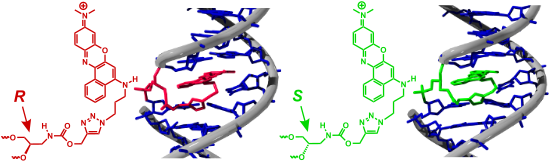
- ” ligation strategy has become an important strategy for postsynthetic labeling of DNA [12][13]. Huisgen described first the [2+3]-cycloaddition between alkynes and azides yielding 1,2,3-triazoles [14]. The utility of this reaction as a bioligation method has grown incredibly after Meldal [15] and – almost




Recognition properties of receptors consisting of imidazole and indole recognition units towards carbohydrates
Beilstein J. Org. Chem. 2010, 6, No. 9, doi:10.3762/bjoc.6.9
- signal (for labeling, see Figure 2), downfield shift and strong broadening of the NHD signal as well as changes of the chemical shifts of the CH3F,G, CH2B,C,E, pyridine CH and imidazole or indole CH resonances of 4 or 5 (see Table 2). The signal due to the indole NH of 5 shifted downfield by 0.20–0.40




Synthesis of coumarin or ferrocene labeled nucleosides via Staudinger ligation
Beilstein J. Org. Chem. 2006, 2, No. 23, doi:10.1186/1860-5397-2-23
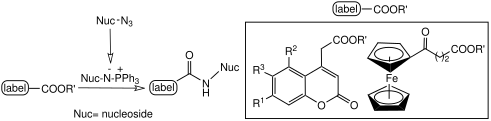
- gives iminophosphoranes which can react with almost any kind of electrophilic reagent, e.g. aldehydes/ketones to form imines or esters to form amides. This so-called Staudinger ligation has been employed in a wide range of applications as a general tool for bioconjugation including specific labeling of
- , [22][23] including specific labeling of nucleic acids, [24] proteomic studies [25][26] and modification of cell surfaces. [17][18] We applied the Staudinger ligation for nucleoside labeling procedures, using coumarin and ferrocene derivatives as labels. According to our knowledge, applications of this
- with maxima of 1a-c. We observed only slight changes of fluorescence intensity in the series of coumarin labeled nucleosides. We also tested the Staudinger ligation as a prospective method for the electrochemical labeling of nucleosides and nucleotides with ferrocene derivatives. 2'-Azido-2


Molecular recognition. 1. Crystal structures of hexaazamacrocyclic amines containing p-xylylene spacers and their adducts with acids
Beilstein J. Org. Chem. 2005, 1, No. 16, doi:10.1186/1860-5397-1-16
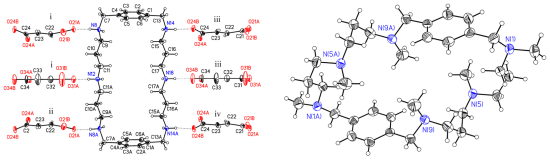
- isolated centrosymmetric molecules. The molecular conformation together with the atom labeling scheme is shown in Figure 4. The overall conformation of the molecule is ellipsoidal with the approximate dimensions of 6.2 and 15.3 Å. All atoms of the molecule (except hydrogens) are within 2.16 Å of the mean
- from one macrocyclic hexa-protonated cation and six fumaric anions, together with the atom labeling scheme. Displacement parameters are drawn at 50% probability level. Symmetry codes: i: 0.5-x, 0.5+y, z; ii: 0.5-x, 0.5+y, 0.5-z; iii 0.5-x, -0.5+y, z; iv: 0.5-x, -0.5+y, 0.5-z The structure of one sheet
- height of one sheet corresponds to the height of the macrocycle, i.e. about 12 Å. The molecular conformation of 1-N-Me, atom labeling scheme indicated. Displacement parameters are drawn at 50% probability level. The unit cell of 1-N-Me, stacks of molecules are indicated. Formulas of macrocyclic amines, 1





