Search results
Search for "overall yield" in Full Text gives 525 result(s) in Beilstein Journal of Organic Chemistry. Showing first 200.
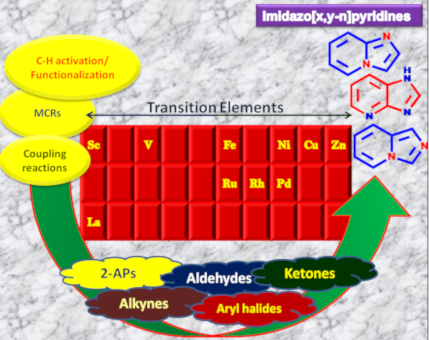
Recent advances on the transition-metal-catalyzed synthesis of imidazopyridines: an updated coverage
Beilstein J. Org. Chem. 2019, 15, 1612–1704, doi:10.3762/bjoc.15.165


Synthesis and biological evaluation of truncated derivatives of abyssomicin C as antibacterial agents
Beilstein J. Org. Chem. 2019, 15, 1468–1474, doi:10.3762/bjoc.15.147
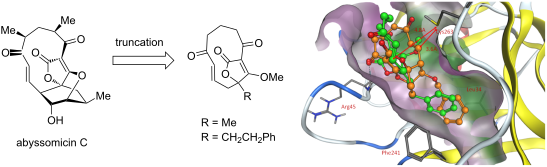
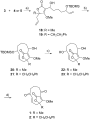
- (Scheme 2), starting with the monoprotection of 1,5-pentanediol (6), followed by Swern oxidation, which afforded 7 in an overall yield of 57% [26]. The so obtained aldehyde 7 was treated with vinylmagnesium bromide in the presence of cerium chloride to afford 8 in 89% yield. An overall translocation of
- the TBDMS group from the primary to the secondary alcohol was achieved by a protection/deprotection sequence, which smoothly provided alcohol 10 in 71% yield over two steps. A final Swern oxidation gave the building block 3 in 91% yield (33% overall yield from 1,5-pentanediol 6). The other key


Efficiency Effsyn of complex syntheses as multicomponent reactions, its algorithm and calculations based on concrete criteria
Beilstein J. Org. Chem. 2019, 15, 1425–1433, doi:10.3762/bjoc.15.142
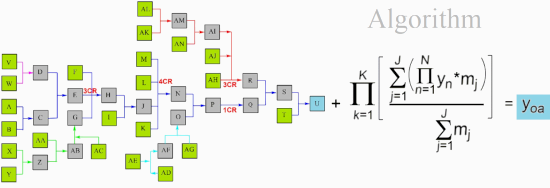
- are highly suitable for electronic data processing (EDP). This algorithm is also suitable as a basis for fair cost assessment of complex chemical syntheses. Keywords: efficiency; efficiency algorithm; multicomponent; overall yield; synthesis algorithm; synthesis efficiency; synthesis evaluation
- ]. Concrete and reliable criteria must be available for this purpose, criteria that can be easily determined and measured, and which can also form the basis for an algorithm. The standard evaluation of a chemical synthesis is traditionally based on the overall yield yoa. This is the product of all sequential
- synthesis steps yn (Equation 1). An extreme example for the impact of the overall yield is the tropinone synthesis by Willstätter (yoa = 0.75%) [7][8] compared to the Robinson–Schöpf synthesis (yoa = 90%) [9][10]) using a double Mannich reaction, a multicomponent reaction (MCR) [11][12][13]. The Mannich-3CR



Borylation and rearrangement of alkynyloxiranes: a stereospecific route to substituted α-enynes
Beilstein J. Org. Chem. 2019, 15, 1416–1424, doi:10.3762/bjoc.15.141

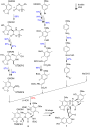
- afforded a mixture of the 2 possible isomers, although in similar overall yield (Table 2, entry 2 vs 1). Decreasing the temperature from −78 to −92 °C for the deprotonation–borylation steps rewardingly allowed the exclusive formation of the E-enyne 4 as a single isomer (Table 2, entry 3). After these


Ugi reaction-derived prolyl peptide catalysts grafted on the renewable polymer polyfurfuryl alcohol for applications in heterogeneous enamine catalysis
Beilstein J. Org. Chem. 2019, 15, 1210–1216, doi:10.3762/bjoc.15.118
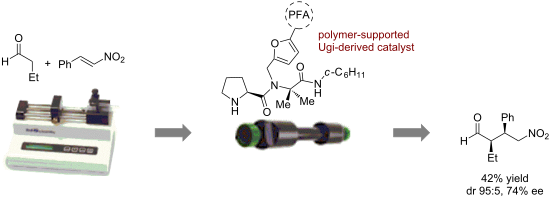
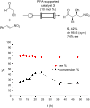
- % ee) compared to the batch process with the same catalyst. Nonetheless, the enantioselectivity remains constant during the whole time of experiment, as shown in Figure 1. Finally, the overall yield of isolated Michael adduct 5 was 42% after column chromatography, which is in agreement with the


Heck- and Suzuki-coupling approaches to novel hydroquinone inhibitors of calcium ATPase
Beilstein J. Org. Chem. 2019, 15, 971–975, doi:10.3762/bjoc.15.94
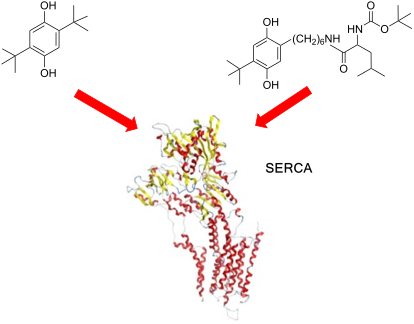
- product amine was not isolated. Instead, it was immediately reacted with the N-hydroxysuccinimidyl ester of Boc-leucine to give 12a in yields of 56–80% overall for two steps. We also obtained the corresponding Z-protected analogue 12b in 43% overall yield for two steps. Both 10 and 12a could be oxidized
- Na2S2O4 or H2/Pd). What finally proved effective was the two step sequence of oxidation of 12a with CAN followed by treatment of the resulting quinone 13 with sodium borohydride in dry methanol – a sequence that gave 14 (which upon standing readily re-oxidizes back to 13) in 34% overall yield from 12a. A


Synthesis of (macro)heterocycles by consecutive/repetitive isocyanide-based multicomponent reactions
Beilstein J. Org. Chem. 2019, 15, 906–930, doi:10.3762/bjoc.15.88
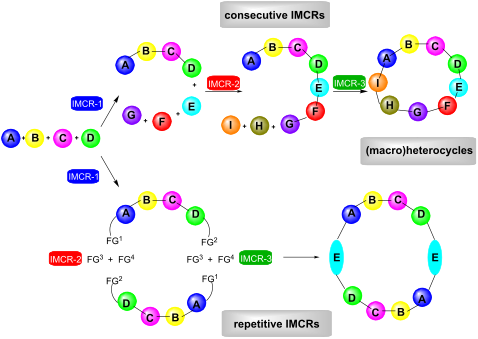
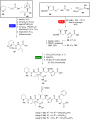
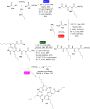
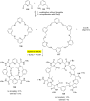
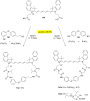
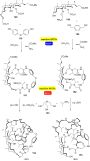
- acid 144, Cbz removal of the macrocycle 145 formed led to another diamine intermediate that was involved in a second double Ugi reaction with paraformaldehyde, tert-butyl isocyanide and diacid 146, to yield cryptand 147 in 31% overall yield from 130. Other macroheterocycles were synthesized in this









An efficient synthesis of the guaiane sesquiterpene (−)-isoguaiene by domino metathesis
Beilstein J. Org. Chem. 2019, 15, 858–862, doi:10.3762/bjoc.15.83
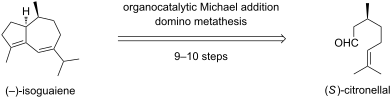
- required to effect the relay metathesis of 3 to (−)-isoguaiene (1) in refluxing benzene in a good yield of 51%. Thus, by application of a domino metathesis strategy featuring trienyne 3, only 9 steps were needed to secure the guaiane sesquiterpene 1 in 19.7% overall yield starting from (S)-citronellal (5
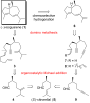
- ), which compares favorably with the previous synthesis of 1 from (+)-dihydrocarvone (10 steps, 6.9% overall yield) [6]. Scheme 3 depicts our first attempts to realize an alternative domino metathesis strategy using enediyne 7. Ozonolysis of the unsaturated acetal 10 gave aldehyde 23 [17][18] that was
- furnish 25 and subsequent acetal hydrolysis provided the known aldehyde 26 [25] in very good overall yield. In our hands, the "demethanation" of (S)-citronellol to produce the primary alcohol corresponding to aldehyde 26 according to the protocol of Abidi (NaNO2, aqueous AcOH) [26] as a potential shortcut




An improved synthesis of adefovir and related analogues
Beilstein J. Org. Chem. 2019, 15, 801–810, doi:10.3762/bjoc.15.77
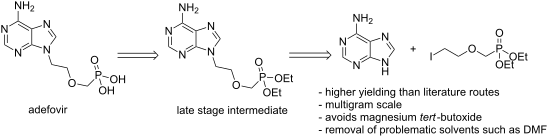
- the major reaction pathway when the reaction was stirred for prolonged periods of time or heated to higher temperatures. Consequently, the overall yield of this process, at 14%, is lower than that of the process outlined in Scheme 1. Given the ease of alkylation of 3 with 1,2-dibromoethane, we
- stable for over one year. Gratifyingly, alkylation of adenine with iodide 14 proceeded smoothly under mild conditions to furnish phosphonate 6 in 70% yield. The overall yield of 6 from 18 was 58% which compared very favourably with that reported in Scheme 1. Interestingly, the unnatural N7-regioisomer 20
- affords 20 in a comparable overall yield of 13%. We conducted a temperature, solvent and base screen to determine what impact these parameters have on the regioselectivity of the alkylation (Table 2). The overall regioselectivity appeared insensitive to the reaction conditions with only a slight decrease


Efficient synthesis of 4-substituted-ortho-phthalaldehyde analogues: toward the emergence of new building blocks
Beilstein J. Org. Chem. 2019, 15, 721–726, doi:10.3762/bjoc.15.67

- complex molecular architectures. Nevertheless, literature generally describes their synthesis in very low yield (below 5%), mainly due to the inefficiency of the last oxidation step. In this paper, we report a reliable synthesis of 4-substituted-ortho-phthalaldehyde analogues in 51% overall yield owing to
- -dihydroisobenzofuran-5-ol intermediate has been tested and oxidation parameters of the dedicated structures were optimized. Finally, a rapid deprotection step was initiated to afford 4-MeO-OPA and 4-HO-OPA with 51% overall yield. Results and Discussion Firstly, 2-((prop-2-ynyloxy)methyl)furan (2) was synthesized


The LANCA three-component reaction to highly substituted β-ketoenamides – versatile intermediates for the synthesis of functionalized pyridine, pyrimidine, oxazole and quinoxaline derivatives
Beilstein J. Org. Chem. 2019, 15, 655–678, doi:10.3762/bjoc.15.61
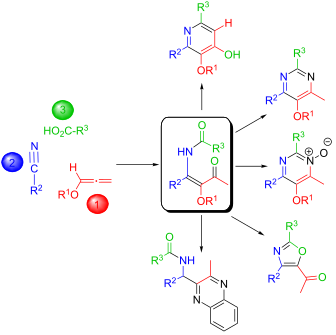
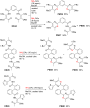
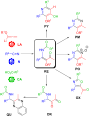
- carried out, but a component such as Mosher acid with a tertiary carbon next to the carboxylic acid function was successfully used in the three-component reaction and the corresponding β-ketoenamide was converted into the corresponding pyridin-4-ol in good overall yield [36]. This demonstrates that
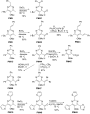
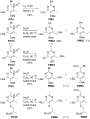
- nonaflate 8 – readily available from β-ketoenamide KE61 [33] – efficiently furnishing the disubstituted alkyne PM57. This intermediate was directly converted into pyrimidyl-substituted furopyridine derivative PM58 in very good overall yield. The example of compound PM58 nicely demonstrates the combination
- -based) pyridinyl nonaflate 8 gave OX25. The removal of the TMSE group by acid treatment and subsequent cyclization furnished the furopyridyl-substituted oxazole derivative OX26 in good overall yield [45]. The examples shown in Scheme 27 and Scheme 28 demonstrate the manifold options to synthesize






Selective benzylic C–H monooxygenation mediated by iodine oxides
Beilstein J. Org. Chem. 2019, 15, 602–609, doi:10.3762/bjoc.15.55

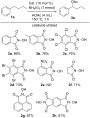
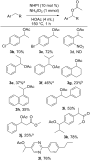
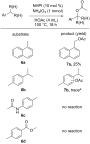
- ). Similarly, fluorene was oxidized to a mixture of 9-fluorenyl acetate (5b, 31%) and fluorenone (5c, 20%). The same mixture of acetate and ketone is observed at a higher temperature (150 °C), but the overall yield was lower. It is proposed that the stabilizing presence of two benzene rings on the monooxidized




Synthesis of the polyketide section of seragamide A and related cyclodepsipeptides via Negishi cross coupling
Beilstein J. Org. Chem. 2019, 15, 577–583, doi:10.3762/bjoc.15.53
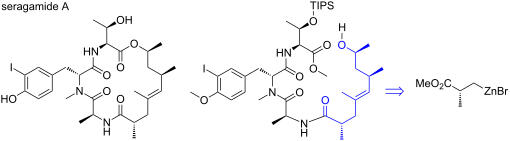
- , geodiamolides and seragamides, is reported. The key step is a Negishi cross coupling of (R)-(3-methoxy-2-methyl-3-oxopropyl)zinc(II) bromide and an (E)-iodoalkene that was synthesized via an aluminium ester enolate attack at (R)-propylene oxide. The overall synthesis comprises nine steps with an overall yield
- -methylated product via oxazolidinone 24 was hampered by low yield on reaction with paraformaldehyde [47][48]. Although subsequent reduction of 24 with Et3SiH/TFA and reprotection of the free N-methyl amino acid with Boc2O proceeded smoothly and delivered iodotyrosine 25, the overall yield via 24 was not
- ), MeI (4-Me), and (R)-(3-methoxy-2-methyl-3-oxopropyl)zinc(II) bromide (8, C1–C3, 2-Me). We obtained 8-hydroxyester 7 within nine steps and an overall yield of 21% starting from (R)-propylene oxide. The efficiency of our route to polyketide 7 compares well to earlier approaches. It proved to be possible




A chemoenzymatic synthesis of ceramide trafficking inhibitor HPA-12
Beilstein J. Org. Chem. 2019, 15, 490–496, doi:10.3762/bjoc.15.42
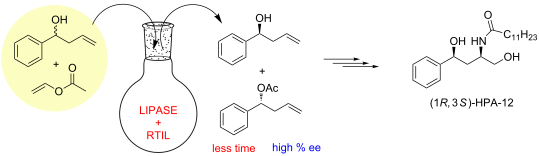
- reactions that use inexpensive reagents, are operationally simple and proceed with good to excellent yields and excellent stereoselectivities. The target compound was obtained in 23% overall yield starting from (S)-4. The protocol can also be used to access different HPA analogues and derivatives. Structure


Convergent synthesis of the pentasaccharide repeating unit of the biofilms produced by Klebsiella pneumoniae
Beilstein J. Org. Chem. 2019, 15, 431–436, doi:10.3762/bjoc.15.37
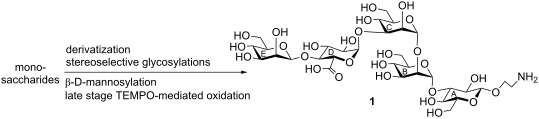
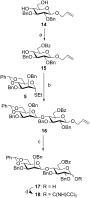
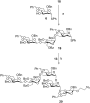
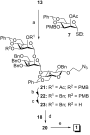
- removal of acetyl groups and benzylation using benzyl bromide and sodium hydroxide in one-pot [37] followed by removal of the p-methoxybenzyl group using DDQ [38] in 84% overall yield. Finally, stereoselective glycosylation of disaccharide trichloroacetimidate donor 18 with trisaccharide acceptor 23 in


Syntheses and chemical properties of β-nicotinamide riboside and its analogues and derivatives
Beilstein J. Org. Chem. 2019, 15, 401–430, doi:10.3762/bjoc.15.36
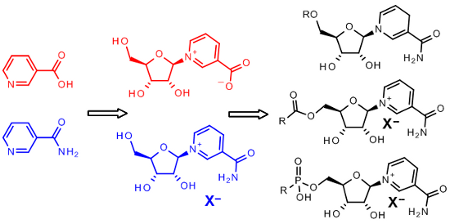
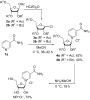
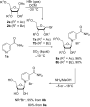
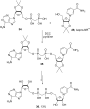
- generation of the protected β-NR+Br− 8a, which was isolated by crystallization from a 5:1 acetone/t-BuOMe mixture in 90% overall yield from 2a [27]. Note that dry acetonitrile was also used as a solvent in the glycosylation step instead of liquid SO2 but the yields of acetylated NR+Br− 8a were lowered (65










Study on the regioselectivity of the N-ethylation reaction of N-benzyl-4-oxo-1,4-dihydroquinoline-3-carboxamide
Beilstein J. Org. Chem. 2019, 15, 388–400, doi:10.3762/bjoc.15.35

- treated with potassium carbonate followed by a dropwise addition of bromoethane, as the alkylating agent. This synthetic strategy provided exclusively the 1-ethylated product 7 with a good overall yield (80%, Scheme 1). Previous treatment of 5 with potassium carbonate promotes the establishment of an acid


Sigmatropic rearrangements of cyclopropenylcarbinol derivatives. Access to diversely substituted alkylidenecyclopropanes
Beilstein J. Org. Chem. 2019, 15, 333–350, doi:10.3762/bjoc.15.29
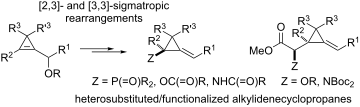
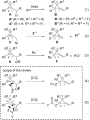
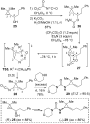
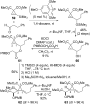
- conditions, which were optimized for imidate 12a, enabled the formation of p-bromobenzylidene[(N-trichloroacetylamino)cyclopropane] 13a as a single (E)-isomer in 63% overall yield (two steps from the corresponding alcohol). Compound 13a was obtained in lower yield in the absence of a base (21%) or when DMF







Unexpected loss of stereoselectivity in glycosylation reactions during the synthesis of chondroitin sulfate oligosaccharides
Beilstein J. Org. Chem. 2019, 15, 137–144, doi:10.3762/bjoc.15.14
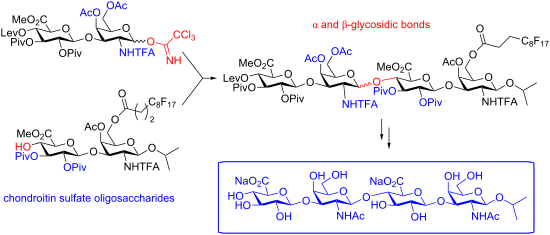
- isolated in good 73% yield. Noteworthy, exclusive formation of the β-product was observed. Nevertheless, the glycosylation of 1 and 18 again provided a mixture of the corresponding α and β-tetrasaccharides 19α and 19β in 71% overall yield (1:2.9 α/β ratio). The use of acetonitrile as solvent and lower
- temperature (−20 ºC), typical conditions for favoring the formation of the β-bond, increased the β-selectivity (1:4 α/β ratio) but also decreased the overall yield (50%). Similarly, a loss of β-selectivity was observed at the hexasaccharide stage (Scheme 7). Tetrasaccharide acceptor 20 was prepared from 19β


Stereodivergent approach in the protected glycal synthesis of L-vancosamine, L-saccharosamine, L-daunosamine and L-ristosamine involving a ring-closing metathesis step
Beilstein J. Org. Chem. 2018, 14, 2949–2955, doi:10.3762/bjoc.14.274
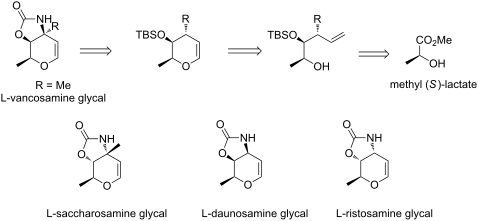
- )-geometry of the crotylboronate, while the 2,3-anti relationship can be rationalized by invoking Cornforth-like transition states [40][41][42][43]. Eventually, silylation of the homoallylic alcohol 12b afforded the expected compound 13b in 68% overall yield from 5 after purification, compared to 29% using a
- the syn diastereomer 18 in high stereoselectivity (93:7). After silylation of the free hydroxy group, the cleavage of the PMB ether with DDQ led to alcohol 20 in 77% yield for the two steps. Ring-closing metathesis of diene 21, obtained by O-vinylation of 20, gave the dihydropyran 22 in 53% overall
- yield for two steps. The silyl group of compound 22 was cleaved using tetrabutylammonium fluoride (TBAF) in THF to form alcohol 23 which was used directly in the next step [48]. At this stage, we envisioned that 23 could be also a key intermediate to access the ristosamine derivative by reversing the


Unnatural α-amino ethyl esters from diethyl malonate or ethyl β-bromo-α-hydroxyiminocarboxylate
Beilstein J. Org. Chem. 2018, 14, 2853–2860, doi:10.3762/bjoc.14.264
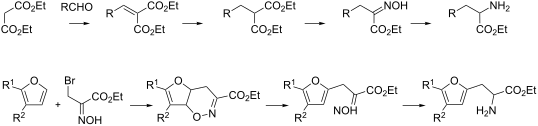
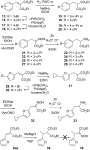
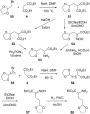
- yields of α-hydroxyimino esters 2t–v reached 49, 59 and 62% from aldehydes 5t–v, respectively. Of note is that we also tried this reducing agent to improve the overall yield of the benzyloxy-bearing oxime 2ab, but to no avail. We next focused on the furan-bearing α-hydroxyimino esters such as compound
- % overall yield via α-hydroxyimino ester 9, but it also forced us to use borohydrides to avoid the furan ring hydrogenation. Accordingly, an extensive study of the reduction of compound 6ae with borohydrides was made. Trials included reactions run at 0 °C overnight, the use of wet ethanol or dry THF, the
- -ylmethylene)propanebis(thioate), the bisthioester homolog of compound 6ae [5]. Finally, the oximation of the pure malonate 3ae only led to a 64% yield of the corresponding α-hydroxyimino ester 2ae, thus accounting for the 33% overall yield reported in Table 1 when we proceeded without purification. It is only



Synthesis of unnatural α-amino esters using ethyl nitroacetate and condensation or cycloaddition reactions
Beilstein J. Org. Chem. 2018, 14, 2846–2852, doi:10.3762/bjoc.14.263
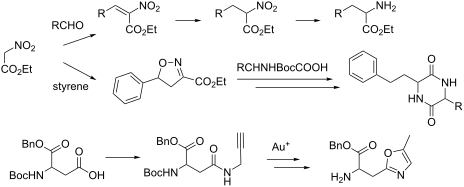
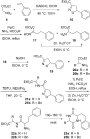
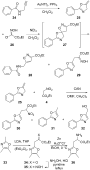
- salts. The use of tetramethylammonium borohydride did not increase the overall yield of 6n, however, a rather substantial improvement was observed when using sodium cyanoborohydride. Indeed, from pure acrylate 2n, a 70% yield of 6n was obtained, and in one pot starting from aldehyde 3n, a 48% overall
- yield of 6n was achieved. Moreover, without using an inert atmosphere for the initial condensation between furfural (3n) and ethyl nitroacetate (4) the overall yield of 6n dropped to 37% even when using sodium cyanoborohydride. The optimized conditions were then applied to aldehyde 3r and afforded a
- 12 in 32% overall yield via the nitro compound 11. We also investigated the reported [4] 1,4-addition of a methyl on compound 2n to prepare the β-methylated derivative 13. In our hands, a rather modest 43% yield of the expected adduct 13 was achieved from purified acrylate 2n. Again, the ensuing



Synthesis of mono-functionalized S-diazocines via intramolecular Baeyer–Mills reactions
Beilstein J. Org. Chem. 2018, 14, 2799–2804, doi:10.3762/bjoc.14.257

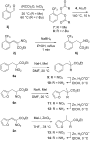
- see Supporting Information File 1) is formed, which lowers the overall yield of S-diazocines 1–3 considerably. Further problems arise from the difficult separation of the azoxy compound from other byproducts. The yields of the azoxy reduction in the ball mill are varying between 18–46%. S-Diazocines


Synthesis of a tyrosinase inhibitor by consecutive ethenolysis and cross-metathesis of crude cashew nutshell liquid
Beilstein J. Org. Chem. 2018, 14, 2737–2744, doi:10.3762/bjoc.14.252
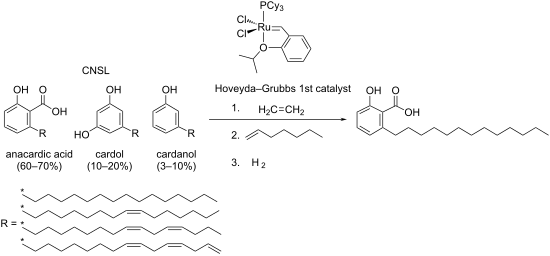
- subsequent hydrogenation step. Overall, the target compound was obtained in an overall yield of 61% based on the unsaturated anacardic acid content and 34% based on the crude CNSL. Keywords: cashew nutshell liquid; cross-metathesis; renewable feedstock; sustainable chemistry; tyrosinase inhibitor
- found that the tridecanyl substituted derivative ginkgolic acid (13:0, 3) exhibits the most promising inhibitory activity. While this modular approach is very appealing for drug-discovery, the use of expensive γ-resorcylic acid as the substrate basis and the low overall yield over several reaction steps
- mmol) scale yielding 72% of the hydrogenated product 3. Combined with the ethenolysis/precipitation step, the entire sequence afforded 61% overall yield based on unsaturated anacardic acids present in the CNSL (Scheme 4). Conclusion In conclusion, a straightforward sequence of an ethenolysis, cross


Assembly of fully substituted triazolochromenes via a novel multicomponent reaction or mechanochemical synthesis
Beilstein J. Org. Chem. 2018, 14, 2689–2697, doi:10.3762/bjoc.14.246
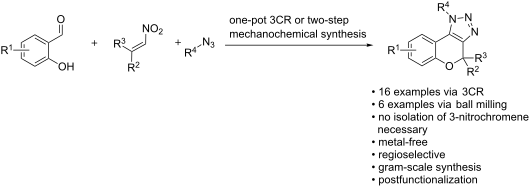
- desired product 5a was obtained in 67% yield, together with an oxidized ring opened side product 6 in 20% yield. The overall yield of 5a after two steps was 48%, considering that the 3-nitro-2H-chromene (3) was obtained in a yield of 71%. We continued our studies by verifying the obtained regiochemistry
- triethylamine was needed but the overall yield of 5a was still lower as it only reached 38%. With the obtained optimized conditions and proof of regioselectivity in hand, further investigation towards the generality of this three-component reaction was carried out by varying the substrate scope (Figure 1). We