


Search results
Search for "pKa" in Full Text gives 252 result(s) in Beilstein Journal of Organic Chemistry. Showing first 200.
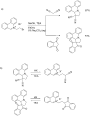
Come-back of phenanthridine and phenanthridinium derivatives in the 21st century
Beilstein J. Org. Chem. 2014, 10, 2930–2954, doi:10.3762/bjoc.10.312





Anomalous diffusion of Ibuprofen in cyclodextrin nanosponge hydrogels: an HRMAS NMR study
Beilstein J. Org. Chem. 2014, 10, 2715–2723, doi:10.3762/bjoc.10.286
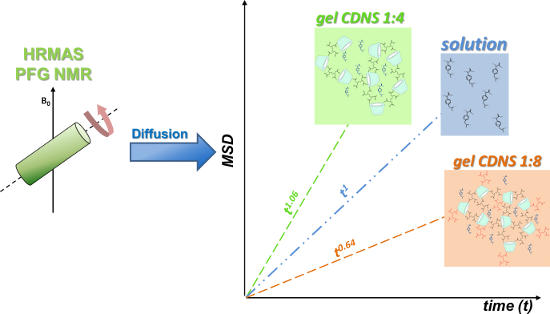
- two gels loaded with IP – CDNSEDTA 1:4 and CDNSEDTA 1:8 – were 6.9 and 6.5, respectively. Taking into account the literature pKa values [33] of EDTA for the ionization of the four COOH groups ( pKa1 = 0.0, pKa2 = 1.5, pKa3 = 2.0, pKa4 = 2.7), the contribution of the two NH+ groups (pKa5 = 6.1, pKa6
- = 10.4) and the pKa value of IP in its acid form (4.91), it is reasonable assuming that the majority of the COOH groups present in our systems are, in the pH interval of our preparations, present in the COO− form and that one NH+ group is significantly contributing. As a consequence, an overall negative


Superoxide chemistry revisited: synthesis of tetrachloro-substituted methylenenortricyclenes
Beilstein J. Org. Chem. 2014, 10, 2531–2538, doi:10.3762/bjoc.10.264

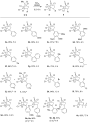
- . The olefin-substituted compound 3p (Table 1, entry 16) underwent a smooth reaction to afford nortricyclene 5m (Scheme 2). The cyclooctane-fused adducts 3o/4o (Table 1, entry 15) afforded exclusively the elimination product 6c in excellent yield. As the pKa of the conjugate acid of the superoxide ion




Second generation silver(I)-mediated imidazole base pairs
Beilstein J. Org. Chem. 2014, 10, 2139–2144, doi:10.3762/bjoc.10.221
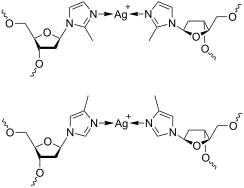
- attempt to increase the stability of the imidazole–Ag(I)–imidazole base pairs, additional shielding of the central silver(I) ions could be accomplished by introducing methyl groups on the imidazole moieties. A comparison of the pKa values [36] of 1-methylimidazole (pKa = 7.21), 1,2-dimethylimidazole (pKa
- = 8.22) and 1,4-dimethylimidazole (pKa = 7.75) indicates that this modification is also expected to slightly increase the basicity of the ligand, thereby also contributing to the formation of a more stable metal complex. Results and Discussion Synthesis and characterization of the nucleosides Scheme 2
- the two hydroxy functions with the dimethoxytrityl and the 2-cyanoethyl-N,N-diisopropylphosphoramidite moieties, finally resulting in the formation of 4a/4b suitable for automated solid-phase oligonucleotide synthesis. The pKa values of the free nucleosides 2a/2b were determined by pD-dependent 1H NMR


Photorelease of phosphates: Mild methods for protecting phosphate derivatives
Beilstein J. Org. Chem. 2014, 10, 2038–2054, doi:10.3762/bjoc.10.212
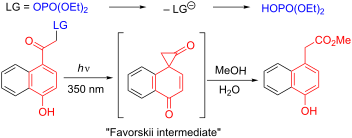
- the lack of product formation for 2-hydroxy-6-trifluoromethylnaphthylene photo-dehydrofluorination reported by Seiler and Wirz [51]. For the 1,5-HNA acetate, the less reactive (higher pKa) of the leaving OAc group of 27 vs DEP, fluorescence decay and reversible ESIPT processes are major factors


Photo, thermal and chemical degradation of riboflavin
Beilstein J. Org. Chem. 2014, 10, 1999–2012, doi:10.3762/bjoc.10.208

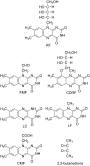
- identified as 2,3-butanedione and is produced from the side-chain of RF by the action of singlet oxygen. Its formation is greatly affected by the pH of the medium as the highest content of this compound was found at pH 6.5, followed by 4.5 and 8.5 [59]. RF is highly sensitive to pH and has pKa values of 1.7
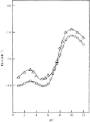
- reaching a maximum at pH 10. This is probably due to the higher reactivity of the flavin triplet in this region [24] (Figure 3). The slight decline above pH 10 is due to the anion formation (pKa 10.2). In acidic region, the slight increase (about 2 folds) in the rate of degradation of RF at pH 3 is due to




Syntheses of 15N-labeled pre-queuosine nucleobase derivatives
Beilstein J. Org. Chem. 2014, 10, 1914–1918, doi:10.3762/bjoc.10.199
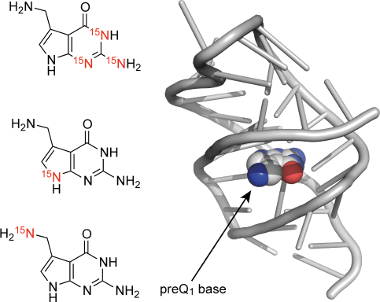
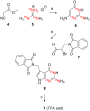
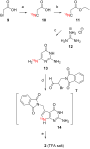
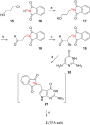
- stoichiometry (preQ1:TFA) based on 1H NMR spectra and consideration of pKa values. However, it is noteworthy that a crystal structure of the preQ1·TFA salt that was crystallized from saturated aqueous solution showed the co-existence of mono- (N(C'7)) and dications (N(C'7), N3) in the crystal [11]. The



Multicomponent reactions in nucleoside chemistry
Beilstein J. Org. Chem. 2014, 10, 1706–1732, doi:10.3762/bjoc.10.179
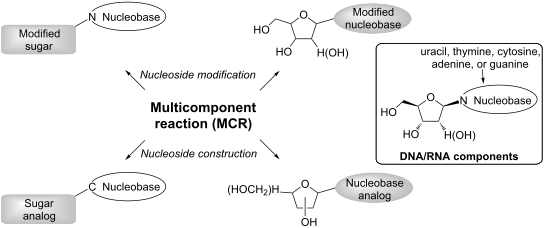
- nucleoside-derived allenes 97 (the uridine example shown), and a number of amines 100 (four equivalents, Scheme 41). The polyfunctional products 101 were obtained with excellent (Z)-stereoselectivity. The authors noticed a pronounced relationship between pKa of the amine and the isolated yield of the product


Synthesis of isoprenoid bisphosphonate ethers through C–P bond formations: Potential inhibitors of geranylgeranyl diphosphate synthase
Beilstein J. Org. Chem. 2014, 10, 1645–1650, doi:10.3762/bjoc.10.171

- (Figure 3). This O,C-digeranyl geminal bisphosphonate was expected to preserve a V-like structure very similar to that of DGBP. However, the presence of an oxygen substituent on the geminal carbon should lower the pKa of bisphosphonate 6 relative to that of compound 5, which might enhance its similarity


C–H-Functionalization logic guides the synthesis of a carbacyclopamine analog
Beilstein J. Org. Chem. 2014, 10, 1564–1569, doi:10.3762/bjoc.10.161
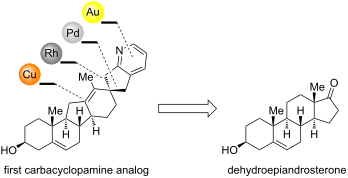
- -carbon E-ring and a pyridine F-ring. Cyclopamine inhibits the 7-transmembrane protein smoothened from converting into its active form [18][19]. Without active smoothened, protein kinases like PKA, GSK3β, and CK1ε phosphorylate the transcription factors Gli2 and Gli3, thereby creating binding sites for


A promising cellulose-based polyzwitterion with pH-sensitive charges
Beilstein J. Org. Chem. 2014, 10, 1549–1556, doi:10.3762/bjoc.10.159
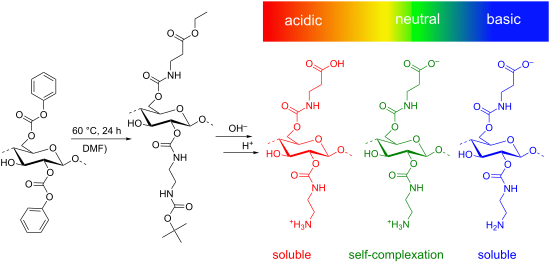
- ). Moreover, the question arises how the pKa value is influenced by further substituents. Therefore, the acidity of the ammonium groups of ω-aminoethylcellulose carbamate [23], (3-ethoxy-3-oxopropyl)(2-aminoethyl)cellulose carbamate 6 and the polyzwitterion 7a were compared. Polycation 6 was titrated forth
- and back in range from pH 4.3 to 10 (Figure 3). The rising point of inflection, representing the pKa value of the amino group (9.0), was determined by the first derivative of the curve (dpH/dV) that yields the minimum. To obtain the pKa value of the amino group in the polyzwitterionic molecule the
- titration curve of 7a could be considered. In Figure 4 the minimum of the first derivative at 340 μL indicates a pKa value of 9.7. Thus, the pKa increases from 8.6 [23] to 9.0 if the ester moiety is present within the polymer chain and, moreover, the value increases to 9.7 for cellulose carbamate containing


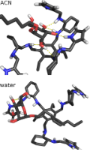
Why a diaminopyrrolic tripodal receptor binds mannosides in acetonitrile but not in water?
Beilstein J. Org. Chem. 2014, 10, 1513–1523, doi:10.3762/bjoc.10.156
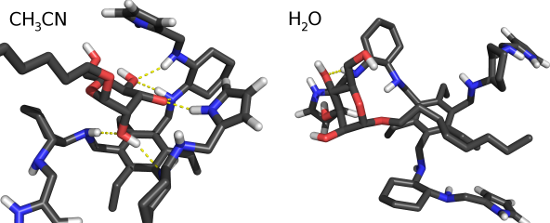
- . In the case of the first generation amino groups, they are much closer to each other, with limited conformational freedom, resulting in much lower pKa values. The small number of titrable sites in the receptor allows us to analyze in detail the population of each possible microstate. In particular
- observations are completely analogous to the described above. As expected, geometrically constrained titrable sites show strong interactions due to electrostatic repulsion which results in shifted pKa values and in some forbidden (not sampled) protonation states. These results illustrate the usefulness of the
- force field. The model compound pKa value used (10.64 for all equivalent amino groups) is the pKa of the dimethylamine [54]. It was used a dielectric constant of 2 for the solute and 80 for the solvent. Grid spacing of 0.1 nm, in the coarser calculation, and 0.025 nm, in the focusing procedure, were




An economical and safe procedure to synthesize 2-hydroxy-4-pentynoic acid: A precursor towards ‘clickable’ biodegradable polylactide
Beilstein J. Org. Chem. 2014, 10, 1365–1371, doi:10.3762/bjoc.10.139

- source of acetylene building moiety; and 2) basic reaction conditions involving a low pKa (<24) to avoid the interruption of the ethynyl proton (pKa ~24) while introducing the acetylene moiety. Propargyl tosylate, prepared from propargyl alcohol and tosyl chloride, is a safe analogue of propargyl bromide
- with low cost. Malonate has a low pKa of ~13 and can be easily deprotonated and alkylated by mild bases such as sodium/potassium alkoxides without deprotonating a terminal alkyne. Conveniently, both malonate and propargyl alcohol are commercially available in bulk quantities. Herein, we report one
- Na2SO3 with ether (Table 2). Apparently, acid 1 precipitated as its sodium salt from ether via an acid–base reaction with Na2SO3 (pKa of 1: ~3.8 [45]; pKa of H2SO3: 1.9, 7.2). When reductant Na2S2O3 was added to an ether solution of acid 1, a yellow solid mixture containing both acid 1 and sulfur was


Substitution effect and effect of axle’s flexibility at (pseudo-)rotaxanes
Beilstein J. Org. Chem. 2014, 10, 1299–1307, doi:10.3762/bjoc.10.131
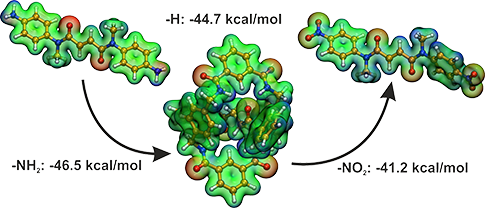
- also witnessed for diketopiperazine-based amide rotaxanes [57]. In Table 2, also the Hammett σ parameters are given. These substituent parameters [43] are the difference of the pKa values of substituted and non-substituted benzoic acids, they can be correlated with the interaction energies resulting in


Atherton–Todd reaction: mechanism, scope and applications
Beilstein J. Org. Chem. 2014, 10, 1166–1196, doi:10.3762/bjoc.10.117

- mechanism proceeding by radical processes. Indeed, the use of UV irradiation or radical initiators in the absence of trialkylamine was found to be unsuccessful to produce phosphoramidates. Recently, Krutikov et al. [9] have reported that hexahydroazepine (a secondary amine with a pKa of 11.1 (Scheme 3-iii




4-Hydroxy-6-alkyl-2-pyrones as nucleophilic coupling partners in Mitsunobu reactions and oxa-Michael additions
Beilstein J. Org. Chem. 2014, 10, 1159–1165, doi:10.3762/bjoc.10.116

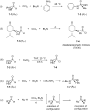
- high acidity of hydroxypyrones such as 3 (Scheme 1; R1 = H, pKa = 4.94 [13]), they would appear to be ideal coupling partners in the Mitsunobu reaction. We recently published an example of the Mitsunobu reaction using the compound 4-hydroxy-6-methyl-2-pyrone (3a) [14]. To the best of our ability, we


On the mechanism of photocatalytic reactions with eosin Y
Beilstein J. Org. Chem. 2014, 10, 981–989, doi:10.3762/bjoc.10.97
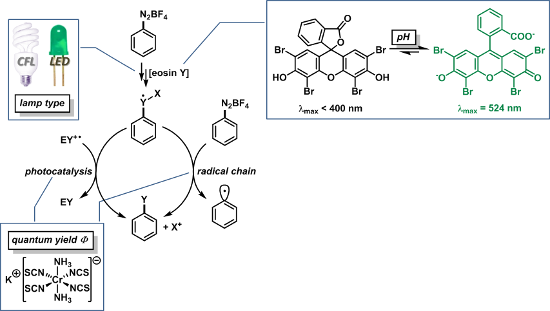
- eosin Y solutions prompted us to further investigate this behaviour. The organic dye eosin Y can exist in four different structures in solution: the spirocyclic form EY1, the neutral EY2, the monoanionic EY3, and the dianionic form EY4 (Scheme 3). Eosin Y contains two relatively acidic protons (pKa 2.0


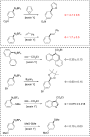
Polyglycerol-functionalized nanodiamond as a platform for gene delivery: Derivatization, characterization, and hybridization with DNA
Beilstein J. Org. Chem. 2014, 10, 707–713, doi:10.3762/bjoc.10.64
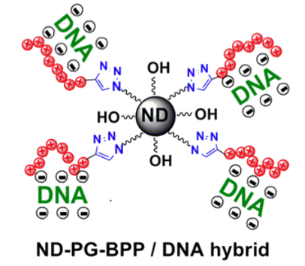
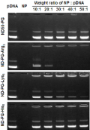
- potentials of the ND-PG-BPP are roughly propotional to the pKa values of the side chains in these basic amino acids; His (6.0), Lys (10.5), and Arg (12.5). The positive surface charge of nanoparticles enables complexation with negatively charged DNA through electrostatic interaction. To analyze the DNA


Isocyanide-based multicomponent reactions towards cyclic constrained peptidomimetics
Beilstein J. Org. Chem. 2014, 10, 544–598, doi:10.3762/bjoc.10.50

- that the lower electrophilicity of arylimines and the possible enamide conjugation could account for this. Furthermore, it was shown that the pKa of the carboxylic acid significantly influenced the reaction rates, in which TFA gave the best results (2 days vs. 5 days for benzoic acid). No


Advancements in the mechanistic understanding of the copper-catalyzed azide–alkyne cycloaddition
Beilstein J. Org. Chem. 2013, 9, 2715–2750, doi:10.3762/bjoc.9.308
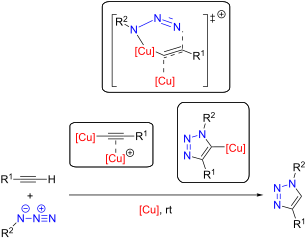
- substrate with formation of the corresponding azolium salt is highly favoured, as copper-coordinated alkynes are much more acidic than imidazolium or imidazolinium cations. For example, the pKa value of copper-coordinated propyne was calculated to be around 15 [13], whereas N,N-diarylimidazolium and N,N
- -diarylimidazolinium chloride salts have pKa values of about 19.8 to 21.1 and 20.7 to 21.5, respectively, for example pKa [1,3-bis(2,6-diisopropylphenyl)imidazolium chloride] = 21.1 ± 0.5 and pKa [1,3-bis(2,6-diisopropylphenyl)imidazolinium chloride] = 21.5 ± 0.5 in aqueous solution at 25 °C [154]. In contrast to free


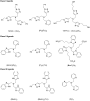


Garner’s aldehyde as a versatile intermediate in the synthesis of enantiopure natural products
Beilstein J. Org. Chem. 2013, 9, 2641–2659, doi:10.3762/bjoc.9.300
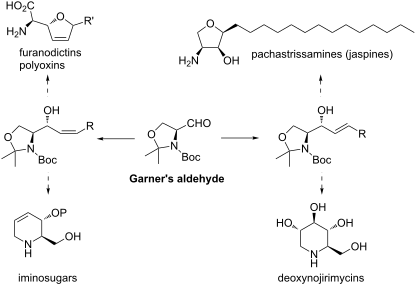
- reactive compared to their non-stabilized counterparts, they tend to epimerize the existing chiral center of 1 a lot less, if at all (pKaH value of 69 in DMSO is 8.5 compared to the pKa value of Ph3(Me)PBr, which is 22.5) [109]. Another method to prepare α,β-unsaturated esters is the Horner–Wadsworth
- , e.g., triphenylphospine oxide. As with the Wittig reaction, the HWE reaction can also promote the epimerization of the α-proton (pKa of triethoxyphosphonoacetate in DMSO is 18.6) [109]. We have experienced this tendency especially with α-amino ketophosphonates [110], but there is also evidence that

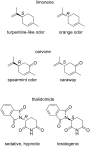


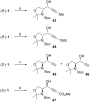


An overview of the synthetic routes to the best selling drugs containing 6-membered heterocycles
Beilstein J. Org. Chem. 2013, 9, 2265–2319, doi:10.3762/bjoc.9.265
- structures will be introduced. The additional nitrogen atom in pyrimidine leads to a significantly reduced basicity when compared to simple pyridine (pKa[pyrimidine] = 1.1; pKa[pyridine] = 5.3) as well as a much more electron-deficient ring system. However, owing to the presence of two nitrogen atoms


Synthesis, characterization and luminescence studies of gold(I)–NHC amide complexes
Beilstein J. Org. Chem. 2013, 9, 2216–2223, doi:10.3762/bjoc.9.260
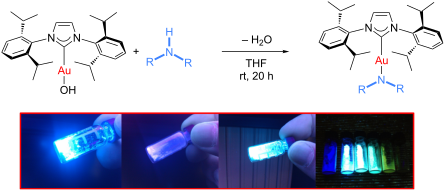
- use of 1 equiv of aniline or 2-aminopyridine led to the isolation of complexes 2 and 3 respectively, in good yields after overnight reaction at room temperature. These results are consistent with the known pKa of [Au(OH)(IPr)] (30.3) [26]; the scope of this preparative route is, as with other
- deprotonation reactions with this building block, limited to substrates with a pKa lower than 30. Encouraged by these exploratory reactions, a series of (hetero)aromatic amines were employed to prepare the corresponding gold(I)–amide complexes. The desired complexes were obtained by reaction of [Au(OH)(IPr)] (1


The chemistry of amine radical cations produced by visible light photoredox catalysis
Beilstein J. Org. Chem. 2013, 9, 1977–2001, doi:10.3762/bjoc.9.234
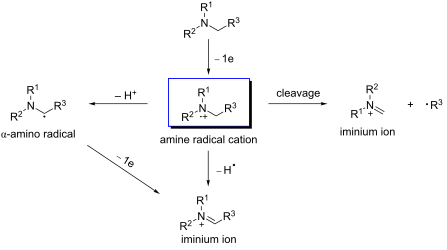
- found to be optimal, lie within a narrow range of pKa values. The authors suggested that TFA protonates the enone 83, thus accelerating the addition of the α-amino radical to the enone (84). The Nishibayashi group reported that α-amino radicals generated from a different class of amines, anilines 87




Gold-catalyzed regioselective oxidation of propargylic carboxylates: a reliable access to α-carboxy-α,β-unsaturated ketones/aldehydes
Beilstein J. Org. Chem. 2013, 9, 1925–1930, doi:10.3762/bjoc.9.227
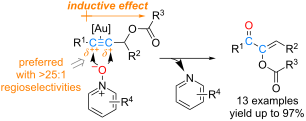
- rationalized by invoking inductive polarization of the C–C triple bond by the electronegative carboxy group. Such polarization could be revealed by calculated natural charges via natural population analysis [39] and corroborated by experimentally detectable properties such as pKa [40] and 13C NMR [41]. We





