


Search results
Search for "platinum" in Full Text gives 207 result(s) in Beilstein Journal of Organic Chemistry. Showing first 200.
Efficient electroorganic synthesis of 2,3,6,7,10,11-hexahydroxytriphenylene derivatives
Beilstein J. Org. Chem. 2012, 8, 1721–1724, doi:10.3762/bjoc.8.196
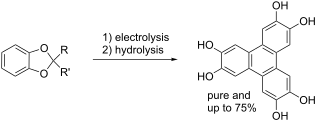
- trimerization protocol [14][15][16]. Usually, yields are in a moderate range (≤35%) [15] when the electrolysis is performed on platinum or graphite anodes in anhydrous and non-nucleophilic electrolytes [14]. Poor yields are caused by the low oxidation potential of the products and the preference for over
- practical galvanostatic conditions using platinum sheets as electrode materials. Due to the large potential window and outstanding solubility for common conducting salts, ACN is among the standard solvents for electrochemical purposes [17]. However, the application of ACN in electrochemical processes is
- and 23.3 mL PC; method B: 4.116 g TBABF4 and 20.7 mL PC) in an undivided standard electrolysis cell and stirred under argon for 5 min. At 20 °C a galvanostatic electrolysis with a current density of 16 mA cm−2 was performed on platinum foil as electrodes (2.2 cm × 3.2 cm). The polarity of electrodes


Supramolecular hydrogels formed from poly(viologen) cross-linked with cyclodextrin dimers and their physical properties
Beilstein J. Org. Chem. 2012, 8, 1594–1600, doi:10.3762/bjoc.8.182
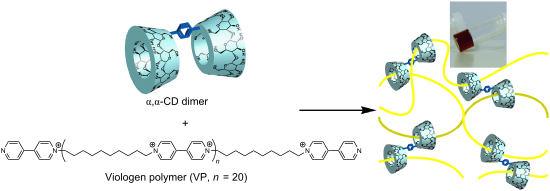
- adding selenium or platinum complexes yields supramolecular assemblies of bis(molecular tube)s cross-linked with the β-CD dimer, which form nanofibers [12][13][14][15]. Moreover, mechanically linked polyrotaxane with the α-CD and poly(ethylene glycol) (PEG) produces a hydrogel material, which exhibits


Synthesis of a novel chemotype via sequential metal-catalyzed cycloisomerizations
Beilstein J. Org. Chem. 2012, 8, 1338–1343, doi:10.3762/bjoc.8.153

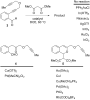
- reaction mixture was added tetrakis(acetonitrile)copper(I) hexafluorophosphate (1.7 mg, 0.005 mmol), and the reaction mixture was stirred at room temperature for 1 h. Platinum(II) chloride (1.2 mg, 0.005 mmol) was added and the reaction mixture was heated to 80 °C for 5 h. The reaction mixture was




Thiophene-based donor–acceptor co-oligomers by copper-catalyzed 1,3-dipolar cycloaddition
Beilstein J. Org. Chem. 2012, 8, 683–692, doi:10.3762/bjoc.8.76

- films, which were deposited on the platinum working electrode within 30 cycles, were investigated in monomer-free dichloromethane solution. The CVs indicated that only dimers of 12 and 13 were formed, which showed quasi-reversible oxidation waves at 0.28 V and 0.68 V versus Fc/Fc+, respectively
- , corresponding to a divinyl-quaterthiophene unit in 12 and a quaterthiophene in 13. Electrochemical polymerization of 14 performed on a platinum working electrode in the range of −0.9 to 0.8 V versus Fc/Fc+ within 30 cycles is displayed in Figure 3 (monomer 14: red, polymerization: gray, polymer film: blue
- respect to 9,10-diphenylanthracene (DPA, Φ = 0.9 in dichloromethane) [43]. Cyclic voltammetry experiments were performed with a computer-controlled EG&G PAR 273 potentiostat in a three-electrode single-compartment cell (2 mL). The platinum working electrode consisted of a platinum wire sealed in a soft




Self-assembly of Ru4 and Ru8 assemblies by coordination using organometallic Ru(II)2 precursors: Synthesis, characterization and properties
Beilstein J. Org. Chem. 2012, 8, 313–322, doi:10.3762/bjoc.8.34
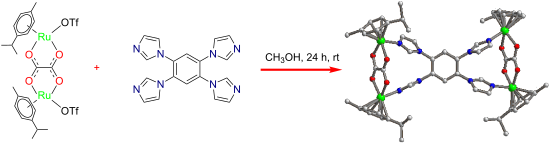
- solvents CH3CN or CH3OH. IR spectra were recorded on a Bruker ALPHA FT-IR spectrometer. Electronic absorption studies were carried out on a Perkin Elmer LAMBDA 750 UV–vis spectrophotometer. The electrochemical measurements were performed in a three-electrode system consisting of a platinum electrode, a


A ferrocene redox-active triazolium macrocycle that binds and senses chloride
Beilstein J. Org. Chem. 2012, 8, 246–252, doi:10.3762/bjoc.8.25
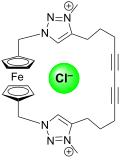
- electrode, a platinum-wire auxiliary electrode and an Innovative Instruments, Inc. LF-2 leak-free silver/silver chloride reference electrode. A 0.50 mM ferrocene sample was used in order to check the reference electrode and internal resistance of the equipment. The electrolyte solution used in all


Fluorescent hexaaryl- and hexa-heteroaryl[3]radialenes: Synthesis, structures, and properties
Beilstein J. Org. Chem. 2012, 8, 71–80, doi:10.3762/bjoc.8.7
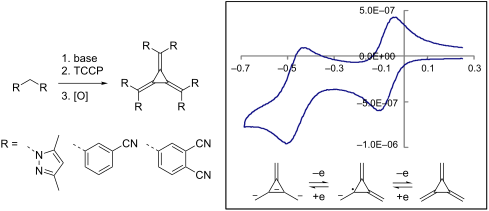
- . Cyclic voltammetry Cyclic voltammetry measurements were performed on a PAR Model 263A potentiostat under nitrogen. Measurements were recorded on 1 mM solutions in dichloromethane/0.1 M [(n-C4H9)4]NPF6] solution using a platinum working electrode, platinum wire auxiliary and pseudo-reference electrodes


Sexithiophenes as efficient luminescence quenchers of quantum dots
Beilstein J. Org. Chem. 2011, 7, 1722–1731, doi:10.3762/bjoc.7.202

- anhydrous CH2Cl2 or acetonitrile as the solvent, aqueous Ag/AgCl as the reference electrode and platinum wire and gold disk (or ITO glass for SEC) as the counter and working electrodes, respectively. All solutions were degassed (Ar) and, where relevant, were prepared so as to contain the substrate in
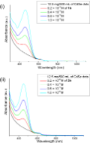
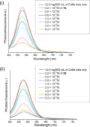
- ITO glass, versus Ag/AgCl reference electrode, platinum wire as the counter electrode, TBAPF6 as the supporting electrolyte in CH3CN (0.1 M), scan rate 100 mV s−1. Absorption spectra in solution (dichloromethane) and solid state. UV–visible spectroelectrochemical measurements of 1b (left) and 2b


Continuous preparation of carbon-nanotube-supported platinum catalysts in a flow reactor directly heated by electric current
Beilstein J. Org. Chem. 2011, 7, 1412–1420, doi:10.3762/bjoc.7.165
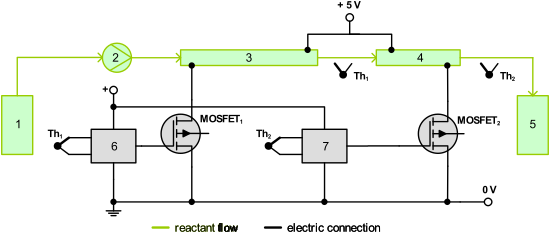
- preparation in a flow reactor which could be used at a large scale. Keywords: carbon nanotubes; continuous catalyst synthesis; direct electrical heating; flow reactors; fuel cell platinum catalyst; Introduction Batch processes represent the state of the art in catalyst preparation. One reason for employing
- results. Most of the work is concerned with the precipitation of hydroxides, oxides or other hardly soluble metal compounds [12]. Platinum nanoparticles supported on conductive carbon materials such as carbon black or carbon nanotubes (CNTs) are commonly used as oxygen reduction reaction (ORR) catalysts
- supported Pt catalyst and its electrochemical activities [16][17][18]. To overcome this challenge, further research on electrocatalyst development is a necessity. Generally, high metal content, small platinum cluster size, and uniform particle distribution over the support material are needed to enhance the


Scaling up of continuous-flow, microwave-assisted, organic reactions by varying the size of Pd-functionalized catalytic monoliths
Beilstein J. Org. Chem. 2011, 7, 1150–1157, doi:10.3762/bjoc.7.133
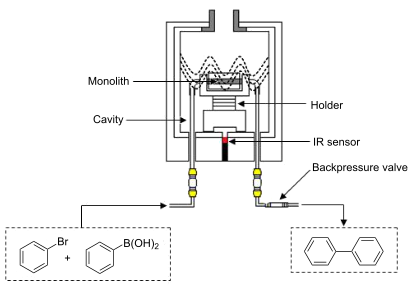
- sealed within the Teflon® tube to form a flow Pd-monolith reactor system. Sample characterization Scanning electron microscopy (SEM) images were obtained by means of a Cambridge S360 scanning electron microscope operated at 20 kV. Each sample was sputter coated with a thin layer of gold–platinum


A practical microreactor for electrochemistry in flow
Beilstein J. Org. Chem. 2011, 7, 1108–1114, doi:10.3762/bjoc.7.127

- without any added electrolyte [4][5]. Atobe et al. constructed a thin layer flow cell from platinum and/or glassy carbon plates (3 × 3 cm), separated by adhesive tape (80 µm), with a space left in between to act as the channel, and the devices were sealed with epoxy resin [6]. They reported the self
- platinum electrodes with a surface area of 45 mm2 were positioned with an inter-electrode gap of either 160 µm or 320 µm, and C–C bond forming reactions based on the electro-reductive coupling of activated olefins and benzyl bromide derivatives were reported. The best result obtained was a 98% formation of
- the continuous synthesis of diaryliodonium compounds. A microflow electrochemical reactor made out of two aluminium bodies (50 mm diameter, 25 mm height) was manufactured. The electrodes are constructed of two PTFE plates (35 mm diameter, 4 mm height) onto which 0.1 mm platinum foil electrodes [16


Recent developments in gold-catalyzed cycloaddition reactions
Beilstein J. Org. Chem. 2011, 7, 1075–1094, doi:10.3762/bjoc.7.124
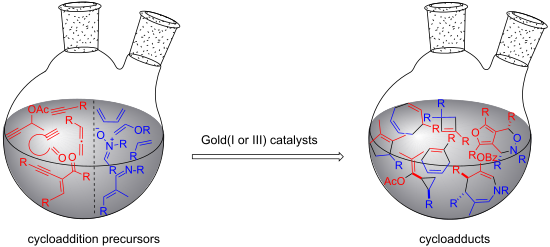
- , cobalt, nickel or palladium catalysts [4]. In recent years, however, platinum and particularly gold complexes have also emerged as excellent catalysts for the promotion of novel types of cycloaddition reactions, usually involving non-activated unsaturated systems (e.g., alkynes, allenes, alkenes or 1,3
- and reductive eliminations). Therefore, platinum(II) and particularly gold(I) or (III) complexes tend to activate alkynes, alkenes or allenes in a highly chemoselective manner; activation that opens interesting reaction pathways that usually involve carbocationic intermediates. Also very important is
- cycloadditions involving zwitterionic intermediates similar to I have also been developed with other transition metal catalysts such as tungsten, rhodium or platinum [32][33][34][35]. In particular, important developments were recently achieved with platinum catalysts [36][37], including the first


Asymmetric Au-catalyzed cycloisomerization of 1,6-enynes: An entry to bicyclo[4.1.0]heptene
Beilstein J. Org. Chem. 2011, 7, 1021–1029, doi:10.3762/bjoc.7.116
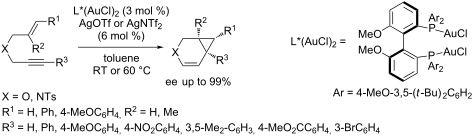
- carbophilic complexes such as platinum or gold [16][17][18][19][20][21][22] that led to the formation of complex bicyclic and tricyclic compounds [23][24][25][26][27][28][29][30][31][32][33][34][35][36][37][38][39][40]. The first asymmetric version was described by Shibata’s group in 2005 in the presence of a
- chiral iridium catalyst [41] (Scheme 1, reaction 2). We and others recently pursued the improvement and development of this enantioselective process, by employing platinum [42][43][44], rhodium [45] or gold [46][47][48] complexes. Following our previous work with chiral gold catalysts [46], we report a
- % isolated yield respectively) resulting from 5-exo- and 6-endo cycloisomerization reactions [20][66]. Thus, the gold catalytic system cannot compete with the results obtained for the cyclizations of nitrogen-tethered enynes in the presence of iridium, platinum or rhodium catalysts [41][42][43][44][45]. The


Synthesis of novel 5-alkyl/aryl/heteroaryl substituted diethyl 3,4-dihydro-2H-pyrrole-4,4-dicarboxylates by aziridine ring expansion of 2-[(aziridin-1-yl)-1-alkyl/aryl/heteroaryl-methylene]malonic acid diethyl esters
Beilstein J. Org. Chem. 2011, 7, 831–838, doi:10.3762/bjoc.7.95
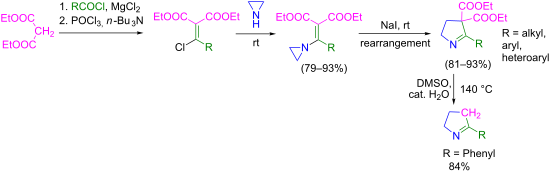
- quantitative yields, either by reduction with sodium borohydride, or by catalytic hydrogenation using platinum on carbon [33][34]. The pyrrolines can be aromatized either by a two step procedure (i) NBS bromination and (ii) dehydrohalogenation in basic medium [35][36][37], or by dehydrogenation with Pd/C [38


High chemoselectivity in the phenol synthesis
Beilstein J. Org. Chem. 2011, 7, 794–801, doi:10.3762/bjoc.7.90
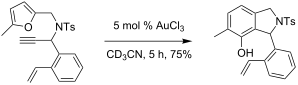
- dinuclear gold(I) complex 36 [44] gave the same result (Figure 3). When the catalyst was changed to platinum(II) chloride in acetone, a complex mixture of inseparable products was obtained. Since the two diastereoisomers 28a and 28b with the propargylic stereocenters were separable, we investigated the gold


Gold-catalyzed heterocyclizations in alkynyl- and allenyl-β-lactams
Beilstein J. Org. Chem. 2011, 7, 622–630, doi:10.3762/bjoc.7.73
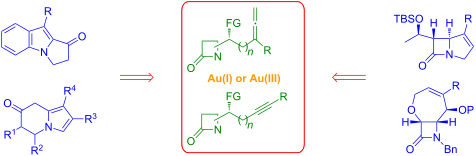
- -(2-alkynylphenyl)-β-lactams 18 has been accomplished (Scheme 10). Platinum was the metal of choice, gold salts being less effective [51]. This cycloisomerization can be viewed as a net intramolecular insertion of one end of the alkyne into the lactam amide bond with concurrent migration of the



A gold-catalyzed alkyne-diol cycloisomerization for the synthesis of oxygenated 5,5-spiroketals
Beilstein J. Org. Chem. 2011, 7, 570–577, doi:10.3762/bjoc.7.66
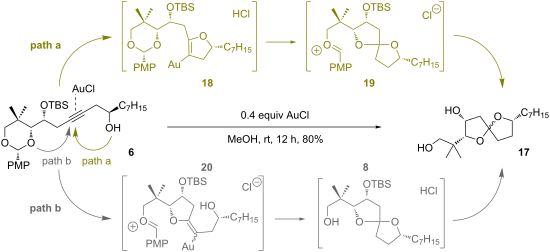
- selectivity using the Utimoto conditions to prepare 6,6-spiroketals. Therefore, he suggested the preferred use of Ziese’s dimer, a platinum catalyst (Scheme 3, Reaction 2), for such cyclizations [9]. In an unrelated study that also bears on the current work, Aponick and co-workers described a gold-catalyzed


One-pot gold-catalyzed synthesis of 3-silylethynyl indoles from unprotected o-alkynylanilines
Beilstein J. Org. Chem. 2011, 7, 565–569, doi:10.3762/bjoc.7.65
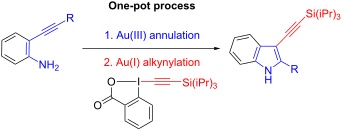
- carbonyl groups, but using platinum catalysts [25][26][27][28]. To date, there are no gold- or platinum-catalyzed methods for the introduction of acetylenes as electrophiles. However, Cacchi developed a palladium-catalyzed domino sequence including cyclization of o-alkynyltrifluoroacetanilides and


Palladium-catalyzed formation of oxazolidinones from biscarbamates: a mechanistic study
Beilstein J. Org. Chem. 2011, 7, 246–253, doi:10.3762/bjoc.7.33
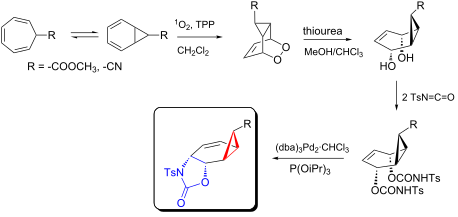
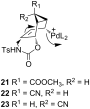
- complex rings and open chain systems containing diverse functionalities. It has been reported that the complexation takes place exclusively anti to the leaving group (Figure 1) [3][4][5][6]. On the other hand, Kurosawa et al. [7] and Greenberg et al. [8] reported that the palladium(0)–olefin and platinum
- (0)–olefin complexes add to 5-(methoxycarbonyl)-2-cyclohexenyl chloride and bromide from the syn-side of the leaving group and that the leaving group is capable of coordinating the metal to give the corresponding (η3-allyl)–palladium or –platinum complexes. In order to determine from which side the


Synthesis and self-assembly of 1-deoxyglucose derivatives as low molecular weight organogelators
Beilstein J. Org. Chem. 2011, 7, 234–242, doi:10.3762/bjoc.7.31
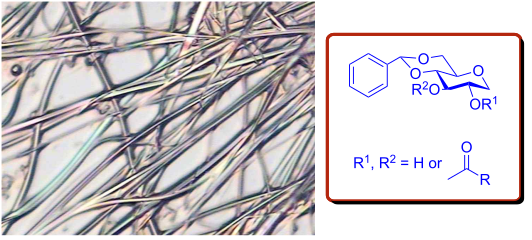
- program used to acquire and store the photos was Corel Photo-Paint 7. Scanning electron microscopy. A piece of the gel was deposited on an aluminum sample holder and allowed to dry in a desiccator. The dried gel sample was coated with a thin layer of platinum (~100–150 Å) by a Denton Vacuum (model Desk II





Identification and synthesis of impurities formed during sertindole preparation
Beilstein J. Org. Chem. 2011, 7, 29–33, doi:10.3762/bjoc.7.5
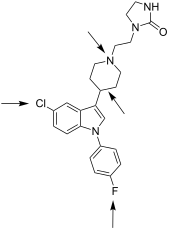
- hydrochloride monohydrate (14) under acidic conditions affords 5-chloro-1-(4-fluorophenyl)-3-(1,2,3,6-tetrahydropyridin-4-yl)-1H-indole hydrochloride (15). Reduction of 15 in the presence of platinum oxide yields 5-chloro-1-(4-fluorophenyl)-3-(4-piperdinyl)-1H-indole (9) which on condensation with 1-(2
- platinum catalyzed reduction of indole 15 is a critical reaction, whilst a prolonged reaction time leads to dehalogenated product 2, termination without complete reduction leads to indole 9 contaminated with 15. This contaminated material upon condensation with imidazolidinone 16 results in sertindole (1
- )-impurity 21 (Scheme 4). The catalytic hydrogenation of indole 19 proved to be a difficult reaction as significant formation of the dehalogenated products was observed, repeated recrystallization from MeOH afforded pure indole 20. Since dehalogenation was observed during the platinum oxide reduction of the


Miniemulsion polymerization as a versatile tool for the synthesis of functionalized polymers
Beilstein J. Org. Chem. 2010, 6, 1132–1148, doi:10.3762/bjoc.6.130
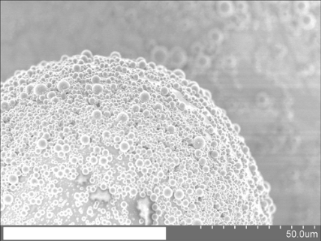
- copolymerized with styrene to yield functionalized particles [34][35] and their uptake by cells was studied [34]. In general, with increased functional groups, an increase in the uptake into cells could be observed. Copolymer particles of styrene and acrylic acid were used to encapsulate a platinum(II) complex





Redox-active tetrathiafulvalene and dithiolene compounds derived from allylic 1,4-diol rearrangement products of disubstituted 1,3-dithiole derivatives
Beilstein J. Org. Chem. 2010, 6, 1002–1014, doi:10.3762/bjoc.6.113

- anhydrous CH2Cl2 with 0.1 M tetrabutylammonium hexafluorophosphate as the supporting electrolyte. Glassy carbon, platinum wire, and Ag/AgCl electrodes were used as the working, counter and reference electrodes, respectively. The cyclic voltammograms are shown in Figure 7, and the potential values of the
- voltammetric analyser with iR compensation, in anhydrous dichloromethane, with aqueous Ag/AgCl as the reference electrode and platinum wire and gold disk as the counter and working electrodes, respectively. The solution was degassed (N2) and contained the substrate in a concentration of ca. 10−3 M together


Synthesis, electronic properties and self-assembly on Au{111} of thiolated (oligo)phenothiazines
Beilstein J. Org. Chem. 2010, 6, No. 72, doi:10.3762/bjoc.6.72
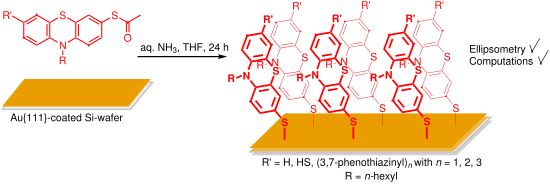
- mm platinum disk, the counter-electrode was a platinum wire, and the reference electrode was an Ag/AgCl electrode. The potentials were corrected to the internal standard of Fc/Fc+ in CH2Cl2 (E00/+1 = 450 mV) [61]. 7-Bromo-10,10′,10″,10′″-tetrahexyl-10H,10′H,10″H,10′″H-3,3′:7′,3″:7″,3


Functional properties of metallomesogens modulated by molecular and supramolecular exotic arrangements
Beilstein J. Org. Chem. 2009, 5, No. 54, doi:10.3762/bjoc.5.54
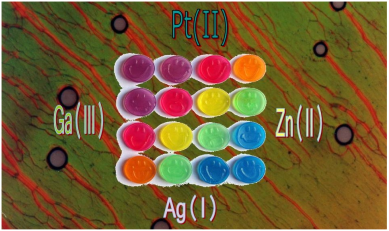
- ligand extensively used in the synthesis of cyclometallated iridium(III) and platinum(II) derivatives [46][47] but whose reactivity towards Pd(II) centres is unexplored. This kind of ligand has been functionalised with a chiral group such as a cholesteryl ester unit, introduced as terminal substituent in
- soft materials with non-conventional structures. Platinum(II) and Zinc(II) For the less explored Pt(II) and Zn(II) metal centres versatile 2,2′-bipyridines have been selected since they are well-known building blocks for the formation of inorganic functional nanomaterials [51]. The complexation of non





