


Search results
Search for "Hoogsteen hydrogen bonding" in Full Text gives 2 result(s) in Beilstein Journal of Organic Chemistry.
Isoorotamide-based peptide nucleic acid nucleobases with extended linkers aimed at distal base recognition of adenosine in double helical RNA
Beilstein J. Org. Chem. 2025, 21, 2513–2523, doi:10.3762/bjoc.21.193
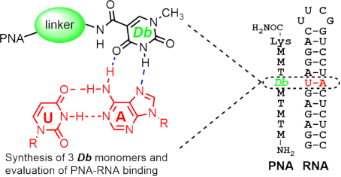
- flexibility. Yet, for the Hoogsteen hydrogen bonding to occur using distal recognition monomers, the entirety of the flexible linker must enter the major groove being forced into a conformation that no longer is freely rotating. Additionally, these longer chains bring in potential issues of steric conflict
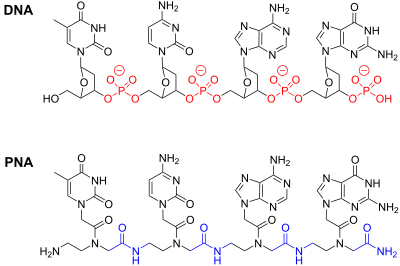
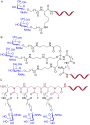
- PNA oligomer with the N-(2-aminoethyl)glycine backbone (in red); (b) Representative monocyclic synthetic nucleobase triples through Hoogsteen hydrogen bonding (blue dashed lines). Watson–Crick hydrogen bonds are in red (dashed lines). Representative extended nucleobase triples through Hoogsteen
- distal binding monomers (Db) demonstrated slightly higher affinity for A–U base pairs while one demonstrated slightly higher affinity for the G–C base pair. These results provide insight into the nature of PNA monomer design particularly around linker design and rigidity. Keywords: Hoogsteen hydrogen


Chemical approaches to discover the full potential of peptide nucleic acids in biomedical applications
Beilstein J. Org. Chem. 2021, 17, 1641–1688, doi:10.3762/bjoc.17.116
- additional Hoogsteen hydrogen bonding [125]. Inserting just one G-clamp nucleobase into a PNA sequence increased the duplex melting temperature with complementary DNA or RNA by 13–20 °C while maintaining good mismatch discrimination [126]. Ganesh and co-workers found that substitution of the 5-position in
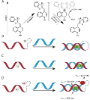
- helical recognition of nucleic acids. The binding affinity and sequence selectivity of triplex-forming oligonucleotides derives from thymine recognition of A–T (or A–U in RNA) base pairs (T•A–T or T•A–U triplet) and protonated cytosine recognition of G–C base pairs (C+•G–C triplet) via Hoogsteen hydrogen
- -bonding (Figure 6) [94]. A significant bottleneck for triple helix formation is the requirement for cytosine protonation to form the natural C+•G–C triplet. Because of the low pKa of cytosine (≈4.5), formation of the C+•G–C triplet is unfavorable at physiological pH, which severely destabilizes the









Other Beilstein-Institut Open Science Activities



