


Search results
Search for "Overman rearrangement" in Full Text gives 4 result(s) in Beilstein Journal of Organic Chemistry.
Ex-situ generation of gaseous nitriles in two-chamber glassware for facile haloacetimidate synthesis
Beilstein J. Org. Chem. 2025, 21, 2465–2469, doi:10.3762/bjoc.21.188
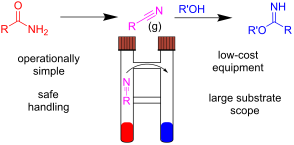
- acetimidates through the Overman rearrangement [8][9]. Trifluoroacetonitrile is a highly toxic gas being of limited commercial availability and it can furthermore be difficult to get from the few commercial suppliers due to transport restrictions. This, together with local restrictions, because of the inherent


Sigmatropic rearrangements of cyclopropenylcarbinol derivatives. Access to diversely substituted alkylidenecyclopropanes
Beilstein J. Org. Chem. 2019, 15, 333–350, doi:10.3762/bjoc.15.29
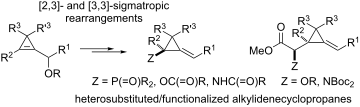
- suitably substituted aminocyclopropane derivatives [44][45][46]. In 2014, Hyland et al. disclosed the Overman rearrangement [47] of cyclopropenylcarbinyl trichloroacetimidates [48]. The optimal conditions for the generation of imidates 12a–i involved treatment of secondary cyclopropenylcarbinols with
- the N-acylamino group explained the modest face selectivity of hydrogen addition which preferentially occurred on the face of the olefin opposite to the N-chloroacetylamino substituent (Scheme 13) [48]. 3,3-Disubstituted cyclopropenylcarbinols could not be used as substrates in the Overman
- rearrangement. This limitation of the substrate scope is due to the instability of the corresponding trichloroacetimidates. Thus cyclopropenylcarbinols 20a–c possessing gem-dimethyl substitution at C3 were converted to imidates 21a–c but upon treatment with silica gel (CH2Cl2, −10 °C), those latter compounds





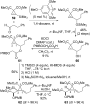


Efficient carbon-Ferrier rearrangement on glycals mediated by ceric ammonium nitrate: Application to the synthesis of 2-deoxy-2-amino-C-glycoside
Beilstein J. Org. Chem. 2014, 10, 300–306, doi:10.3762/bjoc.10.27
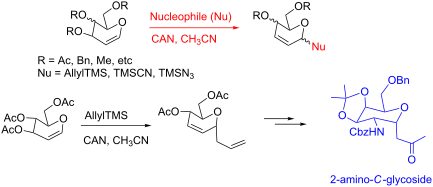
- -glycosides; carbon-Ferrier rearrangement; ceric ammonium nitrate; 2-deoxy-2-aminoglycosides; Overman rearrangement; Introduction The growing significance of C-glycosides can be attributed to their potential use as inhibitors of carbohydrate-processing enzymes [1][2][3], their extraordinary stability
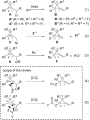
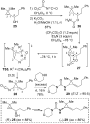
- crude form was heated under reflux in xylene, to afford the single isomer 10 in 72% yield by an Overman rearrangement [61][62][63]. The trichloroacetamide group was hydrolyzed by heating under reflux in 6 N HCl, and the obtained free amine was protected as a benzyloxycarbamate group by using benzyl
- chloroformate and Na2CO3. The protected amide 11 was obtained in 74% yield over 2 steps. The regioselectivity of the Overman rearrangement step was determined from the 1H NMR and COSY experiments of compound 11. These experiments showed that the anomeric proton (H-1) at δ 4.40 correlated with the H-2 proton at


Highly efficient gold(I)-catalyzed Overman rearrangement in water
Beilstein J. Org. Chem. 2011, 7, 781–785, doi:10.3762/bjoc.7.88
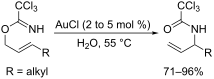
- Dong Xing Dan Yang Department of Chemistry, The University of Hong Kong, Pokfulam Road, Hong Kong, China 10.3762/bjoc.7.88 Abstract A highly efficient gold(I)-catalyzed Overman rearrangement of allylic trichloroacetimidates to allylic trichloroacetamides in water is reported. With this
- environmentally benign and scalable protocol, a series of C3-alkyl substituted allylic trichloroacetamides were synthesized in good to high yields. Keywords: allylic trichloroacetamides; allylic trichloroacetimidate; gold(I) chloride; Overman rearrangement; water; Introduction The aza-Claisen rearrangement of
- allylic trichloroacetimidates to allylic trichloroacetamides (Overman rearrangement) is a powerful and attractive strategy for the synthesis of allylic amines from readily available allylic alcohols [1][2]. This transformation can be conducted thermally at high temperatures or by transition metal


Other Beilstein-Institut Open Science Activities



