


Search results
Search for "azo dyes" in Full Text gives 9 result(s) in Beilstein Journal of Organic Chemistry.
Tautomerism and switching in 7-hydroxy-8-(azophenyl)quinoline and similar compounds
Beilstein J. Org. Chem. 2025, 21, 1404–1421, doi:10.3762/bjoc.21.105
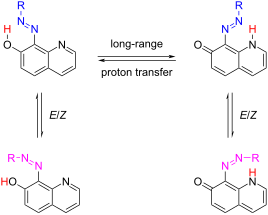
- , Bulgaria Department of Chemistry, University of Copenhagen, DK-2100 Copenhagen Ø, Denmark 10.3762/bjoc.21.105 Abstract Tautomerism in two new azo dyes, based on 7-hydroxyquinoline, has been considered from the viewpoint of the proton crane concept. Although 8-(phenyldiazenyl)quinolin-7-ol exists in
- stabilization of the azo tautomer and making possible long range proton transfer to the quinolyl nitrogen atom. Keywords: azo dyes; E/Z isomerization; DFT; NMR; photochemistry; proton transfer; tautomerism; UV–vis; Introduction Azo compounds have long been utilized as dyes in industries such as textiles
- number of industrially used azo dyes [1][3] and therefore its tautomerism is studied in details. The existing experimental data for low polar solvents (cyclohexane and tetrachloromethane) indicate a ΔG value of around 0.4 kcal/mol [53] at room temperature, which gives a prevalence of the E-tautomer (a




Substituent effects in N-acetylated phenylazopyrazole photoswitches
Beilstein J. Org. Chem. 2025, 21, 830–838, doi:10.3762/bjoc.21.66
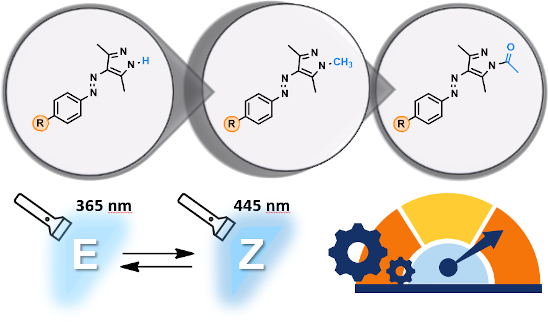
- mechanism is one of the fastest relaxation mechanism for heterocyclic azobenzenes (typically for most of the azo dyes [45]). However, the nature of the mechanism is still a matter of current debate, and additional factors, such as the presence of tautomerizable groups [46][47], and the involvement of the


Azologization and repurposing of a hetero-stilbene-based kinase inhibitor: towards the design of photoswitchable sirtuin inhibitors
Beilstein J. Org. Chem. 2019, 15, 2170–2183, doi:10.3762/bjoc.15.214
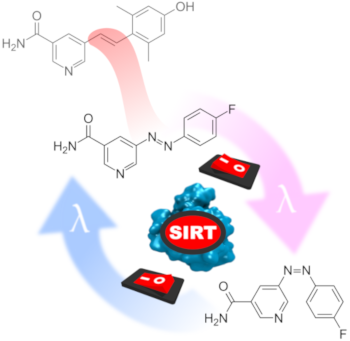
- studies proposed a binding mode in which 2a mimics the nicotinamide residue of NAD+, whereas aromatic amino acid residues of the selectivity pocket stabilize the dimethylphenol ring [35]. As photoisomerization in stilbenes and azo dyes is accompanied by a perpendicular twist of the phenyl ring towards the
- stilbene motive of selected stilbene 2c by a diazeno group, because photoisomerization of azo dyes was anticipated to proceed fast and reversible by application of UV irradiation and visible light, respectively in this analogue. 5-Diazenylnicotinamide 11 was synthetically accessible in two steps through
- state, as envisioned. Possible reasons could be assigned to substituent effects as demonstrated by Simeth et al. [62]. As recently reported by Schehr et al., reducing agents like DTT, used to prevent enzyme oxidation in crystallization mixtures or in vitro assays, can reduce azo dyes to hydrazine


The in situ generation and reactive quench of diazonium compounds in the synthesis of azo compounds in microreactors
Beilstein J. Org. Chem. 2016, 12, 1987–2004, doi:10.3762/bjoc.12.186
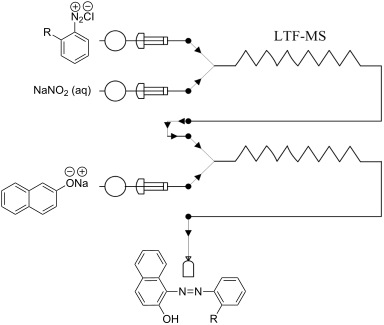
- principles of green chemistry [1][2] such as less hazardous chemical synthesis, efficient atom economy, reduction of waste produced, some alternative cleaner methods for the synthesis of azo dyes have been developed. These methods are however only representative of particular coupling agents and diazotized
- amines. Nonetheless they highlight the green benefits that they offer. For example Noroozi-Pesyan et al. synthesized azo dyes by grinding derivatives of aniline with solid sodium nitrite in the presence of p-toluenesulfonic acid [3]. It was found that the yield of isolated azo dyes obtained increased
- calculated specific interfacial area of 40 cm2, gave a comparable conversion to that attained at a micro scale (calculated specific interfacial area of 80 cm2). In the synthesis of azo dyes and pigments, the cost of production and quality of the product cannot be over looked. Wille et al., in their


New palladium–oxazoline complexes: Synthesis and evaluation of the optical properties and the catalytic power during the oxidation of textile dyes
Beilstein J. Org. Chem. 2015, 11, 1175–1186, doi:10.3762/bjoc.11.132
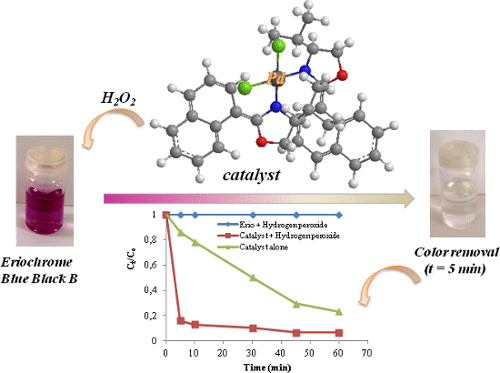
- gap energy values (Eg) ranging between 2.34 and 3.21 eV. Their catalytic activities were tested for the degradation of Eriochrome Blue Black B (a model of azo dyes) in the presence of an ecological oxidant (H2O2). The efficiency of the decolorization has been confirmed via UV–visible spectroscopic
- complexes was evaluated for the first time during the degradation of organic dyes such as Eriochrome Blue Black B referred to as Erio which was chosen as an example of azo dyes (Figure 1). Results and Discussion The use of oxazolines as ligands during the preparation of optically active cyclopalladated
- the UV curve. Finally, we have studied the catalytic activities of the new complexes during the decolorization of azo dyes in solutions which are discharged in textile industry. Oxidative degradation of dyes Six complexes were checked for the oxidative degradation of Eriochrome Blue Black B. The


Host–guest-driven color change in water: influence of cyclodextrin on the structure of a copper complex of poly((4-hydroxy-3-(pyridin-3-yldiazenyl)phenethyl)methacrylamide-co-dimethylacrylamide)
Beilstein J. Org. Chem. 2014, 10, 2480–2483, doi:10.3762/bjoc.10.259
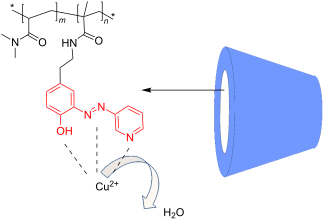
- studied extensively, causing for example a blue to red color transition of polydiacetylenes (PDAS) due to the formation of inclusion complexes [6][7]. Azo dyes, with their remarkable ability to form stable azo–metal chelate complexes with outstanding thermal and optical properties have been studied widely
- addition. Assuming an intermolecular aggregating effect due to ionic interactions between the covalently attached azo dyes in 7 and Cu ions in solution, dynamic light scattering (DLS) experiments in a water/methanol solution were carried out (Figure 3). It was found that, by introducing copper ions to 7


Linkage of α-cyclodextrin-terminated poly(dimethylsiloxanes) by inclusion of quasi bifunctional ferrocene
Beilstein J. Org. Chem. 2013, 9, 1278–1284, doi:10.3762/bjoc.9.144
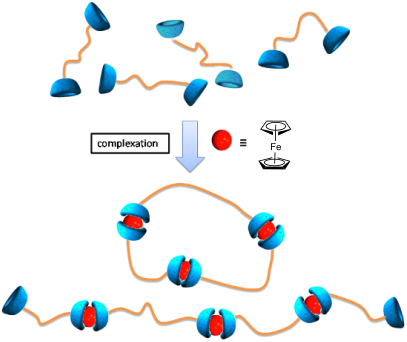
- attached are of increasing interest in recent years. For example, polymers bearing β-CD as side or terminal groups and their interaction with classical guest groups such as adamantane or azo-dyes have been intensively studied [1][2][3][4]. The characterization of the inclusion complexes between


Polymerization of novel methacrylated anthraquinone dyes
Beilstein J. Org. Chem. 2013, 9, 453–459, doi:10.3762/bjoc.9.48

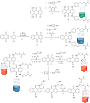
- ][4][5][6] and are used for the coloration of cotton and cellulose fibers as well as for synthetic materials such as polyamides [7]. Besides azo dyes, they represent the second largest class of textile pigments [8], and unlike these dyes, anthraquinone derivatives are resistant against degradation due
- to their aromatic structure [9]. As the syntheses of these dyes are more complicated, their production costs are higher in comparison to azo dyes. Therefore, anthraquinone dyes are only used if the required properties and colors are remarkable or when the desired colors cannot be obtained easily by
- the use of azo dyes, especially in the case of bright blue shades. Anthraquinone dyes can be obtained synthetically and by isolation from fungi such as Dermocybe sanguinea or other fungal species [5][10][11][12][13], to give them a higher compatibility with the environment and an improved availability



Recent advances towards azobenzene-based light-driven real-time information-transmitting materials
Beilstein J. Org. Chem. 2012, 8, 1003–1017, doi:10.3762/bjoc.8.113
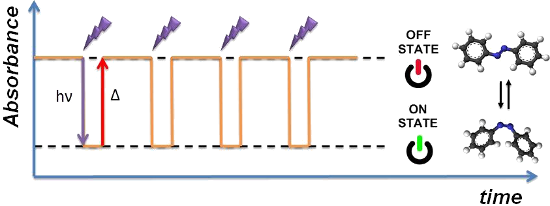
- the azobenzene core is one of the main factors that allows modulating the thermal relaxation rate of azo-dyes and, therefore, determines the response time of the photochromic molecular switch. The response time of the photochromic switch is a key feature in its overall performance. This parameter is
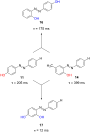
- and type-II azoderivatives allowed the transmission of information within a few of milliseconds. Finally, those azo-dyes that combine both phenomena (type-III) were tested, registering action speeds down to some tens of microseconds. Review Type-I azoderivatives: photochromic switches acting within
- kinetics of the thermal cis-to-trans isomerisation process for azo-dyes 1–6 were analysed by conventional UV–vis spectroscopy. Since these azoderivatives are not water-soluble, ethanol was used as a solvent instead of water. The unimolecular thermal cis-to-trans isomerisation process in the dark obeys







Other Beilstein-Institut Open Science Activities



