


Search results
Search for "ethylmaltol" in Full Text gives 1 result(s) in Beilstein Journal of Organic Chemistry.
One-pot synthesis of ethylmaltol from maltol
Beilstein J. Org. Chem. 2025, 21, 2755–2760, doi:10.3762/bjoc.21.212

- GmbH, Am Brunnen 1, 5330 Fuschl am See, Austria 10.3762/bjoc.21.212 Abstract A novel route to the flavor enhancer ethylmaltol, a synthetic 4-pyrone, from naturally abundant maltol is disclosed. Two strategies were explored for the required C1 homologation. The most direct approach, C–C bond formation
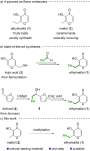
- synthesis of ethylmaltol from a renewable precursor. Keywords: ethylmaltol; flavor enhancer; maltol; methylation; 4-pyrones; Introduction In 1969, a Pfizer patent first disclosed ethylmaltol (1) as a powerful, purely synthetic flavor and aroma enhancer (Scheme 1a) [1]. It has been found to have a 6-times
- higher flavor-enhancing power compared to its naturally occurring congener maltol (2), which has a more caramel-like odor compared to the fruitier ethylmaltol (1). Owing to its strong ability to enhance the taste and odor of food, ethylmaltol (1) is used as an additive in a wide range of beverages


Other Beilstein-Institut Open Science Activities



