


Search results
Search for "indolo[1,2-c]quinazoline" in Full Text gives 2 result(s) in Beilstein Journal of Organic Chemistry.
Discovery of cytotoxic indolo[1,2-c]quinazoline derivatives through scaffold-based design
Beilstein J. Org. Chem. 2025, 21, 2062–2071, doi:10.3762/bjoc.21.161
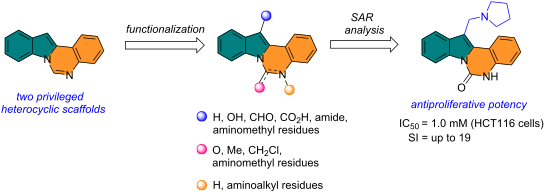
- Street, Moscow 11991, Russia 10.3762/bjoc.21.161 Abstract Indolo[1,2-c]quinazoline derivatives have emerged as promising chemotype in drug discovery due to their versatile biological activities, including antimicrobial and antiviral properties. In this study, we report the design, synthesis, and
- biological evaluation of novel indolo[1,2-c]quinazoline derivatives, with a particular focus on their antiproliferative potential against human cancer cells. We introduced structural modifications at positions 5, 6, and 12 of the indolo[1,2-c]quinazoline core to explore the structure–activity relationships
- , offering valuable insights into their SAR and paving the way for a future evaluation of these compounds as anticancer therapeutics. Keywords: antiproliferative activity; antitumor agents; indolo[1,2-c]quinazoline; modification; structure–activity relationship; Introduction Organic compounds featuring


Synthesis of indolo[1,2-c]quinazolines from 2-alkynylaniline derivatives through Pd-catalyzed indole formation/cyclization with N,N-dimethylformamide dimethyl acetal
Beilstein J. Org. Chem. 2018, 14, 2411–2417, doi:10.3762/bjoc.14.218
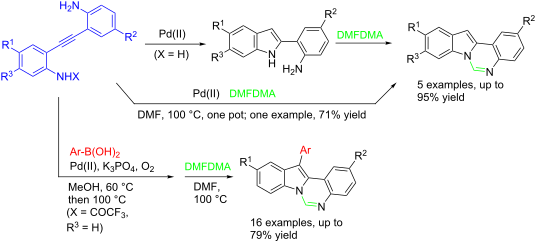
- reaction of 5 gave intermediates 6; then, cyclization to 7 followed by elimination of trifluoromethane afforded products 8. Since the unique molecular skeleton of hinckdentine A is constituted of a 6-unsubstituted indolo[1,2-c]quinazoline nucleus [12][13], we planned to modify our previous procedures to
- acids 12, are summarized in Table 1. In some cases, 12-unsubstituted indolo[1,2-c]quinazoline derivatives 13 were also obtained as byproducts. Electron-rich arylboronic acids worked quite well (Table 1, entries 1, 3, and 4). However, an attempt to carry out the reaction under air, instead of under O2


Other Beilstein-Institut Open Science Activities



