


Search results
Search for "lead-likeness" in Full Text gives 2 result(s) in Beilstein Journal of Organic Chemistry.
Thiadiazino-indole, thiadiazino-carbazole and benzothiadiazino-carbazole dioxides: synthesis, physicochemical and early ADME characterization of representatives of new tri-, tetra- and pentacyclic ring systems and their intermediates
Beilstein J. Org. Chem. 2025, 21, 2220–2233, doi:10.3762/bjoc.21.169
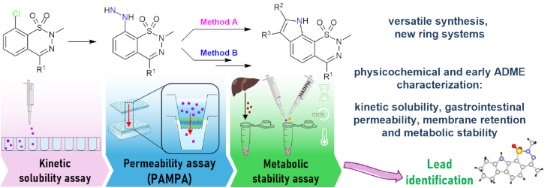
- physicochemical and early ADME characterization study, in the framework of which logP, pKa and logk values were calculated. Following that, kinetic solubility and in vitro gastrointestinal membrane-specific permeability measurements were carried out to assess the lead-likeness of the compounds. Subsequently, the
- metabolic stability of the most promising derivatives was also determined using human liver microsomes. Keywords: early ADME characterization; Fischer indole cyclization; heterocycles; indoles; lead-likeness; new ring systems; physicochemical characterization; Introduction Considering the published
- . Among these, 3d, 7d, (Z)-7h and (E)-9a are shown in Figure 4. To assess the lead-likeness of the newly synthesized compounds 3a–j and 10a,b and to make a priority list among them prior to pharmacological testing, a detailed early-phase pharmacokinetic evaluation has been carried out. Since the


O,S,Se-containing Biginelli products based on cyclic β-ketosulfone and their postfunctionalization
Beilstein J. Org. Chem. 2024, 20, 2143–2151, doi:10.3762/bjoc.20.184
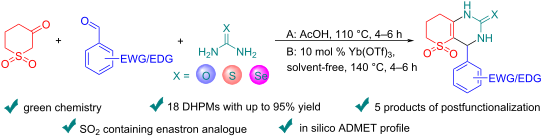
- of condensed thiazoles and tetrazoles. In silico assessment of ADMET parameters shows that most compounds meet the lead-likeness requirements. The biological profiles of new compounds demonstrate high probability levels of activity against the following pathogens/diseases: Candida albicans, Alphis
- , see Supporting Information File 1 (Table S1). To visualize the lead-likeness of compounds 2a–r, 3–7, we utilized the free online software LLAMA (https://llama.leeds.ac.uk) [53], which showed that 70% of the products (16 of 23) fall within the specific lead-like space (Figure 2). We then used the free



Other Beilstein-Institut Open Science Activities



