


Search results
Search for "maltol" in Full Text gives 2 result(s) in Beilstein Journal of Organic Chemistry.
One-pot synthesis of ethylmaltol from maltol
Beilstein J. Org. Chem. 2025, 21, 2755–2760, doi:10.3762/bjoc.21.212

- GmbH, Am Brunnen 1, 5330 Fuschl am See, Austria 10.3762/bjoc.21.212 Abstract A novel route to the flavor enhancer ethylmaltol, a synthetic 4-pyrone, from naturally abundant maltol is disclosed. Two strategies were explored for the required C1 homologation. The most direct approach, C–C bond formation
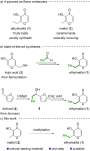
- synthesis of ethylmaltol from a renewable precursor. Keywords: ethylmaltol; flavor enhancer; maltol; methylation; 4-pyrones; Introduction In 1969, a Pfizer patent first disclosed ethylmaltol (1) as a powerful, purely synthetic flavor and aroma enhancer (Scheme 1a) [1]. It has been found to have a 6-times
- higher flavor-enhancing power compared to its naturally occurring congener maltol (2), which has a more caramel-like odor compared to the fruitier ethylmaltol (1). Owing to its strong ability to enhance the taste and odor of food, ethylmaltol (1) is used as an additive in a wide range of beverages


Synthesis of sulfur karrikin bioisosteres as potential neuroprotectives
Beilstein J. Org. Chem. 2022, 18, 549–554, doi:10.3762/bjoc.18.57
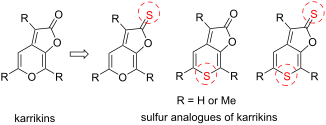
- , derived from the 2H-furo[2,3-c]pyran-2-thione core, differing in the number and the position of methyl groups (9–12), has been prepared from appropriate karrikins. Starting materials, karrikins KAR1 (1), KAR3 (3) and KAR4 (4) (Figure 1) were synthesized from pyromeconic acid (5), allomaltol (13) or maltol
- synthetic strategy based on a procedure [21] employing the cyclization of appropriate esters of thiopyranthiones (Scheme 3). We expected that heterocyclic atom exchange used in the literature [25] for the synthesis of dithiomaltol 16b directly from commercially available maltol (14) would proceed also with


Other Beilstein-Institut Open Science Activities



