


Search results
Search for "modified nucleobases" in Full Text gives 7 result(s) in Beilstein Journal of Organic Chemistry.
Isoorotamide-based peptide nucleic acid nucleobases with extended linkers aimed at distal base recognition of adenosine in double helical RNA
Beilstein J. Org. Chem. 2025, 21, 2513–2523, doi:10.3762/bjoc.21.193
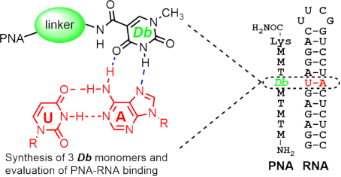
- bonding; modified nucleobases; peptide nucleic acids; PNA–RNA triplexes; RNA recognition; Introduction RNA is a key contributor in countless biological processes. Though coding RNA has a well-known role in the central dogma of biology, most RNA is non-coding (ncRNA) and plays a multitude of roles


A new route for the synthesis of 1-deazaguanine and 1-deazahypoxanthine
Beilstein J. Org. Chem. 2022, 18, 1617–1624, doi:10.3762/bjoc.18.172
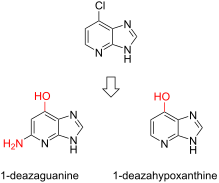
- nucleosides thereof [10][11][12], mostly associated with the inhibition of adenosine deaminase (ADA) [11] and as adenosine receptor antagonists [10]. Another important field of applications for deaza-modified nucleobases is their use in atom-specific mutagenesis experiments. For example, site specific 1-, 3


Chemical approaches to discover the full potential of peptide nucleic acids in biomedical applications
Beilstein J. Org. Chem. 2021, 17, 1641–1688, doi:10.3762/bjoc.17.116
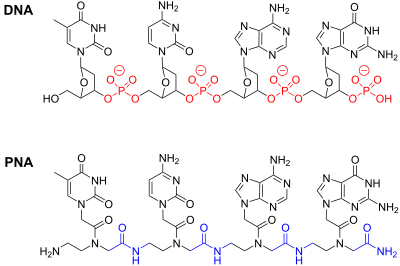
- PNAs to HeLa cells achieving sub-nanomolar antisense activity [91]. More recent studies introduced sulphate and carboxylate groups at the γ-position of PNA backbone (Figure 5) but neither modification showed promising hybridization profiles or improved cellular uptake [92][93]. Modified nucleobases in
- recognition of the C–G base pair in dsDNA and dsRNA remains elusive. While the modified nucleobases reviewed above have given promising results, they typically lack either the binding affinity or selectivity of the natural triplets. This is especially true when the task is to recognize several pyrimidines
- complementarity as well. An elegant solution to this problem has been to use 2,6-diaminopurine (D) instead of adenosine and 2-thiouridine (s2U) instead of uridine as modified nucleobases in PNAs designed for double duplex invasion [129][130]. D and s2U form more stable Watson–Crick base pairs with T and A









Stimuli-responsive oligonucleotides in prodrug-based approaches for gene silencing
Beilstein J. Org. Chem. 2018, 14, 436–469, doi:10.3762/bjoc.14.32
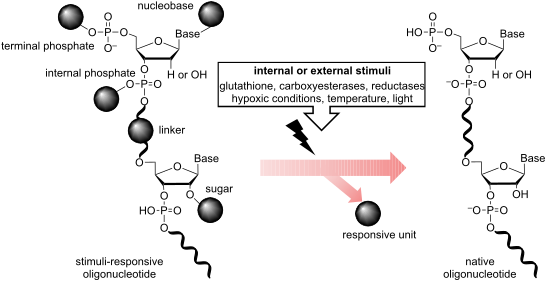
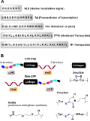
- protected by photolabile groups is to use artificial photolabile nucleobases [90]. Generally, these modified nucleobases are introduced into ONs through their corresponding phosphoramidites. Photocaged approaches to inhibit translation: Mikat and Heckel introduced deoxyguanosine and thymidine, respectively


DNA functionalization by dynamic chemistry
Beilstein J. Org. Chem. 2016, 12, 2136–2144, doi:10.3762/bjoc.12.203
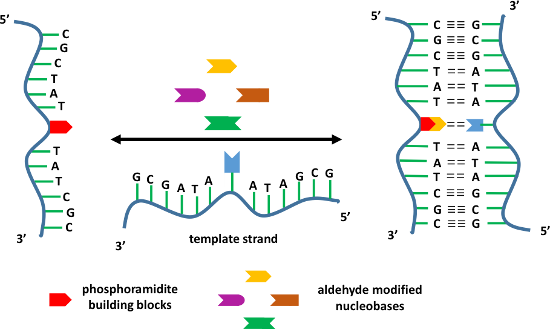
- oligonucleotides. The amino group containing phosphoramidite was used together with complementary single-strand DNA templates that influenced the Watson–Crick base-pairing equilibrium in the mixture with a set of aldehyde modified nucleobases. A significant fraction of all possible base-pair mismatches was
- analogue with a peptide backbone carrying nucleobases on its amino acid side chains [42] while Bradley et al. used the backbone of a peptide nucleic acid (PNA) with abasic sites which gives a reactive secondary amine for reversible attachment of aldehyde modified nucleobases [43]. Moreover, the DNA
- of nucleobase monomers. In case of an amine group on the backbone, a reversible imine exchange reaction with aldehyde modified nucleobases was performed (Figure 1a). In the presence of a thiol group on the backbone, a thioester exchange reaction with thioester modified nucleobases was expected


Second generation silver(I)-mediated imidazole base pairs
Beilstein J. Org. Chem. 2014, 10, 2139–2144, doi:10.3762/bjoc.10.221
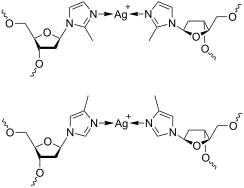
- functional moieties have been introduced into various nucleic acid building blocks, including, for example, modified nucleobases and modified sugar entities. A recent addition is the application of ligand systems as nucleobases surrogates [5][6][7][8][9]. In the presence of suitable transition metal ions, so


Pyrene-modified PNAs: Stacking interactions and selective excimer emission in PNA2DNA triplexes
Beilstein J. Org. Chem. 2014, 10, 1495–1503, doi:10.3762/bjoc.10.154
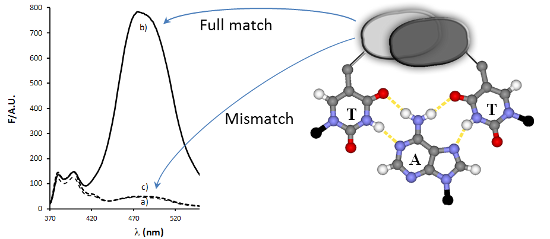
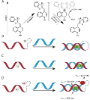
- into the major groove; (b) pyrene-modified uracil derivative used in PNA monomer in the present study; (c) sequences of PNA and DNA used. T indicates pyrene modified nucleobases; bold letters indicate the position of W1282X point mutation. Fluorescence spectra at 347 nm excitation, recorded at 20 °C of


Other Beilstein-Institut Open Science Activities



