


Search results
Search for "reductive azo condensation" in Full Text gives 2 result(s) in Beilstein Journal of Organic Chemistry.
Synthesis of functionalized diazocines for application as building blocks in photo- and mechanoresponsive materials
Beilstein J. Org. Chem. 2019, 15, 727–732, doi:10.3762/bjoc.15.68
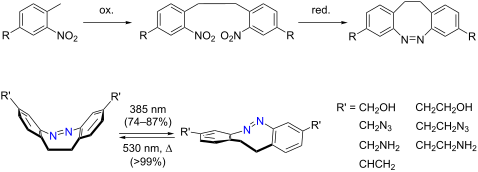
- azo condensation proved to be reliable key steps in the synthesis of these substituted diazocines. The photophysical properties of compounds 4–7 were investigated by NMR and UV–vis experiments. The previously investigated 3,3’-diaminodiazocine 2 and 4,4’-diaminodiazocine 3 exhibited poor
- electronic decoupling of substituents in diazocines 4–7 has proven to retain the excellent photochemical properties in regard to PSS and half-life (t1/2) of the parent system 1. Conclusion Seven symmetrically substituted diazocines 4–7 were synthesized and characterized. Oxidative C–C coupling and reductive


Synthesis of mono-functionalized S-diazocines via intramolecular Baeyer–Mills reactions
Beilstein J. Org. Chem. 2018, 14, 2799–2804, doi:10.3762/bjoc.14.257

- synthesis of diazocines opens a novel and convenient access to unsymmetrically substituted diazocines. Keywords: Baeyer–Mills reaction; bridged azobenzene; diazocine; reductive azo condensation; unsymmetrically functionalized S-diazocines; Introduction Photopharmacology is a promising, rapidly evolving
- precursor 16 was reduced using a borane tetrahydrofuran complex and immediately reacted in the Baeyer–Mills reaction without further purification. In Table 2 the yields using the Baeyer–Mills reaction are compared with the yields using the reductive azo condensation with lead [17]. Compared to the reductive
- azo condensation, the yields obtained using the Baeyer–Mills reaction are higher, more reproducible and applicable for an enlarged number of functional groups. Using this method, five different mono-functionalized S-diazocines 1–5 could be synthesized, which are suitable starting materials for further


Other Beilstein-Institut Open Science Activities



