


Search results
Search for "strained molecules" in Full Text gives 6 result(s) in Beilstein Journal of Organic Chemistry.
Arene activation via π-bond localization: concepts and opportunities
Beilstein J. Org. Chem. 2026, 22, 257–273, doi:10.3762/bjoc.22.19
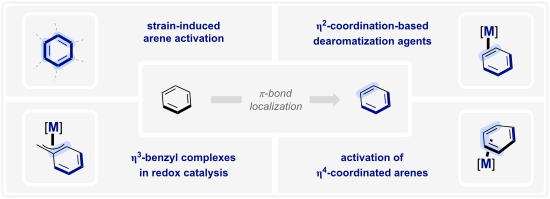
- highlighted. Collectively, these concepts create a roadmap for the development of new strategies that harness π-bond localization to expand the synthetic utility of aromatic compounds. Keywords: arene activation; arene functionalization; dearomatization; metal–arene π-complexes; strained molecules


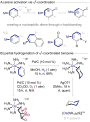


Ring opening of photogenerated azetidinols as a strategy for the synthesis of aminodioxolanes
Beilstein J. Org. Chem. 2024, 20, 1671–1676, doi:10.3762/bjoc.20.148
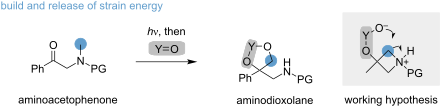
- strain; Introduction Identifying efficient methods for the preparation of densely functionalized molecules is one of the central goals of modern organic chemistry. In this context, application of strained molecules has garnered increasing attention due to their intrinsic reactivity [1][2]. However
- , accessing strained molecules continues to pose a synthetic challenge because many reported methods require harsh conditions for the preparation. An attractive alternative to traditional synthesis can be found in photochemical methods, bypassing energetic constraints by the utilization of photon energy. Thus


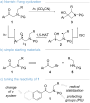

Chiral isothiourea-catalyzed kinetic resolution of 4-hydroxy[2.2]paracyclophane
Beilstein J. Org. Chem. 2021, 17, 800–804, doi:10.3762/bjoc.17.68
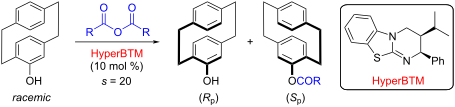
- ) via gas phase pyrolysis of para-xylene in 1949 [5]. Over the years, these compounds established themselves as a unique class of “bent and battered” [6] strained molecules with remarkable chemical and physical properties [1][2][3][4][7][8][9]. Besides their potential applications in material and


Building complex carbon skeletons with ethynyl[2.2]paracyclophanes
Beilstein J. Org. Chem. 2014, 10, 2013–2020, doi:10.3762/bjoc.10.209

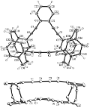
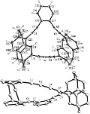
- the extra diacetylene bridges, compound 11 preserves the general structural features of [2.2]paracyclophanes, which are strained molecules. We have discussed these in detail in our previous paper [1], and summarize them here as follows: the single bonds in the bridges, C1–C2 and C9–C10, are elongated




Topochemical control of the photodimerization of aromatic compounds by γ-cyclodextrin thioethers in aqueous solution
Beilstein J. Org. Chem. 2013, 9, 1858–1866, doi:10.3762/bjoc.9.217
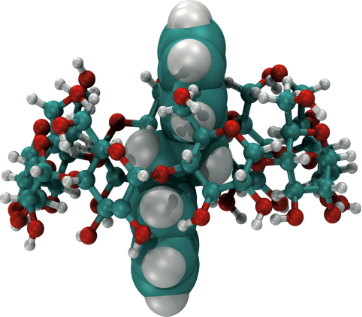
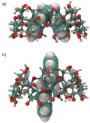
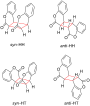
- attractive for a long time because they often lead to products that are otherwise virtually inaccessible by thermal reactions. The syntheses of highly strained molecules such as cubane [1] and pagodane [2] are famous examples. However, it is often difficult to predict and control the outcome of photochemical



Intramolecular carbolithiation cascades as a route to a highly strained carbocyclic framework: competition between 5-exo-trig ring closure and proton transfer
Beilstein J. Org. Chem. 2013, 9, 537–543, doi:10.3762/bjoc.9.59
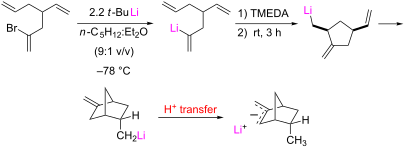
- constructing a highly strained system by an intramolecular carbolithiation cascade involving three coupled 5-exo-trig cyclizations. Although many strained molecules could have been selected for this exploration, the stellane framework (tricyclo[3.3.0.03,7]octane [18][19]), 1, with its mesmerizing symmetry, was


Other Beilstein-Institut Open Science Activities



