Search results
Search for "layers" in Full Text gives 1173 result(s) in Beilstein Journal of Nanotechnology. Showing first 200.
Multilayered hyperbolic Au/TiO2 nanostructures for enhancing the nonlinear response around the epsilon-near-zero point
Beilstein J. Nanotechnol. 2026, 17, 251–261, doi:10.3762/bjnano.17.17
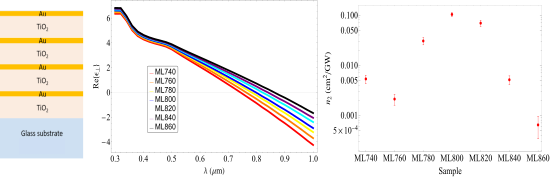
- found that we could avoid problems like lack of adherence between the layers. We also decided that, instead of relying on a tunable femtosecond source, we would manipulate the material geometry to design different samples with an ENZ point at different wavelength values around 800 nm, that is, we will
- employ the effective medium approximation (EMA) to calculate the properties of the whole system. It is important to note that the layers must follow a metal–dielectric repetition sequence. For a metal and a dielectric with permittivities εm and εd, respectively, it is possible to obtain a relation for
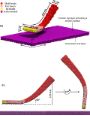
- the principal components and of the composite, which are given by [25]: where dm and dd are the widths of the metallic and dielectric layers, respectively, as seen in Figure 1a. The z-scan technique employed to study the nonlinear properties of the samples involves normal incident light, where the


Comparative study on 3D morphologies of delignified, single tracheids and fibers of five wood species
Beilstein J. Nanotechnol. 2026, 17, 239–250, doi:10.3762/bjnano.17.16
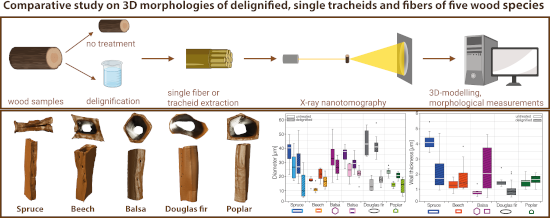
- (S1 and S2) and a tertiary wall (T) strongly supplemented by lignin. Apart from the middle lamella (ML) and the primary wall (P), the S2 layer being the thickest of the three main layers (S1, S2, and T), is the most important for mechanical support [1][10][11]. Lignin is present in all layers of the
- secondary and tertiary wall structure, with varying distribution and concentration across these layers but the highest proportions generally found in the S2 and T layers (spruce earlywood: ML 26.8%, S1 10.4%, S2+T 62.8%; spruce latewood: ML 18.4%, S1 7.9%, S2+T 73.7%) [12][13]. Moreover, lignification plays


Gold nanoparticle-decorated reduced graphene oxide as a highly effective catalyst for the selective α,β-dehydrogenation of N-alkyl-4-piperidones
Beilstein J. Nanotechnol. 2026, 17, 218–238, doi:10.3762/bjnano.17.15
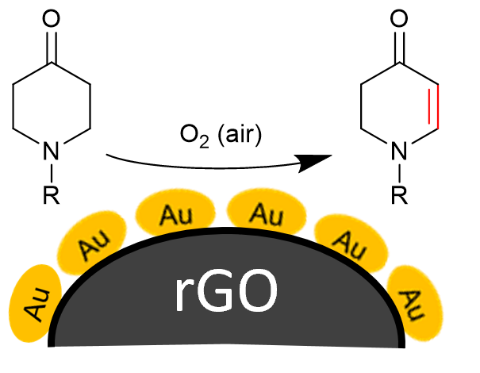
- a heterogeneous, rough surface with lamellar layers and pronounced macroporosity. The rGO carbon (Figure 2b) exhibits a structure composed of thin, wrinkled, and sheet-like layers, characteristic of exfoliated graphene-based materials. The morphology of CB (Figure 2c) is formed of highly aggregated
- AuNPs and carbon layers. Similar behavior has been reported in other Au–polyoxometalate systems where the W signal dominates and the Si 2p peak is below detection limits [45]. Collectively, these XPS results confirm that gold is predominantly metallic (Au0) and the rGO support contains functional groups
- layers and lower microporosity of rGO (Figure 2 and Figure S1, Supporting Information File 1) minimize product entrapment, thereby enhancing overall catalytic efficiency. These textural properties make rGO the most effective support for AuNP catalysts. For the AC- and CB-based composites, a higher


Time of flight secondary ion mass spectrometry imaging of contaminant species in chemical vapour deposited graphene on copper
Beilstein J. Nanotechnol. 2026, 17, 200–213, doi:10.3762/bjnano.17.13
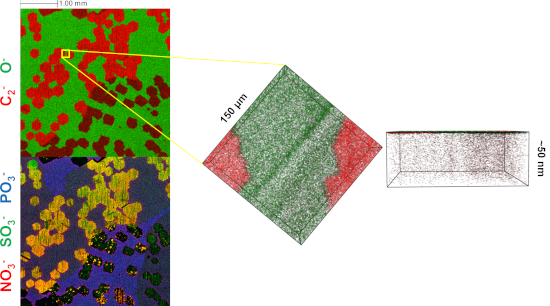
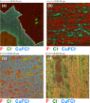
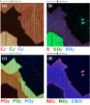
- growth of the graphene; in particular, the accumulation of contaminations present in the copper foil, which has implications for the potential electrical properties of the graphene. We also observe variations in the permeation of oxygen underneath the graphene layers, resulting in oxidation of the copper
- quality control method. These results highlight the significance of understanding the role of trace contaminants and elemental distributions within the catalyst in conjunction with growth parameters for optimised CVD of graphene layers. Keywords: contamination; copper; CVD; graphene; ToF-SIMS
- layers, or normalised to the maximum ion intensity to highlight location of species at low concentration. To probe the surface of the samples in more detail, larger 500 µm × 500 µm surface images (with a pixel density of 256 × 256) were also acquired with 25 keV Bi3+ ions for longer acquisition times to





Structure-dependent thermochromism of PAZO thin films: theory and experiment
Beilstein J. Nanotechnol. 2026, 17, 186–199, doi:10.3762/bjnano.17.12
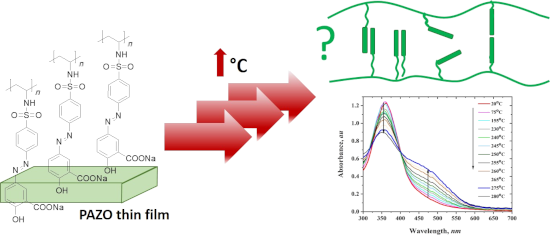
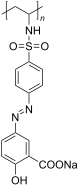
- nondoped thin films [17][18], as well as on thin nanocomposite layers doped with nanoparticles of diverse chemical compositions, shapes, and sizes [19]. Additional efforts have focused on thermally treated layers of pure PAZO up to 200 °C [20], and on PAZO/PAH (with PAH denoting poly(allylamine
- thin layers subjected to thermal treatment at temperatures up to 300 °C. Particular attention is given to the changes in absorption features and spectral shifts that may arise from structural rearrangements within the material. To rationalize the experimental findings, density functional theory (DFT
- fluorescence. Moreover, the reorientation of the aggregates themselves appears to demand an even greater energy threshold. The enhancement of absorption around 444 nm is of limited practical utility, as the absorption becomes excessively strong, restricting effective energy delivery to the surface layers of


Capabilities of the 3D-MLSI software tool in superconducting neuron design
Beilstein J. Nanotechnol. 2026, 17, 122–138, doi:10.3762/bjnano.17.8
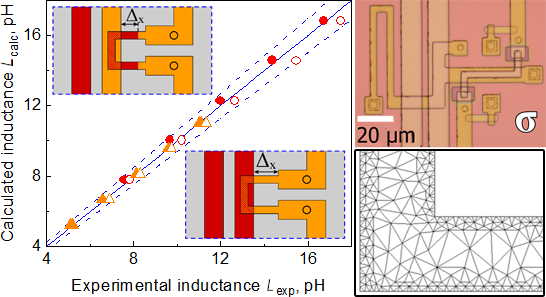
- -depth testing regarding the capability of 3D-MLSI for inductance extraction, several series of simple C-shaped two-junction SQUIDs were fabricated and studied. The fabricated samples contained three superconducting niobium layers separated by insulating layers (see Figure 1). The first superconducting
- layer (M1) served both as a superconducting ground plane and the bottom electrode of the Josephson junctions. The second (M2) and third (M3) layers formed interferometers loops, control lines, and wiring. Overlap areas between layers M2 and M3 provided inductive coupling between elements. The
- thicknesses of the superconducting layers were 200, 250, and 350 nm for M1, M2, and M3, respectively. The SiO2 insulating layers had thicknesses of 200 nm (I1) and 300 nm (I2). Deposition of metallic layers was performed via magnetron sputtering in argon atmosphere, while insulating layers were thermally



Functional surface engineering for cultural heritage protection: the role of superhydrophobic and superoleophobic coatings – a comprehensive review
Beilstein J. Nanotechnol. 2026, 17, 63–96, doi:10.3762/bjnano.17.6

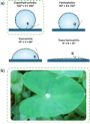
- relevant when considering different threats. Water is the most pervasive menace, in both indoor and outdoor environments [52]. For stone and other inorganic materials, high porosity and surface irregularities can increase coating absorption, resulting in thicker and less uniform layers that compromise
- temperatures, demonstrating its potential for passive cooling and material preservation in architectural heritage. Embedding specific functional fillers into thin layers is the best way to quickly endorse conventional and tailored polymers, possibly already widely used in the field of cultural heritage




Terahertz-range on-chip local oscillator based on Josephson junction arrays for superconducting quantum-limited receivers
Beilstein J. Nanotechnol. 2025, 16, 2296–2305, doi:10.3762/bjnano.16.158
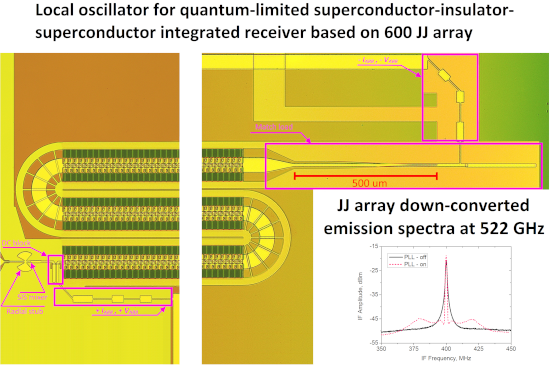
- technological layers near the JJ and the shunt in the cross-section shown by the dashed line in Figure 2 is shown in Figure 3. The details of the fabrication processes can be found in our previous works [19][20]. Measurement technique When the JJ array irradiates the SIS mixer, the probability of quasiparticle
- image of the junctions in the array. The length of each of the three sections of the array is 2 mm (the major part is not shown for visibility). The dashed red line shows the cross-section of the layers illustrated in Figure 3. Cross-section of the technological layers near the JJ and the shunt (see the


Visualizing nanostructures in supramolecular hydrogels: a correlative study using confocal and cryogenic scanning electron microscopy
Beilstein J. Nanotechnol. 2025, 16, 2274–2284, doi:10.3762/bjnano.16.156
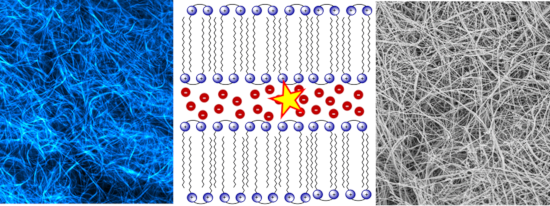
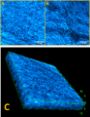
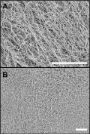
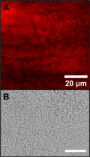
- cationic imidazolium layers lie the bromide counterions. Note: sizes are not to scale. The molecular structures of the fluorophores (ZnPc and DPP-BC) are also shown. CLSM micrographs of ZnPc@Gel at two magnifications. (A) Micrograph of an air bubble present in a ZnPc@Gel sample. (B) Region where the gel




Optical bio/chemical sensors for vitamin B12 analysis in food and pharmaceuticals: state of the art, challenges, and future outlooks
Beilstein J. Nanotechnol. 2025, 16, 2207–2244, doi:10.3762/bjnano.16.153


Ultrathin water layers on mannosylated gold nanoparticles
Beilstein J. Nanotechnol. 2025, 16, 2183–2198, doi:10.3762/bjnano.16.151
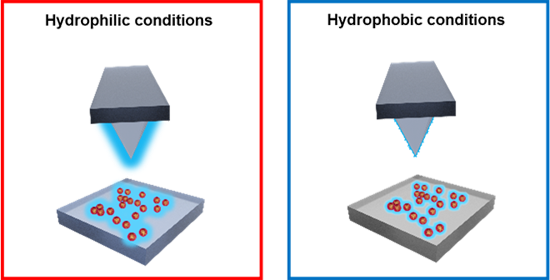
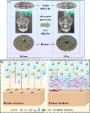
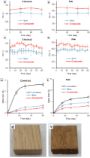
- hydrophobic tips. While VSFG indicated preferential hydration of the dimannoside and proved conformational changes in the organic ligands, AFM provided sub-nanometer changes in particle topography due to water adsorption. In general, the dimannoside nanoparticles condense ultrathin water layers upon humidity
- inorganic surfaces, usually modified with organic layers, and probed by Fourier-transform infrared spectroscopy (FTIR), vibrational sum frequency generation (VSFG), and atomic force microscopy (AFM). For VSFG and AFM, we systematically varied the relative air humidity (RH). DLS and ZP yield particle size
- organic layers. In contrast, VSFG was applied to obtain interface-sensitive information on CH and OH bonds at the AuNP/air interface, under hydration and dehydration. We also used a deuterated water (D2O) atmosphere to distinguish the mannosyl hydroxy groups from adsorbed and absorbed water. Absorption is



Missing links in nanomaterials research impacting productivity and perceptions
Beilstein J. Nanotechnol. 2025, 16, 2168–2176, doi:10.3762/bjnano.16.149
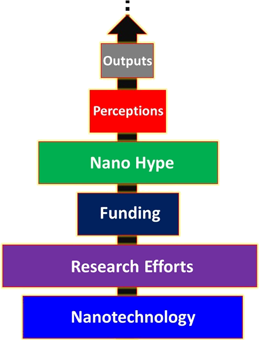
- nanoscale science to commercial technology is complex, involving multiple layers of regulation, safety, interdisciplinary integration, and market readiness. Need of dedicated regulatory systems Although experts and policymakers at various levels often question the output and commercial viability of
Electron transport through nanoscale multilayer graphene and hexagonal boron nitride junctions
Beilstein J. Nanotechnol. 2025, 16, 2132–2143, doi:10.3762/bjnano.16.147
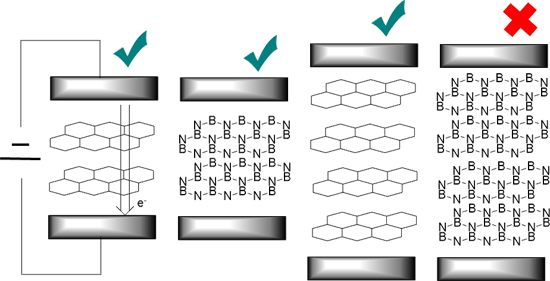
- ) method combined with density functional theory (DFT) to compare electron transport through several layers of nanoscale graphene and hexagonal boron nitride (h-BN). Calculations were performed for one to six layers, corresponding to thicknesses of 0.5–3.0 nm, respectively. Electron transport was computed
- perpendicular to the layers in the stacking direction. We compared the decay of the current with the number of layers and evaluated the ability of h-BN to filter currents as a material coating. To investigate the effect of disorder, we included two major defects in the graphene lattice, namely, nitrogen doping
- [22]. The electron tunneling through ultrathin h-BN crystalline barriers was investigated recently with experimental techniques showing exponential decay of the current with the number of layers [23]. Accurate density functional theory (DFT) calculations demonstrated the bandgap change in one to eight


Rapid synthesis of highly monodisperse AgSbS2 nanocrystals: unveiling multifaceted activities in cancer therapy, antibacterial strategies, and antioxidant defense
Beilstein J. Nanotechnol. 2025, 16, 2105–2115, doi:10.3762/bjnano.16.145
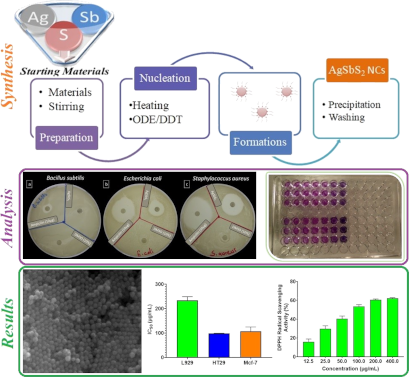
- their simpler outer membranes compared to those of gram-negative species. The moderate effectiveness of AgSbS2 NCs against E. coli (MIC and MBC; 1.0 mg/mL and 2.0 mg/mL, respectively) also aligns with findings in nanoparticle research where the outer lipopolysaccharide layers of gram-negative bacteria


Molecular and mechanical insights into gecko seta adhesion: multiscale simulations combining molecular dynamics and the finite element method
Beilstein J. Nanotechnol. 2025, 16, 2055–2076, doi:10.3762/bjnano.16.141
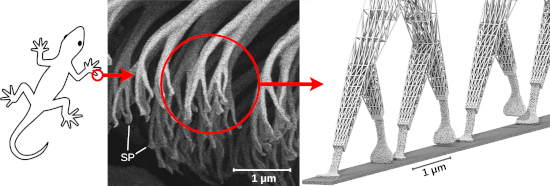
- surface, and a 13 nm thick amorphous bulk below, which matched the same bead density as our previous random-substrate model. All substrate beads had identical interactions with the spatula, and both layers were held fixed in space. Since the regular top monolayer differed from the fully random arrangement







Evaluating metal-organic precursors for focused ion beam-induced deposition through solid-layer decomposition analysis
Beilstein J. Nanotechnol. 2025, 16, 1942–1951, doi:10.3762/bjnano.16.135
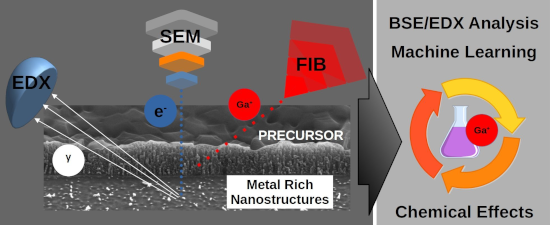
- new metal-organic precursors, in the form of supported thick layers, to the ion beam irradiation is studied through analysis of the chemical composition and morphology of the resulting structures. This is done using SEM backscattered electron/energy-dispersive X-ray spectroscopy along with machine
- studies. Here, we present a pathway for unraveling how the chemical composition of metal-organic precursors affects their decomposition when irradiated with FIB in the form of supported layers. A decomposition process of the studied layer was quantitatively monitored by scanning electron microscopy
- analysis of nanostructures [33]. Finally, we determined the quantitative chemical composition of the formed metal-rich deposits (structures). While the decomposition of precursor layers presents a significant challenge compared to gas-phase deposition driven by differing mechanisms, our approach of layer


Quantum circuits with SINIS structures
Beilstein J. Nanotechnol. 2025, 16, 1931–1941, doi:10.3762/bjnano.16.134
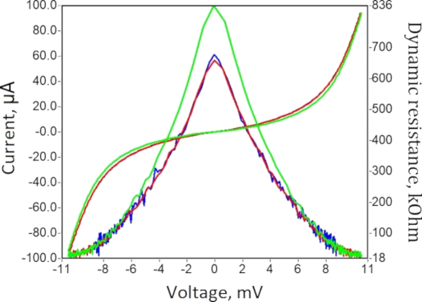
- layers and ensures ease of manufacturing a tunnel barrier, in contrast to Nb-based technology, which requires the formation of an artificial anodic oxide or an additional insulating layer to prevent short circuits, as well as an additional Al layer to form an AlOx or AlN tunnel barrier. Results NIS
- different layers of superconducting aluminum and normal metal (e.g., copper). In case of chemical wet etching, this is achieved through an alkali and acid pair, for dry etching, chlorine and fluorine plasmas are used. Alternatively, in the case of magnetron sputtering and separate lithography, ion etching


PEGylated lipids in lipid nanoparticle delivery dynamics and therapeutic innovation
Beilstein J. Nanotechnol. 2025, 16, 1914–1930, doi:10.3762/bjnano.16.133
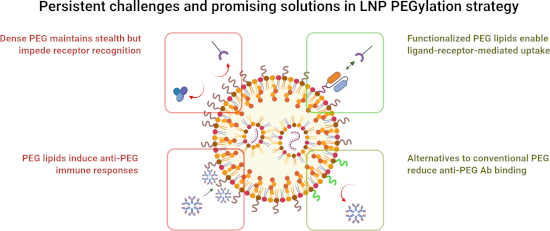
- [24]. However, the effectiveness of this barrier depends on PEG density, molecular weight, and chain configuration. The previously mentioned high-density PEG layers in a “brush” conformation are particularly effective at repelling proteins compared to lower-density “mushroom” configurations, which may
- regimes, ρPEG < 0.32 nm−2, permit substantial protein binding due to sparse PEG coverage, whereas intermediate densities, 0.32 nm−2 < ρPEG < 0.96 nm−2, show partial shielding. High-density PEG layers, ρPEG > 0.96 nm−2, in a “brush” conformation are particularly effective at repelling proteins, achieving



Targeting the vector of arboviruses Aedes aegypti with nanoemulsions based on essential oils: a review with focus on larvicidal and repellent properties
Beilstein J. Nanotechnol. 2025, 16, 1894–1913, doi:10.3762/bjnano.16.132


Programmable soliton dynamics in all-Josephson-junction logic cells and networks
Beilstein J. Nanotechnol. 2025, 16, 1883–1893, doi:10.3762/bjnano.16.131
- ], voltage [20], or magnetic fields [21][22]. At the same time, the use of hybrid superconductor–normal metal structures makes it possible to increase the effect of frequency tuning [23][24], while the addition of ferromagnetic layers permits the non-volatile control [25][26]. Another feature of tunable


Current status of using adsorbent nanomaterials for removing microplastics from water supply systems: a mini review
Beilstein J. Nanotechnol. 2025, 16, 1837–1850, doi:10.3762/bjnano.16.127
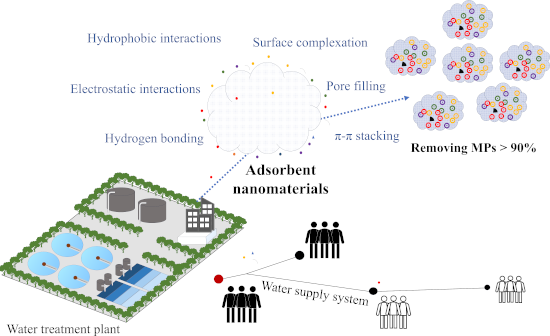
- range of 1–20 μm can easily pass through the filter layers, limiting the overall removal efficiency [41]. These observations highlight the persistence of MPs, especially those with small sizes, in treated water, revealing the limitations of current technologies and the need for ongoing innovation in


Phytol-loaded soybean oil nanoemulsion as a promising alternative against Leishmania amazonensis
Beilstein J. Nanotechnol. 2025, 16, 1826–1836, doi:10.3762/bjnano.16.126
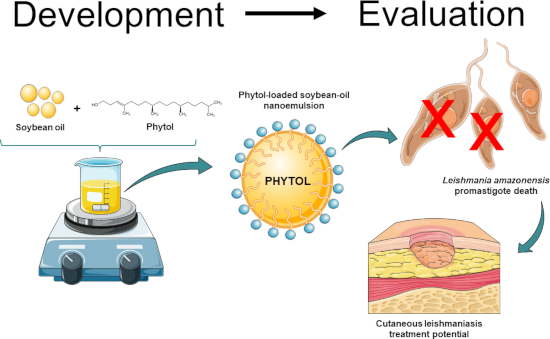
- surface curvature and increased solute concentration at the droplet interface in the aqueous phase. Such structural features can promote a higher drug flux and localized delivery in the skin layers [34][35][36]. Chiu et al. (2024) reported a significant increase in curcumin skin permeability when carried


Piezoelectricity of layered double hydroxides: perspectives regarding piezocatalysis and nanogenerators
Beilstein J. Nanotechnol. 2025, 16, 1812–1817, doi:10.3762/bjnano.16.124
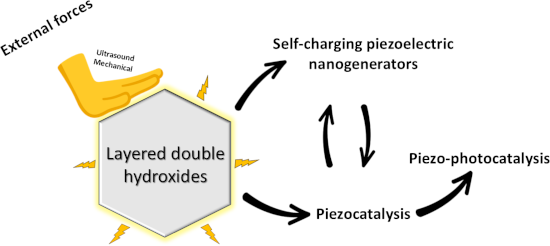
- synthetic layered hydroxides, also called hydrotalcite-like compounds, have a number of unique properties inherent to this class of materials [3]. LDHs easily undergo targeted modification because the composition of cations in the hydroxide layers and anions in the interlayer space can be varied over a wide
- current output. The piezoelectric potential generated in the ZnO nanosheets functions as an applied voltage, facilitating charge storage within the LDH layers, which act as capacitors. This mechanism leads to enhanced voltage and current pulses under mechanical stimulation. LDHs can also enhance the
- bulk materials with centrosymmetric properties, display piezoelectricity when reduced to a single or few layers due to the loss of their inversion centers. An actively developing area of piezocatalysis is its application to enhance photocatalytic reactions, called piezo-photocatalysis. Zn/Al-LDHs with

Electrical, photocatalytic, and sensory properties of graphene oxide and polyimide implanted with low- and medium-energy silver ions
Beilstein J. Nanotechnol. 2025, 16, 1794–1811, doi:10.3762/bjnano.16.123
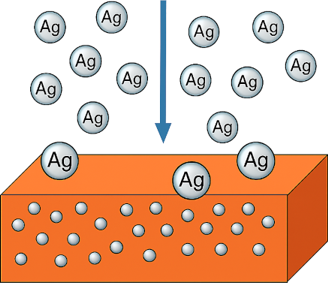
- for the precise introduction of implanted atoms into the surface layers without the need for subsequent chemical modification, thus opening new possibilities in the development of functional thin films. In this study, Ag ions were used to modify polymer matrices to improve chemical and electronic
- implantation primarily affects subsurface layers, leading to bulk modifications with more gradual structural changes and less surface sputtering. The details of the energy stopping powers at the depth of ion implantation are given in Figure 1. Elemental characterization by RBS and ERDA The elemental
- formation of free radicals and their subsequent recombination [26]. The results obtained from the XPS analysis, in conjunction with the RBS findings, reveal a consistent trend indicative of ongoing carbonization processes occurring in the surface layers of the PI samples. The reduction in oxygen-containing


Multifunctional anionic nanoemulsion with linseed oil and lecithin: a preliminary approach for dry eye disease
Beilstein J. Nanotechnol. 2025, 16, 1711–1733, doi:10.3762/bjnano.16.120

- ingredient [1]. NEs are designed as droplets that can potentially replenish the lipid layer in DED patients, mimicking the trilayered structure of the tear film, consisting of lipid, aqueous, and mucin layers [13][15][18][20]. According to the literature, the tear film compromises the stability of NE
- addition to PFAs, phospholipids are notable for their structure, which includes a hydrophilic part (phosphate groups) and a hydrophobic part (fatty acid chains). This unique configuration allows phospholipids to interact at the interface between the lipid and aqueous layers of the tear film, increasing its