


Search results
Search for "biomarker" in Full Text gives 30 result(s) in Beilstein Journal of Nanotechnology.
Synthesis of radioactively labelled CdSe/CdS/ZnS quantum dots for in vivo experiments
Beilstein J. Nanotechnol. 2014, 5, 2383–2387, doi:10.3762/bjnano.5.247

- phase transfer of the QDs. Keywords: biomarker; CdSe/CdS/ZnS; quantum dots; radioactive labelling; 65Zn; Introduction Two decades of research and investigation in the field of luminescent semiconductor nanoparticles, also known as quantum dots (QDs), have now passed since the fundamental work of


Effect of silver nanoparticles on human mesenchymal stem cell differentiation
Beilstein J. Nanotechnol. 2014, 5, 2058–2069, doi:10.3762/bjnano.5.214

- . Osteocalcin is a suitable biomarker for osteogenic differentiation when differentiation is analyzed after a prolonged period of three weeks under differentiating conditions. Although alkaline phosphatase activity occurs earlier, osteocalcin expression is detectable in MSCs after the first week of osteogenic
- biomarker aggrecan in the presence or absence of Ag-NP/Ag+ ions was measured by using ELISA (Figure 10). The structural proteoglycan aggrecan is found in the extracellular matrix of cartilage and is a suitable biomarker for chondrogenic differentiation of MSCs at late time points (at least three weeks), as


Silica nanoparticles are less toxic to human lung cells when deposited at the air–liquid interface compared to conventional submerged exposure
Beilstein J. Nanotechnol. 2014, 5, 1590–1602, doi:10.3762/bjnano.5.171
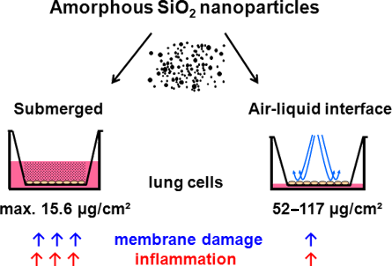
- phosphorylation was detected after 7 h of exposure whereas LDH and IL-8 release were monitored after 24 h, a more detailed kinetic analysis is needed to substantiate a possibly different regulation of this biomarker in response to SiO2-50 nm NPs. Our studies on the biological effects of Aerosil200 under submerged


The softening of human bladder cancer cells happens at an early stage of the malignancy process
Beilstein J. Nanotechnol. 2014, 5, 447–457, doi:10.3762/bjnano.5.52

- -malignant cells. This underlines the diagnostic character of stiffness that can be used as a biomarker of bladder cancer. Similar stiffness levels, observed for cancerous cells, cannot be fully explained by the organization of the actin cytoskeleton since it is different in all malignant cells. Our results
- progression. This makes the cell stiffness a powerful biomarker for detecting cancer-related alterations in human bladder tumors. Conclusion Nanomechanical measurements performed with a force microscope at the single cell level have been applied to characterize the elastic properties of human bladder cancer


Magnetic nanoparticles for biomedical NMR-based diagnostics
Beilstein J. Nanotechnol. 2010, 1, 142–154, doi:10.3762/bjnano.1.17

- -assembled clusters, and the consequent increase in cross-sectional area of the particles shortens T2 relaxation times. DMR assay configurations Analogous to MRI, DMR exploits targeted MNPs to modulate the spin–spin T2 relaxation time of biological samples. Depending on the size of the target biomarker, DMR
- antibodies/nanoparticles resulted in higher nanoparticle binding to cells. In comparison to alternative standard techniques, such as the avidin/biotin method, BOND-2 not only amplifies the biomarker signals but also significantly improves the detection sensitivity. Moreover, this platform is broadly
- bovine serum albumin (BSA) protein as a control did not elicit any change in T2 (Figure 5b). More recently, MRSw biosensors, capable of detecting soluble tumor biomarker proteins (such as CA-125, VEGF, and α-fetoprotein) were described, and used for parallel detection of multiple markers in blood samples


Other Beilstein-Institut Open Science Activities



