


Search results
Search for "nanoparticle aggregation" in Full Text gives 31 result(s) in Beilstein Journal of Nanotechnology.
Green synthesis of fluorescent carbon dots from spices for in vitro imaging and tumour cell growth inhibition
Beilstein J. Nanotechnol. 2018, 9, 530–544, doi:10.3762/bjnano.9.51
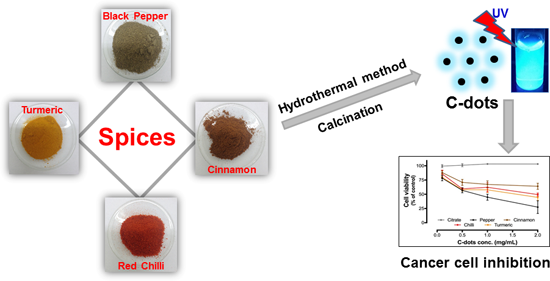
- environmental hazard concerns [2]. Furthermore, due to their ultra-small size, the Brownian motion provides enough energy to prevent nanoparticle aggregation, giving rise to an excellent solubility and stability in aqueous media [3][4]. Their excitation wavelength-dependent emission, their environmental


Performance of colloidal CdS sensitized solar cells with ZnO nanorods/nanoparticles
Beilstein J. Nanotechnol. 2017, 8, 210–221, doi:10.3762/bjnano.8.23

- nanoparticle aggregation. Various disulfide bonds, thiol residues and other hydroxyl moieties that exist on BSA can serve as effective surface functionalized groups on CdS surfaces [27]. This may further lead to better anchoring with the metal oxide-based photoanode. Among the alternative single oxide


Surface-enhanced infrared absorption studies towards a new optical biosensor
Beilstein J. Nanotechnol. 2016, 7, 1736–1742, doi:10.3762/bjnano.7.166

- the detector causing a nearly wavelength-independent baseline shift. Figure 2 shows the results of a sensor chip with polycarbonate (PC) coating. This case shows the same finding: appearance of the water band by addition of nanoparticles, and further absorbance increase by PBS-induced nanoparticle
- aggregation. The band increase here is smaller than in the case of the Teflon sensor. A possible explanation is that the nanoparticle solution has aged, and aggregation may have already started before PBS addition. Discussion Although the RIfS spectra look similar to the ATR spectra in [13], their origin is


The impact of the confinement of reactants on the metal distribution in bimetallic nanoparticles synthesized in reverse micelles
Beilstein J. Nanotechnol. 2014, 5, 1966–1979, doi:10.3762/bjnano.5.206

- droplets of the microemulsion can be conceived as tiny compartments or nano-reactors. The isolation of each nanoparticle inside a micelle avoids nanoparticle aggregation with particles located in nearby micelles. In this way, microemulsion droplets act as ideal templates, providing a compartmentalized


Current state of laser synthesis of metal and alloy nanoparticles as ligand-free reference materials for nano-toxicological assays
Beilstein J. Nanotechnol. 2014, 5, 1523–1541, doi:10.3762/bjnano.5.165
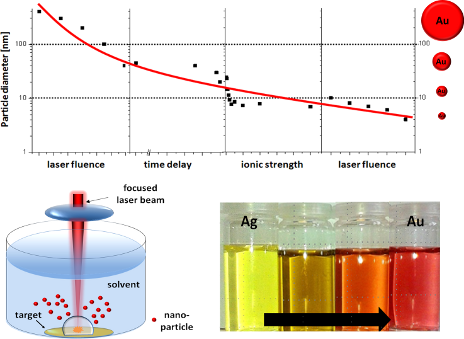
- nanoparticle aggregation [80], a strategy well established in literature and inspired by previous work on the impact of electrolytes on laser-fabricated gold nanoparticles [81]. The procedure to induce nanoparticle aggregation by electrolytes has been previously reported in context with PLML during the


Dye-sensitized Pt@TiO2 core–shell nanostructures for the efficient photocatalytic generation of hydrogen
Beilstein J. Nanotechnol. 2014, 5, 360–364, doi:10.3762/bjnano.5.41

- particles are in a solid spherical shape and composed by nanoparticle aggregation, and the average diameter of deposited Pt nanoparticles is about 5 nm. Figure 3 shows the UV–vis diffuse reflectance spectra of the Pt@TiO2 core–shell nanostructures and the Pt/TiO2 control sample. The absorption from 250 to


Other Beilstein-Institut Open Science Activities



