


Search results
Search for "oral administration" in Full Text gives 37 result(s) in Beilstein Journal of Nanotechnology.
Serum type and concentration both affect the protein-corona composition of PLGA nanoparticles
Beilstein J. Nanotechnol. 2019, 10, 1002–1015, doi:10.3762/bjnano.10.101
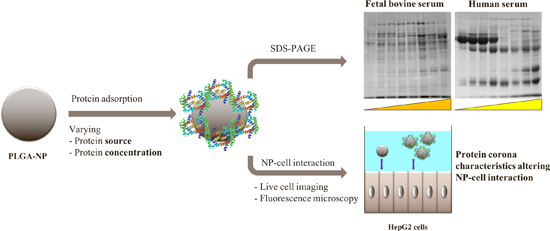
- source [10][11][12], temperature [13], incubation time [14], and flow status [15], also play a determinant role in the formation of the protein corona. NPs can be administered via different routes, such as intravenous, intradermal, oral administration or via inhalation. During their journey through the



Tungsten disulfide-based nanocomposites for photothermal therapy
Beilstein J. Nanotechnol. 2019, 10, 811–822, doi:10.3762/bjnano.10.81

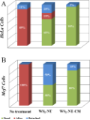
- important advantage of WS2 (and of other TMDCs) nanostructures over their carbon equivalents is the low toxicity and biocompatibility, enabling their use for medical applications. Preliminary studies on rats with WS2 INTs and IFs showed no apparent toxic reaction after oral administration [18], inhalation
- [19], or dermal application [20]. More recent studies conducted on rhenium-doped MoS2 nanoparticles showed no acute toxic risk, neither by oral administration nor by dermal application [21][22]. A few years ago, Teo et al. compared the cytotoxicity of exfoliated MoS2, WS2, and WSe2 to that of their






Non-agglomerated silicon–organic nanoparticles and their nanocomplexes with oligonucleotides: synthesis and properties
Beilstein J. Nanotechnol. 2018, 9, 2516–2525, doi:10.3762/bjnano.9.234

- nanoparticles with a diameter of 20–77 nm can easily penetrate into cellular cytoplasm and nuclei [7]. Polylysine-modified nanoparticles appeared to be nontoxic upon oral administration in mice, which opens the possibility for their wide application [8]. Under physiological conditions, SiO2 nanoparticles are


Low uptake of silica nanoparticles in Caco-2 intestinal epithelial barriers
Beilstein J. Nanotechnol. 2017, 8, 1396–1406, doi:10.3762/bjnano.8.141
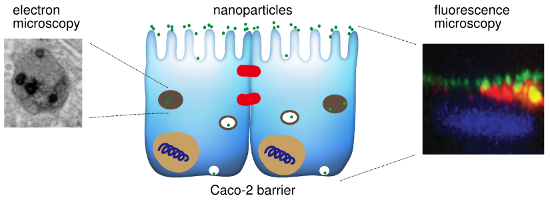
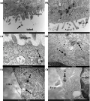
- into the Caco-2 barrier. In the context of nanomedicine, the low internalisation could suggest that oral administration routes may lead to poor transport across the intestinal epithelium. For nanosafety, toxic responses measured for single cell cultures (where internalisation is usually substantial



Association of aescin with β- and γ-cyclodextrins studied by DFT calculations and spectroscopic methods
Beilstein J. Nanotechnol. 2017, 8, 348–357, doi:10.3762/bjnano.8.37
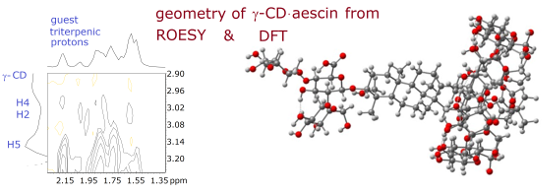
- and allergic reactions) [2][3]. Anti-inflammatory and anti-oedematous activities following oral administration have also been reported, both in rodents [4] and in human patients with proven chronic venous insufficiency [5]. The anti-inflammatory properties are associated with down-regulation of pro


Chitosan-based nanoparticles for improved anticancer efficacy and bioavailability of mifepristone
Beilstein J. Nanotechnol. 2016, 7, 1861–1870, doi:10.3762/bjnano.7.178

- the gastrointestinal absorption and bioavailability of nanoparticles designed for oral administration was closely related to the properties of the composition and the ingredient for specific targeting [30], the influencing factors of the size of MCNs were not studied in this work. In vitro release
- genders. The bioavailability of MIF in male rats was significantly lower than in female rats [37]. Therefore, we chose male rats to perform the pharmacokinetic study to investigate whether MCNs could improve bioavailability of MIF. Following its oral administration, the plasma concentrations of MCNs were
- Care and Use Committee to reduce the suffering and use of animals. Oral administration Eight male SD rats were randomly divided into two groups (n = 4). Group 1 was given a single 30 mg/kg dose of MIF (in soybean oil solution) and Group 2 was given a single dose of MCNs equivalent to the same dosage of


Tight junction between endothelial cells: the interaction between nanoparticles and blood vessels
Beilstein J. Nanotechnol. 2016, 7, 675–684, doi:10.3762/bjnano.7.60

- several pathways (oral administration [11], skin exposure [12], breathing [13], intravenous injection [14]). No matter which way, the NPs will finally reunite in the blood vascular system. Blood vessels function as a transportation pipe for blood, which carries nutrients and other necessary substances
- most important are cytoxicity and genotoxicity. While considering nanoparticle effects on human health, we need to know the pathways they use to get into biological systems. Here, we discussed four different entrance pathways: oral administration, skin exposure, breathing intake, intravenous injection

Unraveling the neurotoxicity of titanium dioxide nanoparticles: focusing on molecular mechanisms
Beilstein J. Nanotechnol. 2016, 7, 645–654, doi:10.3762/bjnano.7.57

- mice with TiO2 NPs through oral administration for 21 days, ROS increased, and the activities of anti-oxidant enzymes (such as SOD, and CAT, among others) were affected in the brain tissues. These changes were associated with neurotoxicity of NPs. TiO2 NPs were also shown to induce elevated levels of
Influence of gold, silver and gold–silver alloy nanoparticles on germ cell function and embryo development
Beilstein J. Nanotechnol. 2015, 6, 651–664, doi:10.3762/bjnano.6.66
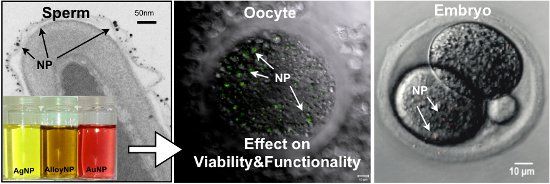
- blood after oral administration. Transplacental transfer to mouse embryos after intraveneous application of nanoparticles to the dam was also confirmed for AgNP [47]. Therefore, it seems reasonable to assume that they are as much if not more targeted by nanoparticles than their male equivalents as
- ovaries for instance are not protected by a biological barrier. Interestingly, a recent study revealed no adverse effects to the reproductive process after oral administration to rats [48]. In summary, the listed results emphasize the importance of reprotoxicological testing of nanoparticles, as close and




The distribution and degradation of radiolabeled superparamagnetic iron oxide nanoparticles and quantum dots in mice
Beilstein J. Nanotechnol. 2015, 6, 111–123, doi:10.3762/bjnano.6.11

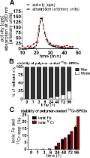
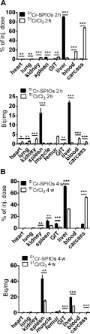
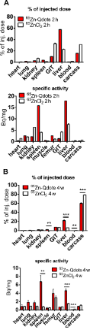
- the specific isotope through feces and urine. After oral administration, the whole body retention after 7–14 d is a well-accepted measure of the intestinal absorption of the isotopes in the respective galenic formulation, because non-absorbed material is completely excreted at that time via the feces





Nanobioarchitectures based on chlorophyll photopigment, artificial lipid bilayers and carbon nanotubes
Beilstein J. Nanotechnol. 2014, 5, 2316–2325, doi:10.3762/bjnano.5.240

- single-walled carbon nanotubes (f-SWCNTs, 0.05 mg/mL) internalized inside hamster ovary cells without toxicity. Immature dendritic cells incubated with doses of SWCNTs up to 100 μg/mL had no effect on their functionality and viability [13]. Many scientific papers report that oral administration of both


In vitro and in vivo interactions of selected nanoparticles with rodent serum proteins and their consequences in biokinetics
Beilstein J. Nanotechnol. 2014, 5, 1699–1711, doi:10.3762/bjnano.5.180

- diameter (i.e., the SSA) the accumulation of the remainder increases sharply with SSA, which is a clearly different behavior compared to intratracheal instillation. For more details see [11]. After oral administration more than 99% of all AuNP were excreted via feces. Yet, absorption and translocation





