


Search results
Search for "biomechanics" in Full Text gives 53 result(s) in Beilstein Journal of Nanotechnology.
Functional morphology, biomechanics and biomimetic potential of stem–branch connections in Dracaena reflexa and Freycinetia insignis
Beilstein J. Nanotechnol. 2011, 2, 173–185, doi:10.3762/bjnano.2.21

- Tom Masselter Sandra Eckert Thomas Speck Plant Biomechanics Group Freiburg, Botanic Garden, Faculty of Biology, University of Freiburg, Schänzlestraße 1, 79104 Freiburg, Germany Competence Network Biomimetics and Bionics Competence Network BIOKON e.V 10.3762/bjnano.2.21 Abstract Branching in
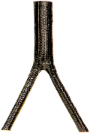
- Morphology and biomechanics The monocotyledonous mode of branching has important implications for the morphology and anatomy in Dracaena reflexa and Freycinetia insignis. It determines the shape of the branch–stem-junctions, the arrangement and course of the fibrous bundles in the main stem and in the
- ). It can be assumed that the ability to build secondary tissues has a high impact on growth form and biomechanics. While the attachment modes of D. reflexa and F. insignis are generally similar in that the lateral branches clasp around the main stem (Figure 2), the distinct separation (in some parts by




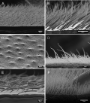
Superhydrophobic surfaces of the water bug Notonecta glauca: a model for friction reduction and air retention
Beilstein J. Nanotechnol. 2011, 2, 137–144, doi:10.3762/bjnano.2.17

- Biomechanics, Christian-Albrechts-University of Kiel, Am Botanischen Garten 1–9, Kiel, 24098, Germany Lehrstuhl Strömungsmechanik, Universität Rostock, Albert Einstein Str. 2, Rostock, 18051, Germany 10.3762/bjnano.2.17 Abstract Superhydrophobic surfaces of plants and animals are of great interest for



Review of "Contact Mechanics and Friction: Physical Principles and Applications" by Valentin L. Popov
Beilstein J. Nanotechnol. 2011, 2, 57–58, doi:10.3762/bjnano.2.7
- Stanislav N. Gorb Department of Functional Morphology and Biomechanics, Zoological Institute at the University of Kiel, Am Botanischen Garten 1–9, D-24098 Kiel, Germany 10.3762/bjnano.2.7 Keywords: adhesion; capillarity; contact mechanics; continuum mechanics; friction; lubrication; materials
- . Such an interdisciplinary theoretical basis is provided by Popov’s book. Because of an increasing scientific interest in understanding contact mechanics and friction/adhesion phenomena in biological systems, Popov’s book is very useful in experimental biology and biomechanics (for an example of a
- therefore, can be used also by scientists specializing in biological surface science, biomechanics, experimental biology, and biomimetics. These scientists will find concise and precise models that aid quantitative description of surface phenomena in biology. The chapters of the book illustrate a few
Other Beilstein-Institut Open Science Activities



