


Search results
Search for "waste" in Full Text gives 127 result(s) in Beilstein Journal of Nanotechnology.
Silver nanoparticles nucleated in NaOH-treated halloysite: a potential antimicrobial material
Beilstein J. Nanotechnol. 2021, 12, 798–807, doi:10.3762/bjnano.12.63

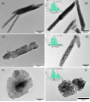
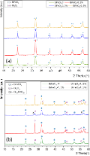
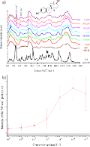
- of quartz (ICDD 46-1045), a commonly found secondary phase in HNT samples [30]. This result confirms that the substrate is indeed halloysite clay and the absence of any NaOH phase indicates that the treatment waste was successfully washed away. For Ag/HNT-8, diffraction peaks were found at 2θ = 38.12




Nanogenerator-based self-powered sensors for data collection
Beilstein J. Nanotechnol. 2021, 12, 680–693, doi:10.3762/bjnano.12.54
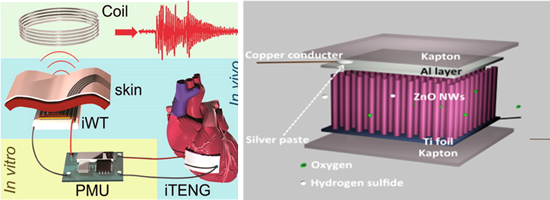
- ][44][45][46], waste milk carton [15], and skin [47][48][49]. Thus, low-cost self-powered sensors can be deployed on a large scale and are a good candidate for data sources for the Internet of things (IoT), big data, and artificial intelligence (AI). NGs can be used as both pressure sensors and as
- , portable, easy-to-deploy, and low-cost TENGs are novel devices for water quality monitoring. Zhou et al. proposed the use of waste materials to make an arc-shaped TENG (AS-TENG) [15]. The AS-TENG can provide energy for a pH sensor in water. The system can trigger an alarm when the pH value is lower than 5
- voltages according to the ion concentration, as shown in Figure 5d. The TENGs are a low-cost and environmentally friendly solution for detecting heavy metal ions. The kinetic energy generated by the flow of waste water is converted into electricity through a water-driven triboelectric nanogenerator (WD




A review on the biological effects of nanomaterials on silkworm (Bombyx mori)
Beilstein J. Nanotechnol. 2021, 12, 190–202, doi:10.3762/bjnano.12.15

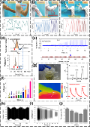
- silkworms to nanoparticles in order to understand the interaction between NPs and silkworms. The effects of nanomaterials on the environment and on human and animal health. (A) Nanomaterial waste; (B) fumes and gases from factories; (C) inflammation of the lungs after inhalation of gases/fumes or when in
- contact with nanomaterial waste; (D) damage in the membrane and in the lumen of silkworm silk glands; (E) dead zebrafish embryos; (F) NM; (G) contamination of water bodies; (H) silkworm feeding on mulberry leaves containing chemical residues. An illustration of how nanomaterials are directly fed to the


Paper-based triboelectric nanogenerators and their applications: a review
Beilstein J. Nanotechnol. 2021, 12, 151–171, doi:10.3762/bjnano.12.12
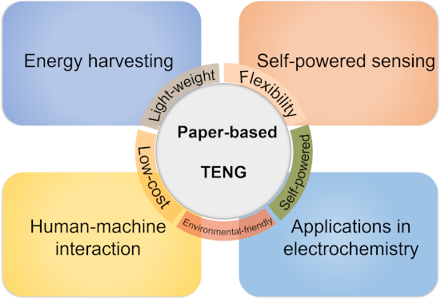
- ); paper-based sensors; self-powered devices; P-TENGs; triboelectric nanogenerator; Introduction Environmental pollution is an undeniable fact in our daily lives. The air pollution caused by industrial waste generation (gases/toxins) and by the combustion of fossil fuels is getting more and more serious






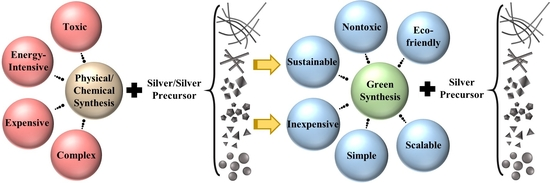
A review on the green and sustainable synthesis of silver nanoparticles and one-dimensional silver nanostructures
Beilstein J. Nanotechnol. 2021, 12, 102–136, doi:10.3762/bjnano.12.9


Bio-imaging with the helium-ion microscope: A review
Beilstein J. Nanotechnol. 2021, 12, 1–23, doi:10.3762/bjnano.12.1


Nanocasting synthesis of BiFeO3 nanoparticles with enhanced visible-light photocatalytic activity
Beilstein J. Nanotechnol. 2020, 11, 1822–1833, doi:10.3762/bjnano.11.164
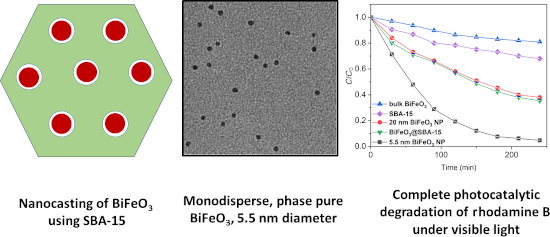
- the production of secondary waste products that require further treatment. Advanced oxidation processes, in general, and heterogeneous semiconductor photocatalysis, in particular, are promising candidates to efficiently treat wastewater as they are cost-effective and green treatment methods in which




Selective detection of complex gas mixtures using point contacts: concept, method and tools
Beilstein J. Nanotechnol. 2020, 11, 1631–1643, doi:10.3762/bjnano.11.146
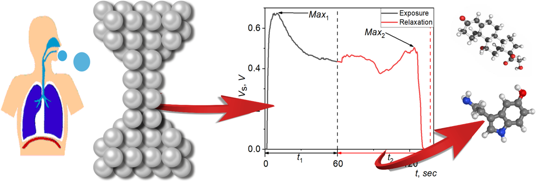
- -invasive diagnosis of erosive-ulcerative lesions of the gastrointestinal tract based on the detection in the breath of ill patients of waste products from the bacterium Helicobacter pylori, including cytotoxic strains of this microorganism. However, it should be noted that further improvement of analytical


![[Graphic 4]](/bjnano/content/inline/2190-4286-11-146-i8.svg?max-width=637&scale=1.18182) in th...
in th...

![[Graphic 7]](/bjnano/content/inline/2190-4286-11-146-i11.svg?max-width=637&scale=1.18182) in the...
in the...
A self-powered, flexible ultra-thin Si/ZnO nanowire photodetector as full-spectrum optical sensor and pyroelectric nanogenerator
Beilstein J. Nanotechnol. 2020, 11, 1623–1630, doi:10.3762/bjnano.11.145

- -circuit current output that can be used as a power generator [13][14]. Pyroelectric nanogenerators (PENGs) based on a pyroelectric material have been demonstrated as an effective approach that could avoid the waste of energy by converting temperature fluctuations induced by photoabsorption into electric


Antimicrobial metal-based nanoparticles: a review on their synthesis, types and antimicrobial action
Beilstein J. Nanotechnol. 2020, 11, 1450–1469, doi:10.3762/bjnano.11.129

- friendly approach to synthesize nanoparticles has been the use of biological and agricultural waste as reducing agent sources. Researchers have been focusing on this field that leads to one of the most ecologically friendly, sustainable, cost-efficient, and easy methods for synthesizing NPs. Recently, Soto
- et al. (2019) used fruit peel waste to synthesize silver nanoparticles with antimicrobial activity against foodborne pathogens [93]. Ibrahim et al. (2015) have also synthesized spherical silver nanoparticles (23.7 nm) by using banana peels. These Ag NPs have exhibited antimicrobial activity against


Ultrasensitive detection of cadmium ions using a microcantilever-based piezoresistive sensor for groundwater
Beilstein J. Nanotechnol. 2020, 11, 1242–1253, doi:10.3762/bjnano.11.108

- essential for sustaining life, and an increase in the global population has led to an exponential increase in waste disposal, which causes significantly increased requirements regarding the control of water quality [1]. Clean water is one of the main priorities of the 21st century worldwide, and negligence




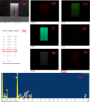
Highly sensitive detection of estradiol by a SERS sensor based on TiO2 covered with gold nanoparticles
Beilstein J. Nanotechnol. 2020, 11, 1026–1035, doi:10.3762/bjnano.11.87
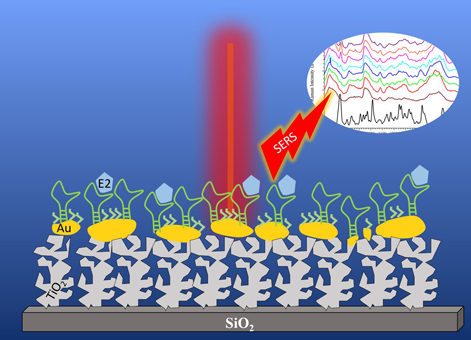
- formation, and childbearing in mammals. It is the most potent estrogen [22]. Estrogens found in the environment originate from human and animal excretions and are released into surface waters from agricultural activities, non-treated waste or wastewater treatment effluents [23]. High concentrations of E2



Effect of magnetic field, heat generation and absorption on nanofluid flow over a nonlinear stretching sheet
Beilstein J. Nanotechnol. 2020, 11, 976–990, doi:10.3762/bjnano.11.82

- nanofluids with nonlinear equations. Applications in nuclear waste storage were initiated by Gaffar et al. [11], who focussed on viscoelastic Jeffrey fluid in a porous medium considering the effect of various dimensionless parameters that influence the heat and mass transfer flow. Dogonchi and Ganji [12


Adsorptive removal of bulky dye molecules from water with mesoporous polyaniline-derived carbon
Beilstein J. Nanotechnol. 2020, 11, 597–605, doi:10.3762/bjnano.11.47
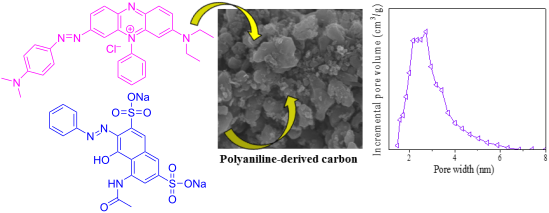
- annually; and a considerable quantity of the produced dyes is discharged into waste water [1]. Such dyes are usually toxic or are converted into toxic substances after further treatment [1][2], and dyes discarded in waste water inevitably increase the biochemical oxygen demand (BOD) and chemical oxygen
- demand (COD) levels. Additionally, dyes decrease sunlight penetration through water, decreasing the natural restoration activity of rivers. Moreover, dyes in waste water are also considered problematic in the aesthetic sense, since the absorbance of dyes is usually very high (therefore, even small
- removal of contaminants of emerging concern, hazardous organics and persistent organic pollutants. Carbonaceous materials have been particularly attractive in the purification of contaminated water via adsorption because of the easy preparation of carbon materials [26], especially from waste materials [28


Facile biogenic fabrication of hydroxyapatite nanorods using cuttlefish bone and their bactericidal and biocompatibility study
Beilstein J. Nanotechnol. 2020, 11, 285–295, doi:10.3762/bjnano.11.21
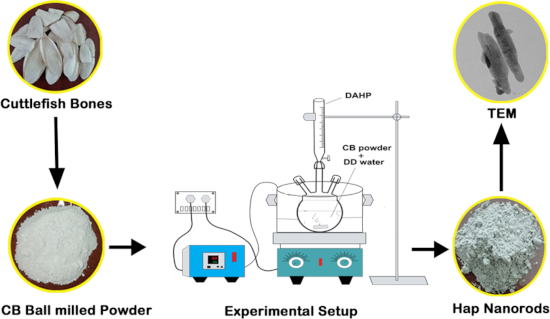
- Department of Chemical Engineering, Curtin University, Miri, Sarawak 98009, Malaysia 10.3762/bjnano.11.21 Abstract Cuttlefish bones are an inexpensive source of calcium carbonate, which are produced in large amounts by the marine food industry, leading to environmental contamination and waste. The
- waste material every day by the marine food industry across the world, resulting in environmental contamination [10]. In ancient times, cuttlefish bone powder was used as biomedicine in China and India for oral health and is proven to be completely suitable for biomedical applications [11]. Further, the
- calculated as 79.05 ± 0.453 nm and 219.66 ± 0.38 nm, respectively, derived from the TEM micrographs using ImageJ software, as shown in Figure 4h,i. Kumar et al. (2015) synthesized Hap nanorods with 40–60 nm width and 500 to 700 nm length using waste shells of snail via a microwave irradiation method [38




Recent progress in perovskite solar cells: the perovskite layer
Beilstein J. Nanotechnol. 2020, 11, 51–60, doi:10.3762/bjnano.11.5

- , which can lead to an overall reduction of material usage and waste. Mathies et al. [24] report the fabrication and optimization of multipass inkjet-printed PSCs. Here, the thickness and grain size of the perovskite films were controlled during multipass inkjet printing of a MAPbI3-ink yielding PSCs with
- producing less Pb waste, thus promoting the development of perovskite digital printing technologies. Large-area fabrication of perovskite films Since the PCE of PSCs already exceeds 23%, the research focus is gradually shifting towards important issues related to commercialization. One of the challenges met


Improvement of the thermoelectric properties of a MoO3 monolayer through oxygen vacancies
Beilstein J. Nanotechnol. 2019, 10, 2031–2038, doi:10.3762/bjnano.10.199

- of utilizing waste heat without generating any greenhouse gas, thermoelectric technology has attracted increasing attention [1]. Nevertheless, the application of thermoelectric materials is limited by the low energy conversion efficiency. The performance of thermoelectric materials is usually


Upcycling of polyurethane waste by mechanochemistry: synthesis of N-doped porous carbon materials for supercapacitor applications
Beilstein J. Nanotechnol. 2019, 10, 1618–1627, doi:10.3762/bjnano.10.157

- EMIM-BF4 (70 F·g−1). Keywords: mechanochemistry; polyurethane; porous carbon; supercapacitor; waste; Introduction Currently more than 275 million tons of plastics end up as waste every year, 12.7 million tons of which accumulate in the oceans [1][2]. This waste is mainly packaging materials such as
- ][4][5]. So far, different recycling techniques have been devised to counteract environmental pollution through accumulation of plastic waste. Especially, the recovery of PE and PP, as well as depolymerization processes for PET and the reprocessing of PVC by crushing and melting in conversion systems
- are well developed [6][7][8][9]. Commonly, 10–30% of the plastic waste is recycled by manufacturing new plastic products. Another 10–25% is used for energy recovery as fuel for industrial processes. However, 55–80% still end up in landfills or even in the environment [3][4][10]. Some of the polymers


Materials nanoarchitectonics at two-dimensional liquid interfaces
Beilstein J. Nanotechnol. 2019, 10, 1559–1587, doi:10.3762/bjnano.10.153













High-temperature resistive gas sensors based on ZnO/SiC nanocomposites
Beilstein J. Nanotechnol. 2019, 10, 1537–1547, doi:10.3762/bjnano.10.151
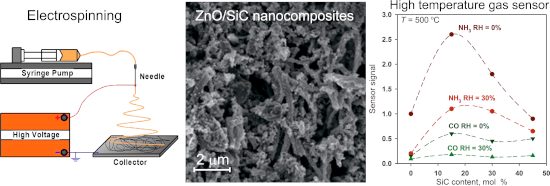
- of bio-fuels in the energy sector, modern waste treatment, and new automotive and aircraft engines [1][2]. Increasing requirements for environmental protection lead to the need for the development of control systems for exhaust gases that can directly monitor at high temperatures in the range of 300





Growth of lithium hydride thin films from solutions: Towards solution atomic layer deposition of lithiated films
Beilstein J. Nanotechnol. 2019, 10, 1443–1451, doi:10.3762/bjnano.10.142
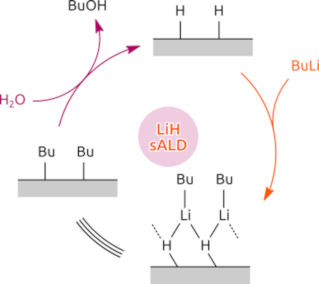
- filters for hazardous byproducts, since the liquid waste from the deposition process can be easily caught, neutralized, and the solvent can be recovered by distillation. sALD opens up the possibility to use n-butyllithium, which does not exist in the gas phase, as a precursor for lithiated films [13
- chemistry, a quartz crystal microbalance (QCM) system was installed behind the exit of the deposition setup with tubing of minimal length (2 cm), effectively allowing the deposition to occur on the QCM crystal as well. The waste pumped out of the QCM chamber was immediately neutralized with ethanol


Kelvin probe force microscopy of the nanoscale electrical surface potential barrier of metal/semiconductor interfaces in ambient atmosphere
Beilstein J. Nanotechnol. 2019, 10, 1401–1411, doi:10.3762/bjnano.10.138

- considered solid-state heat engines. The former enables direct waste heat conversion into electrical energy very elegantly (no moving parts, long-term stability, maintenance-free, silent). Unfortunately, one of the limiting factors of this technology is still poor conversion efficiency. The conversion


Janus-micromotor-based on–off luminescence sensor for active TNT detection
Beilstein J. Nanotechnol. 2019, 10, 1324–1331, doi:10.3762/bjnano.10.131
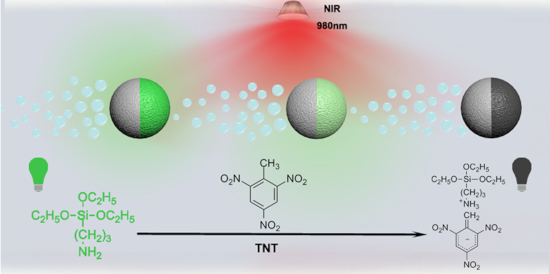
- hazardous waste, as it is possibly carcinogenic and mutagenic. Consequently, TNT-contaminated water has become one of the most serious pollution problems in war and military testing areas [1][2][3][4][5][6][7]. To date, various approaches including mass spectroscopy [8], ion transfer spectroscopy [9


Green fabrication of lanthanide-doped hydroxide-based phosphors: Y(OH)3:Eu3+ nanoparticles for white light generation
Beilstein J. Nanotechnol. 2019, 10, 1200–1210, doi:10.3762/bjnano.10.119

- methods have been widely used such as sol–gel, hydrothermal, combustion, emulsion, and precipitation methods [31][32][33][34]. Among those, the sol–gel and co-precipitation methods are, in general, slow and usually involve additional steps. On the other hand, there is a huge waste of organic solvents



Tailoring the stability/aggregation of one-dimensional TiO2(B)/titanate nanowires using surfactants
Beilstein J. Nanotechnol. 2019, 10, 1024–1037, doi:10.3762/bjnano.10.103
- , Croatia Karlsruhe Institute of Technology (KIT), Institute for Nuclear Waste Disposal, Hermann-von-Helmholtz-Platz 1, 76344 Eggenstein-Leopoldshafen, Germany Department of Chemistry, Faculty of Science, University of Zagreb, Horvatovac 102a, 10002 Zagreb, Croatia current affiliation: Department of Organic





