Search results
Search for "Al2O3" in Full Text gives 161 result(s) in Beilstein Journal of Nanotechnology.
Synthesis of carbon nanowalls from a single-source metal-organic precursor
Beilstein J. Nanotechnol. 2018, 9, 1895–1905, doi:10.3762/bjnano.9.181
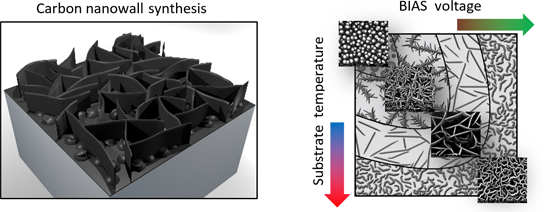
- carbon, aluminium, chromium and iron from the stainless steel substrate, and oxygen can be identified. The oxygen is likely from the metal-organic precursor, which also contains oxygen. Thus, in addition to the Al3C4 clusters, also Al2O3 compounds in the films are possible, also H2O adsorption cannot be


Cryochemical synthesis of ultrasmall, highly crystalline, nanostructured metal oxides and salts
Beilstein J. Nanotechnol. 2018, 9, 1755–1763, doi:10.3762/bjnano.9.166

- , aqueous solutions of Al- and Fe-sulfates were used to obtain highly dispersed Al2O3 and Fe2O3 crystallites by a freeze-drying technique. The formation and growth of chain-like aggregates of crystallites was shown as a process followed the surface diffusion mechanism. It was observed that the orientation


Light extraction efficiency enhancement of flip-chip blue light-emitting diodes by anodic aluminum oxide
Beilstein J. Nanotechnol. 2018, 9, 1602–1612, doi:10.3762/bjnano.9.152

- of the pore structure in this direction. In Figure 3e, the orange dotted line represents the boundary between pores and the sapphire substrate of AAO60. The area bounded by the yellow dotted line is Al, the area bounded by the blue dotted line is a pore, and the area between these lines is Al2O3. In
- Al2O3 is 100 nm, which is consistent with the hole radius. If the hole radius decreases, then the yellow area (Al) will expand. Figure 10a shows the calculation results obtained with different Al2O3 thicknesses and diameter values of air holes in the absence of Al. All the three samples have the same
- transmittance of 440–450 nm. However, AAO80 has wider transmittance windows than other samples. Figure 10b shows that transmittance drastically decreases when Al is present in the sample structure. The thickness of Al in the form of Al2O3 is less than 10 nm. Figure 10c shows the modified absorption result for


Understanding the performance and mechanism of Mg-containing oxides as support catalysts in the thermal dry reforming of methane
Beilstein J. Nanotechnol. 2018, 9, 1162–1183, doi:10.3762/bjnano.9.108
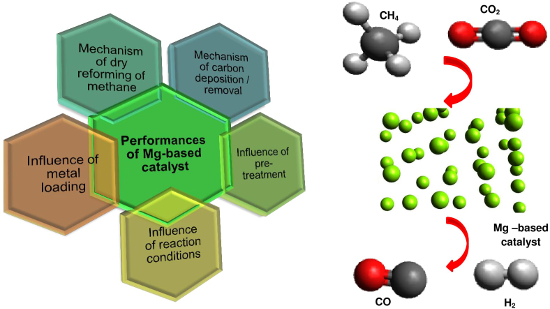
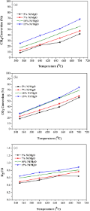
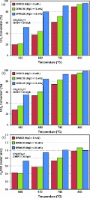
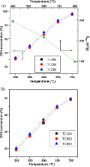
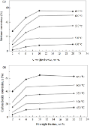
- in DRM. Application of MgO as a co-support Abdollahifar et al. [49] investigated catalyst performance by applying the ultrasound-assisted impregnation (sonochemistry) method in the synthesis of a Ni/Al2O3–MgO catalyst for a DRM reaction. The measured surface area for the Ni/Al2O3–MgO catalyst was
- 800 °C, the recorded CO2 is markedly higher than CH4 conversion and the H2/CO ratio reaches unity. The Ni/Al2O3–MgO catalyst was stable without deactivation for up to 53 h at a reaction temperature of 700 °C. The recorded performance might be influenced by the high surface area of Al2O3 and the high
- CO2/CH4 ratio. The conversion of CO2 and CH4 was in the range of 70 to 80% when the obtained H2/CO ratio was between 1 and 1.5. The influence of the synthesis method on the Ni/Al2O3–MgO catalyst by sol–gel and impregnation techniques was investigated by Hassani Rad et al. [37]. A higher specific






Field-controlled ultrafast magnetization dynamics in two-dimensional nanoscale ferromagnetic antidot arrays
Beilstein J. Nanotechnol. 2018, 9, 1123–1134, doi:10.3762/bjnano.9.104
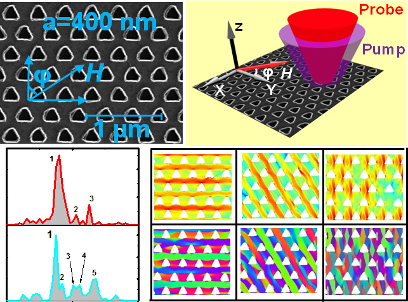
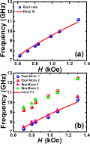
- -thick protective layer of Al2O3 was deposited on top of the Py film in an ultrahigh vacuum chamber at a base pressure of 2 × 10⁻⁸ Torr. The Al2O3 capping layer was deposited on the Py film to protect the samples from external contamination of the environment, degradation with time, and also from direct



Comparative study of antibacterial properties of polystyrene films with TiOx and Cu nanoparticles fabricated using cluster beam technique
Beilstein J. Nanotechnol. 2018, 9, 861–869, doi:10.3762/bjnano.9.80

- organic cells. Because of these toxic properties the films and nanostructures of such metals or metal compounds are widely used as antibacterial and antimicrobial agents. Among them are Ag, Cu, Au, CuO, ZnO, Fe3O4, Al2O3 and TiO2, to name just a few [1][2][3]. They all exhibit bactericidal properties




Facile synthesis of a ZnO–BiOI p–n nano-heterojunction with excellent visible-light photocatalytic activity
Beilstein J. Nanotechnol. 2018, 9, 789–800, doi:10.3762/bjnano.9.72
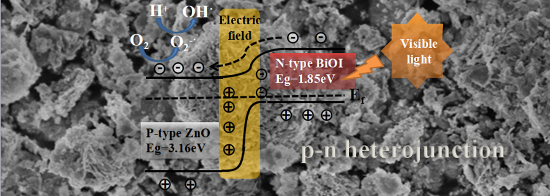
- degradation [3][4][5][6], nitrogen fixation [7][8], to solar fuel production [9]. The metal oxides, such as CdO [10], Al2O3 [11], and CuO [12][13], has attracted a lot of interest in photocatalytic applications. And among all of these metal oxides, it is titanium dioxide and zinc oxide (TiO2 and ZnO) that are



A review of carbon-based and non-carbon-based catalyst supports for the selective catalytic reduction of nitric oxide
Beilstein J. Nanotechnol. 2018, 9, 740–761, doi:10.3762/bjnano.9.68

- (ZSM-5), TiO2, and Al2O3 supported materials, were identified as the most up-to-date and recently used catalysts for the removal of NO gas. The main focus of this review is the study of catalyst preparation methods, as this is highly correlated to the behaviour of NO removal. The general mechanisms
- loading Zn- (Fe-, Ni-, Cu- or Ag-) promoted Co/Al2O3 catalyst to study the effect of additive metals on the SCR of NO. From the experimental studies, it was found that this technique definitely contributes towards a good homogeneous dispersion and helps prevent aggregation of highly deposited cobalt on
The effect of atmospheric doping on pressure-dependent Raman scattering in supported graphene
Beilstein J. Nanotechnol. 2018, 9, 704–710, doi:10.3762/bjnano.9.65

- doping by adsorbates [13], and substrate-induced electrostatic doping [16]. The G and 2D peak positions upshifted by 5–8 cm−1 and the considerably low I2D/IG ratio of 1.3–1.4 for graphene transferred onto copper and Al2O3 could be explained by similar effects, which in this case, tend to be less
- graphene transferred to Cu and Al2O3 as typical conducting and dielectric materials, a stronger carrier density change was obtained for the latter. As the pressure decreases, removal of adsorbates from the surface of graphene on Al2O3 results in the Raman spectra parameters becoming close to those typical
- (interaction energy of 0.72 J/m2 against ≈0.47 J/m2 for graphene on Al2O3 substrate [20][21]) and therefore more pronounced substrate-induced doping [16]. Besides, the electrostatic screening of the electron–electron interaction for graphene on a metallic substrate [22][23] can contribute. The screening effect


Combined pulsed laser deposition and non-contact atomic force microscopy system for studies of insulator metal oxide thin films
Beilstein J. Nanotechnol. 2018, 9, 686–692, doi:10.3762/bjnano.9.63

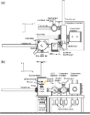
- ][41][42]. Different conditions of annealing and sputtering result in different types of surface reconstruction even under the same preparation conditions [26]. As an example of an insulator metal oxide, an Al2O3(0001) surface prepared using iterations of annealing and sputtering was imaged with atomic


Review: Electrostatically actuated nanobeam-based nanoelectromechanical switches – materials solutions and operational conditions
Beilstein J. Nanotechnol. 2018, 9, 271–300, doi:10.3762/bjnano.9.29
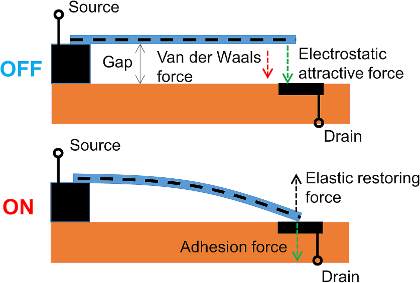
- cycles with stable actuation voltages [47]. The jump-in voltage of TiN NEM switches can be lowered by using a harder material with higher melting temperature (for example, Al2O3) as the electrode coating [48]. Configuration of 2T TiN switches with three operation states (one off state and two on states


BN/Ag hybrid nanomaterials with petal-like surfaces as catalysts and antibacterial agents
Beilstein J. Nanotechnol. 2018, 9, 250–261, doi:10.3762/bjnano.9.27
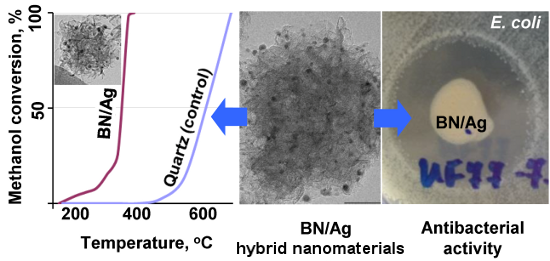
- -BN compared with commonly used catalyst supports (i.e., SiO2, Al2O3, etc.). An important question that needs additional analysis is the role of catalyst support morphology. In contrast to the previous works, that were focused on the catalytic activity of 2D BN nanosheets decorated with Ag NPs during





Al2O3/TiO2 inverse opals from electrosprayed self-assembled templates
Beilstein J. Nanotechnol. 2018, 9, 216–223, doi:10.3762/bjnano.9.23
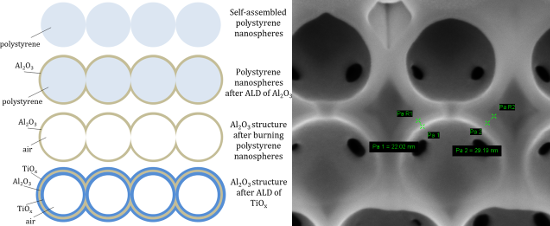
- size) or silicon dioxide nanoparticles with dimensions typically several hundreds of micrometers with a close packed, face-centered cubic, three-dimensional order. In parallel we have shown the use of Al2O3 as a good candidate for the inverse opal supporting layer regarding the low temperature
- errors and Al2O3/TiO2 as a structural layer infiltrated through the voids. This is a two-step atomic layer deposition (ALD) process in which the polymeric template is eliminated after the deposition of the alumina layer and before the ALD deposition of the titania layer. Results and Discussion The
- fabrication process of the Al2O3/TiO2 inverse opals is schematically outlined in Figure 1 where the starting step can be seen in Figure 1a and consists of the electrospray deposition of the template layer of ordered polystyrene nanoparticles. Only a side view of one row of four nanoparticles is shown for


Dopant-stimulated growth of GaN nanotube-like nanostructures on Si(111) by molecular beam epitaxy
Beilstein J. Nanotechnol. 2018, 9, 146–154, doi:10.3762/bjnano.9.17

- reconstruction should be on the NW top polar facet [20] enabling good bonding of Ga atoms, while on nonpolar sidewalls, the adsorbed atoms are weakly bonded and diffuse to the top facet or can be desorbed. Self-induced formation of NWs has been discovered on Al2O3 [21] and was successfully reproduced on other


Beyond Moore’s technologies: operation principles of a superconductor alternative
Beilstein J. Nanotechnol. 2017, 8, 2689–2710, doi:10.3762/bjnano.8.269

- interlayer Al2O3 between the superconducting Nb electrodes, and its thickness d ≈ 1 nm. The critical current density value lies typically in the range jc = 10–100 μA/μm2. The corresponding specific capacitance of the Josephson junction is c ≈ 40–60 fF/μm2. A variation of the critical current of a Josephson


Exploring wear at the nanoscale with circular mode atomic force microscopy
Beilstein J. Nanotechnol. 2017, 8, 2662–2668, doi:10.3762/bjnano.8.266

- . Finally, we describe the advantages of this method and we report a relevant application example addressing a Cu/Al2O3 nanocomposite material used in industrial applications. Keywords: circular mode atomic force microscopy; composite materials; image processing; nanowear; wear mechanisms; Introduction
- and erratic, their related trends regarding Cu/Al2O3 nanocomposites at the nanoscale may be obtained. Experimental The investigated copper-based nanocomposite was produced by powder metallurgy technology and contained approximately 4.7 wt % of nanometer-sized Al2O3 particles (the average diameter was


Localized growth of carbon nanotubes via lithographic fabrication of metallic deposits
Beilstein J. Nanotechnol. 2017, 8, 2592–2605, doi:10.3762/bjnano.8.260
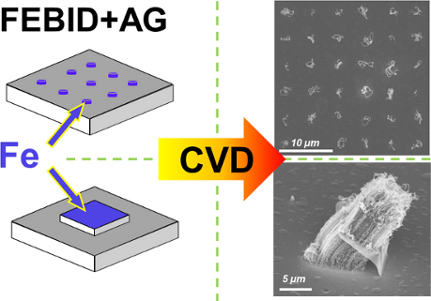
- an Al2O3 layer on a silicon sample. A peculiar lift-up of the Fe seed structures as “flakes” was observed and the mechanism was discussed. Finally, a proof-of-principle was presented showing that EBID deposits from the precursor Co(CO)3NO are also very effective catalysts for the CNT growth. Even
- , for the formation of high-density vertically aligned CNTs (referred to as CNT forests), a thin Al2O3 layer was introduced to improve the CNT yield grown on EBID Fe deposits. The significant increase in the yield can be attributed to the reduced mobility of the Fe deposits on the Al2O3 substrate
- forests on Al2O3 support layer After the successful exploration of the localized fabrication of individual CNTs at a predefined position, the next step was to target the growth of CNT forests which represent appealing materials for different applications, such as super-capacitor electrodes [6][37




Refractive index sensing and surface-enhanced Raman spectroscopy using silver–gold layered bimetallic plasmonic crystals
Beilstein J. Nanotechnol. 2017, 8, 2492–2503, doi:10.3762/bjnano.8.249
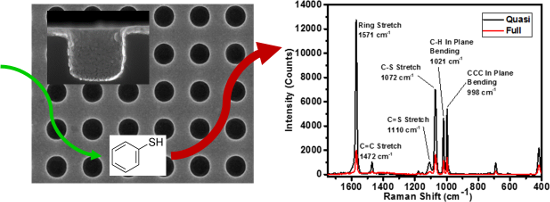
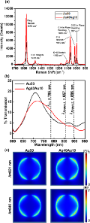
- penetration of liquid solution into the interfaces formed between the metal films and the SOG substrate. To prevent the degradation in performance that this engendered, a conformal ≈6 nm thick Al2O3 passivation film was deposited on top of the metal by atomic layer deposition (Cambridge Nanotech). Bulk
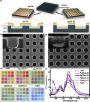
- and calculated normal incidence transmission spectra and electric field distributions around the nanoholes for full-3D PCs with Au50 (Figure 2a), Ag50 (Figure 2b), and Ag30Au20 (Figure 2c) mass-coverage metal films. The Al2O3 passivation layer was not included in the calculations as it was found to


Laser-assisted fabrication of gold nanoparticle-composed structures embedded in borosilicate glass
Beilstein J. Nanotechnol. 2017, 8, 2454–2463, doi:10.3762/bjnano.8.244
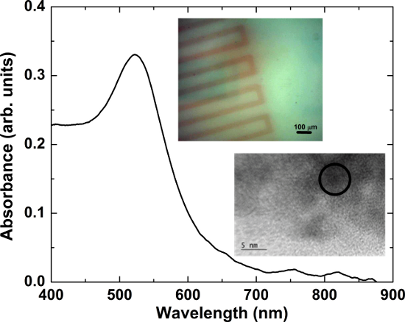
- % Al2O3, 20% B2O3, 5% CaO, 2% Li2O, 3% MgO, where AuCl3 is added to the initial mixture in an amount ensuring 0.015 wt % of Au in the final glass sample. The mixed material is melted in a Pt crucible and kept at a temperature of 1450 °C for three hours. After cooling, the glass sample is cut into pieces
- large amounts of B2O3 and Al2O3, a contribution of defect absorption induced by modification of the bond in these oxides should also be considered. According to Sakka [29], defects induced in borate glasses have strong absorption in the visible range, peaking at about 590 nm. For alumina-based glasses


Increasing the stability of DNA nanostructure templates by atomic layer deposition of Al2O3 and its application in imprinting lithography
Beilstein J. Nanotechnol. 2017, 8, 2363–2375, doi:10.3762/bjnano.8.236
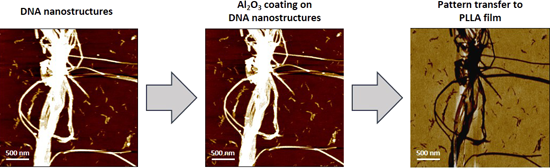
- conformal coating with a nanometer-thin protective inorganic oxide layer created using atomic layer deposition (ALD). DNA nanotubes and origami triangles were coated with ca. 2 nm to ca. 20 nm of Al2O3. Nanoscale features of the DNA nanostructures were preserved after the ALD coating and the patterns are
- resistive to UV/O3 oxidation. The ALD-coated DNA templates were used for a direct pattern transfer to poly(L-lactic acid) films. Keywords: aluminium oxide (Al2O3); atomic layer deposition; DNA nanostructure; nanofabrication; nanoimprint lithography; pattern transfer; polymer stamp; replica molding
- Al2O3 onto the nanostructures followed by thermal annealing [36]. In addition to the 2D pattern transfer processes, gold nanoparticles with specified 3D shapes were synthesized by growing seed particles in the internal cavities of 3D DNA nanostructures [37][38]. Compared to the above developments, there


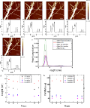


Ta2N3 nanocrystals grown in Al2O3 thin layers
Beilstein J. Nanotechnol. 2017, 8, 2162–2170, doi:10.3762/bjnano.8.215
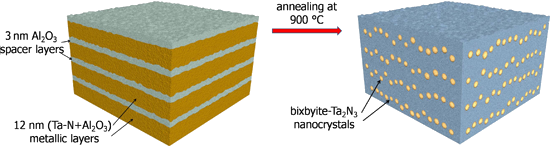
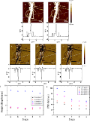
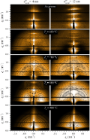
- -Sincrotrone Trieste, Strada Statale 14, km 163.5, I-34149 Basovizza (TS), Italy 10.3762/bjnano.8.215 Abstract Tantalum nitride nanoparticles (NPs) and cubic bixbyite-type Ta2N3 nanocrystals (NCs) were grown in (Ta–N+Al2O3)/Al2O3 periodic multilayers (MLs) after thermal treatment. The MLs were prepared by
- nitride NPs could be confined within the metallic layers. Here we tested the feasibility of this procedure with the tantalum nitride (Ta–N) system, more specifically with the cubic bixbyite type (space group 206, ) Ta2N3 nanocrystals embedded within the Al2O3 matrix. The Ta–N system has a uniquely rich
- (nitrogen fraction in sputtering gas mixture pN2 = 0.2) with a total gas pressure of 0.47 Pa. Ta (99.95% purity) and Al2O3 (99.995% purity) targets were used in dc (15 W) and rf (140 W) operated magnetrons, respectively. The deposition rates were 0.31 nm/s for the Ta target and 0.19 nm/s for the Al2O3


A comparative study of the nanoscale and macroscale tribological attributes of alumina and stainless steel surfaces immersed in aqueous suspensions of positively or negatively charged nanodiamonds
Beilstein J. Nanotechnol. 2017, 8, 2045–2059, doi:10.3762/bjnano.8.205

- materials. Alumina (Al2O3) ball and the disk contacts were purchased from PCS Instruments (London, United Kingdom), with respective part #’s MTMB3/4AL2O3 and MTMD3/4AL2O3. Stainless steel (AISI 52100) polished ball and the disk contacts were also purchased from PCS Instruments (London, United Kingdom), with
- and the sample was then immersed into 4 wt % oxalic acid solution maintained at 0 °C. A cathode was placed in the bath and an electric potential of 40 V was applied between the anode and the cathode. Anodization was halted at 3 min yielding an approximately 100 nm thick Al2O3 layer. After the
- aluminum, the surface-exposed aluminum metal is readily oxidized to Al2O3 under ambient air. This surface layer of alumina is protecting the rest of metal from a further corrosion. In our experiments, the electrodes were additionally anodized for 3 min. This procedure is expected to yield approximately 50




Fluorination of vertically aligned carbon nanotubes: from CF4 plasma chemistry to surface functionalization
Beilstein J. Nanotechnol. 2017, 8, 1723–1733, doi:10.3762/bjnano.8.173
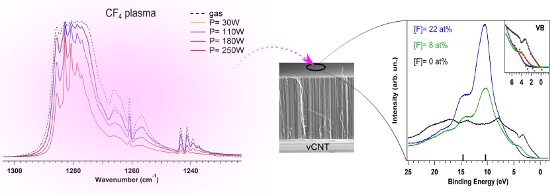
- vapor deposition (CCVD) at atmospheric pressure. The catalysts are prepared by magnetron sputtering: a 30 nm Al2O3 buffer layer is deposited on Si wafers with native SiO2 and a 6 nm Fe layer is then deposited to form nanoparticles which catalyse the vCNT growth. Then, the substrate is placed inside the




Three-in-one approach towards efficient organic dye-sensitized solar cells: aggregation suppression, panchromatic absorption and resonance energy transfer
Beilstein J. Nanotechnol. 2017, 8, 1705–1713, doi:10.3762/bjnano.8.171
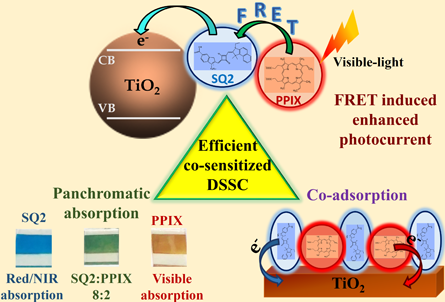
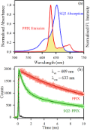
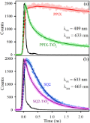
- proximity. To create this proximity between these two dyes Al2O3 has been used. The excited-state lifetime of PPIX (attached to Al2O3) was measured in presence and absence of SQ2 by fitting the time-resolved fluorescence decays (Figure 2b). It can be noted from the lifetime components summarized in Table 1
- that the average lifetime of the PPIX excited state (attached to Al2O3) is shortened from 13.20 to 5.47 ns when SQ2 is added to the solution. We propose FRET between the donor (PPIX) and the acceptor (SQ2) as the mechanistic explanation of the shortened lifetime of the excited donor state. The
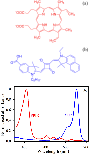
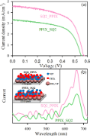
- concurrently fulfilled by PPIX. Structure of (a) PPIX and (b) SQ2; (c) normalized absorption spectra of PPIX in DMSO and SQ2 in ethanol. (a) Spectral overlap between the emission of PPIX and the absorption of SQ2, (b) The picosecond-resolved fluorescence decays of PPIX attached to Al2O3 in absence (red) and


Low-temperature CO oxidation over Cu/Pt co-doped ZrO2 nanoparticles synthesized by solution combustion
Beilstein J. Nanotechnol. 2017, 8, 1546–1552, doi:10.3762/bjnano.8.156

- , different types of catalysts including monometallic (e.g., Pt, Pd, Rh, Au, Ni, Co and Sn), bimetallic (e.g., Pd–Au, Pd–Rh, Pt–Co, Cu–Rh, Au–Cu and Au–Ag) along with various types of supports (e.g., CeO2, SiO2, Al2O3, Co3O4, Fe2O3, activated carbon (AC), carbon nanotubes (CNTs) and ZrO2) have been reported
- acidic reaction environments [18] and a better catalyst/support than other materials such as SiO2, TiO2, and Al2O3 [19]. Recently, we reported the usage of ZrO2 and Pt-doped ZrO2 nanoparticles for CO oxidation [20]. In this paper, the synthesized ZrO2 showed 100% CO conversion at a temperature which is