


Search results
Search for "amino acid" in Full Text gives 85 result(s) in Beilstein Journal of Nanotechnology.
Carbon nano-onions (multi-layer fullerenes): chemistry and applications
Beilstein J. Nanotechnol. 2014, 5, 1980–1998, doi:10.3762/bjnano.5.207
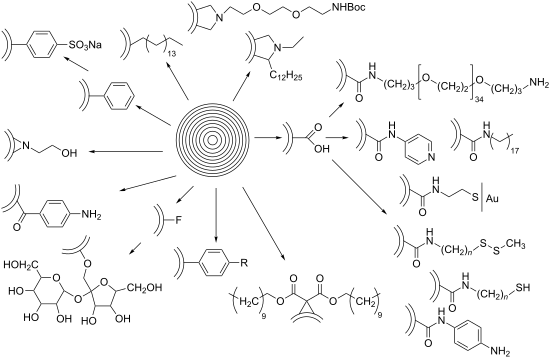
- heated with an amino acid and paraformaldehyde. Following filtration and washing with toluene, the solid was suspended in chloroform. After one week, the formed precipitate was removed and the functionalized CNO material was obtained by evaporation of the chloroform. The authors reported that the final
- solvents and give rise to potential future applications in various fields of technology. The synthesis of ferrocene (Fc)-decorated CNOs was reported by Prato et al. [34]. CNOs were functionalized in a 1,3-dipolar cycloaddition reaction with a BOC-protected amin/amino acid [35] and paraformaldehyde


PVP-coated, negatively charged silver nanoparticles: A multi-center study of their physicochemical characteristics, cell culture and in vivo experiments
Beilstein J. Nanotechnol. 2014, 5, 1944–1965, doi:10.3762/bjnano.5.205

- , the dissolution rate is strongly increased. On the other hand, the dissolution is significantly slower in the presence of dissolved NaCl, a fact that may be due to the formation of insoluble silver chloride. An even stronger inhibiting effect is exerted by the sulfur-containing amino acid cysteine. We
- . As an early response to genomic DSB, a variant of histone H2A becomes phosphorylated at amino acid 139 by members of the PI3-kinase family in the direct vicinity of the break. The phosphorylated form of H2AX (γ-H2AX) is necessary to activate the DSB-repair machinery [117] and therefore, it can be




Protein-coated pH-responsive gold nanoparticles: Microwave-assisted synthesis and surface charge-dependent anticancer activity
Beilstein J. Nanotechnol. 2014, 5, 1452–1462, doi:10.3762/bjnano.5.158
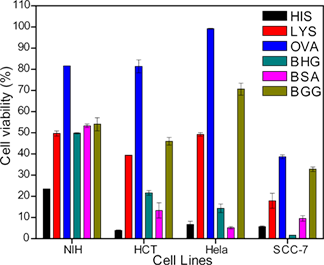
- and thereby deactivates some of the amino acid residues responsible for the reduction of the Au ions. Structural conformation The main objective of this work was the preparation of AuNPs by using proteins, not retaining the structural conformation of the proteins, because changes in the structural
- remaining proteins are expected to retain their amino acid sequence and not have extensive changes in their properties, such as their intrinsic pH and isoelectric points. Composition of amino acid residues Recent reports suggest that amino acid residues, such as aspartic acid, cysteine, glutamic acid
- , tyrosine and tryptophan, can reduce Au(III) and Ag(I) ions [12][18][38][41][42][43][44][45][46]. In this study, amino acid content of each protein is different due to differences in their molecular weights and amino acid sequences. Thus, predicting that a particular amino acid is responsible for the


Organic and inorganic–organic thin film structures by molecular layer deposition: A review
Beilstein J. Nanotechnol. 2014, 5, 1104–1136, doi:10.3762/bjnano.5.123
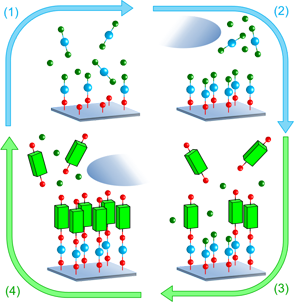
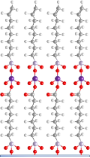
- and phenols” have also another functional group, such as 4-aminophenol with both –OH and –NH2 groups. (2S)-2-Aminopentanedioic acid, an amino acid with carboxylic acid functionality, is considered under “Acids”. “Other organic precursors” consist of all the organic precursors that do not fall clearly
- and FTIR experiments conducted for the crystallized films, the composition was close to that of MOF-5. Klepper et al. [112] used (2S)-2-aminopentanedioic acid, an amino acid with a carboxylic acid functional group, together with TMA. The films were grown in the temperature range of 200–350 °C. The GPC




Controlling mechanical properties of bio-inspired hydrogels by modulating nano-scale, inter-polymeric junctions
Beilstein J. Nanotechnol. 2014, 5, 887–894, doi:10.3762/bjnano.5.101

- quinones. For mussel adhesives, DOPAquinone is formed by oxidation of a catecholic amino acid, 3,4-dihydroxy-L-phenylalanine (DOPA). Subsequently, DOPAquinone rapidly reacts with basic amino acids, such as lysine and/or histidine, forming covalent adducts of DOPA-DOPA, lysyl-DOPA, and/or histeinyl-DOPA [7



Manipulation of isolated brain nerve terminals by an external magnetic field using D-mannose-coated γ-Fe2O3 nano-sized particles and assessment of their effects on glutamate transport
Beilstein J. Nanotechnol. 2014, 5, 778–788, doi:10.3762/bjnano.5.90

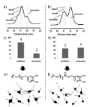
- that D-mannose-modified iron oxide nanoparticles could cross the cell membranes and be internalized by rat bone marrow stromal cells [12]. In the mammalian central nervous system, amino acid glutamate plays a primary role as a key excitatory neurotransmitter. Glutamate participates in many aspects of



Extracellular biosynthesis of gadolinium oxide (Gd2O3) nanoparticles, their biodistribution and bioconjugation with the chemically modified anticancer drug taxol
Beilstein J. Nanotechnol. 2014, 5, 249–257, doi:10.3762/bjnano.5.27

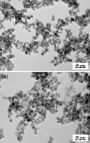
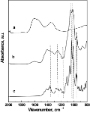
- secreted in the solution by the fungus Humicola sp. in response to the stress conditions encountered by the fungus in the presence of GdCl3. Some of these amino acid residues constitute the protein layer, which can cap the nanoparticles. As soon as GdCl3 gets dissolved in water along with fungal biomass


Nanoscopic surfactant behavior of the porin MspA in aqueous media
Beilstein J. Nanotechnol. 2013, 4, 278–284, doi:10.3762/bjnano.4.30

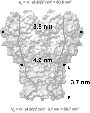
- describes the energetic contribution arising from the interactions of the vestibules of MspA in the bilayer. Due to the presence of polar amino-acid side-chains at the exterior of the MspA’s “head”, hydrogen bonding [29] is most likely responsible for the discrepancy of the calculated packing parameter P




Detection of interaction between biomineralising proteins and calcium carbonate microcrystals
Beilstein J. Nanotechnol. 2011, 2, 222–227, doi:10.3762/bjnano.2.26

- . These two protein bands (one at approx. 19 kDa and the other at about 25 kDa) belong to the protein perlucin [10]. The corresponding fractions of purified protein showing these two bands on SDS-PAGEs had been subjected to N-terminal amino acid sequence analysis [11] in several different experiments
- of perlucin has saccharide oligomers bound to these sites. In MALDI-MS (matrix-assisted laser desorption/ionization mass spectroscopy) of perlucin [10] variable molecular weights of perlucin are detectable, which can be related to a 10 amino acid repeat at the C-terminus being present in various


Electrochemical behavior of dye-linked L-proline dehydrogenase on glassy carbon electrodes modified by multi-walled carbon nanotubes
Beilstein J. Nanotechnol. 2010, 1, 135–141, doi:10.3762/bjnano.1.16

- typical Michaelis–Menten catalytic response with lower apparent constant. Keywords: dye-linked L-proline dehydrogenase; electrocatalysis; electron transfer; multi-walled carbon nanotube; Introduction As an essential amino acid for the proper functioning of tendons and joints in the human body, the quick
- for the detection of various types of chemical or biochemical substances [18][19][20][21][22][23]. Some amino acid biosensors have already been reported based on CNTs-modified electrodes [24][25][26][27]. In our previous work, the recombinant thermostable dye-linked L-proline dehydrogenase (L-proDH





