Search results
Search for "electron-transfer" in Full Text gives 249 result(s) in Beilstein Journal of Nanotechnology. Showing first 200.
Interface interaction of transition metal phthalocyanines with strontium titanate (100)
Beilstein J. Nanotechnol. 2021, 12, 485–496, doi:10.3762/bjnano.12.39
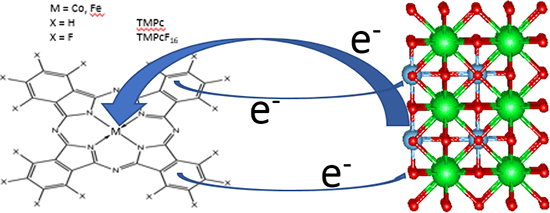
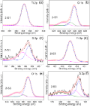
- transfer with the oxide substrate was observed, involving both the macrocycle and the central metal atom. For molecules of the first monolayer, an electron transfer to the central metal atom is concluded from transition metal 2p core level photoemission spectra. The number of interacting molecules in the
- interface interactions observed at both metallic and oxidic substrates [39][40][58][60][61][62]. The lower binding energy of the interface component arises from an electron transfer to the central Co ion of CoPc, which can be accompanied by a backdonation from the macrocycle to the substrate [61][62], in
- eV) compared to the main component of the thickest film (780.9 eV). Thus, analogously to CoPc, the interface component in the Co 2p3/2 spectra can be understood by an electron transfer from the substrate to the Co ion of CoPcF16. The reduction of the Co ion results in a significant change of the


A review on nanostructured silver as a basic ingredient in medicine: physicochemical parameters and characterization
Beilstein J. Nanotechnol. 2021, 12, 440–461, doi:10.3762/bjnano.12.36

- not exert their antibacterial effects in a single specific location, but rather at several levels (e.g., in the bacterial wall and by blocking electron transfer, in cell respiration and replication due to the damage to the proteins, RNA, and DNA [8][107]). In addition, there is substantial evidence


Nickel nanoparticle-decorated reduced graphene oxide/WO3 nanocomposite – a promising candidate for gas sensing
Beilstein J. Nanotechnol. 2021, 12, 343–353, doi:10.3762/bjnano.12.28
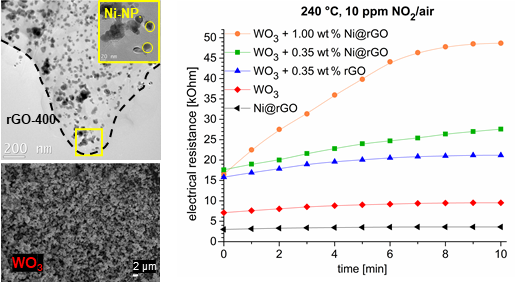
- , which leads to a rapid electron transfer from the surface reaction of the target gas with the MOS to the electrodes [35]. Additionally, MOS and graphene can form junctions at their interface. For example, p–p homojunctions can be formed between NiO and rGO to increase the gas sensing responsivity and
- possibility of electron transfer from nickel particles to rGO and WO3), which leads to a greater decrease in the resistance of the composite. In our case, these processes enhance the diffusion of charges at the WO3/rGO interface, but the role of nickel particles remains to be further clarified. Magnetic


Paper-based triboelectric nanogenerators and their applications: a review
Beilstein J. Nanotechnol. 2021, 12, 151–171, doi:10.3762/bjnano.12.12
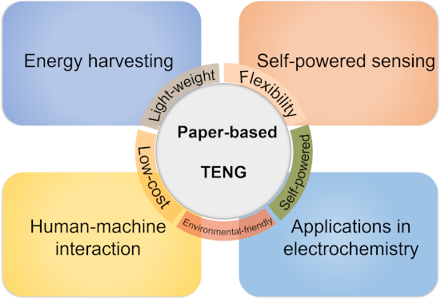
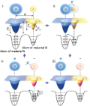
- (most common design in previous works) as a typical representative example, we further systematically analyze the working mechanism of the detailed charge-transfer process. Figure 2b elucidates the charge generation and the electron-transfer process at the friction interfaces (paper/the other dielectric
- negative charges) are induced by the same amount on the surfaces of the friction layers. As there is no electric potential at this stage, there is no electron transfer between the two conductive layers (Figure 2b-I). When the two friction layers start to separate along the vertical direction, opposite
- transferred charges and the corresponding CE mechanism in TENGs. The results shown in [90] suggest that the electron transfer dominates the CE process. The charge retention ability is attributed to the intrinsic potential barrier heights of the different materials, which can prevent the charge dissipation. As






Atomic layer deposited films of Al2O3 on fluorine-doped tin oxide electrodes: stability and barrier properties
Beilstein J. Nanotechnol. 2021, 12, 24–34, doi:10.3762/bjnano.12.2
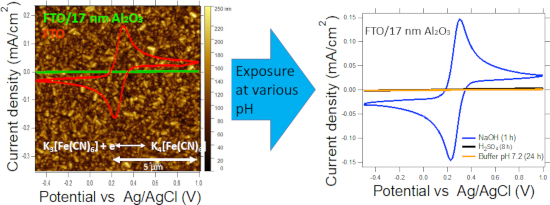
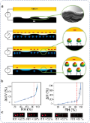
- , Technická 5, 166 28 Prague 6, Czech Republic 10.3762/bjnano.12.2 Abstract Al2O3 layers were deposited onto electrodes by atomic layer deposition. Solubility and electron-transport blocking were tested. Films deposited onto fluorine-doped tin oxide (FTO, F:SnO2/glass) substrates blocked electron transfer to
- better the blocking. This approach has been used previously [18][19][20] for testing semiconducting nonporous blocking layers of oxides (TiO2 or SnO2) deposited onto FTO. In this way, direct electron transfer between the redox couple in the electrolyte solution and the conducting substrate (i.e., FTO
- absorber (sensitizing dye or perovskite) to the negative terminal of the solar cell, usually an FTO or a similar transparent conducting oxide. At the same time, this layer blocks the back electron transfer from the current collector (FTO) to the electrolyte redox mediator, to the hole-transporting medium


Bio-imaging with the helium-ion microscope: A review
Beilstein J. Nanotechnol. 2021, 12, 1–23, doi:10.3762/bjnano.12.1

- aspects of microbe–mineral interactions, such as the formation of intra- or extracellular mineral precipitates, or intracellular organelles associated with energy gain or electron transfer [92]. However, over recent years, the number of articles related to geomicrobiology and containing HIM data has


Free and partially encapsulated manganese ferrite nanoparticles in multiwall carbon nanotubes
Beilstein J. Nanotechnol. 2020, 11, 1891–1904, doi:10.3762/bjnano.11.170

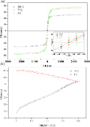
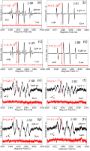
- nanoparticles compared to free MnFe2O4 nanoparticles. Upon attachment, evidence of electron transfer from MWCNTs to MnFe2O4 was observed. An increase in the hyperfine field of MnFe2O4/MWCNTs compared to free manganese ferrite nanoparticles was also detected. This can be assigned to two factors: strain from the




Selective detection of complex gas mixtures using point contacts: concept, method and tools
Beilstein J. Nanotechnol. 2020, 11, 1631–1643, doi:10.3762/bjnano.11.146
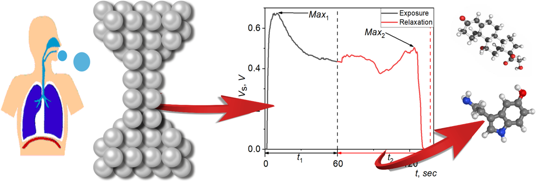
- energy state. This, in turn, happens due to the peculiarities of the electron transfer through the conduction channel of the point contact viewed as the elementary unit of the gas-sensitive array. This allows us to propose a method for detecting individual components of a complex gaseous medium by


![[Graphic 4]](/bjnano/content/inline/2190-4286-11-146-i8.svg?max-width=637&scale=1.18182) in th...
in th...

![[Graphic 7]](/bjnano/content/inline/2190-4286-11-146-i11.svg?max-width=637&scale=1.18182) in the...
in the...
Detecting stable adsorbates of (1S)-camphor on Cu(111) with Bayesian optimization
Beilstein J. Nanotechnol. 2020, 11, 1577–1589, doi:10.3762/bjnano.11.140
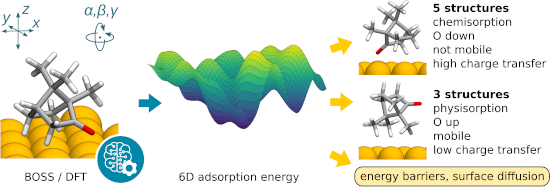
- adsorption on the electronic structure. The Mulliken analysis of partial charges in the relaxed structures (Figure 7a and Table 2), in comparison to the charge distribution of an isolated camphor molecule, shows electron transfer from the adsorbed camphor molecule to the Cu substrate. The electron transfer
- molecule centers there, and the methyl groups point sideways. The DOS of class Ox structures feature hybridization of the electronic states and the electron transfer from the molecule to the substrate is significantly larger than in class Hy structures, with the largest contribution per atom from O. This
- indicates chemisorption of camphor via O to the Cu substrate. Conversely, in class Hy structures we observed the characteristics of physisorption. Class Hy structures have systematically lower adsorption energies, energy barriers, and electron transfer to the substrate, and their DOS resembles the HOMO and


Antimicrobial metal-based nanoparticles: a review on their synthesis, types and antimicrobial action
Beilstein J. Nanotechnol. 2020, 11, 1450–1469, doi:10.3762/bjnano.11.129

- in microorganism-catalyzing metabolic reactions and are a fundamental part of cellular structures. Proteomic analysis has revealed deregulation in proteins involved in nitrogen metabolism, electron transfer, and substance transport in the presence of CuO NPs [164]. Silver ions released from Ag NPs


Structure and electrochemical performance of electrospun-ordered porous carbon/graphene composite nanofibers
Beilstein J. Nanotechnol. 2020, 11, 1280–1290, doi:10.3762/bjnano.11.112

- surface area of CGCNFs, thereby significantly increasing their specific capacitance. In addition, the ordering of CGCNFs within the electrode improved the electron transfer efficiency, resulting in a higher specific capacitance. Keywords: carbon/graphene composite nanofibers; carbonization
- manner in the electrolyte, improving the electron transfer efficiency while reducing the charge transfer resistance. (ii) By applying a pore-forming agent to OPCGCNF the electrode specific surface area increases and acquires many mesopores, which significantly facilitates the transport of electrons. In


Nickel nanoparticles supported on a covalent triazine framework as electrocatalyst for oxygen evolution reaction and oxygen reduction reactions
Beilstein J. Nanotechnol. 2020, 11, 770–781, doi:10.3762/bjnano.11.62
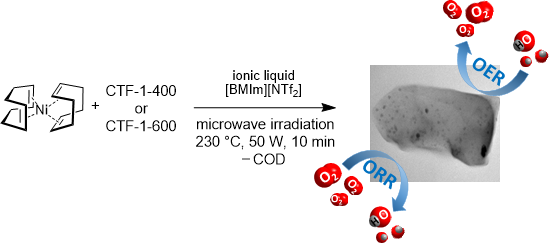
- the oxygen reduction reaction (ORR) are two crucial processes, which require improvements through the design of efficient catalysts. Both OER and ORR suffer from slow kinetics of the four-electron transfer process [2][3]. Thus, highly efficient electrocatalysts with enhanced performance need to be


Effect of Ag loading position on the photocatalytic performance of TiO2 nanocolumn arrays
Beilstein J. Nanotechnol. 2020, 11, 717–728, doi:10.3762/bjnano.11.59
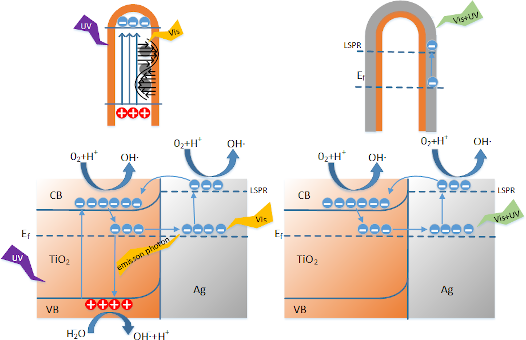
- affords specimens with different electron transfer characteristics than those of rutile and anatase TiO2, and the as-prepared films fit the template well. When Ag particles are combined with TiO2, the photocatalytic performance of the film can be significantly enhanced by hot electron injection [24


Synthesis and enhanced photocatalytic performance of 0D/2D CuO/tourmaline composite photocatalysts
Beilstein J. Nanotechnol. 2020, 11, 407–416, doi:10.3762/bjnano.11.31
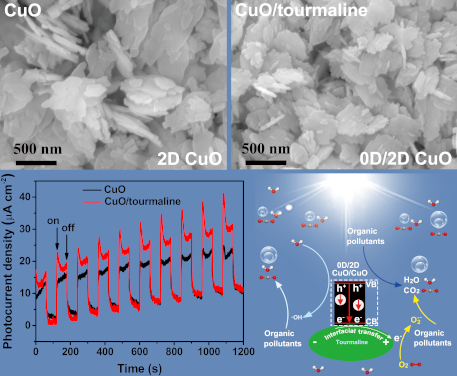
- with reference to pristine CuO (3.24 ns) (Table 1). This result indicated that an additional nonradiative decay pathway may be opened through the electron transfer from CuO to tourmaline [35]. The above analyses confirmed the role of tourmaline in suppressing the recombination of photoinduced charge


Nonequilibrium Kondo effect in a graphene-coupled quantum dot in the presence of a magnetic field
Beilstein J. Nanotechnol. 2020, 11, 225–239, doi:10.3762/bjnano.11.17

- potential. This electron transfer determines a finite relaxation time τσ, that can be calculated using second-order perturbation theory [12][13]. It can be intuitively introduced by substituting δ in the self-energies Σiσ(ω) with [31][34]. By considering a small value for e.g., = δ ≈ 10−7 [31], the


Mobility of charge carriers in self-assembled monolayers
Beilstein J. Nanotechnol. 2019, 10, 2449–2458, doi:10.3762/bjnano.10.235
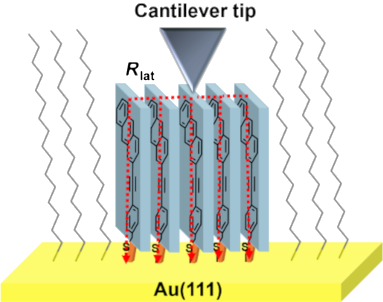
- stability resulting from the formation of a strong S–Au bond grafting the thiolates to the substrate. In selected cases, very high structural quality has been reported, with ordered domains in the size range of several 100 nm [11]. Previous research into the electron transfer within SAMs focused on the


Polyvinylpyrrolidone as additive for perovskite solar cells with water and isopropanol as solvents
Beilstein J. Nanotechnol. 2019, 10, 2374–2382, doi:10.3762/bjnano.10.228

- cm2. All samples were measured in air (25 °C). Results and Discussion Figure 1 illustrates how the PSCs were prepared. The PSCs of this study comprises a SnO2 electron transfer layer (ETL), a MAPbI3 coating, a Spiro-OMeTAD HTL as well as a gold electrode. In a first step, the perovskite layer was
- -Fermi level in the contacted perovskite and electron transfer material, but also by the defect-induced recombination in the electron transport channels [33]. It is clear that perovskite solar cells using a PVP-containing aqueous lead nitrate precursor solution will lead to an increase in Voc. The Voc of




Mannosylated brush copolymers based on poly(ethylene glycol) and poly(ε-caprolactone) as multivalent lectin-binding nanomaterials
Beilstein J. Nanotechnol. 2019, 10, 2192–2206, doi:10.3762/bjnano.10.212
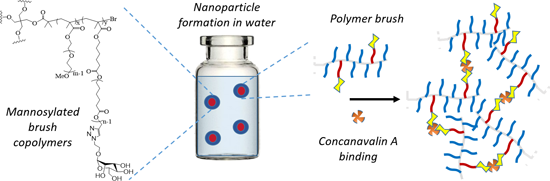
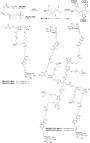
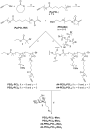
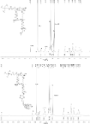
- functionality can influence the macromolecule bioactivity [8]. Controlled radical polymerization (CRP) techniques, such as atom transfer radical polymerization (ATRP), reversible addition fragmentation chain transfer (RAFT) polymerization, single-electron transfer living radical polymerization (SET-LRP) and



Improved adsorption and degradation performance by S-doping of (001)-TiO2
Beilstein J. Nanotechnol. 2019, 10, 2116–2127, doi:10.3762/bjnano.10.206

- the differently exposed crystal faces have different atomic and electronic structures and surface energy. This results in differences in the adsorption capacity regarding pollutant molecules and in the electron transfer properties of TiO2 [8][9]. It is widely believed that the exposed (001) face has a




TiO2/GO-coated functional separator to suppress polysulfide migration in lithium–sulfur batteries
Beilstein J. Nanotechnol. 2019, 10, 1726–1736, doi:10.3762/bjnano.10.168

- . The excellent adhesion between TiO2 nanoparticles and GO sheets resulted in enhanced conductivity, which is highly desirable for an efficient electron transfer process. The Li/S battery with a TiO2/GO-coated separator exhibited a high initial discharge capacity of 1102.8 mAh g−1 and a 100th cycle
- and GO sheets exhibit excellent adhesion, which ensures efficient electron transfer from the GO sheet to nanoporous TiO2. The use of TiO2/GO composites as an interlayer can greatly suppress the migration of polysulfides due to their physical and chemical interactions with dissolved polysulfides


Kelvin probe force microscopy work function characterization of transition metal oxide crystals under ongoing reduction and oxidation
Beilstein J. Nanotechnol. 2019, 10, 1596–1607, doi:10.3762/bjnano.10.155
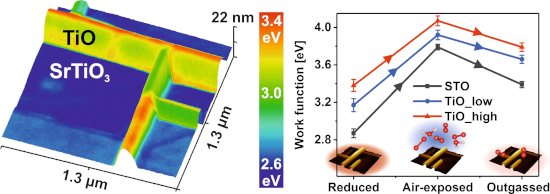
- superior for many cases in both fundamental research and applications, such as the identification of adsorption geometries of molecules on oxide surfaces [7], probing energetics of electron transfer within single molecules [8] and operation of prototypical electronic devices, such as perovskite solar cells


Materials nanoarchitectonics at two-dimensional liquid interfaces
Beilstein J. Nanotechnol. 2019, 10, 1559–1587, doi:10.3762/bjnano.10.153
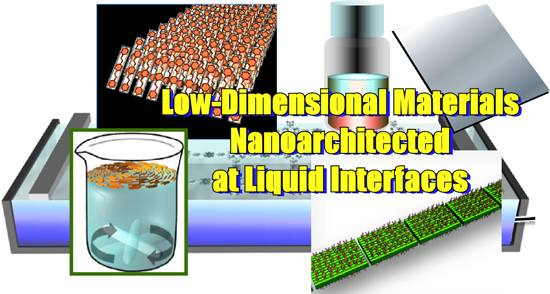
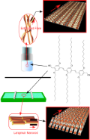
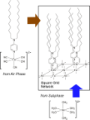
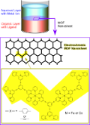
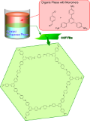
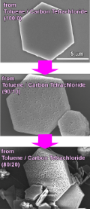
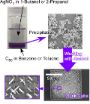
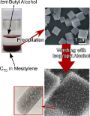
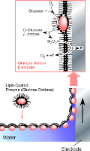
- structural characteristics of those without intercalator compounds were preserved in the presence of naphthalene. In addition, intercalation of the polycyclic molecules significantly modified the spectral emissions of the fullerene assemblies probably due to effects of molecular packing on the electron
- transfer within the assembled structures. Acharya, Shrestha, and co-workers decorated one-dimensional C60 nanorods with zero-dimensional Ag nanoparticles that were used as substrates for surface-enhanced Raman scattering (SERS) to detect model targets such as rhodamine 6G with high sensitivity [246]. This













High-temperature resistive gas sensors based on ZnO/SiC nanocomposites
Beilstein J. Nanotechnol. 2019, 10, 1537–1547, doi:10.3762/bjnano.10.151
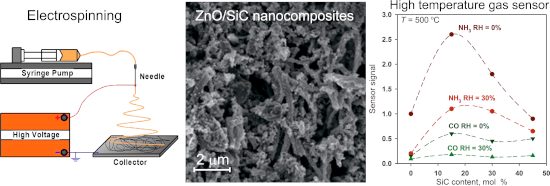
- interpreted in the context of the assumption of the formation of an n–n heterojunction at the ZnO/SiC interface, resulting in electron transfer from SiC to ZnO. The increase in the concentration of electrons in the near-surface layer of ZnO leads to an increase in the concentration of chemisorbed oxygen on





Synthesis of P- and N-doped carbon catalysts for the oxygen reduction reaction via controlled phosphoric acid treatment of folic acid
Beilstein J. Nanotechnol. 2019, 10, 1497–1510, doi:10.3762/bjnano.10.148

- ]. Strelko et al. used theoretical methods to establish an interesting relationship between the bandgap energy of a given catalyst and its ability to promote reactions involving electron transfer [21]. Moreover, P-doping of graphitic layers was revealed to have an effect similar to that of N-doping and hence
- of P2 and P3 species, i.e., by the contents of P atoms directly bonded to one or two carbon atoms as shown in Figure 9. Previously, the enhanced ORR activity of PN-doped carbon materials was ascribed to an increase of asymmetric spin density [24][25][39], electron transfer from N or P to C [36
- relationship between the work function of cathode catalysts and their ORR activity demonstrated that the former parameter strongly influences the latter and affects electron transfer in elementary reaction steps. As the Fermi level is the highest-energy electronic level of a given solid, the ORR reaction





Hierarchically structured 3D carbon nanotube electrodes for electrocatalytic applications
Beilstein J. Nanotechnol. 2019, 10, 1475–1487, doi:10.3762/bjnano.10.146

- series resistance to promote electron transfer. CNT–CNT composites have been successfully employed as catalyst supports. Kundu et al. reported that Pt supported on such hierarchical structures showed enhanced surface atomic concentration, indicating an improved Pt dispersion. The oxygen reduction
- . Additionally, the Fe nanoparticles seem to prefer to nucleate on cross junctions between primary CNTs, as observed from Figure S3a, which could be caused by improvement of electron transfer or preferential nucleation sites. The growth of secondary CNTs using the same optimized gas mixture as above and a gas
- transfer resistance with respect to the primary CNTs as determined by electrochemical impedance spectroscopy. Thus, we speculate that the improvement in Pt dispersion is due to a better conductivity within the 3D network and a facilitated electron transfer, which may facilitate Pt nucleation at the CNT