

Search results
Search for "scanning transmission electron microscopy" in Full Text gives 85 result(s) in Beilstein Journal of Nanotechnology.
Self-organization of mesoscopic silver wires by electrochemical deposition
Beilstein J. Nanotechnol. 2014, 5, 1285–1290, doi:10.3762/bjnano.5.142

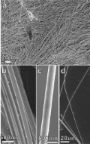
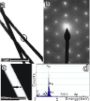
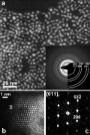
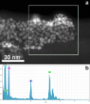
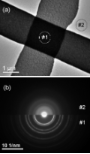
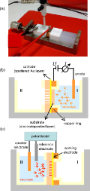
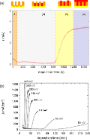
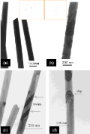
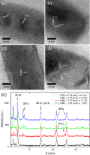
- profile equipment. Transmission electron microscopy (TEM) investigations were performed with a Philips Tecnai F20 ST system operated at 200 kV. EDX analyses were carried out in STEM (scanning transmission electron microscopy) mode in order to measure nanometer-scale samples (1 nm spot size for the EDX



Purification of ethanol for highly sensitive self-assembly experiments
Beilstein J. Nanotechnol. 2014, 5, 1254–1260, doi:10.3762/bjnano.5.139

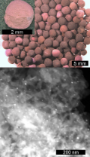
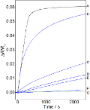
- , zeolite, to facilitate the handling and to suppress coagulation. These hybrid systems were characterized using (scanning) transmission electron microscopy (TEM/STEM) and energy-dispersive X-ray (EDX) spectroscopy. The cleaning capacity of the immobilized NPs and their recyclability depending on the
- . Afterwards they were sprayed onto carbon-coated copper grids using a modified UIS250v Hielscher sonifier [44]. Measurements were carried out with a FEI TECNAI F30 S-TWIN microscope working at 300 kV. Scanning transmission electron microscopy (STEM) images were acquired with a scanning unit by a FISCHIONE

Surface processes during purification of InP quantum dots
Beilstein J. Nanotechnol. 2014, 5, 1220–1225, doi:10.3762/bjnano.5.135

- D/MAX 2500 diffractometer using Cu Kα radiation (λ = 1.540598 Å). Transmission electron microscopy (TEM) was performed on a LEO912 AB OMEGA microscope. High-angle annular dark field scanning transmission electron microscopy (HAADF-STEM) imaging and energy-dispersive X-ray (EDX) analysis have been



Design criteria for stable Pt/C fuel cell catalysts
Beilstein J. Nanotechnol. 2014, 5, 44–67, doi:10.3762/bjnano.5.5
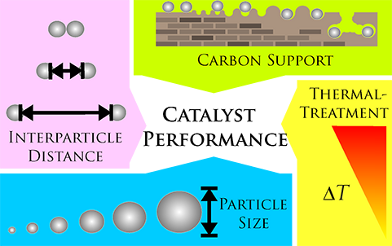
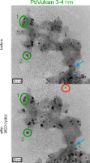
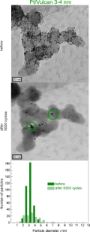
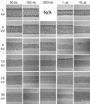
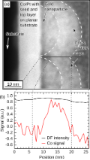
- investigation discloses also the platinum nanoparticles inside and on the back side of the porous network. Figure 5 shows dark field scanning transmission electron microscopy (DF-STEM) images for all three materials at the same locations as in Figure 4, before (top) and after (middle) the above described






The role of electron-stimulated desorption in focused electron beam induced deposition
Beilstein J. Nanotechnol. 2013, 4, 474–480, doi:10.3762/bjnano.4.56

- desorption. Keywords: desorption energy; focused electron beam induced processing; scanning transmission electron microscopy; temperature dependence; tungsten hexacarbonyl; Introduction When the electron beam in an electron microscope is focused on a sample in the presence of a precursor gas, it can be


Characterization of electroforming-free titanium dioxide memristors
Beilstein J. Nanotechnol. 2013, 4, 467–473, doi:10.3762/bjnano.4.55
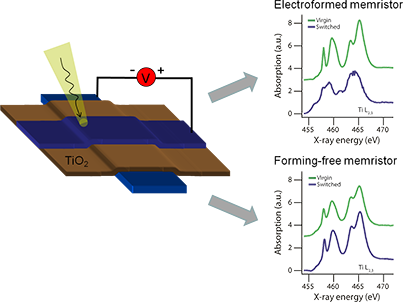
- . Scanning transmission electron microscopy (STEM) was also used to explore the forming-free device from a structural and morphological standpoint. Figure 5 depicts STEM images obtained from bright-field (BF) detection. BF imaging was utilized rather than HAADF detection due to the latter having an image



Low-dose patterning of platinum nanoclusters on carbon nanotubes by focused-electron-beam-induced deposition as studied by TEM
Beilstein J. Nanotechnol. 2013, 4, 77–86, doi:10.3762/bjnano.4.9

- [24][25][26][27]. The ability of FEBID to write ultrasmall nanostructures has been demonstrated by using scanning transmission electron microscopy (STEM) with an electron probe of 0.2 nm operated at 200 kV [28][29]. By using scanning electron microscopy (SEM)-assisted FEBID, Co nanowires of lateral
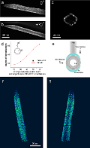
- dark-field scanning transmission electron microscopy (HAADF-STEM) is used to study the morphology and distribution of the nanoclusters deposited by using different electron beam parameters. Although the as-deposited nanoclusters are composed of Pt and amorphous carbon, it is demonstrated that the
- the morphology and distribution of the nanostructures in 3D, high-angle annular dark-field scanning transmission electron microscopy (HAADF-STEM) tilt series of the as-deposited CNTs are acquired. The tilt series have an angular range of ±70° with projections taken every 2°, and the tilt axis is set



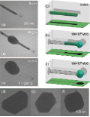
Characterization and properties of micro- and nanowires of controlled size, composition, and geometry fabricated by electrodeposition and ion-track technology
Beilstein J. Nanotechnol. 2012, 3, 860–883, doi:10.3762/bjnano.3.97








Tuning the properties of magnetic thin films by interaction with periodic nanostructures
Beilstein J. Nanotechnol. 2012, 3, 831–842, doi:10.3762/bjnano.3.93

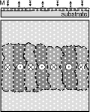
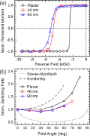
- commercially available Au nanoparticles as described above. The structure of the magnetic multilayer on the nanoparticles strongly influences its magnetic properties. By means of SEM and cross-sectional scanning transmission electron microscopy (STEM) investigations, it was found that, independent of the


The morphology of silver nanoparticles prepared by enzyme-induced reduction
Beilstein J. Nanotechnol. 2012, 3, 404–414, doi:10.3762/bjnano.3.47
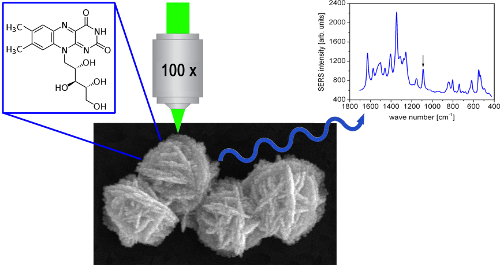
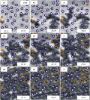
- vertical direction. Structural investigations of the silver EGNP A more detailed picture of the shape of the single silver nanoparticles was obtained by means of scanning transmission electron microscopy on thinned cross sections. With the help of high-resolution images the crystal structure of the