Search results
Search for "roughness" in Full Text gives 481 result(s) in Beilstein Journal of Nanotechnology. Showing first 200.
9.1% efficient zinc oxide/silicon solar cells on a 50 μm thick Si absorber
Beilstein J. Nanotechnol. 2021, 12, 766–774, doi:10.3762/bjnano.12.60
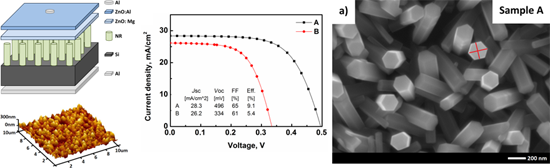
- the tested PV cells, as measured with atomic force microscopy (AFM). The results for the photovoltaic cell modified with zinc oxide nanorods are shown in Figure 4a and Figure 4c. The results for the planar cell are shown in Figure 4b and Figure 4d. There are significant differences in the roughness
- to a non-uniform surface morphology, as intended by us. The average root mean square (RMS) roughness of sample A equals 60 nm. As a result, light reflection is reduced for the cell. This effect was published previously [14] for PV structures prepared on a thicker Si absorber. This feature enhances
- the light-trapping effect. The impact of light-trapping on the operation of solar cells is presented by means of current–voltage curves. In contrast, sample B showed a flat surface morphology. The average RMS roughness value was 9 nm. Therefore, interference peaks in external quantum efficiency (EQE


Physical constraints lead to parallel evolution of micro- and nanostructures of animal adhesive pads: a review
Beilstein J. Nanotechnol. 2021, 12, 725–743, doi:10.3762/bjnano.12.57
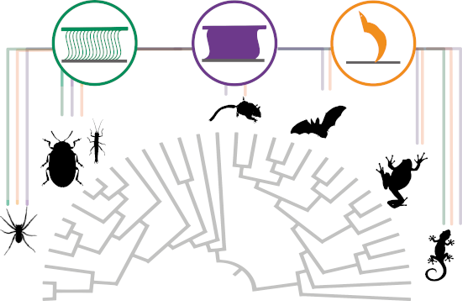
- morphology of attachment devices is affected by physical constraints. This resulted in two main types of attachment devices in animals: hairy and smooth. They differ in morphology and ultrastructure but achieve mechanical adaptation to substrates with different roughness and maximise the actual contact area
- influence of different factors, such as substrate roughness and pad stiffness, on contact forces, and review the chemical composition of pad fluids, which is an important component of an adhesive function. Attachment systems are omnipresent in animals. We show parallel evolution of attachment structures on
- contact with a wide range of microscopically rough substrate profiles (Figure 2). Also, due to the low bending stiffness of their terminal plates, can even adapt to substrates with roughness on a sub-nanometre scale [1][3][4][34]. Smooth pads can also maximise their contact areas with a variety of


Electromigration-induced formation of percolating adsorbate islands during condensation from the gaseous phase: a computational study
Beilstein J. Nanotechnol. 2021, 12, 694–703, doi:10.3762/bjnano.12.55

- [42], control of surface roughness [43] and morphology of islands or nanowires [26][44][45][46][47], as well as control of adsorbate transfer to graphene [48]. Thus, the effects of EM induced by the presence of a potential difference on opposite sides of the substrate can significantly affect the


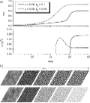


![[Graphic 29]](/bjnano/content/inline/2190-4286-12-55-i36.svg?max-width=637&scale=1.18182) on the adsorption coefficient α ...
on the adsorption coefficient α ...

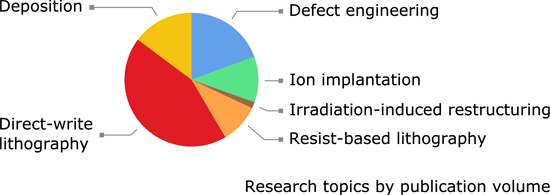
A review of defect engineering, ion implantation, and nanofabrication using the helium ion microscope
Beilstein J. Nanotechnol. 2021, 12, 633–664, doi:10.3762/bjnano.12.52


High-yield synthesis of silver nanowires for transparent conducting PET films
Beilstein J. Nanotechnol. 2021, 12, 624–632, doi:10.3762/bjnano.12.51

- nanowire interactions. Also, the aligned assembly may not only yield reduced PET film roughness and resistance but also improved transmissivity. Here, AgNWs with lengths and diameters of 3.3–4.7 µm and 75–97 nm, respectively, have been formed in the reaction. The AgNWs with larger diameters yield lower
- free from impurities, that is, silver nanoparticles. No other nanostructures could affect the optical and conduction properties, or the roughness of the film. A silver nanowire ink formulated by adding HEC to an aqueous solution of silver nanowires, was then loaded onto the surface of PET films by


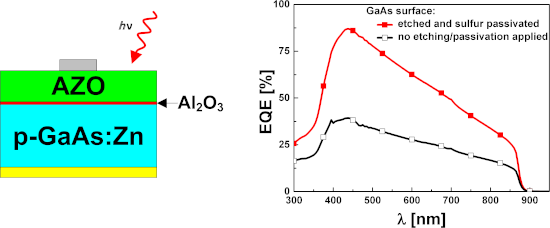
Impact of GaAs(100) surface preparation on EQE of AZO/Al2O3/p-GaAs photovoltaic structures
Beilstein J. Nanotechnol. 2021, 12, 578–592, doi:10.3762/bjnano.12.48
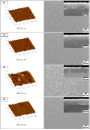
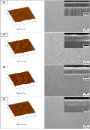
- B series, respectively. From the AFM results shown in Figure 3 and Figure 4, one can see that A1, A2, A4, B1, and B4 samples exhibit uniform surfaces by the means of polycrystalline thin film topography. By taking into consideration the roughness of the surfaces (RMS was measured for an area of 4
- μm2 for every sample), the lowest RMS values are observed in A4 and B4 samples: 2.05 and 1.96 nm, respectively (those samples were treated with the ammonia aqueous solution during stage 3). Conversely, the highest roughness is observed in samples in which the HCl solution was applied (also during
- stage 3). For A3 and B3 samples we report RMS values of 4.54 and 4.55 nm, respectively. Also, A1 and A2 samples show relatively low roughness, which is likely related to the passivation of the surface with the ammonium sulphide aqueous solution. These values are lower than that of the B1 and B2 samples




Properties of graphene deposited on GaN nanowires: influence of nanowire roughness, self-induced nanogating and defects
Beilstein J. Nanotechnol. 2021, 12, 566–577, doi:10.3762/bjnano.12.47
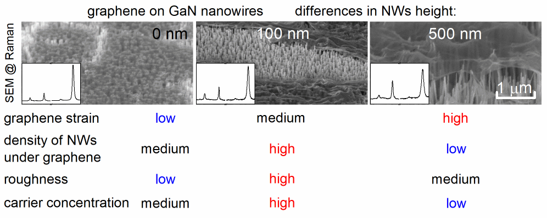
- nanowires impact graphene properties such as roughness, strain, and carrier concentration as well as density and type of induced defects. Tracing the manifestation of those interactions is important for the application of novel heterostructures. A detailed analysis of Raman spectra of graphene deposited on




Interface interaction of transition metal phthalocyanines with strontium titanate (100)
Beilstein J. Nanotechnol. 2021, 12, 485–496, doi:10.3762/bjnano.12.39
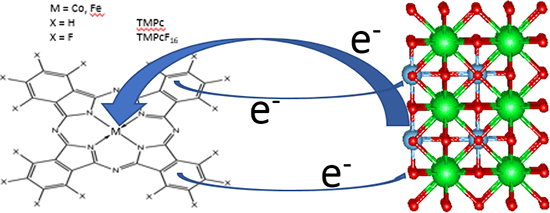
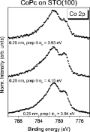
- termination; but slightly different preparation conditions may affect also the surface morphology and roughness. Notably, for all three preparations the intensity of the interface component is in the range between 40% and 60%. That is, only for about the half of the molecules an interaction between the Co ion


The patterning toolbox FIB-o-mat: Exploiting the full potential of focused helium ions for nanofabrication
Beilstein J. Nanotechnol. 2021, 12, 304–318, doi:10.3762/bjnano.12.25

- roughness may be minimized by removing the material with only few cycles. For standard geometries, both of these optimization problems are already targeted with the high-level approach and the pre-defined raster strategies [17]. However, only the low-level approach enables these strategies for arbitrary
- -crystalline gold constitute an ideal platform for plasmonic applications due to the lack of scattering losses at grain boundaries and surface roughness [56]. In nanostructured gold, collective excitations of the free electron gas may occur under the incidence of visible light [2]. These plasmon polaritons of
- round. Each monomer acts as a small dipole in our measurement configuration and its response is not very sensitive to its actual shape as long as surface roughness does not increase the scattering losses. Finite-difference time-domain modeling taking into account the slightly varying geometries led to


The nanomorphology of cell surfaces of adhered osteoblasts
Beilstein J. Nanotechnol. 2021, 12, 242–256, doi:10.3762/bjnano.12.20

- apical plasma membrane surface. Several other morphological and dynamic parameters are evaluated, for example, cell edge heights, membrane surface roughness, and membrane fluctuations, and discussed with respect to cellular functions. Results and Discussion In Figure 1 we show a typical overview SICM
- , serve to enhance the exchange of substances with the extracellular medium (through absorption and secretion) while filopodia are used to explore the environment of an adhering cell on a surface, especially if it exhibits some roughness or edges. Occasionally, we observed depression or hole features in
- fiber network. Largely featureless regions, free of ruffles and other membrane structures, are scarce; they show waviness on the mesoscopic scale and a 2D-rms roughness value of 17 nm on the nanoscopic scale, as illustrated in Figure 7b. We find it noteworthy that hardly any filopodia were formed at


Determination of elastic moduli of elastic–plastic microspherical materials using nanoindentation simulation without mechanical polishing
Beilstein J. Nanotechnol. 2021, 12, 213–221, doi:10.3762/bjnano.12.17

- specimen is assumed to be a perfectly flat surface, thus ignoring the influences of surface roughness that might be encountered in experiment. For nanoindentation measurements, a flat surface is fabricated from curved specimens by mechanical polishing. However, the position of the polished curved surface
- influences of surface roughness that might be encountered in experiment. For nanoindentation measurements, a flat surface is fabricated from curved specimens by mechanical polishing. However, the position of the polished curved surface cannot be controlled [13]. Small-scale microplastics with curved


Paper-based triboelectric nanogenerators and their applications: a review
Beilstein J. Nanotechnol. 2021, 12, 151–171, doi:10.3762/bjnano.12.12
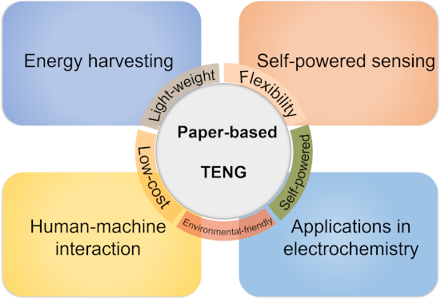
- . Paper and other fiber-based materials are integral components of many objects that are used on a regular basis by the population, which are also available in different compositions, thickness and surface roughness. Most importantly, paper is biocompatible, biodegradable, and environmentally friendly
- (i.e., electronegative). Furthermore, due to the high roughness and porous nanofiber structure it can lead to enhanced TENG output performances owing to improved charge-trapping abilities. Based on the above advantages and conveniences, paper-based TENGs (P-TENGs) have exhibited great potential for






Molecular dynamics modeling of the influence forming process parameters on the structure and morphology of a superconducting spin valve
Beilstein J. Nanotechnol. 2020, 11, 1776–1788, doi:10.3762/bjnano.11.160
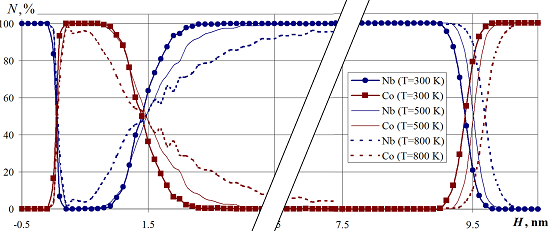
- structural quality of superconducting niobium layers, for example, with a thickness comparable to the coherence length of approximately <10 nm, is worse than that of thicker films, and the destructive effect of the interface roughness also suppresses the manifestation of interference effects in ultrathin


Mapping of integrated PIN diodes with a 3D architecture by scanning microwave impedance microscopy and dynamic spectroscopy
Beilstein J. Nanotechnol. 2020, 11, 1764–1775, doi:10.3762/bjnano.11.159

- BEOL steps were accomplished. The SPM electrical measurements were performed in the cross section of the chip at the wafer level. In order to enable a stable and constant nanoscale contact between the sensor tip and the sample, a surface with a low roughness is required. For this purpose, the sample
- was hand-polished down to a roughness of a few nanometres with diamond-based lapping films with decreasing granularity. In the following section, the local electrical properties of all layers in the cross section of the PIN diode are analysed. In order to evaluate the impact of the applied VDC bias
- ) have a slightly different polishing rate, which results in the observed topography. In the AFM topography image, one can localize the two deep trench isolation structures in the silicon wafer, as well as the anode and cathode contacts. It is important to note that a low roughness is required for a


Application of contact-resonance AFM methods to polymer samples
Beilstein J. Nanotechnol. 2020, 11, 1714–1727, doi:10.3762/bjnano.11.154

- modes including scanning under continuous contact wear and damage the sample and/or alter the surface roughness, the results of point CR measurements on bulk and thin films are presented. Though Young’s moduli of bulk polystyrene and poly(methyl methacrylate) could be determined through the presented
- such results must still be confirmed by further studies, it is evident that ripples change the roughness of the sample, the geometry of the contacting surfaces and, hence, the contact area, which plays a crucial role in the characterization of mechanical properties. Even when ripples are not formed and
- the static load is not high enough to induce a uniform depression, abrasion and plastic deformation can lead to the formation of disordered agglomerates of polymer chains, severely changing the roughness of the surface. Since these wear phenomena are due to the lateral movement of the tip, a second
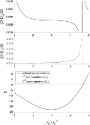


Seebeck coefficient of silicon nanowire forests doped by thermal diffusion
Beilstein J. Nanotechnol. 2020, 11, 1707–1713, doi:10.3762/bjnano.11.153

- require an oxidation of the surface for the trapping of the doping species. However, the reduction of the thermal conductivity, which is the aim of the nanoscale structuring, relies on the roughness of the nanowire surfaces, and the smoothing produced by the oxide growth would heavily reduce this effect
- applications, we cannot afford an oxidization process, because it would smooth the surfaces. The reduction of the thermal conductivity, which is essential for good thermoelectric features, relies on the roughness of the surfaces, which would be compromised by an oxidation step. Hence, the best solution is to


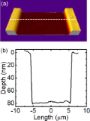
Out-of-plane surface patterning by subsurface processing of polymer substrates with focused ion beams
Beilstein J. Nanotechnol. 2020, 11, 1693–1703, doi:10.3762/bjnano.11.151

- cm−2, the values of the root-mean-square (RMS) roughness, measured with AFM in the irradiated areas, were approx. 0.7 and 4.4 nm for irradiation with He+ and Ga+ ions, respectively. The RMS roughness value of the pristine sample was approx. 0.6 nm. The irradiation with Ne+ ions also significantly
- roughens the surface and sputters away the metal film. The RMS roughness was approx. 3.1 nm after the irradiation with Ne+ FIB at a fluence of 2.0 × 1015 cm−2. The sputtering efficiency of Ga+ and Ne+ ions is substantially higher than that of He+ ions [3] due to the significantly higher mass values of Ne


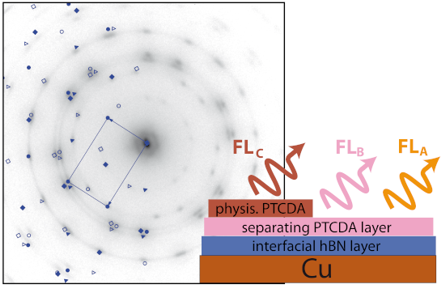
The influence of an interfacial hBN layer on the fluorescence of an organic molecule
Beilstein J. Nanotechnol. 2020, 11, 1663–1684, doi:10.3762/bjnano.11.149
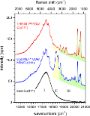
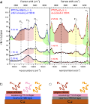
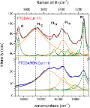
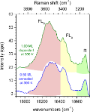
- (varying by a factor of up to ca. 7). This indicates that the specific local surface quality, for example, the surface roughness at the spot where the Raman scattering occurred, influences the intensity of the Raman modes. Hence, we cannot draw quantitative conclusions here. Nevertheless, we gain some
- effect as a function of the roughness on a surface [48]. They found that on an inhomogeneously rough surface, the Raman spectrum is dominated by the enhanced signals from molecules located at features that exhibit a maximum in roughness. We can support this interpretation by results from a previous
- morphology on a micrometer scale [60]. We propose that the defect-rich regions exhibit a large step density due to impurities and/or grain boundaries. Consequently, we assume that the hot spots are related to an inhomogeneous mesoscopic roughness of the Cu(111) surface, which is remnant after sputtering and





Fabrication of nano/microstructures for SERS substrates using an electrochemical method
Beilstein J. Nanotechnol. 2020, 11, 1568–1576, doi:10.3762/bjnano.11.139

- mechanical stirring cooling system. To study the influence of surface conditions (e.g., porosity and roughness) on the SERS intensity, the duration of the PEO treatment was set as the single variable (1, 2, and 5 min), as shown in Table 1. The structured Mg surfaces were coated with Au of varying thickness
- nanopores. Results and Discussion Fabrication of arrayed nanopores on the Mg surface Surface roughness and chemical composition have a strong influence on the intensity of Raman signals. PEO was employed to fabricate a porous oxide layer on a Mg alloy surface, which benefits from the increase of surface
- roughness and shows the potential for storing micro- or nanoparticles. During PEO treatment, the intrinsic passivation layer of the Mg alloy is disrupted in random positions through local melting during electrical breakdowns. After cooling by the electrolyte, a stable oxide layer containing arrayed pores is


Wafer-level integration of self-aligned high aspect ratio silicon 3D structures using the MACE method with Au, Pd, Pt, Cu, and Ir
Beilstein J. Nanotechnol. 2020, 11, 1439–1449, doi:10.3762/bjnano.11.128
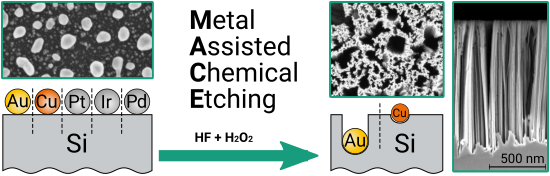
- catalytic metal that supports the wet etching of silicon. However, copper dissolves in the harsh HF/H2O2 solution too fast for the etching of high aspect ratio templates. On the other side, this metal can be used to increase surface roughness. The complete dissolution of copper leaves a clean metal-free


Proximity effect in [Nb(1.5 nm)/Fe(x)]10/Nb(50 nm) superconductor/ferromagnet heterostructures
Beilstein J. Nanotechnol. 2020, 11, 1254–1263, doi:10.3762/bjnano.11.109
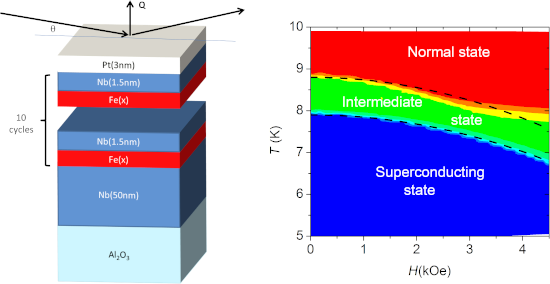
- interdiffusion does not depend strongly on the deposition temperature TSL. We fitted experimental curves to models with varying SLD, thickness, and rms roughness of all layers and varying magnetization of the Fe layer. The resulting depth profiles ρ0(z) and M(z) are shown in Figure 5b. According to our model the

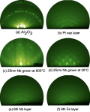
![[Graphic 13]](/bjnano/content/inline/2190-4286-11-109-i17.svg?max-width=637&scale=1.18182) ) substrate, (b) the Pt cap layer, and the Nb buffer layer grown at...
) substrate, (b) the Pt cap layer, and the Nb buffer layer grown at...
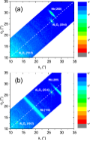


![[Graphic 16]](/bjnano/content/inline/2190-4286-11-109-i20.svg?max-width=637&scale=1.18182) (T) for the samples s4 (black) and s3 (red) in the vicinity of the superconducting transition m...
(T) for the samples s4 (black) and s3 (red) in the vicinity of the superconducting transition m...
Revealing the local crystallinity of single silicon core–shell nanowires using tip-enhanced Raman spectroscopy
Beilstein J. Nanotechnol. 2020, 11, 1147–1156, doi:10.3762/bjnano.11.99
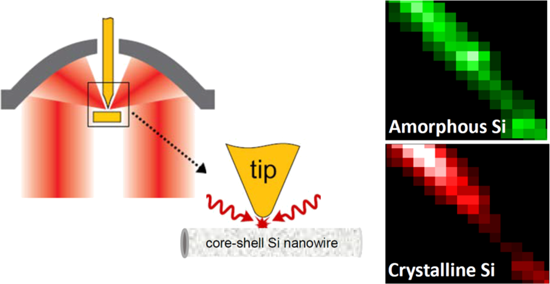
- popular method to investigate structural properties of silicon samples [16][17]. Mizoguchi et al. [18] and Hopkins et al. [19] utilized it to show the influence of stress on the crystal lattice orientation angles and to determine the degree of surface roughness. Kolb et al. measured the lattice


Atomic layer deposition for efficient oxygen evolution reaction at Pt/Ir catalyst layers
Beilstein J. Nanotechnol. 2020, 11, 952–959, doi:10.3762/bjnano.11.79
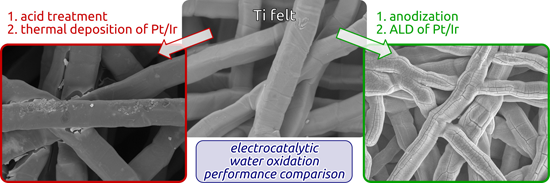
- consider here two distinct catalyst preparation methods. As a standard method used in the engineering context, we perform an acid etch of the titanium fibers (to generate surface roughness and thereby increase the specific surface area), followed by dip-coating of a noble metal salt precursor solution on
- porosities, which in the following we will call A and B) were pretreated in acid (12 M HCl at 85 °C) in order to generate surface roughness, then dip-coated with the catalyst precursor solution and dried. The dip-coating was repeated until the desired loading was achieved as determined by gravimetric methods
- etching. The surface roughness has increased, thereby increasing the specific surface area. The acid treatment also generates a homogeneously thin and stable TiO2 layer, which provides corrosion resistance while maintaining low transfer coefficients [24]. After coating with the catalyst layer (Figure 1c


A 3D-polyphenylalanine network inside porous alumina: Synthesis and characterization of an inorganic–organic composite membrane
Beilstein J. Nanotechnol. 2020, 11, 938–951, doi:10.3762/bjnano.11.78
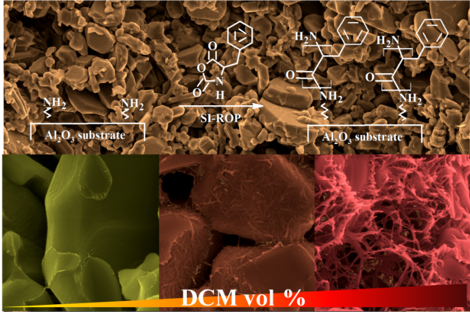
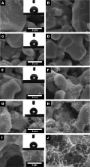
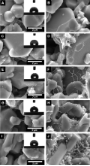
- temperature for 24 hours. SEM characterization and contact angle measurements of pPA-functionalized ALOX-membranes The analysis of the SEM results shows a significant change of morphology of the grafted polymer films (see Figure 4) due to the use of different solvent mixtures. The observed surface roughness
- roughness of the outer surface [52][53][54]. where θ is the Young contact angle on smooth surfaces, rf is the roughness ratio, which is defined by the ratio of the true surface area and the apparent surface area of the solid–liquid interface, and f is the fraction of the projected area of the solid that is
- wetted by the liquid. Equation 1 shows that the Young contact angle on smooth and hydrophobic surfaces (θ > 90°) is further increased by increasing the surface roughness ratio rf. If the fraction of the projected area of the outer surface (which is wetted by the water droplet) becomes about 100% (f = 1




Band tail state related photoluminescence and photoresponse of ZnMgO solid solution nanostructured films
Beilstein J. Nanotechnol. 2020, 11, 899–910, doi:10.3762/bjnano.11.75
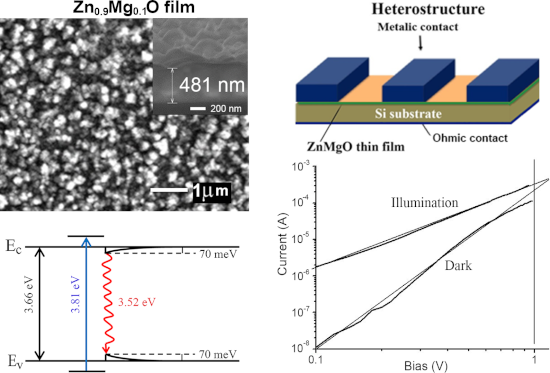
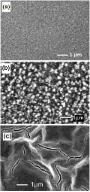
- . Results and Discussion Figure 1a compares the morphology of ZnMgO films deposited by spin coating and aerosol spray pyrolysis methods. Both methods produce thin films with uniform morphology. However, the roughness of films prepared by spin coating is larger as compared to those prepared by aerosol spray
- pyrolysis. The roughness parameters of films were determined from the analysis of AFM images as published in our previous paper [28]. Graphical representations of the AFM profiles for films prepared by spin coating and aerosol spray pyrolysis are presented in Figure 1b. The RMS values deduced from the AFM
- °C with the morphology of the film prepared by spin coating annealed at 650 °C. The analysis of the morphology in Figure 2a and Figure 2b corroborate the results of the AFM analysis revealing a larger roughness of films prepared by spin coating as compared to those prepared by aerosol spray pyrolysis