


Search results
Search for "trajectory" in Full Text gives 107 result(s) in Beilstein Journal of Nanotechnology.
Analysis of fluid flow around a beating artificial cilium
Beilstein J. Nanotechnol. 2012, 3, 163–171, doi:10.3762/bjnano.3.16

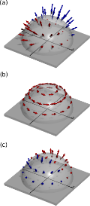
- height z above the surface, to which the cilium was attached. In order to observe the generated fluid flow, nonmagnetic tracer particles were introduced into the system and their motion was recorded. A typical trajectory of a tracer particle is shown in Figure 2a. The cilium was attached to the surface
- . The colours of the arrows specify the velocity amplitude. The second component of the trajectory is a translation in the −y direction that follows the generated directed fluid flow. Since only one cilium was used in the experiment, the translational flow is not straight but has an additional
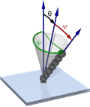
- experiment. Analytical calculation of the average flow velocity A very basic approach to modelling the flows around a beating cilium, regardless of its precise beat pattern, consists of replacing the cilium with a small hypothetical particle circling along a tilted elliptical trajectory [19]. We have shown



Current-induced forces in mesoscopic systems: A scattering-matrix approach
Beilstein J. Nanotechnol. 2012, 3, 144–162, doi:10.3762/bjnano.3.15

- ) expectation value , evaluated for a given trajectory X(t) of the mechanical degrees of freedom, plus fluctuations containing both Johnson–Nyquist and shot noise. These fluctuations give rise to a Langevin force ξν. Hence Equation 7 becomes where the trace “tr” is taken over the dot levels, and we have
- current-induced forces show that we need to evaluate the electronic Green’s function for a given classical trajectory X(t). In doing so, we can exploit the assumption that the mechanical degrees of freedom are slow compared to the electrons. Thus, we can approximate the Green’s function by its solution to
- drive the system into a limit cycle by varying the bias potential. The existence of this limit cycle is shown in Figure 8a, where we have plotted various Poincaré sections of the nonlinear system without fluctuations. The figure shows the trajectory in phase space of the (dimensionless) oscillator

![[Graphic 55]](/bjnano/content/inline/2190-4286-3-15-i141.png?max-width=637&scale=1.18182) can be tuned by the bias voltage. We consider...
can be tuned by the bias voltage. We consider...


Parallel- and serial-contact electrochemical metallization of monolayer nanopatterns: A versatile synthetic tool en route to bottom-up assembly of electric nanocircuits
Beilstein J. Nanotechnol. 2012, 3, 134–143, doi:10.3762/bjnano.3.14

- silver-film stamp (Ag/OTS/Si), whereas precise delivery of metal to selected surface sites within selected OTSeo features of such a monolayer nanopattern can be realized in a serial mode, by moving a positively biased silver-coated SFM tip along a planned trajectory across the patterned area of the
- programmed to move across the surface according to a predefined trajectory, it should be possible to create more complex "pattern-within-pattern" structures by serial delivery of metal to selected surface sites within selected OTSeo template regions of a prepatterned OTS monolayer. For example, in the case


Surface induced self-organization of comb-like macromolecules
Beilstein J. Nanotechnol. 2011, 2, 569–584, doi:10.3762/bjnano.2.61

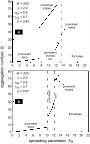
- findings make the use of the persistence length meaningless as a quantity for the description of the local bending properties. The trajectory of comblike macromolecule (semiflexible cylindrical object) also follows a power law dependence, rather than exponential [23], and thus cannot be correctly described




Functional morphology, biomechanics and biomimetic potential of stem–branch connections in Dracaena reflexa and Freycinetia insignis
Beilstein J. Nanotechnol. 2011, 2, 173–185, doi:10.3762/bjnano.2.21

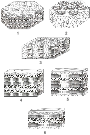
- not significantly. A possible reason for this may be the lack of anomalous secondary growth in F. insignis which is thereby restricted to develop only comparatively thin main stems and lateral branches throughout its entire ontogenetic trajectory. It can be argued that these ‘thin branchings’ in F





Manipulation of gold colloidal nanoparticles with atomic force microscopy in dynamic mode: influence of particle–substrate chemistry and morphology, and of operating conditions
Beilstein J. Nanotechnol. 2011, 2, 85–98, doi:10.3762/bjnano.2.10
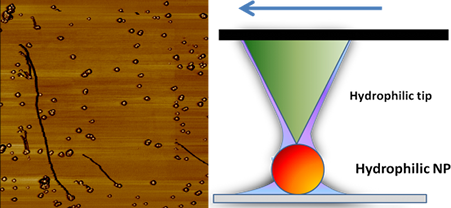
- important physical parameters. Indeed small and large particles do not undergo the same trajectory during manipulation. This size-dependence of the particle trajectory under manipulation can thus provide a way to fractionate or to separate a mixture of nano-objects. In Figure 2a and Figure 2b, we can
- fractionate and separate small from big particles adsorbed on a substrate. This size-dependence of the particle trajectory was explained by a simulation which shows that the trajectory of the particle at the same time depends on i) the operating parameter which is the scanning path used by AFM (zigzag or
- compare two consecutive trajectories of the particle before and after collision, the single Au particle (thinner line) moves at a smaller angle, as compared to the case where it meets another particle (thicker line). In this case, the variation of the trajectory can be explained by the variation of the


The description of friction of silicon MEMS with surface roughness: virtues and limitations of a stochastic Prandtl–Tomlinson model and the simulation of vibration-induced friction reduction
Beilstein J. Nanotechnol. 2010, 1, 163–171, doi:10.3762/bjnano.1.20

- loop is completed. As a last step the trajectory of the contact point is evaluated for the first part of a second loop: from the last point in the cycle to the first time it encounters the original curve again. Indeed, the starting point of the second loop is not the same as that of the first, when the


Other Beilstein-Institut Open Science Activities



