


Search results
Search for "convergence" in Full Text gives 131 result(s) in Beilstein Journal of Nanotechnology.
Deconvolution of the density of states of tip and sample through constant-current tunneling spectroscopy
Beilstein J. Nanotechnol. 2011, 2, 607–617, doi:10.3762/bjnano.2.64

- criterion available to determine a better choice. In the following examples we achieved better results, i.e., faster convergence and better accuracy, when starting with data for the smaller set current. Note also, as previously reported [7][13], that numerical errors may accumulate during the iterations




Towards a scalable and accurate quantum approach for describing vibrations of molecule–metal interfaces
Beilstein J. Nanotechnol. 2011, 2, 427–447, doi:10.3762/bjnano.2.48

- terms, two-dimensional couplings, three-dimensional couplings, etc. This expansion guarantees convergence, as a 3Na − 6 dimensional expansion describes the complete PES for a problem consisting of Na atoms in the case of an isolated molecule. Note that other representations, such as polynomial
- expansions, do not necessarily possess such well defined multi-dimensional convergence properties. For large systems, Gerber et al. [10] have shown that a truncation of the expansion to two-dimensional (2-D) couplings built on the normal modes of the system is sufficiently accurate for most applications
- sufficient for most applications, and convergence with respect to Ng is easily checked. This leads to a relatively small computational burden on the diagonalisation routines. As the potential energy is usually computed ab initio on a grid that is sparser than Ng, the 1-D PES is interpolated using a cubic


Simulation of bonding effects in HRTEM images of light element materials
Beilstein J. Nanotechnol. 2011, 2, 394–404, doi:10.3762/bjnano.2.45

- is always necessary to do convergence tests of the main parameters such as k-points and basis set size [22]. Usually the convergence is tested with respect to the total energy and the electric field gradients. This was done using ideal graphene as a test structure. Interestingly, we find that the
- 43: WIEN2k convergence tests for ideal graphene Supporting Information File 44: Program to get 3D WIEN2k potentials (Phyton script, rename to .py). Acknowledgements We gratefully acknowledge financial support by the German Research Foundation (DFG) within research project SFB 569 “Hierarchic


Effect of large mechanical stress on the magnetic properties of embedded Fe nanoparticles
Beilstein J. Nanotechnol. 2011, 2, 268–275, doi:10.3762/bjnano.2.31
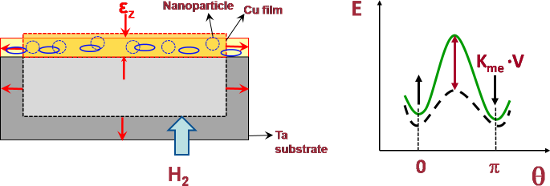
- similar behaviour before and after loading, whereas the FC curves differ for both samples. As a result, the temperature above which the FC and the ZFC curves fall together (called convergence temperature Tcon here) shifts from about Tcon= 170 K in the as-prepared state to about Tcon = 220 K after H


Structural and magnetic properties of ternary Fe1–xMnxPt nanoalloys from first principles
Beilstein J. Nanotechnol. 2011, 2, 162–172, doi:10.3762/bjnano.2.20
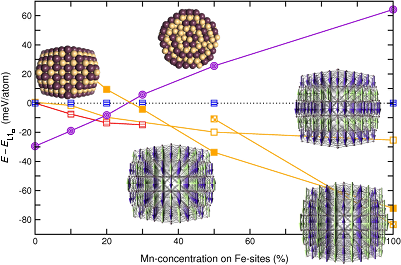
- . The structural relaxations were stopped when the energy difference between two consecutive relaxations was less than 0.1 meV, leading to a convergence of forces down to the order of 10 meV/Å. The symmetrization of wavefunctions and forces was consistently switched off in all calculations. The


On the reticular construction concept of covalent organic frameworks
Beilstein J. Nanotechnol. 2010, 1, 60–70, doi:10.3762/bjnano.1.8

- the DFTB+ code on elementary unit cells in order to validate the calculations within the Γ-point approximation. The number of k-points has been determined by reaching convergence for the total energy as a function of k-points according to the scheme proposed by Monkhorst and Pack [27]. Band structures




Other Beilstein-Institut Open Science Activities



