


Search results
Search for "band structure" in Full Text gives 158 result(s) in Beilstein Journal of Nanotechnology.
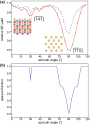
Channeling in helium ion microscopy: Mapping of crystal orientation
Beilstein J. Nanotechnol. 2012, 3, 501–506, doi:10.3762/bjnano.3.57

- specimen. A measurement of the energy of the backscattered helium atoms provides quantitative information on composition [3], and ionoluminescence gives access to electronic properties such as the band structure and the nature of color centers. Unfortunately, to date no experimental procedure has been




X-ray absorption spectroscopy by full-field X-ray microscopy of a thin graphite flake: Imaging and electronic structure via the carbon K-edge
Beilstein J. Nanotechnol. 2012, 3, 345–350, doi:10.3762/bjnano.3.39
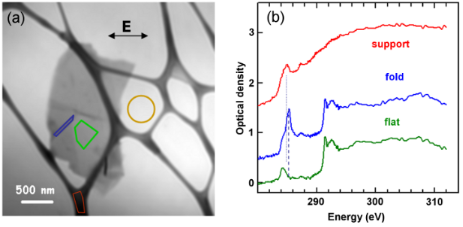
- properties of graphene in 2004 by Geim and Novoselov triggered intense interest in its electronic structure [1][2][3][4][5][6][7][8][9][10][11]. A key aspect of the electronic structure, namely understanding how the graphene band structure is altered by impurity doping introduced during the synthesis



Investigation on structural, thermal, optical and sensing properties of meta-stable hexagonal MoO3 nanocrystals of one dimensional structure
Beilstein J. Nanotechnol. 2011, 2, 585–592, doi:10.3762/bjnano.2.62

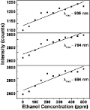
- transformation into a highly stable orthorhombic structure were confirmed by thermal studies. The optical band structure and ethanol vapor-sensing behavior were studied by means of diffuse reflectance spectroscopy (DRS) and fiber optics spectroscopy, respectively. To the best of our knowledge, this paper reports


Room temperature excitation spectroscopy of single quantum dots
Beilstein J. Nanotechnol. 2011, 2, 516–524, doi:10.3762/bjnano.2.56

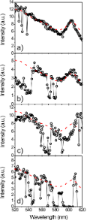
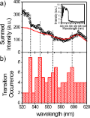
- trapped in a dark state. Clearly, these drops to the background level are not related to narrow absorbance lines due to the band structure of the semiconductor quantum dots. In this case, drops in the recorded intensity would result in excitation wavelengths for which no emission can be recorded. The

Simple theoretical analysis of the photoemission from quantum confined effective mass superlattices of optoelectronic materials
Beilstein J. Nanotechnol. 2011, 2, 339–362, doi:10.3762/bjnano.2.40
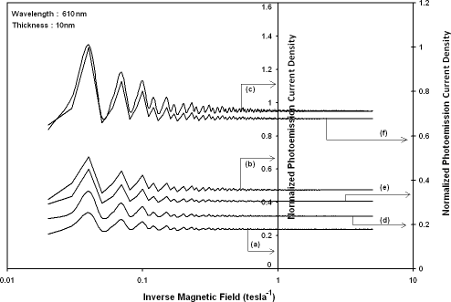
- ], IV–VI [12] and HgTe/CdTe [13] SLs have also been experimentally realized. The IV–VI SLs shows new physical properties in comparison with the III–V SL owing to the peculiar band structure of the constituent materials [14]. The II–VI SLs are being used for optoelectronic operation in the blue [14


Schottky junction/ohmic contact behavior of a nanoporous TiO2 thin film photoanode in contact with redox electrolyte solutions
Beilstein J. Nanotechnol. 2011, 2, 127–134, doi:10.3762/bjnano.2.15
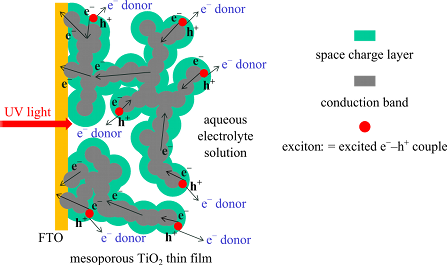
- solution) negatively charged. As the result the band structure of the SC (both the valence band (VB) and the conduction band) is bent as shown in Figure 3. This curved portion of the band structure is called a space charge layer (also called a depletion layer, where electrons are depleted). Under this
- the VB. The electron and the hole form an exciton (excited electron–hole pair), which is usually short-lived and recombines if there is no driving force to separate them. However, when the band structure is bent as in Figure 3 for an n-SC, the hole can migrate towards the SC interface, and the
- are transported first to the fluorine-doped tin oxide (FTO, SnO2:F) conductive layer through TiO2 grain boundaries and then to the cathode reducing electron acceptor there (O2 in the present case). In a Schottky junction, under the conditions when the band structure is flat without any bending, the




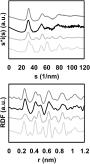
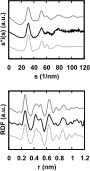
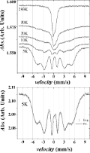
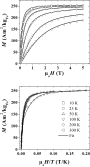
Ultrafine metallic Fe nanoparticles: synthesis, structure and magnetism
Beilstein J. Nanotechnol. 2010, 1, 108–118, doi:10.3762/bjnano.1.13

- ferromagnetic metals [1][2][3][4]. More surprisingly, the study of small Rh NPs revealed a paramagnetic to ferromagnetic phase transition induced by size reduction for clusters containing less than 40 atoms [5]. Band structure calculations have investigated the role of size reduction and demonstrated that it
- [16]. For all these systems, the structure of the clusters and the influence of the substrate, which could both modify the electronic band structure, remain uncertain. This could explain the disparities observed in the experimental results. The theoretical investigations carried out so far were
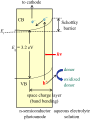
- to the atomic polytetrahedral arrangement, in particular the presence of many non-equivalent Fe sites compared to the conventional α-Fe phase. Band structure calculations on cubic Fe phases show a shell dependent magnetic moment with quite large differences between the core and the surface [7][8][9





On the reticular construction concept of covalent organic frameworks
Beilstein J. Nanotechnol. 2010, 1, 60–70, doi:10.3762/bjnano.1.8

- second code, which can perform calculations using k-points, was used to calculate the electronic properties (band structure and density of states). Band gaps have been calculated as an additional stability indicator. While these quantities are typically strongly underestimated in standard LDA- and GGA




Other Beilstein-Institut Open Science Activities



