

Search results
Search for "clusters" in Full Text gives 472 result(s) in Beilstein Journal of Nanotechnology. Showing first 200.
DFT calculations of the structure and stability of copper clusters on MoS2
Beilstein J. Nanotechnol. 2020, 11, 391–406, doi:10.3762/bjnano.11.30
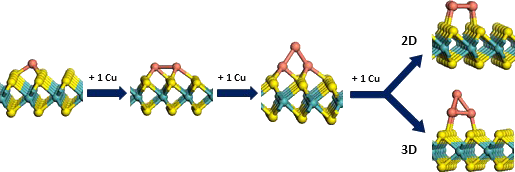
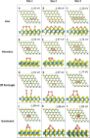
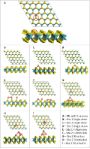
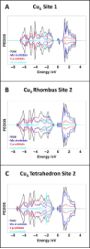
- vacancy on the adsorption energy and geometry of single Cu adatoms and the Cu4 clusters. The results of this investigation show that the stability of small Cun clusters on a MoS2 ML is driven mainly by Cu–Cu interactions and not dependent on whether the cluster is 2D or 3D. Further, the density-of-states
- , compared to the various 2D structures. While site 1 continued to be less favourable than sites 2 and 3 for the 2D configurations, for the 3D adsorption mode this difference disappears, with similar binding energies for all sites, suggesting that once 3D clusters begin to form on MoS2 the binding energy is
- (2D) and two configurations are 3D nanoclusters. For the flat adsorption structures, the four Cu atoms are adsorbed in a linear configuration, with Cu–Cu distances of around 3.2 Å, depending on the adsorption site, or in a 4-membered flat structure. In the 3D clusters, one configuration is a rhombus

Formation of nanoripples on ZnO flat substrates and nanorods by gas cluster ion bombardment
Beilstein J. Nanotechnol. 2020, 11, 383–390, doi:10.3762/bjnano.11.29
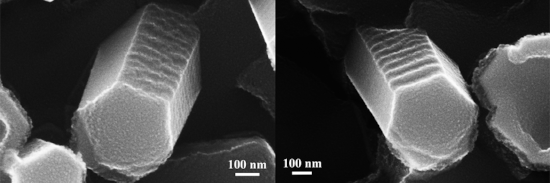
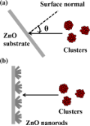
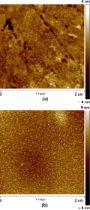
- and ion fluence were 10 kV and 4 × 10¹⁶ clusters/cm2, respectively. Scratches and pits of 50–100 nm in size and 5 nm in depth are visible on the substrate surface before irradiation (Figure 2a and Figure 3a). After irradiation at θ = 0° the scratches and pits disappeared and features ca. 10 nm in size
- homogeneously dispersed all over the surface formed (Figure 2b and Figure 3b). These surface features can exhibit overlapped craters formed after collisions of the accelerated clusters with the surface. The surface roughness after normal cluster irradiation slightly decreases from initial 0.8 nm to 0.6 nm
- developed and wavelength and height of the ripples calculated from the bottom drift line surface increase (Figure 4b and Table 1). This behavior is in agreement with data obtained for SiO2 films and gold surfaces bombarded with Ar clusters [19][22]. The process of ripple formation is triggered by the



Implementation of data-cube pump–probe KPFM on organic solar cells
Beilstein J. Nanotechnol. 2020, 11, 323–337, doi:10.3762/bjnano.11.24
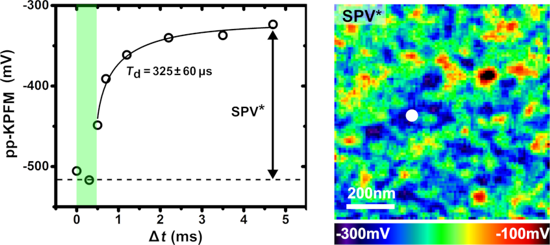
- compositional and/or morphological heterogeneities generating the dark-state SP and SPV contrast play also a key role in the photocarrier trapping process. A reasonable (yet to be definitely confirmed) scenario could invoke the existence of non-percolating PC71BM clusters acting as trapping centers. Such an




Fabrication of Ag-modified hollow titania spheres via controlled silver diffusion in Ag–TiO2 core–shell nanostructures
Beilstein J. Nanotechnol. 2020, 11, 141–146, doi:10.3762/bjnano.11.12

- Ag–TiO2 CSNs, silver cores were fully converted to Ag species (i.e., positively charged Ag clusters as discussed below or other subnanometric silver species) embedded in a titania shell or smaller AgNPs located at the shell surface (Figure 2 E). To the best of our knowledge, the silver diffusion in
- in Ag@TiO2 CSNs can occur in the following manner. Titania is oxidized in an air atmosphere and as a result, holes, which may further oxidize AgNPs surrounded by the titania shell, are generated. Upon oxidation, AgNPs gain a positive electric charge and may eject positively charged Ag clusters. In
- case of Ag@TiO2 CSNs and depending on the annealing time, these ejected Ag clusters may either be accommodated within or on the titania shell. In the titania shell, these silver clusters could react with the TiO2 host through the formation of a complex [Ag–(TiO2)] [21]. Upon reaching the surface of the



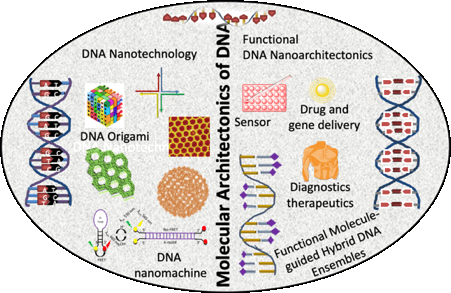
Molecular architectonics of DNA for functional nanoarchitectures
Beilstein J. Nanotechnol. 2020, 11, 124–140, doi:10.3762/bjnano.11.11


Recent progress in perovskite solar cells: the perovskite layer
Beilstein J. Nanotechnol. 2020, 11, 51–60, doi:10.3762/bjnano.11.5

- contain preformed perovskite clusters, which can be rapidly (within 20 s) deposited on a substrate of an area larger than 100 cm2. The MAPbI3 films formed by the wire-bar (D-bar) coating technique were highly oriented. Smooth high-quality perovskite films with an average PCE of 17.01% were obtained


Long-term stability and scale-up of noncovalently bound gold nanoparticle-siRNA suspensions
Beilstein J. Nanotechnol. 2019, 10, 2568–2578, doi:10.3762/bjnano.10.248
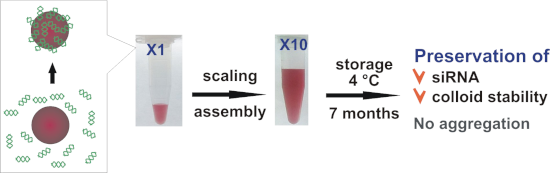
- suspension at 4 °C for different times resulted in the formation of particle clusters of high colloidal stability as demonstrated by conventional methods. These clusters completely disintegrated when albumin was added, indicating that they are agglomerates (and not aggregates) of AuNP-siRNA. The AuNPs-siRNA
- and Figure 3A). The appearance of rounded clusters of AuNP-siRNA with a diameter of not more than 200 nm was a consequence of aggregation/agglomeration of particles over the course of one day (Figure 3E). The particles in the clusters were arranged in several layers and were distinguishable. The
- scanning probe image processor (SPIP) analysis of the TEM image showed a predominance of clusters with a size of up to 100 nm in samples ×1 and ×10 (85–90% of the total number of clusters); about 10% of clusters had a size of 100–200 nm. Thus, the TEM study showed a tendency towards clumping of the AuNP


Advanced hybrid nanomaterials
Beilstein J. Nanotechnol. 2019, 10, 2563–2567, doi:10.3762/bjnano.10.247
- synthesize clusters, so-called colloidal molecules [21]. Nanospherical satellites were covalently bonded via amide groups within the dimples of valence-endowed patchy nanoparticles, allowing the tuning of their topology and self-assembling ability. Polyion complex micelles formed by complexation between poly
- is the focus of an article reporting the performance of functionalized gold clusters deposited on ZrO2 nanoparticles for benzyl alcohol oxidation in [39]. Interestingly, the defunctionalized gold nanoclusters exhibit full catalytic conversion. Overall, this thematic issue clearly highlights not only
Formation of metal/semiconductor Cu–Si composite nanostructures
Beilstein J. Nanotechnol. 2019, 10, 2497–2504, doi:10.3762/bjnano.10.240
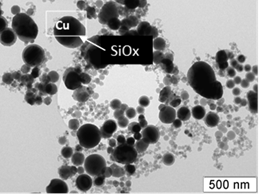
- Verlet algorithm. The visualisation and analysis of the simulation results was carried out in the OVITO program [26][27]. Figure 2 shows clusters with different silicon content at 1.5 ns after the start of simulation. As revealed in [23], with a low silicon content of 10 atom %, a core–shell structure is
- structure, in particular, the size and phase composition of the nanoparticles has been presented in [5]. The analysis of the obtained data on atomic dynamics in nanoscale clusters showed that at a cooling rate of 1.5 K/ps, a core–shell structure is formed in 70% of the clusters and the Janus-like structure
- is formed in 30% of the clusters. In the obtained cluster structures, twinning prevails as a mixture of the icosahedral (IR) and dodecahedral (DK) phase (Figure 3a). With a decrease in the cooling rate to 1 K/ps, the probability of the formation of the Janus-like structure increases to 50%. In


Label-free highly sensitive probe detection with novel hierarchical SERS substrates fabricated by nanoindentation and chemical reaction methods
Beilstein J. Nanotechnol. 2019, 10, 2483–2496, doi:10.3762/bjnano.10.239

- beam lithography and self-assembly methods to fabricate gold clusters of micrometer size and regular spacing. Subsequently, the detection resolution of 4-acetamidothiophenol was 0.05 g/L using the substrate. Nanoparticle cluster array structures with a size of 40 nm were fabricated by electron beam
- pyramidal hierarchical SERS substrates with higher sensitivity can be achieved. Therefore, the combination of Ag nanoparticle clusters on the pile-up of copper surface leads to a new nanogap and improves the density of SERS hotspots. The electric field intensity of the hierarchical substrate on the pile-ups


Dynamics of superparamagnetic nanoparticles in viscous liquids in rotating magnetic fields
Beilstein J. Nanotechnol. 2019, 10, 2294–2303, doi:10.3762/bjnano.10.221

- ]. Inside the cells magnetic nanoparticles usually form dense clusters tightly bound to the surrounding tissues [21][22][23][24], so that the rotation of a nanoparticle as a whole in AMF is difficult or completely absent. Thus, the AMF energy absorption is only associated with the dynamics of the magnetic


Targeted therapeutic effect against the breast cancer cell line MCF-7 with a CuFe2O4/silica/cisplatin nanocomposite formulation
Beilstein J. Nanotechnol. 2019, 10, 2217–2228, doi:10.3762/bjnano.10.214
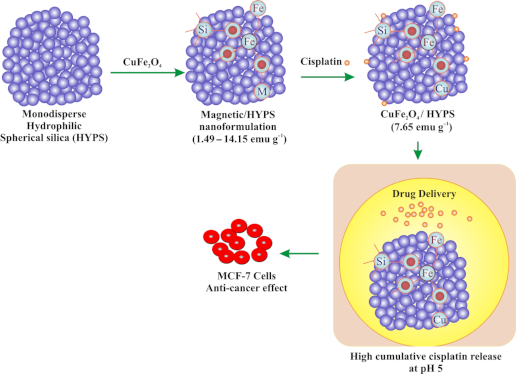
- nanometer-sized copper spinel clusters over HYPS (Figure 5). The particle size reduction tends to decrease the saturation magnetization. In particular, noncollinear spin arrangements present at the external nanoparticle surface play a major role, which in influences the response of the material to the


Mannosylated brush copolymers based on poly(ethylene glycol) and poly(ε-caprolactone) as multivalent lectin-binding nanomaterials
Beilstein J. Nanotechnol. 2019, 10, 2192–2206, doi:10.3762/bjnano.10.212
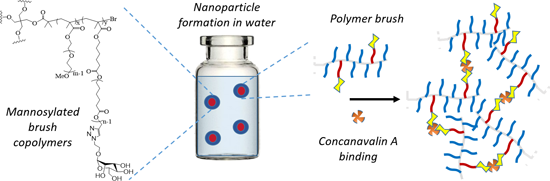
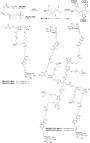
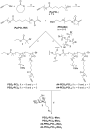
- ]. When multivalent carbohydrate compounds bridge multiple Con A tetramers, insoluble clusters are formed, turning the originally transparent solution turbid (Figure 6B). Each single macromolecule may interact with many Con A receptors, although steric effects prevent binding of every mannose residue [38
- multivalent fashion, leading to an increase of turbidity. Interestingly, turbidity was not observed with the monovalent compound PEG9-PCL1-Man1, suggesting that the polymer and the resulting nanosized colloid in water do not have a suitable valency for the formation of Con A clusters. We assumed that the
- showed a similar behavior as A4-PEG8-PCL2-Man2, but it reached a much lower plateau, which indicated the formation of smaller colloidal clusters when the valency was reduced from 8 to 4. Moreover, the octavalent compound seemed to bound Con A more slowly (k-octa = 0.32 AU/min vs k-tetra = 0.41 AU/min



Nitrogen-vacancy centers in diamond for nanoscale magnetic resonance imaging applications
Beilstein J. Nanotechnol. 2019, 10, 2128–2151, doi:10.3762/bjnano.10.207
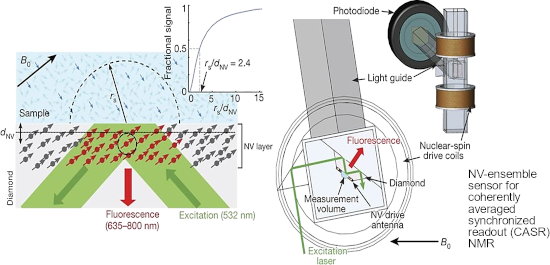
- positive or negative imaging contrast for resolution as fine as cell clusters. The more precise the imaging that is required, the higher is the dose of the contrast medium that is necessary. This poses a question of possible toxicity that must be adequately considered and ultimately constitutes a key


Microbubbles decorated with dendronized magnetic nanoparticles for biomedical imaging: effective stabilization via fluorous interactions
Beilstein J. Nanotechnol. 2019, 10, 2103–2115, doi:10.3762/bjnano.10.205

- physiological media [30]. To the best of our knowledge, the implementation of dendronized IONPs in phospholipid-shelled MBs has not yet been reported. This approach is expected to combine some advantages over existing methods, including the ability to graft isolated IONPs instead of clusters at the MB surface


The importance of design in nanoarchitectonics: multifractality in MACE silicon nanowires
Beilstein J. Nanotechnol. 2019, 10, 2094–2102, doi:10.3762/bjnano.10.204

- according to literature [38], and a Poisson’s ratio of 0.22. The values of ARcrit thus obtained range from 2.2 to 1.5, while the aspect ratios of the NWs are of 555 for sample SiNW1 and of 144 for sample SiNW2. This confirms theoretically the stability of the observed NW clusters. The process of self




Porous silver-coated pNIPAM-co-AAc hydrogel nanocapsules
Beilstein J. Nanotechnol. 2019, 10, 1973–1982, doi:10.3762/bjnano.10.194

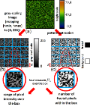
- -magnification image of a THPC gold-seeded pDADMAC-modified pNIPAM-co-AAc hydrogel core particle. Due to insufficient electron density in the pNIPAM-co-AAc, the polymer core is not visible by TEM. However, due to the consistent size measurements of the gold clusters, and the absence of randomness in the gold


Fabrication and characterization of Si1−xGex nanocrystals in as-grown and annealed structures: a comparative study
Beilstein J. Nanotechnol. 2019, 10, 1873–1882, doi:10.3762/bjnano.10.182

- HiPIMS and dcMS followed by rapid thermal annealing (1 min) at different temperatures. It is shown that HiPIMS deposition facilitates the formation of small nanoparticles/clusters in the as-grown structures. A suitable selection of annealing temperature and time results in the columnar self-assembly of


Engineered superparamagnetic iron oxide nanoparticles (SPIONs) for dual-modality imaging of intracranial glioblastoma via EGFRvIII targeting
Beilstein J. Nanotechnol. 2019, 10, 1860–1872, doi:10.3762/bjnano.10.181
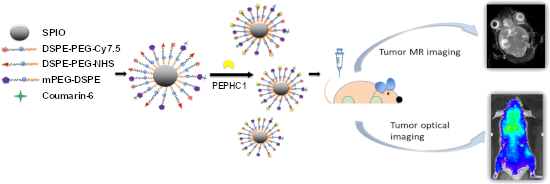
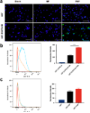
- size of whole clusters was around 100 nm, which is much larger than the diameter as determined by TEM. This discrepancy might be due to nanoprobe cluster formation in water. Nanoparticles of diameter around 110 nm can successfully escape the phagocytosis of the reticuloendothelial system (RES) and




Toxicity and safety study of silver and gold nanoparticles functionalized with cysteine and glutathione
Beilstein J. Nanotechnol. 2019, 10, 1802–1817, doi:10.3762/bjnano.10.175
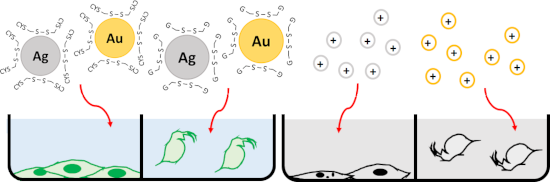
- lead to the formation of thiol-coated AgNPs [48]. New clusters consisting of Ag2S can be created from free Ag+ [47]. This process, known as sulfidation, affects AgNP behavior in the biological system [49], most notably by reducing their toxicity [47][50]. The binding of thiols to AuNP surfaces has been


Synthesis of nickel/gallium nanoalloys using a dual-source approach in 1-alkyl-3-methylimidazole ionic liquids
Beilstein J. Nanotechnol. 2019, 10, 1754–1767, doi:10.3762/bjnano.10.171
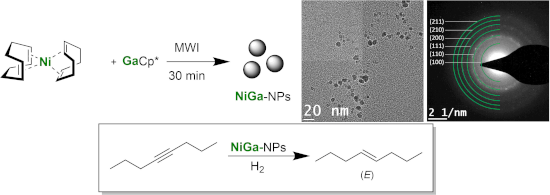
- carbene ligands (NHC) stabilize metal clusters and nanoparticles [44]. By insertion of the transition-metal center into the C2–H bond of imidazolium salts, transition-metal hydride complexes are formed [45]. Finally, H transfer reactions from the transition metal to GaCp* lead to the release of Cp*H
- assume that during the dispersion a chemical reaction of the precursors to Ni/Ga clusters occurs. The formation of clusters from metal precursor materials in ionic liquids has been described before, for example, [EMIm][Ni(P2S8)] [51], [BMMIm]16[Sn24Se56] [52], [Ru2Bi14Br4][AlCl4] [53], [Bi5(AlCl4)3] [53
- ], [Au(Bi8)(AlCl4)5] [54], and [(CuBi8)(AlCl4)] [55] In organic solvents, organometallic Ni complexes, e.g., Ni(COD)2 and Ni(CO)4 are known to form different types of intermetallic clusters with GaCp* and similar compounds, such as Ni(Cp*Ga)(CO)3, Ni4(Cp*Ga)4(CO)6, Ni(GaCp*)4 [46][56][57][58][59][60




The impact of crystal size and temperature on the adsorption-induced flexibility of the Zr-based metal–organic framework DUT-98
Beilstein J. Nanotechnol. 2019, 10, 1737–1744, doi:10.3762/bjnano.10.169

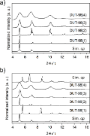
- supramolecular building blocks (SBBs), which consist of Zr6 clusters interconnected by 3,6-carbazole dicarboxylate ligands [20]. An additional benzoate functionality of the ligand connects the SBB into a 3D framework with a structure (Figure 1) similar to MIL-53 [21][22]. Upon removal of the solvent molecules
- cluster of 1.5 nm, which is in good agreement with the lattice parameter and the inter-cluster distance of the DUT-98op crystal structure (Supporting Information File 1, Figure S8). The regular arrangement of the clusters indicates a high symmetry that matches the tetragonal symmetry in DUT-98op. In



Kelvin probe force microscopy work function characterization of transition metal oxide crystals under ongoing reduction and oxidation
Beilstein J. Nanotechnol. 2019, 10, 1596–1607, doi:10.3762/bjnano.10.155
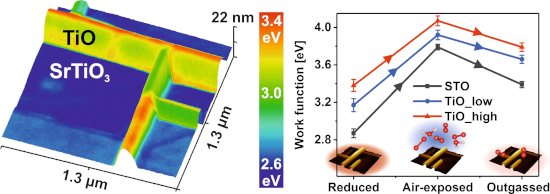
- equiprobable orientations of (√5×√5)R26.6° domains, both rotated with respect to the (1×1) surface by 26.6 degrees. Those two domains are labeled A and B, both in LEED and STM images. Bright protrusions seen in the STM picture, which also decorate domain boundaries, are either oxygen vacancies/vacancy clusters


Materials nanoarchitectonics at two-dimensional liquid interfaces
Beilstein J. Nanotechnol. 2019, 10, 1559–1587, doi:10.3762/bjnano.10.153
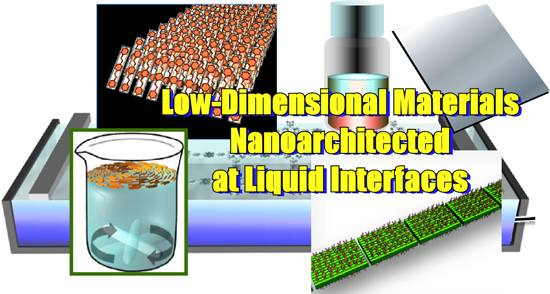
- systems fabricated with low-dimensional materials are actively investigated. For example, Lvov and co-workers reported the immobilization of small functional materials such as metal clusters and metal catalysts within one-dimensional halloysite clay nanotubes to make them work under appropriate protection













Growth of lithium hydride thin films from solutions: Towards solution atomic layer deposition of lithiated films
Beilstein J. Nanotechnol. 2019, 10, 1443–1451, doi:10.3762/bjnano.10.142
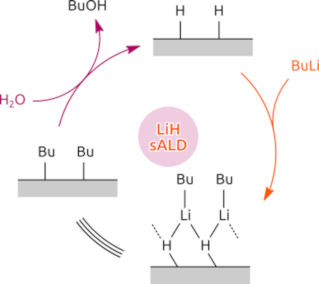
- , indicating and increase in mass with decrease of frequency [21]. SEM images of the surface show clusters of crystals that grew possibly due to bubbles forming in the chamber shown in Figure 3 or the influence of air sensitivity. One such crystal is presented in Figure 9. The film covering the sample appears