


Search results
Search for "near-infrared" in Full Text gives 159 result(s) in Beilstein Journal of Nanotechnology.
In vitro toxicity and bioimaging studies of gold nanorods formulations coated with biofunctional thiol-PEG molecules and Pluronic block copolymers
Beilstein J. Nanotechnol. 2014, 5, 546–553, doi:10.3762/bjnano.5.64
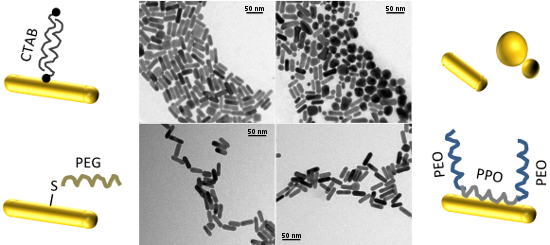
- longitudinal absorption peak within the range from 600 to 1500 nm [6]. It is well recognized that near infrared (NIR) light is able to penetrate the human tissue up to a few centimeters since water and blood cells absorb light only minimally at this region. AuNRs can be designed to absorb light specifically in


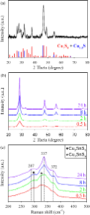
One-step synthesis of high quality kesterite Cu2ZnSnS4 nanocrystals – a hydrothermal approach
Beilstein J. Nanotechnol. 2014, 5, 438–446, doi:10.3762/bjnano.5.51

- has a theoretical band gap of 1.5 eV and has high light absorption coefficient (>104 cm−1) in the range of visible and near infrared irradiation of solar spectrum [2][3][4]. Shockley–Queisser balanced calculations have predicted that the theoretical efficiency of PVs using light absorbers like CZTS is




Near-infrared dye loaded polymeric nanoparticles for cancer imaging and therapy and cellular response after laser-induced heating
Beilstein J. Nanotechnol. 2014, 5, 313–322, doi:10.3762/bjnano.5.35
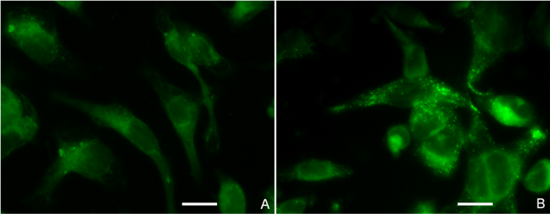
- that combine imaging and therapeutic agents. In our study, we use a new biocompatible and biodegradable polymer, termed poly(glycerol malate co-dodecanedioate) (PGMD), for the synthesis of nanoparticles (NPs) and loading of near-infrared (NIR) dyes. IR820 was chosen for the purpose of imaging and
- synthesis of PGMD polymer, PGMD NPs were also successfully formulated. Optical imaging has several advantages over more traditional imaging techniques (MRI, PET, CT, etc.), such as high spatial resolution, real time imaging, and systems that are usually smaller and less expensive. Near-infrared imaging dyes
- elimination half-life of over 30 h for IR820 compared to approximately 2 h for ICG [8]. Based on these advantages we chose IR820 as our near-infrared agent and we synthesized and characterized IR820-PGMD NPs for cancer imaging and HT applications. HT is used clinically as an adjuvant treatment with


Dye-doped spheres with plasmonic semi-shells: Lasing modes and scattering at realistic gain levels
Beilstein J. Nanotechnol. 2013, 4, 974–987, doi:10.3762/bjnano.4.110
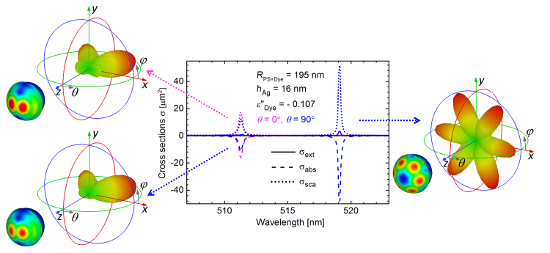
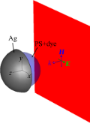
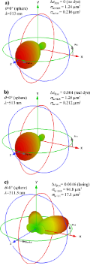
- ; spaser; Introduction Noble metal nanoparticles are of current interest both in fundamental and applied science because of their localized plasmonic resonances (LPR) in the visible and near infrared range of the optical spectrum. The simplest nanoparticle geometry is spherical, but the spectral position




Template based precursor route for the synthesis of CuInSe2 nanorod arrays for potential solar cell applications
Beilstein J. Nanotechnol. 2013, 4, 868–874, doi:10.3762/bjnano.4.98
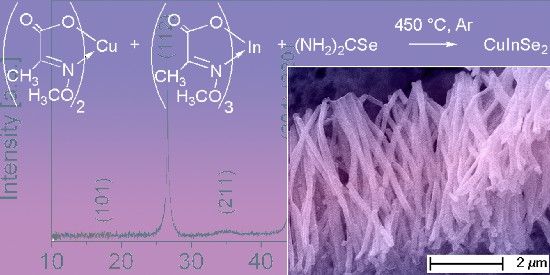
- range and a part of the near infrared diapason as well (with a threshold that corresponds to a bandgap energy of 1.03 eV). A future challenge would be the incorporation of the 3D aligned CISe nanorod arrays as absorber material in a solar cell. Obviously, one of the main challenges towards this end is


Probing the plasmonic near-field by one- and two-photon excited surface enhanced Raman scattering
Beilstein J. Nanotechnol. 2013, 4, 834–842, doi:10.3762/bjnano.4.94

- Plasmonic silver nanoaggregates The highest SERS enhancement levels obtained so far are related to silver or gold nanoparticles that form aggregates as “SERS-active substrates” and by using excitation in the near infrared [20][21][22]. The first SERS spectra of single molecules had been measured by using




Controlling the near-field excitation of nano-antennas with phase-change materials
Beilstein J. Nanotechnol. 2013, 4, 632–637, doi:10.3762/bjnano.4.70

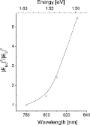
- switching the phase states of a GST thin film can be easily accomplished by various well-developed methods, such as electric current, optical pumping and thermal stimulus [23][24]. In the near-infrared (NIR) range, a drastic change in the real part of the refractive index from the phase transition and low


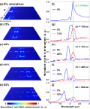

How to remove the influence of trace water from the absorption spectra of SWNTs dispersed in ionic liquids
Beilstein J. Nanotechnol. 2011, 2, 653–658, doi:10.3762/bjnano.2.69
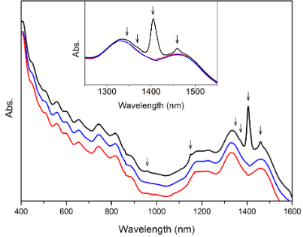
- to their chiralities is of great importance in the quantitative analysis of bulk SWNT samples. However, because water has strong absorption bands in the near-infrared (NIR) region where the E11 of semiconducting SWNTs lies, even a trace amount of water dissolved in an IL may introduce notable peaks


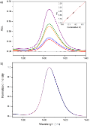


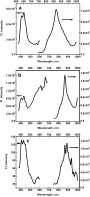
Precursor concentration and temperature controlled formation of polyvinyl alcohol-capped CdSe-quantum dots
Beilstein J. Nanotechnol. 2010, 1, 119–127, doi:10.3762/bjnano.1.14

- samples were fluorescent at room temperature; the green fluorescence was assigned to band edge emission, and the near-infrared fluorescence peaks at about 665 and 865 nm were assigned to shallow and deep trap states emissions, respectively. The quantum dots were fairly stable up to several days. Keywords




Other Beilstein-Institut Open Science Activities



