
Search results
Search for "plant" in Full Text gives 160 result(s) in Beilstein Journal of Nanotechnology.
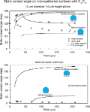
Impact of cell shape in hierarchically structured plant surfaces on the attachment of male Colorado potato beetles (Leptinotarsa decemlineata)
Beilstein J. Nanotechnol. 2012, 3, 57–64, doi:10.3762/bjnano.3.7

- Bettina Prum Robin Seidel Holger Florian Bohn Thomas Speck Plant Biomechanics Group Freiburg, Botanic Garden, Faculty of Biology, University of Freiburg, Schänzlestraße 1, 79104 Freiburg, Germany Bionics Competence Network BIOKON e. V., Ackerstraße 76, 13355 Berlin, Germany Competence Network
- Biomimetics, Schänzlestraße 1, 79104 Freiburg, Germany 10.3762/bjnano.3.7 Abstract Plant surfaces showing hierarchical structuring are frequently found in plant organs such as leaves, petals, fruits and stems. In our study we focus on the level of cell shape and on the level of superimposed microstructuring
- plant surfaces possessing convex or papillate cells on insect attachment remains unclear. We performed traction experiments with male Colorado potato beetles on nine different plant surfaces with different structures. The selected plant surfaces showed epidermal cells with either tabular, convex or


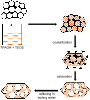
Synthesis and catalytic applications of combined zeolitic/mesoporous materials
Beilstein J. Nanotechnol. 2011, 2, 785–801, doi:10.3762/bjnano.2.87

- reducing agent and precursor in fine chemistry. Water and tarlike compounds are the major byproducts. Conversion and selectivity are significantly higher than those achieved by acidic and radical catalysts. Therefore, since 1986, a plant near Ravenna, Italy, is producing 10,000 tons per year of diphenols
- over 90%. Both Enichem as well as Sumitomo Chemical Co. operate such a TS-1 based caprolactam plant. Epoxidation of propylene: Propylene oxide is one of the largest propene derivatives in production, ranking second behind polypropylene, and is primarily used as a reactive chemical intermediate. The
- -Evonik/Headwaters developed a new technology based on the use of aqueous solutions of H2O2 and a fixed-bed TS-1 reactor. At the end of 2008, the largest plant using this new process was started up in Antwerp by BASF/Dow. Although the implementation of TS-1 has been successful, there are still some




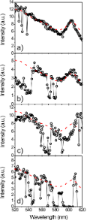
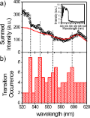
Room temperature excitation spectroscopy of single quantum dots
Beilstein J. Nanotechnol. 2011, 2, 516–524, doi:10.3762/bjnano.2.56

- Christian Blum Frank Schleifenbaum Martijn Stopel Sebastien Peter Marcus Sackrow Vinod Subramaniam Alfred J. Meixner Nanobiophysics Group and MESA+ Institute for Nanotechnology, University of Twente, PO Box 217, 7500 AE Enschede, The Netherlands Center for Plant Molecular Biology, Biophysical

The effect of surface anisotropy in the slippery zone of Nepenthes alata pitchers on beetle attachment
Beilstein J. Nanotechnol. 2011, 2, 302–310, doi:10.3762/bjnano.2.35

- Elena V. Gorb Stanislav N. Gorb Department of Functional Morphology and Biomechanics, Zoological Institute, University of Kiel, Am Botanischen Garten 1–9, D-24098 Kiel, Germany 10.3762/bjnano.2.35 Abstract The slippery zone in pitchers of the carnivorous plant Nepenthes alata bears scattered
- contributions, from claw interlocking and pad adhesion, to insect attachment on the pitcher surfaces, intact versus claw-ablated beetles were used in the second type of experiment. On both de-waxed plant samples and their replicas, intact insects generated much higher forces in the downward direction compared
- downward pitcher direction, since, in this direction, they could interlock with overhanging edges of lunate cells. Keywords: adhesive pads; claws; Coccinella septempunctata; insect–plant interactions; traction force; Introduction Pitcher-shaped trapping organs produced at the tips of tendrils are



Recrystallization of tubules from natural lotus (Nelumbo nucifera) wax on a Au(111) surface
Beilstein J. Nanotechnol. 2011, 2, 261–267, doi:10.3762/bjnano.2.30
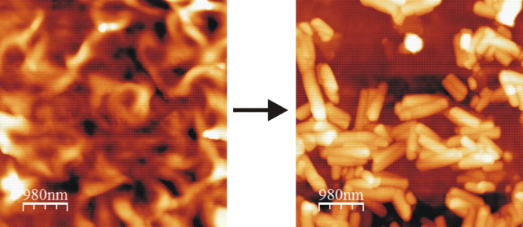
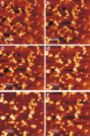
- HOPG, the tubules lie flat on Au(111). Taking into account the physical properties of HOPG and Au(111), we put forward a hypothesis which can explain the different tubule orientations on both substrates. Keywords: AFM; Au(111); lotus wax; Introduction Natural nonacosan-10-ol waxes derived from plant

Hierarchically structured superhydrophobic flowers with low hysteresis of the wild pansy (Viola tricolor) – new design principles for biomimetic materials
Beilstein J. Nanotechnol. 2011, 2, 228–236, doi:10.3762/bjnano.2.27

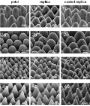
- superhydrophobic, low adhesive surface design, which combines the hierarchical structuring of petals with a wetting behavior similar to that of the lotus leaf. Keywords: anti-adhesive; petal effect; petal structures; polymer replication; superhydrophobic; Introduction Plant surfaces provide a large diversity of
- “petal effect” and are anti-adhesive for water droplets. It is well known that hierarchical surface architecture represents optimized structures for superhydrophobic surfaces [11][33][34][35][36]. Based on the data presented here, we can describe two main superhydrophobic surface architectures for plant
- nanocrystals the surface structures of Viola could be qualified, for example, for large area foil imprinting processes. Thus, a new surface design for the development of superhydrophobic, water repellent biomimetic materials is presented. Experimental Plant material The upper surface (adaxial) sides of the



Sorting of droplets by migration on structured surfaces
Beilstein J. Nanotechnol. 2011, 2, 215–221, doi:10.3762/bjnano.2.25

- ]. Plant surfaces are also known to develop a huge variety of patterns on different length scales [11]. A prominent example are the leaf wax structures leading to superhydrophobicity and the Lotus-effect [12]. Larger structures are also common, e.g., trichomes (leaf hairs) or wart-like structures. Stomata


Functional morphology, biomechanics and biomimetic potential of stem–branch connections in Dracaena reflexa and Freycinetia insignis
Beilstein J. Nanotechnol. 2011, 2, 173–185, doi:10.3762/bjnano.2.21

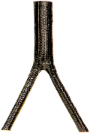
- Tom Masselter Sandra Eckert Thomas Speck Plant Biomechanics Group Freiburg, Botanic Garden, Faculty of Biology, University of Freiburg, Schänzlestraße 1, 79104 Freiburg, Germany Competence Network Biomimetics and Bionics Competence Network BIOKON e.V 10.3762/bjnano.2.21 Abstract Branching in
- using solutions inspired by plant ramifications, e.g., in automotive and aerospace engineering, architecture, sports equipment and prosthetic manufacturing. Keywords: Biomimetics; branching; Dracaena reflexa; Freycinetia insignis; monocotyledons; Introduction One of the most conspicuous features of
- branch occurs mainly in relatively young, possibly not fully lignified branches (see below). Failure in the stem results in longitudinal cracks which very quickly reach a critical length and lead to failure of the main stem. This failure mode is the most disadvantageous one for the plant and can be




Superhydrophobicity in perfection: the outstanding properties of the lotus leaf
Beilstein J. Nanotechnol. 2011, 2, 152–161, doi:10.3762/bjnano.2.19
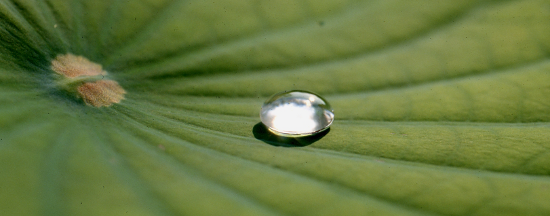
- lower epidermis. The lotus plant has successfully developed an excellent protection for this delicate epistomatic surface of its leaves. Keywords: epicuticular wax; leaf surface; Lotus effect; papillae; water repellency; Introduction Since the introduction of the ‘Lotus concept’ in 1992 [1][2], the
- lotus leaf became the archetype for superhydrophobicity and self-cleaning properties of plant surfaces and a model for technical analogues [3][4] . Lotus (Nelumbo nucifera) is a semi-aquatic plant and develops peltate leaves up to 30 cm in diameter with remarkable water repellency. As an adaptation to
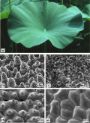
- been known for a long time that plant surfaces covered with epicuticular wax crystals are water repellent, and that this feature is enhanced when the epidermis has additional structures such as papillae or hairs [5][6]. Neinhuis and Barthlott (1997) [7] presented an overview of more than 200 species







Biomimetics inspired surfaces for drag reduction and oleophobicity/philicity
Beilstein J. Nanotechnol. 2011, 2, 66–84, doi:10.3762/bjnano.2.9

- animals, and seashells with properties of commercial interest. Certain plant leaves, such as lotus (Nelumbo nucifera) leaves, are known to be superhydrophobic and self-cleaning due to the hierarchical surface roughness and presence of a wax layer. In addition to a self-cleaning effect, these surfaces with
- the negative replica. To generate several replicas the second step of replication was repeated twenty times for each surface type. Nanostructures were created by self-assembly of plant wax deposited by thermal evaporation [12][13]. Tubule forming wax, which was isolated from a leaf of Nelumbo nucifera
- hydrophobicity using a dynamic AFM method [16][33]. Data on one hydrophilic, one hydrophobic, and one superhydrophobic surface are presented in Table 2. Mica was taken as the hydrophilic surface. Hydrophobic and superhydrophobic surfaces were fabricated by deposition of evaporated plant wax on smooth epoxy